Tarot symbolism explores the meanings hidden within tarot cards, from their colors and figures to their animals, numbers, and mysterious landscapes. In the United States, people use tarot for spiritual reflection, personal growth, creative inspiration, and entertainment. Some view the cards as tools for divination, while others treat them as prompts for understanding their thoughts and feelings.
Each tarot card tells a visual story. A shining sun might suggest clarity and vitality, while a dark moon can represent uncertainty, dreams, or intuition. However, a card’s meaning depends on its traditional associations, its position in a reading, and the reader’s interpretation.
Tarot has changed considerably since its earliest European decks appeared during the Renaissance. What began as a card game later developed into a widely recognized tool for fortune-telling and spiritual exploration. Today, tarot appears in American wellness communities, online discussions, art, tattoos, and popular culture.
Understanding these symbols helps explain why tarot continues to attract people with different beliefs. You don’t have to accept supernatural explanations to appreciate the stories, emotions, and questions these cards can inspire.
Quick Answer
Tarot symbolism in the United States commonly represents intuition, self-discovery, personal transformation, and the desire to understand life’s uncertainties. More broadly, tarot cards combine historical imagery, spiritual traditions, and psychological reflection to explore choices, relationships, challenges, and possibilities.
TL;DR
- Tarot cards symbolize intuition, change, relationships, challenges, and personal growth.
- Early tarot decks appeared in Renaissance Europe as playing cards.
- Modern American readers use tarot for reflection, divination, creativity, and entertainment.
- Major Arcana cards often represent important life themes and personal transitions.
- Colors, numbers, animals, and objects add layers of meaning to each card.
- Tarot interpretations vary across spiritual traditions, readers, and individual experiences.
What Is Tarot Symbolism?
Tarot symbolism refers to the meanings communicated through the pictures, characters, colors, and objects on tarot cards. These visual details help readers interpret a card beyond its name or written description.
A traditional tarot deck contains 78 cards divided into two groups. The Major Arcana explores larger life themes, while the Minor Arcana often focuses on everyday experiences.
The Major and Minor Arcana
The Major Arcana contains 22 cards, including The Fool, The Magician, Death, The Star, and The World. These cards often represent major transitions, important lessons, or broad patterns in human experience.
The Minor Arcana contains 56 cards divided into four suits: Wands, Cups, Swords, and Pentacles. Each suit offers a different symbolic lens.
- Wands: Creativity, ambition, energy, and action.
- Cups: Emotions, relationships, intuition, and connection.
- Swords: Thoughts, communication, conflict, and difficult decisions.
- Pentacles: Material resources, work, stability, and practical responsibilities.
Court cards, such as Pages, Knights, Queens, and Kings, can represent people, personal qualities, or approaches to a situation. Their interpretation depends on the card and the reading.
Why Images Matter
Tarot cards communicate through recognizable visual details. A bridge might suggest a transition, while a closed door can represent a boundary or an unexplored possibility.
For example, The Star depicts a figure pouring water beneath a star-filled sky. Readers often associate this image with hope, renewal, inspiration, and emotional restoration.
However, no single detail determines a card’s entire meaning. The surrounding cards, the question being considered, and the reader’s tradition can all influence its interpretation.
The Historical Origins of Tarot
Tarot’s history begins in Renaissance Europe, not in a proven ancient Egyptian or prehistoric spiritual system. Its original purpose was recreational, although later generations developed elaborate mystical interpretations.
Tarot in Renaissance Europe
The earliest known tarot decks appeared in northern Italy during the 15th century. Wealthy households used these illustrated cards to play a trick-taking game commonly known as tarocchi.
Early decks featured allegorical figures, religious imagery, virtues, rulers, and scenes reflecting European culture. These images drew from artistic and social traditions already familiar to their audiences.
During this period, tarot was not primarily a fortune-telling system. Its later spiritual role emerged through changing interests in symbolism, astrology, and the occult.
From Playing Cards to Divination
In the late 18th century, French writers connected tarot with ancient mysteries and esoteric traditions. Antoine Court de Gébelin helped popularize claims linking the cards to Egyptian wisdom, although those historical claims lack convincing evidence.
Around the same period, occult writers began developing systems for interpreting tarot cards divinatorily. Later figures, including Éliphas Lévi and members of British occult circles, helped connect tarot with astrology, Kabbalah, and other mystical frameworks.
The Rider-Waite-Smith deck, first published in 1909, became especially influential. Created through the collaboration of Arthur Edward Waite and artist Pamela Colman Smith, it featured illustrated scenes on the Minor Arcana cards as well as the Major Arcana.
These detailed illustrations made symbolic interpretation more accessible. As a result, the deck became a major influence on many modern tarot designs.
Tarot Symbolism in American Culture
In the United States, tarot occupies several cultural spaces at once. Some Americans approach it as a spiritual practice, while others enjoy it as a form of reflection, art, or entertainment.
The Influence of Modern Spirituality
Tarot became increasingly visible through American occult communities, New Age spirituality, metaphysical bookstores, and alternative spiritual movements. During the 20th century, interest in astrology, meditation, and personal exploration helped create a broader audience for card readings.
Today, tarot readings take place in private homes, spiritual shops, online sessions, and social settings. Some readers incorporate crystals, candles, journaling, or meditation into their practice.
For many Americans, tarot offers a structured way to consider questions they might otherwise avoid. A card about change, for instance, can encourage someone to think about a career decision or a changing relationship.
Tarot in Everyday American Life
Tarot has also become part of mainstream visual culture. Its dramatic illustrations appear on clothing, posters, notebooks, jewelry, and social media graphics.
| Context | Common Meaning in the USA | Typical Association |
| Personal readings | Reflection and possible directions | Choices and uncertainty |
| Spiritual practice | Intuition and inner awareness | Ritual and contemplation |
| Art and fashion | Mystery and individuality | Personal expression |
| Social media | Relatable life themes | Identity and storytelling |
| Journaling | Exploring feelings and decisions | Self-understanding |
However, tarot does not have one universal meaning across American society. Religious beliefs, family traditions, personal experiences, and cultural backgrounds all shape how people respond to it.
Some Christians and members of other religious communities avoid divination because of their beliefs. Others approach the imagery as art or use the cards without accepting supernatural claims.
The Spiritual Meaning of Tarot
Tarot often symbolizes the search for insight, meaning, and connection with something beyond ordinary daily concerns. Its spiritual interpretation depends on the reader’s beliefs and the tradition guiding the reading.
Intuition and Inner Guidance
Many tarot readers believe the cards help them notice patterns or insights they might otherwise overlook. In spiritual settings, this experience may be understood as intuition, divine guidance, or communication with a deeper level of awareness.
Others explain the experience in psychological terms. The images can prompt memories, feelings, and associations that help someone reconsider a problem.
Neither approach requires every card to have one fixed meaning. Instead, tarot provides a symbolic language for exploring personal questions.
Tarot and Spiritual Growth
Certain cards have become especially associated with spiritual development.
- The High Priestess: Inner wisdom, mystery, and intuition.
- The Hermit: Solitude, contemplation, and the search for understanding.
- The Star: Hope, renewal, and spiritual reassurance.
- Judgement: Awakening, reflection, and a new sense of purpose.
- The World: Completion, integration, and a broader perspective.
These interpretations are common in modern tarot traditions, although individual readers may interpret the cards differently. Their spiritual significance comes from the combined influence of imagery, tradition, and personal belief.
The Meanings of Major Tarot Symbols
Tarot cards contain visual details that guide interpretation. Colors, objects, animals, and landscapes can reinforce a card’s central theme or introduce a useful contrast.
Colors and Their Associations
Color is one of the most noticeable features of tarot artwork. However, colors do not carry exactly the same meaning in every deck or culture.
- Red: Passion, vitality, desire, or decisive action.
- Blue: Calm, reflection, communication, or spiritual depth.
- Yellow and gold: Clarity, confidence, knowledge, or vitality.
- Black: Mystery, endings, hidden matters, or the unknown.
- White: Purity, openness, simplicity, or spiritual awareness.
- Green: Growth, renewal, nature, or material abundance.
For example, a figure wearing red may suggest action or strong emotion. A blue background might encourage a calmer interpretation, especially when paired with water or a quiet landscape.
Still, the card’s overall scene matters more than any isolated color. Red can suggest danger in one image and celebration in another.
Animals, Objects, and Landscapes
Tarot artists often use familiar elements to communicate complex ideas.
A dog can symbolize loyalty, instinct, or companionship. A snake may suggest transformation, danger, knowledge, or renewal, depending on the card and interpretive tradition.
Other recurring elements include:
- Mountains: Obstacles, endurance, and difficult goals.
- Rivers: Emotional movement, change, and the passage of time.
- Keys: Access, discovery, and hidden knowledge.
- Crowns: Authority, responsibility, and achievement.
- Stars: Hope, direction, inspiration, and guidance.
These meanings aren’t universal rules. Instead, they provide starting points for interpreting how each image contributes to a card’s story.
The Meaning of the Major Arcana
The Major Arcana is often treated as the heart of tarot symbolism. Its 22 cards explore themes such as beginnings, ambition, love, uncertainty, endings, and fulfillment.
From The Fool to The World
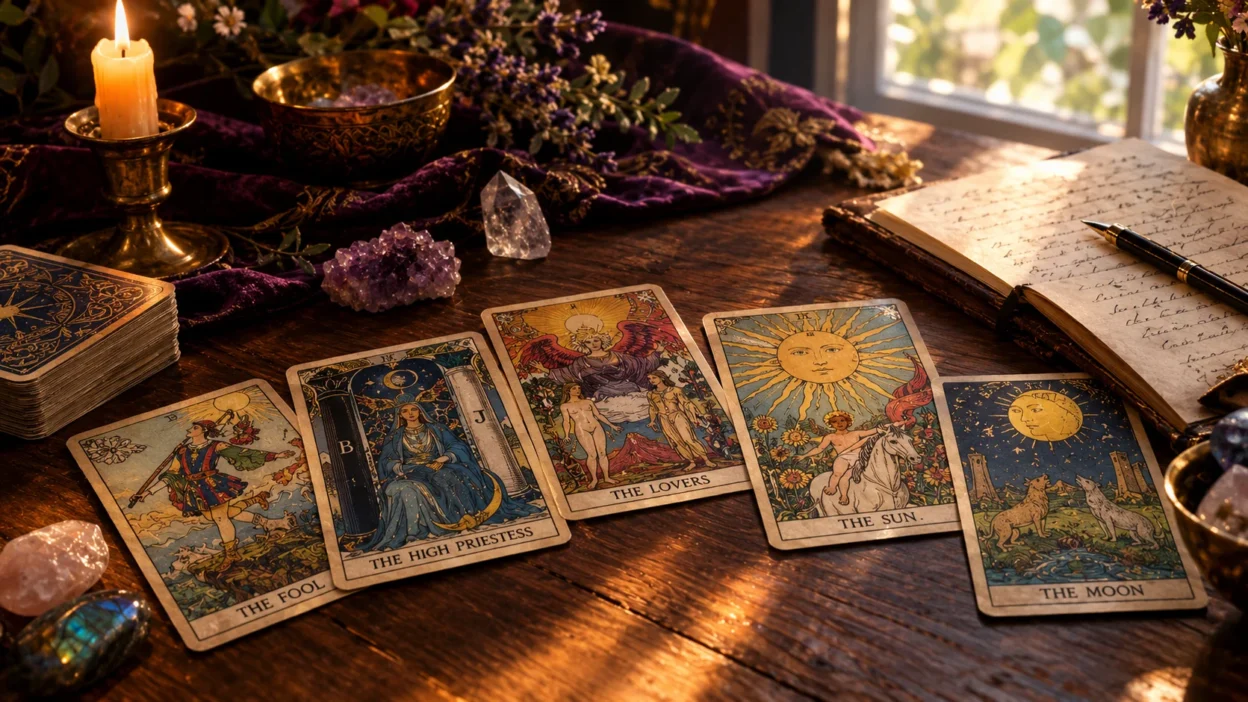
The Fool, numbered zero in many decks, often symbolizes beginnings, openness, freedom, and the willingness to take a risk. The card’s traveler may appear carefree, suggesting both exciting possibilities and the need for awareness.
The Magician commonly represents skill, initiative, and the ability to turn ideas into action. The High Priestess, by contrast, emphasizes intuition, patience, and knowledge that isn’t immediately visible.
Later cards introduce relationships, authority, conflict, and transformation. Death traditionally represents endings and change rather than a literal prediction of someone’s death.
The final card, The World, often represents completion, integration, and the achievement of a significant stage. Together, the cards can be interpreted as a symbolic journey through different experiences.
Important Major Arcana Cards
- The Lovers: Connection, attraction, values, and meaningful choices.
- The Chariot: Direction, discipline, determination, and controlled movement.
- The Wheel of Fortune: Cycles, changing circumstances, and uncertainty.
- The Hanged Man: Pause, surrender, and a different perspective.
- The Tower: Disruption, revelation, and the collapse of unstable structures.
- The Moon: Dreams, ambiguity, fears, and hidden emotions.
- The Sun: Joy, clarity, confidence, and vitality.
A challenging card doesn’t automatically predict a negative event. For example, The Tower can represent the recognition that an old belief or habit no longer works.
Similarly, The Moon doesn’t necessarily indicate deception. It may simply invite someone to slow down when facts and feelings remain unclear.
Tarot Symbolism in Love and Relationships
In love readings, tarot commonly represents emotional needs, relationship patterns, commitment, and personal choices. These interpretations can appeal to Americans seeking language for complicated feelings or changing relationships.
Cards Associated With Love
The Lovers is strongly associated with relationships, attraction, and meaningful choices. However, it can also represent alignment between personal values and actions.
The Two of Cups often suggests mutual understanding, emotional exchange, or partnership. The Ten of Cups is commonly connected with belonging, family happiness, and a shared vision of fulfillment.
Other cards may explore difficulties rather than idealized romance. The Three of Swords, for example, is frequently associated with grief, heartbreak, or painful realization.
What Love Readings Can and Cannot Tell You
Tarot can provide prompts for considering communication, boundaries, expectations, and emotional needs. Someone drawing the Queen of Swords might reflect on honesty, clear communication, or the importance of personal boundaries.
However, a card cannot reliably establish what another person feels or predict whether a relationship will succeed. It is more useful as a reflection tool than as proof of another person’s intentions.
Tarot and Psychological Meaning
Tarot can work as a form of symbolic reflection because people naturally connect images with their memories, emotions, and experiences. The cards offer a starting point for questions that might otherwise remain difficult to express.
Archetypes and Human Experience
An archetype is a recurring pattern, character, or image found across stories and human experience. The wise guide, the wandering traveler, the ruler, and the shadowy figure are examples of patterns that appear in many traditions.
Some modern tarot interpretations draw on ideas associated with psychologist Carl Jung, including archetypes and the unconscious. However, tarot isn’t a validated psychological test, and its traditional meanings shouldn’t be confused with established clinical assessments.
Still, symbolic images can encourage reflection. A person who draws The Hermit might ask whether they need rest, solitude, or time to reconsider a decision.
Reflection Without Fixed Predictions
A practical approach is to treat a reading as a conversation with yourself rather than a final verdict.
- Ask what emotions the image brings to mind.
- Consider which details seem relevant to your current situation.
- Explore more than one possible interpretation.
- Separate personal feelings from facts you can verify.
- Use the reflection to identify constructive next steps.
This approach preserves tarot’s imaginative value without requiring certainty about supernatural explanations.
Tarot in Dreams and the Subconscious
Tarot and dreams share an interest in images that feel meaningful or emotionally powerful. Both can encourage people to examine fears, hopes, memories, and unresolved questions.
The Moon, The Star, and The High Priestess
The Moon is often connected with dreams, uncertainty, intuition, and the parts of experience that remain unclear. Its night scene can evoke the feeling of moving through unfamiliar emotional territory.
The Star frequently suggests hope and renewal after a difficult period. Meanwhile, the High Priestess is associated with quiet awareness, hidden knowledge, and careful observation.
These connections are interpretive rather than scientific rules. Dreaming about a tarot card doesn’t prove that it predicts the future or carries a universal message.
Using Tarot for Dream Reflection
Some people draw a card after recording a dream in a journal. They then compare the card’s imagery with the emotions or themes they remember.
For example, a dream about getting lost might prompt reflection through The Moon or The Hermit. The goal isn’t to find a single correct answer, but to explore what the dream means to the individual.
Tarot Across Cultures and Spiritual Traditions
Tarot’s historical development is primarily European, but its modern interpretation draws on a wider range of spiritual and philosophical ideas. These connections deserve careful treatment because similar symbols don’t always share the same origins.
European and Western Esoteric Traditions
Modern tarot systems often connect cards with astrology, numerology, alchemy, and Kabbalah. These links developed through particular European occult traditions rather than forming one ancient, unified system.
Different tarot decks arrange or interpret these associations in different ways. As a result, readers may disagree about the meaning of a symbol without either interpretation representing a universal rule.
Broader Spiritual Connections
People from different backgrounds may use tarot alongside meditation, prayer, journaling, or other reflective practices. However, these personal combinations shouldn’t be treated as proof that tarot belongs to every religious tradition.
Tarot is not an essential practice of Christianity, Islam, Hinduism, Buddhism, or other major religions. Individuals within those communities may hold different views about it, including acceptance, caution, or rejection.
It’s also important to distinguish tarot from systems with their own histories, such as the I Ching. Both may be used for reflection or divination, but they developed through different cultural traditions.
Tarot Tattoos, Fashion, and Social Media
Tarot’s visual richness makes it popular in contemporary design. In the United States, the cards appear in tattoos, jewelry, home decor, clothing, illustrations, and digital content.
Popular Tarot Tattoo Meanings
People often choose tarot tattoos because a particular card expresses an important personal theme. The image may represent a life transition, a valued quality, a memory, or an approach to uncertainty.
- The Fool: New beginnings, independence, and willingness to explore.
- The Sun: Joy, optimism, confidence, and renewed energy.
- The Moon: Intuition, mystery, imagination, and emotional depth.
- Death: Transformation, release, and the close of a chapter.
- The Star: Hope, healing, inspiration, and perseverance.
- The World: Completion, personal growth, and a sense of wholeness.
Some people choose a card because it matches their personality, while others connect it to a specific experience. The intended meaning can be more personal than traditional interpretations suggest.
Tarot on Social Media
Online tarot content often features daily card pulls, short readings, deck reviews, and symbolic artwork. These formats make tarot accessible to people who may never visit a professional reader.
However, brief readings can remove important context. A dramatic claim about love, money, or destiny may attract attention without offering a balanced interpretation.
When viewing online readings, remember that a general message may not apply to your individual circumstances. Treat it as an invitation to reflect rather than a guaranteed prediction.
Misunderstandings and Controversies About Tarot
Tarot can inspire curiosity, comfort, suspicion, or disagreement. Understanding its symbolism requires separating historical facts, spiritual beliefs, and popular myths.
Is Tarot Evil or Dangerous?
Some religious traditions discourage divination because they believe people should seek guidance through other spiritual practices. Others object to tarot when it appears to encourage fear, dependence, or attempts to control uncertain outcomes.
Meanwhile, many people use tarot as harmless entertainment, artistic inspiration, or a personal reflection exercise. Its meaning depends partly on how it’s practiced and understood.
A balanced explanation recognizes these different viewpoints without declaring one belief system correct for everyone.
Does the Death Card Mean Someone Will Die?
No. In many established tarot traditions, Death represents endings, transition, release, and transformation.
The image may feel unsettling, but its symbolic meaning usually concerns change rather than a literal death prediction. Context and the reader’s interpretive system also matter.
Can Tarot Predict the Future?
Some readers believe tarot offers spiritual insight into possible future events. Others understand readings as intuitive interpretations, while skeptics see them as exercises in imagination and reflection.
There is no reliable scientific basis for treating tarot cards as a dependable method of predicting future events. It’s wise to avoid making major personal decisions solely because of a reading.
Cultural Respect and Responsible Practice
Tarot’s long history includes layers of European religious art, modern occult thought, and contemporary spiritual interpretation. However, claims that it preserves a complete ancient Egyptian system are not supported by strong historical evidence.
Responsible discussion distinguishes documented history from later spiritual claims. It also avoids presenting one reader’s interpretation as the only authentic meaning of a card.
How Tarot Symbolism Has Changed Over Time
Tarot’s meaning has shifted as its audiences, artwork, and uses have changed. This evolution helps explain why modern readers may interpret the same card differently.
Read More: Astrology Symbolism: Meanings, History, and Modern Beliefs
From Card Game to Spiritual Tool
During the 15th century, tarot decks served primarily as playing cards. Their images reflected the art, values, and allegorical traditions of Renaissance Europe.
By the late 18th century, occult writers began attaching esoteric meanings to tarot. In the 19th and early 20th centuries, these ideas expanded through new interpretive systems and influential illustrated decks.
The Rider-Waite-Smith deck helped establish visual conventions that many readers still recognize today. Later artists adapted those conventions to reflect different cultures, identities, artistic styles, and spiritual viewpoints.
Tarot in Contemporary Life
Modern decks may feature diverse characters, contemporary settings, minimalist designs, fantasy worlds, or themes drawn from nature. These choices allow artists to reinterpret traditional meanings for new audiences.
At the same time, tarot has become more visible through online communities and popular entertainment. Its symbolism now serves several purposes, including spiritual practice, storytelling, creative expression, and personal reflection.
The cards remain recognizable, but their meanings aren’t frozen in time. Tradition provides a foundation, while individual experience continues to shape interpretation.
FAQs
What does tarot symbolism mean?
Tarot symbolism refers to the ideas communicated through a card’s imagery, colors, numbers, characters, and objects. These details help readers explore themes such as relationships, choices, uncertainty, and change.
What is the spiritual meaning of tarot cards?
Many people associate tarot with intuition, self-discovery, spiritual guidance, and personal transformation. However, the meaning depends on the reader’s beliefs, the deck, and the tradition being followed.
What does the Death card symbolize in tarot?
The Death card usually represents endings, transition, release, and transformation. It doesn’t normally predict literal death in traditional symbolic interpretations.
Is tarot connected to ancient Egypt?
Tarot’s earliest known decks appeared in Renaissance Italy during the 15th century. Claims that tarot originated in ancient Egypt became popular later, but historians haven’t established that connection.
What does The Fool symbolize in tarot?
The Fool commonly represents new beginnings, freedom, curiosity, and taking a step into the unknown. It can also suggest the need to balance openness with awareness of possible risks.
Can tarot cards have different meanings for different people?
Yes. Traditional interpretations provide a shared foundation, but personal experiences, cultural backgrounds, deck designs, and reading contexts can influence how someone understands a card.
Conclusion
Tarot symbolism brings together art, history, spirituality, and human experience. From The Fool’s fresh beginning to The World’s sense of completion, the cards offer images that people use to explore change, relationships, uncertainty, and personal growth. You don’t have to believe the cards can predict the future to appreciate their imagery. Start with a card that catches your attention, notice the details, and consider what its story might help you understand about your own life.