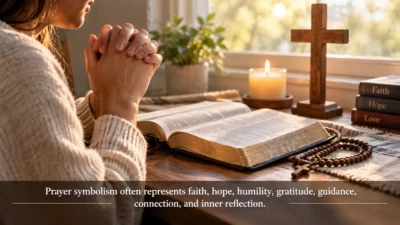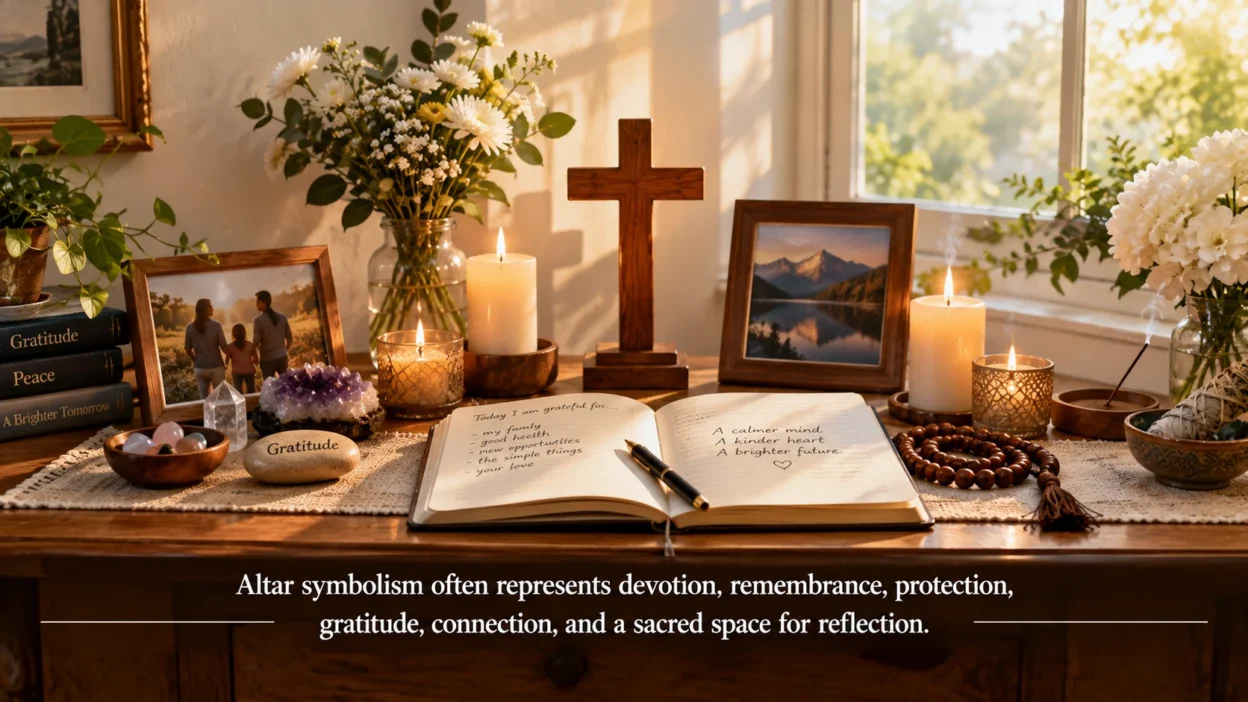
Altars are places where people pause, remember, pray, honor, or connect with something they consider meaningful. Altar symbolism can appear through objects, colors, candles, flowers, photographs, food, religious images, or natural materials.
In 2026, altars appear in churches, homes, memorial spaces, cemeteries, museums, and personal rituals. Some are formally religious, while others are deeply personal.
However, the basic idea is often similar. An altar gathers meaningful objects into one intentional place, turning ordinary space into a setting for attention and reflection.
Quick Answer
Altar symbolism in the USA commonly represents devotion, remembrance, protection, gratitude, sacrifice, and connection with the sacred or meaningful. More broadly, an altar can mark a meeting point between everyday life and spiritual, emotional, or ancestral concerns.
TL;DR
- Altars create intentional spaces for devotion, remembrance, or reflection.
- Candles often represent light, hope, presence, or prayer.
- Flowers can symbolize beauty, renewal, love, mourning, or offering.
- American altars range from churches to private memorial spaces.
- Ancient altars often involved offerings to gods, ancestors, or sacred powers.
- Modern personal altars can express identity without formal religious rules.
What Is an Altar and How Does It Appear?
An altar is a designated place where people present offerings, perform rituals, pray, remember someone, or express devotion. It may be a raised platform, table, stone surface, shelf, or temporary arrangement.
For American readers, an altar doesn’t always mean the same thing. A church altar has a formal religious role, while a home altar may simply provide a quiet place for reflection.
Common Altar Elements
The objects placed on an altar often communicate its purpose. Their meanings depend heavily on the person’s tradition and intention.
- Candles can suggest light, hope, prayer, or spiritual presence.
- Flowers may represent beauty, renewal, love, mourning, or gratitude.
- Photographs can honor family members, ancestors, or loved ones.
- Food and drink can express hospitality, remembrance, or offering.
- Religious objects can represent faith, teachings, protection, or devotion.
- Natural objects can connect rituals with earth, seasons, or personal memories.
The arrangement matters, too. Symmetry can create order, while scattered natural objects may create a more relaxed feeling.
What Does an Altar Symbolize in America?
In the United States, an altar often symbolizes a boundary between ordinary life and intentional reflection. Its meaning changes according to religious tradition, family practice, and personal experience.
American culture also combines many religious and cultural traditions. As a result, altars can appear in churches, private homes, memorials, weddings, and public remembrance spaces.
Common American Meanings
Several ideas appear repeatedly in American altar traditions.
- Faith through prayer, worship, and religious devotion.
- Remembrance through photographs, flowers, candles, and personal belongings.
- Sacrifice through offerings or symbolic acts of devotion.
- Protection through prayers, sacred objects, or meaningful symbols.
- Gratitude through food, flowers, written messages, or offerings.
- Connection through family memories, spiritual beliefs, or community traditions.
A wedding altar offers another familiar American example. It can symbolize commitment, transition, family support, and the beginning of a shared life.
What Is the Historical Origin of Altars?
Altars are far older than Christianity, Judaism, Islam, or other major modern religious traditions. Ancient societies used designated places for offerings, ceremonies, communal worship, and relationships with supernatural powers.
Archaeological evidence shows that ancient people created ritual spaces using stones, platforms, vessels, hearths, and other structures. These spaces helped separate ritual activity from everyday activities.
Ancient Roots
In many ancient societies, offerings formed an important part of ritual life. People might present food, drink, incense, animals, or valuable objects.
The purpose varied greatly. Offerings could express gratitude, seek favor, mark festivals, honor deities, or remember the dead.
Ancient Greek and Roman traditions included household and public sacred spaces. In ancient Rome, for example, household religious practice could involve small sacred areas dedicated to protective household spirits.
Ancient Egyptian temples also contained carefully organized sacred spaces. Altars and offering tables could support rituals connected with gods, temples, and the afterlife.
From Ancient Ritual to Later Traditions
Over centuries, altar practices changed as religions developed. Some traditions rejected earlier practices, while others adapted familiar ritual forms into new religious settings.
This explains why the altar has such a long history. Its basic function is flexible enough to survive major cultural and religious changes.
How Did Altars Develop in Christianity?
Christian altar symbolism developed within a different religious framework from many ancient sacrificial traditions. Early Christians gradually developed formal worship spaces, especially as Christianity became publicly established in the Roman Empire.
Today, the altar remains an important feature of many Christian churches. However, its exact meaning differs among Catholic, Orthodox, Anglican, Lutheran, and other Christian traditions.
The Christian Altar
In many Christian settings, the altar is associated with worship, communion, sacrifice, remembrance, and the central story of Jesus.
Its design can also communicate religious ideas. Stone may suggest permanence, while wood can create warmth and connection with older worship traditions.
Candles, crosses, cloths, flowers, and sacred vessels may add further layers of meaning.
Why the Altar Became Powerful
The altar brings religious ideas into physical space. Instead of thinking about faith only as an invisible concept, worshippers encounter meaningful objects in a specific location.
That physical focus can make rituals feel more memorable. It also helps communities share a recognizable visual language.
What Do Altar Colors and Materials Mean?
Colors and materials can strongly influence an altar’s emotional and symbolic atmosphere. However, there isn’t one universal color code for every altar.
Religious traditions often establish their own meanings. Personal altars may use colors based on memory, seasons, personal taste, or spiritual beliefs.
Colors and Their Common Associations
| Color or Material | Meaning in the USA | Common Associations | Notes |
| White | Peace, purity, remembrance | Weddings, prayer, mourning | Meaning changes by tradition |
| Red | Love, sacrifice, passion | Devotion, courage, sacred ritual | Can also signal danger or intensity |
| Blue | Peace, trust, contemplation | Sky, water, calmness | Often creates a quiet atmosphere |
| Green | Renewal, life, growth | Nature, spring, hope | Common in seasonal religious settings |
| Wood | Warmth, simplicity, tradition | Home, nature, craftsmanship | Often used in personal altars |
| Stone | Permanence, strength, endurance | Ancient ritual, stability | Can create a solemn feeling |
Materials also carry emotional associations. A handmade wooden altar may feel intimate, while a large stone altar can feel permanent and ceremonial.
What Do Candles and Fire Symbolize on an Altar?
Candles are among the most recognizable altar objects. Their symbolism often centers on light, presence, prayer, remembrance, and hope.
Fire has carried symbolic meaning for thousands of years. Its ability to illuminate darkness naturally made it a powerful image for knowledge, protection, transformation, and divine presence.
The Meaning of Candlelight
A single flame can create a sense of focus. Instead of filling a room with bright light, it draws attention toward one small point.
Candles may therefore represent:
- Hope during difficult periods.
- Prayer expressed through quiet ritual.
- Remembrance for someone who has died.
- Guidance during uncertain moments.
- Presence when honoring something absent or unseen.
- Transformation because fire changes what it touches.
However, candle meanings depend on context. A birthday candle, memorial candle, church candle, and personal ritual candle can carry very different messages.
What Do Flowers, Food, and Offerings Symbolize?
Offerings are central to many altar traditions. They transform the altar from a decorative surface into a place of giving, remembering, or honoring.
Flowers are especially common in American religious ceremonies and memorial settings. Food can also carry strong emotional meaning because sharing food connects people with family, hospitality, celebration, and memory.
Offerings as Expressions of Meaning
An offering doesn’t always need to be valuable. Its importance often comes from what it represents.
For example, someone may place a loved one’s favorite flower beside a photograph. Another person may leave bread, fruit, or another meaningful food.
In personal practice, an offering can simply represent gratitude. The physical object becomes a reminder of an emotional or spiritual intention.
What Is the Spiritual Meaning of an Altar?
Spiritually, an altar can represent a meeting place between the visible and invisible. It may help a person focus on prayer, meditation, gratitude, ancestors, nature, or a particular spiritual tradition.
However, there is no single spiritual meaning shared by everyone. Different religions and personal practices understand altars in distinct ways.
Cross-Cultural Perspectives
Altars and altar-like ritual spaces appear in many cultures. Some honor deities, while others focus on ancestors, saints, nature, or seasonal cycles.
In some Mexican traditions, for example, home and community altars associated with Día de los Muertos honor deceased loved ones. Photographs, candles, flowers, food, and personal objects can help create a bridge between memory and celebration.
Buddhist traditions may use offerings and images in dedicated devotional spaces. Hindu traditions can include home shrines where images of deities receive offerings and prayers.
These traditions shouldn’t be treated as interchangeable. Each has its own history, beliefs, and practices.
What Does an Altar Mean Emotionally and Psychologically?
An altar can provide a physical place for emotions that are otherwise difficult to express. Grief, gratitude, hope, love, fear, and longing can all become visible through objects.
This can be especially meaningful during major life changes. Creating a dedicated space gives an abstract feeling a physical form.
The Psychology of a Dedicated Space
People often use objects to organize memory. A photograph can recall a person, while a candle can mark a moment of reflection.
The altar also creates a ritual boundary. Sitting beside it, lighting a candle, or arranging flowers can signal that it’s time to slow down.
For some people, this repeated action can provide comfort and structure. For others, it may simply offer a peaceful visual reminder of personal values.
What Does an Altar Symbolize at a Wedding?
The wedding altar is one of the most familiar forms of altar symbolism in American culture. It represents a place where two people publicly mark a major transition.
Its meaning extends beyond religion. Even secular weddings may use an altar-like setting as a focal point for vows.
Marriage and Commitment
At a wedding, the altar can symbolize:
- Commitment between two people.
- Transition from one life stage to another.
- Witness from family, friends, or community.
- Promises made publicly and intentionally.
- Shared values expressed through ceremony and setting.
Flowers, arches, candles, rings, and family objects can add additional symbolism.
In modern American weddings, the altar may be traditional, minimalist, rustic, outdoor, or highly personalized.
How Are Altars Used in Modern American Life?
Modern American altar practices extend well beyond formal churches. People create small spaces for meditation, remembrance, creativity, family history, or personal spirituality.
Social media has also made carefully arranged personal spaces more visible. A shelf with candles and crystals, for example, may function as both decoration and a personal ritual space.
Home and Lifestyle Uses
Common modern examples include:
- Memorial shelves honoring deceased family members.
- Meditation corners with candles and meaningful objects.
- Wedding and commitment ceremony spaces.
- Seasonal displays connected with holidays or nature.
- Personal spiritual spaces in bedrooms or living rooms.
- Family displays combining photographs, heirlooms, and flowers.
The modern altar often blends beauty with meaning. A person may choose objects because they feel spiritually important and visually calming.
What Does an Altar Tattoo Symbolize?
Altar-inspired tattoos can represent devotion, memory, spiritual identity, transformation, or respect for a particular tradition.
Because tattoos remain on the body, the symbol can become a permanent reminder of something important. However, the exact meaning comes from the person wearing it.
Common Tattoo Elements
A tattoo might combine an altar with candles, flowers, crosses, photographs, skulls, religious figures, or other meaningful objects.
For one person, the design may honor a family member. For another, it may represent faith, survival, personal transformation, or connection with ancestry.
Context matters greatly. A symbol associated with a particular tradition can have a different meaning when removed from that tradition.
What Are Common Misunderstandings About Altars?
One common misunderstanding is that every altar represents the same religious practice. In reality, altars differ widely across traditions and personal settings.
Another misunderstanding comes from treating an altar as merely decorative. While some modern displays are primarily aesthetic, others are connected to serious religious, cultural, or family practices.
Respect and Cultural Context
People should avoid assuming that an unfamiliar altar is mysterious, dangerous, or superstitious simply because it looks different.
Likewise, borrowing sacred objects without understanding their meaning can create tension. Cultural symbols often carry histories that aren’t obvious from their appearance.
Some altar imagery also appears in horror films and popular entertainment. These portrayals can exaggerate or distort traditional practices for dramatic effect.
How Has Altar Symbolism Changed Over Time?
Altar symbolism has continually changed as societies changed. Ancient offering places, medieval churches, modern memorials, and personal home altars can look very different.
Yet the underlying purpose often remains recognizable. People use a dedicated place to focus attention on something they consider important.
Read More: Mosque Symbolism: Meaning, History, and Modern Use
From Public Ritual to Personal Meaning
In earlier societies, many altar rituals were strongly connected to community and organized religion. Today, some Americans maintain private spaces that combine religious and personal symbolism.
Digital culture has accelerated this personalization. People can share altar arrangements, memorial displays, and ritual objects with wider audiences.
At the same time, traditional religious altars remain important. Modern personal practices haven’t replaced older forms; they exist alongside them.
FAQs
What does an altar symbolize?
An altar can symbolize devotion, remembrance, sacrifice, protection, gratitude, or connection. Its meaning depends on the religious, cultural, or personal context.
What is the spiritual meaning of an altar?
A spiritual altar can represent a dedicated meeting place for prayer, reflection, devotion, or remembrance. Different traditions give altars different roles and meanings.
Why do people put candles on altars?
Candles commonly represent light, hope, prayer, remembrance, or guidance. Their specific meaning depends on the ritual and tradition.
What does a wedding altar symbolize?
A wedding altar commonly represents commitment, vows, transition, and community witness. It can carry religious meaning or serve as a symbolic focal point in a secular ceremony.
Why are flowers placed on altars?
Flowers can express love, beauty, remembrance, renewal, gratitude, or mourning. Their meaning often changes according to the occasion and culture.
Are altars only religious?
No. Many altars are religious, but personal memorials and reflective spaces can also function as altars. Their purpose depends on how people use and understand the space.
Conclusion
Altars turn meaningful ideas into visible places. They can represent devotion, remembrance, protection, gratitude, sacrifice, love, and connection across many traditions. Whether an altar holds a candle, photograph, flower, family object, or sacred symbol, its meaning comes from the relationship between the object and the person. That personal connection is what makes a simple space feel significant.