Alchemy Symbolism connects the search for transformation with ideas about wisdom, purity, balance, and personal growth. Historically, alchemy involved experiments with metals, minerals, and other substances. However, it also developed a rich symbolic language that explored the relationship between matter, nature, and the human spirit.
For many people, alchemy represents the possibility of becoming something better through patience, effort, and self-understanding. The image of turning lead into gold, for example, can describe both a historical goal and a personal journey. Someone might use this idea to express recovery, creativity, ambition, or a major change in life.
Although alchemy has connections to early chemistry, ancient philosophy, and religious traditions, its meanings have never been completely uniform. Understanding its history helps separate established traditions from modern interpretations.
Quick Answer
In the United States, Alchemy Symbolism commonly represents transformation, personal growth, wisdom, and the pursuit of something valuable. Its historical symbols also relate to the elements, planets, metals, and natural processes, while modern spiritual interpretations often connect alchemy with inner change and self-discovery.
TL;DR
- Alchemy symbolizes transformation, purification, wisdom, and the search for perfection.
- Turning lead into gold represents both material change and personal improvement.
- Ancient alchemical traditions influenced early chemistry, medicine, philosophy, and mystical thought.
- In America, alchemy appears in tattoos, fantasy art, jewelry, and spiritual imagery.
- The four elements represent different qualities of nature and symbolic states of matter.
- Modern interpretations often emphasize emotional growth rather than literal metal transformation.
What Is Alchemy Symbolism?
Alchemy symbolism is the visual and philosophical language associated with alchemy, an old tradition concerned with changing substances and understanding nature. Its symbols helped practitioners describe materials, processes, planetary influences, and ideas that were sometimes difficult to express directly.
For American readers, these images can represent a meeting point between science, history, spirituality, and imagination. However, their meanings depend on the symbol, the historical period, and the person using it.
Common Alchemical Symbols
Alchemy uses a variety of traditional signs, each with its own historical context.
- Gold: Perfection, incorruptibility, value, and the completion of a process.
- Lead: Imperfection, heaviness, limitations, and the starting point for transformation.
- The Philosopher’s Stone: The legendary substance associated with transmutation and perfected knowledge.
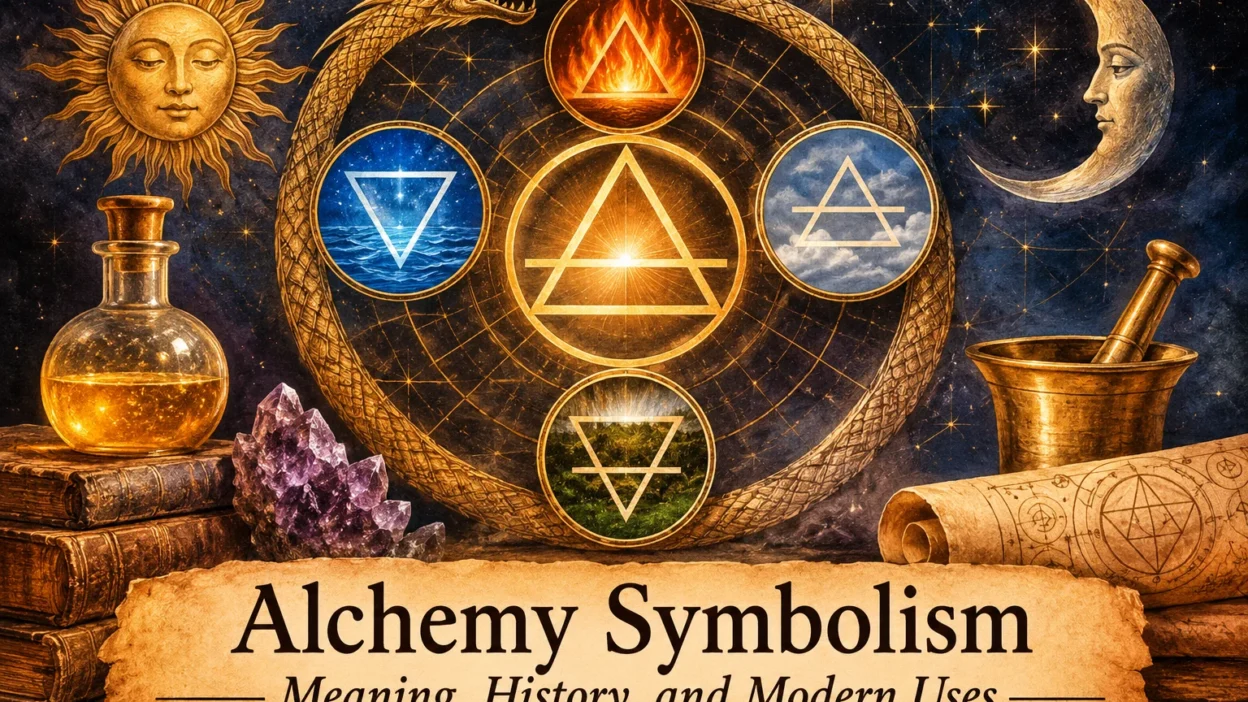
- The Ouroboros: A serpent or dragon eating its own tail, representing cycles and renewal.
- The Sun and Moon: Often associated with gold and silver, masculine and feminine principles, or complementary forces.
Why These Symbols Matter
Alchemical signs were practical as well as symbolic. Historically, practitioners used specialized marks to identify substances and communicate complicated processes.
Over time, these signs also gained philosophical meanings. Today, people may interpret them as reminders that growth often requires patience, balance, and change.
Historical Origins of Alchemy
Alchemy developed across several ancient and medieval societies rather than beginning in one place. Its history includes practical metalworking, philosophical ideas about nature, medical experimentation, and spiritual reflection.
Understanding these roots matters because modern depictions often combine traditions that originally belonged to different periods and cultures.
Ancient Egyptian and Greek Influences
Ancient Egyptian metalworking, dyeing, mineral preparation, and religious traditions contributed to the environment in which alchemical ideas developed. The Greek-speaking world of Hellenistic Egypt, particularly Alexandria, became an important center for early alchemical writing.
Greek philosophers also explored the basic substances that made up the world. Their theories about elements and change later influenced alchemical thinking, although ancient philosophy was not identical to alchemy itself.
Islamic and Medieval European Traditions
During the medieval period, scholars working in Arabic helped preserve, develop, and expand knowledge of alchemy, medicine, minerals, and chemical techniques. These works later influenced European learning through translation and intellectual exchange.
European alchemy became closely associated with laboratory practices, secretive manuscripts, Christian philosophy, and the pursuit of transmutation. However, practitioners differed widely in their goals and beliefs.
From Alchemy to Modern Chemistry
By the early modern period, alchemy had contributed to laboratory techniques, equipment, and the study of substances. Over time, experimental chemistry developed methods that differed from alchemy’s broader philosophical and mystical traditions.
Alchemy did not simply become modern chemistry overnight. Some practices contributed to scientific development, while claims such as transforming ordinary lead into gold through traditional alchemical methods remained unproven.
The Four Elements in Alchemy
The four classical elements are among the most recognizable parts of alchemical symbolism. They offered ways to describe nature, explain material change, and connect the physical world with philosophical ideas.
In American fantasy art and spiritual imagery, these elements often appear as simple triangles. Their designs make complicated ideas easier to recognize and combine.
Fire, Water, Air, and Earth
Fire represents heat, action, destruction, and renewal. It can symbolize the force that changes something old into something new.
Water suggests fluidity, dissolution, and the ability to change shape. Symbolically, it may also represent emotional depth and receptiveness.
Earth represents solidity, structure, and the physical world. It can suggest patience, grounding, and the foundations needed for lasting change.
What Do the Elemental Triangles Mean?
In a common alchemical convention, fire is an upward-pointing triangle, while water is a downward-pointing triangle. Air uses an upward triangle crossed by a horizontal line, and earth uses a downward triangle crossed by a horizontal line.
These shapes make useful modern designs for jewelry, illustrations, and tattoos. However, meanings can vary across symbolic systems, so not every triangular emblem should automatically be labeled alchemical.
The Philosopher’s Stone and the Meaning of Gold
The Philosopher’s Stone is one of alchemy’s most famous symbols. In historical writings, it was associated with the possibility of transforming base metals into precious ones and, in some traditions, producing an elixir connected with longevity.
Its modern appeal comes from a powerful question: Can something ordinary become extraordinary?
The Philosopher’s Stone
The stone represents the goal of a difficult search. Depending on the text, it could signify a substance, a perfected process, or a deeper understanding of nature.
In contemporary symbolic interpretations, it often represents the wisdom gained through experience. It may also suggest that meaningful achievement requires more than wealth or outward success.
Why Gold Represents Perfection
Gold resists tarnishing under ordinary conditions and has long been valued for its beauty and rarity. These qualities helped make it a natural symbol of permanence, excellence, and incorruptibility.
The contrast between lead and gold also creates a powerful metaphor. A person may begin with uncertainty or limited experience and gradually develop greater confidence, patience, and understanding.
The Deeper Lesson
The symbolic journey toward gold isn’t always about becoming rich or flawless. Instead, it can represent the effort to recognize personal strengths and improve areas that need attention.
For modern readers, this interpretation makes alchemy relevant to education, creative work, recovery from setbacks, and other experiences that involve gradual change.
The Seven Planetary Metals and Their Meanings
Traditional alchemical systems connected seven metals with seven classical celestial bodies. This relationship reflected historical ideas about the links between the heavens and earthly materials.
The system is important to understanding alchemical artwork, although it shouldn’t be confused with modern scientific explanations of planetary influence.
Traditional Planetary Correspondences
| Metal | Celestial association | Common symbolic interpretation |
|---|---|---|
| Gold | Sun | Vitality, excellence, and completeness |
| Silver | Moon | Reflection, receptiveness, and intuition |
| Iron | Mars | Strength, conflict, and determination |
| Mercury | Mercury | Movement, communication, and change |
| Tin | Jupiter | Growth, authority, and expansion |
| Copper | Venus | Beauty, attraction, and harmony |
| Lead | Saturn | Limits, weight, time, and endurance |
Why These Connections Matter
These correspondences appear in historical manuscripts, symbolic illustrations, and modern occult-inspired designs. They also help explain why alchemical images sometimes include planetary signs beside metals.
However, the associations aren’t universal psychological truths. They’re part of a historical symbolic framework, and contemporary artists may reinterpret them for personal or creative reasons.
Alchemy Symbolism in the United States
In the United States, alchemy is commonly encountered through books, movies, video games, fantasy illustrations, jewelry, and alternative spiritual communities. Its imagery can suggest mystery, hidden knowledge, transformation, or the desire to discover something beyond everyday experience.
Unlike a national emblem or a widely shared holiday symbol, alchemy doesn’t have one fixed American meaning. People often encounter it through entertainment and then develop their own interpretations.
Alchemy in American Popular Culture
Fantasy stories frequently use alchemy to create fictional systems of transformation. Characters might combine substances, draw intricate circles, or use mysterious signs to change objects and overcome obstacles.
These portrayals make alchemy visually memorable. However, fictional magic systems often simplify or invent traditions, so their symbols shouldn’t automatically be treated as accurate historical examples.
Personal Growth and Self-Improvement
American wellness culture and self-development communities sometimes use alchemy as a metaphor for changing difficult experiences into valuable lessons. The idea fits familiar themes of resilience, reinvention, and learning from failure.
For example, an artist might describe a difficult period as the raw material for a new creative direction. In this sense, alchemy becomes a language for personal change rather than a claim about supernatural powers.
Everyday American Associations
- Creativity: Turning early ideas into meaningful work.
- Resilience: Finding lessons within difficult experiences.
- Mystery: Exploring subjects beyond ordinary explanations.
- Reinvention: Developing a new identity after a major life change.
- Knowledge: Seeking understanding through observation and experimentation.
These meanings reflect contemporary uses rather than one shared national tradition. An alchemical emblem on a pendant may communicate personal spirituality to one person and artistic taste to another.
Spiritual Meaning of Alchemy
Alchemy has spiritual interpretations in several historical and modern traditions. In some writings, physical transformation and spiritual development were closely connected, while other works focused more heavily on materials, medicines, or practical processes.
Today, spiritual interpretations often emphasize inner change. However, alchemy doesn’t belong exclusively to one religion or spiritual movement.
Inner Transformation
Some modern readers interpret alchemical processes as stages of personal development. Difficult emotions, uncertainty, and old habits become material for reflection and change.
This approach treats alchemy as a metaphor. It can provide a meaningful framework for self-examination without requiring someone to accept historical theories about matter or the universe.
Balance and Opposing Forces
Alchemical artwork often places contrasting symbols together, such as the sun and moon or fire and water. These pairings can represent complementary qualities or the challenge of bringing different forces into balance.
For example, a modern illustration might use the sun for action and the moon for reflection. That interpretation is understandable, although specific meanings depend on the tradition and design.
A Respectful Cross-Cultural Perspective
Alchemy developed through exchanges among different intellectual and cultural communities, including Egyptian, Greek, Arabic-speaking, and European traditions. Their practices and beliefs weren’t identical, even when they shared some symbols or ideas.
Modern spiritual art sometimes blends alchemy with astrology, meditation, or other symbolic systems. Such combinations may express personal beliefs, but they shouldn’t be mistaken for a single ancient teaching shared by all cultures.
Emotional and Psychological Meanings of Alchemy
Alchemy appeals to people because it gives visible form to an experience everyone understands: change. Its images can help people describe difficult transitions, personal ambitions, and the desire to find meaning in life’s challenges.
These interpretations are symbolic rather than psychological diagnoses. An alchemical image doesn’t reveal someone’s personality by itself, but it can express values that matter to its owner.
Transformation and Resilience
The journey from lead to gold can represent growth through difficulty. Someone who has overcome a setback might connect with this image because it turns struggle into a story of development.
The symbol doesn’t suggest that suffering is always beneficial. Instead, it can express the possibility of learning and rebuilding after an unwanted experience.
Balance and Self-Understanding
Alchemical images frequently combine contrasting elements or opposing forces. Modern viewers may interpret these pairings as reminders to balance ambition with rest, action with reflection, or independence with connection.
For example, a person might use a sun-and-moon design to express different sides of their identity. The meaning comes from the person’s interpretation rather than a universal psychological rule.
The Search for Purpose
The Philosopher’s Stone can symbolize a goal that requires patience and dedication. Its appeal often lies in the journey itself, including mistakes, discoveries, and changing priorities.
For some people, alchemy represents curiosity about life’s deeper questions. For others, it simply communicates a love of history, symbolism, or mysterious imagery.
Alchemy Symbols in Tattoos and Jewelry
Alchemy has become a popular source of inspiration for symbolic body art and accessories. Its compact signs can look striking on their own, while more detailed designs can tell a personal story.
In the United States, these designs may express individuality, creativity, spirituality, or an interest in fantasy and historical traditions.
Popular Alchemical Tattoo Ideas
- Ouroboros: A circular serpent representing cycles, continuity, and renewal.
- Philosopher’s Stone: A design expressing transformation, ambition, or the pursuit of wisdom.
- Elemental triangles: Symbols representing fire, water, air, or earth.
- Sun and moon: Images that may express balance, contrast, or complementary qualities.
- Gold and lead imagery: A visual metaphor for growth through experience.
Choosing a Meaningful Design
Before choosing an alchemical tattoo, learn what its symbols meant in historical contexts. This helps you distinguish traditional associations from interpretations created by modern artists or online communities.
Also, consider whether you want a historically recognizable symbol or a personal design inspired by alchemy. Both approaches can work, but they communicate different things.
Jewelry and Personal Identity
Alchemy-inspired rings, pendants, and bracelets can serve as private reminders of personal goals. A wearer might choose a symbol for patience, transformation, or the ability to adapt.
However, the same design can communicate different ideas to different people. Some will recognize an alchemical reference, while others may simply see an interesting geometric pattern.
Colors, Shapes, and Visual Patterns in Alchemy
Alchemical imagery uses color, geometry, animals, and combinations of symbols to express ideas about transformation. These visual details can help modern readers understand a design, although not every color or shape has one fixed historical meaning.
For American artists and collectors, understanding these patterns can make alchemy-inspired work more thoughtful and distinctive.
Common Colors and Their Associations
- Gold: Perfection, achievement, permanence, and valuable results.
- Silver: Reflection, clarity, lunar associations, and subtle beauty.
- Black: Darkness, hidden potential, or a stage of breakdown in some modern interpretations.
- White: Purification, clarity, and refinement in certain symbolic systems.
- Red: Heat, vitality, action, or the completion of a process in some traditions.
Color meanings can change between texts and periods. In particular, modern descriptions of black, white, and red as fixed stages of inner transformation shouldn’t be applied to every historical alchemical work.
Circles, Triangles, and Interlocking Forms
Circles often suggest cycles, wholeness, or continuity. Triangles can identify elements, while interlocking shapes may express the union of different substances or opposing forces.
A design combining circles, triangles, and planetary signs can therefore communicate several ideas at once. However, its meaning depends on the exact arrangement and historical source.
Animals and Mythical Creatures
Alchemical illustrations sometimes use animals to represent substances or stages in a process. Serpents, dragons, lions, birds, and phoenixes may appear in different traditions, each with context-specific meanings.
For example, a phoenix rising from ashes is widely understood today as an image of renewal. In alchemical-inspired art, it can also represent the successful completion of a transformative process.
Misunderstandings and Controversies About Alchemy
Alchemy has a complicated reputation because its history includes genuine experimentation, philosophical speculation, spiritual beliefs, and unsupported claims. Modern interpretations can become misleading when they treat all these activities as identical.
For American readers, the most useful approach is to separate historical evidence from personal belief and fictional storytelling.
Was Alchemy Just Fake Science?
No. Although many alchemical goals were never achieved as practitioners imagined, historical alchemy included careful observation and practical experiments with substances.
Some practitioners developed techniques and equipment that contributed to later chemical work. However, traditional attempts to turn ordinary metals into gold did not establish a workable method for achieving that transformation.
Science History Institute
+2
Did Alchemy Always Mean Spiritual Transformation?
No. Some alchemical writings connected material processes with spiritual development, but others concentrated on metals, medicines, and practical laboratory work.
Modern self-help interpretations are meaningful to many people. Still, they shouldn’t be presented as the only original purpose of alchemy.
When Does Modern Symbolism Become Misleading?
Problems arise when a modern interpretation is presented as an established ancient fact without supporting evidence. An artist can give a symbol a personal meaning, but that doesn’t prove every historical alchemist used it the same way.
It’s also important to avoid assuming that everyone wearing an alchemical symbol follows a particular religion or spiritual practice. People choose these designs for many different reasons.
How Alchemy Symbolism Has Changed Over Time
Alchemy’s meanings have changed as societies developed new ideas about nature, science, and spirituality. Its symbols once served practical and philosophical purposes, but many now appear in art, entertainment, and personal expressions of identity.
From Laboratory Signs to Cultural Symbols
In earlier periods, alchemical signs could identify substances, describe procedures, or communicate ideas within specialized traditions. Some manuscripts used elaborate imagery and coded language to explain processes or protect knowledge.
As modern chemistry developed, alchemy gradually lost its status as a central framework for understanding matter. Nevertheless, its historical illustrations continued to attract artists, collectors, writers, and people interested in mystery.
The Revival of Alchemy in Modern Culture
Fantasy literature, films, games, and online communities have introduced alchemical imagery to new audiences. These settings often emphasize magical transformation, secret knowledge, and extraordinary abilities.
Modern spirituality has also renewed interest in the idea of inner alchemy. In this interpretation, changing one’s habits, beliefs, or responses becomes a metaphorical process of refinement.
What Has Stayed the Same?
The desire to understand transformation remains central to alchemy’s appeal. Whether someone studies its historical experiments or wears an alchemical pendant, the imagery still invites questions about what things can become.
However, today’s meanings are often more personal than those found in historical manuscripts. This flexibility helps explain why the same symbol can appear in a scientific history exhibit, a fantasy game, and a spiritual artwork.
Alchemy Symbolism in Art, Home Decor, and Design
Alchemy-inspired designs work well in visual art because they combine geometric shapes, unusual signs, and rich historical associations. In the United States, they appear in posters, book illustrations, decorative objects, and creative spaces.
Their appeal often comes from the balance between visual simplicity and deeper possible meanings.
Home Decor and Creative Spaces
A framed alchemical chart can suit a study, reading room, or artist’s workspace. Brass-colored accents, geometric patterns, and antique-style illustrations can also create a historical or mysterious atmosphere.
However, decorative choices don’t need to express a spiritual belief. Someone may simply appreciate the shapes, craftsmanship, or connection to the history of science.
Branding and Visual Storytelling
Alchemy can provide a visual theme for fictional worlds, creative projects, and products associated with change or discovery. Its imagery can suggest experimentation, craftsmanship, or the transformation of an initial idea into a finished result.
Still, a brand’s use of alchemical imagery doesn’t establish a historical or spiritual connection. Context and accompanying language help explain what the designer intends to communicate.
Alchemy Symbolism Compared With Modern Chemistry
Alchemy and chemistry share a historical connection, but they aren’t interchangeable. Understanding their differences helps prevent confusion when modern media portrays alchemical symbols as scientific facts.
Similarities and Differences
| Feature | Historical alchemy | Modern chemistry |
|---|---|---|
| Main interest | Transforming substances and understanding nature | Studying matter, its properties, and its changes |
| Symbol system | Specialized signs for metals, materials, planets, and processes | Standardized chemical symbols and formulas |
| Methods | Varied, including experiments, philosophical reasoning, and traditional beliefs | Evidence-based methods, controlled experiments, and reproducible results |
| Spiritual role | Sometimes closely connected with spiritual or philosophical ideas | Scientific explanations don’t depend on spiritual interpretations |
| Transformation | Sought methods such as transmutation and purification | Explains chemical changes through established scientific principles |
Can Science Turn Lead Into Gold?
Modern nuclear physics can transform one element into another under specialized conditions. However, this is different from traditional alchemical methods, and it isn’t a practical way to produce gold for everyday use.
Consequently, the lead-to-gold image remains powerful as a metaphor for transformation. Its symbolic meaning doesn’t depend on whether the historical goal could be achieved through traditional alchemy.
Read More: Dragon Symbolism: Power, Wisdom, Protection, and Transformation
FAQs
What Does Alchemy Symbolism Mean Spiritually?
Spiritually, alchemy is often interpreted as a journey toward greater awareness, balance, and personal refinement. This interpretation draws on traditions that connect changes in matter with changes in the self, although not all historical alchemy focused on spiritual development.
What Is the Most Powerful Symbol in Alchemy?
The Philosopher’s Stone is among the most recognizable alchemical symbols because it represents the pursuit of transformation and perfection. However, there isn’t one universally accepted ranking of alchemical symbols, and different traditions emphasize different images.
What Does Turning Lead Into Gold Symbolize?
Turning lead into gold can represent the transformation of something ordinary or imperfect into something valuable. In modern personal interpretations, it may express learning from hardship, developing new abilities, or becoming more confident through experience.
What Does the Ouroboros Mean in Alchemy?
The Ouroboros depicts a serpent or dragon eating its own tail. It commonly represents cycles, continuity, renewal, and the relationship between endings and beginnings, although its meanings vary across historical and cultural settings.
What Do the Four Alchemical Elements Represent?
The four elements are fire, water, air, and earth. They traditionally describe qualities of the natural world and can symbolize energy, fluidity, movement, and stability in modern interpretations.
Is Alchemy a Religion or a Science?
Alchemy isn’t a single religion, and its history includes both practical experimentation and philosophical or spiritual beliefs. It contributed to the development of chemistry, but many traditional theories and goals differ from modern scientific understanding.
Conclusion
Alchemy Symbolism represents transformation, wisdom, balance, and the search for something more complete. Its historical imagery connects metals, elements, planets, and laboratory processes with broader questions about nature and human experience. Ultimately, alchemy invites you to think about transformation in a new way. Consider what the symbols mean within their historical context, then reflect on which ideas resonate with your own experiences.