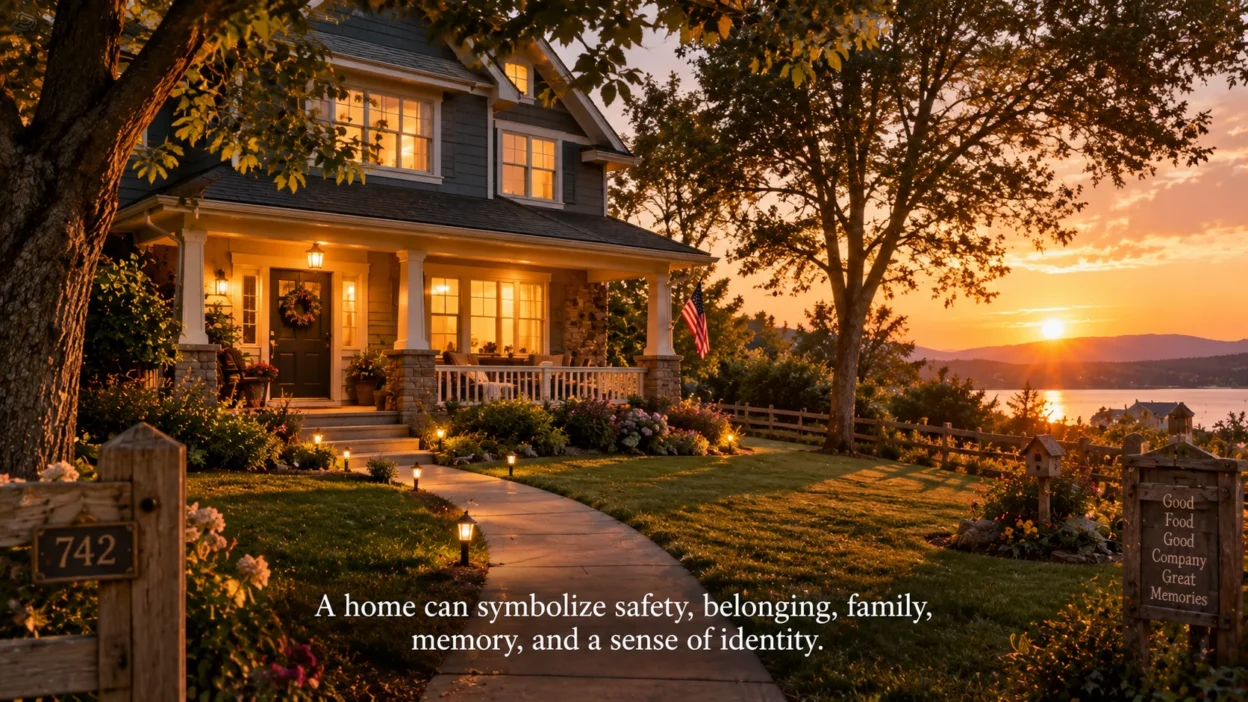
Home symbolism is closely connected to the ideas of safety, belonging, family, identity, and stability. In the United States, a home often represents more than a building because it can hold memories, traditions, relationships, and personal values.
Across history, people have treated the home as a protected space between the outside world and private life. However, its meaning changes with culture, family structure, architecture, and personal experience. A house can represent success for one person and comfort or childhood memories for another.
Today, home imagery appears in tattoos, jewelry, art, social media, holiday decorations, literature, films, and everyday language. Because of this, understanding Home Symbolism can reveal how people think about security, roots, independence, and belonging.
Quick Answer
Home Symbolism in the USA commonly represents safety, belonging, family, stability, comfort, and personal identity. More broadly, the home can symbolize protection, roots, inner life, memory, and a place where a person feels connected.
TL;DR
- Homes commonly symbolize safety, belonging, family, and stability.
- Ancient shelters connected home imagery with protection and survival.
- American culture often links homes with independence and personal achievement.
- A home can represent memories, identity, roots, and emotional comfort.
- Modern home imagery appears in tattoos, decor, art, and social media.
What Does a Home Symbolize?
A home is one of the most familiar symbols in human life. However, its meaning goes beyond walls, doors, windows, and furniture. It often represents the emotional space where people feel protected and connected.
For American readers, the idea of home can also carry strong cultural meanings. The home may represent independence, family life, privacy, achievement, or the hope of building a better future.
Safety and Protection
A home creates a physical boundary between its occupants and the outside world. Therefore, it naturally becomes associated with protection.
Common symbolic meanings include:
• Safety from physical and emotional threats
• Shelter during difficult times
• Protection of family and personal belongings
• A private space away from public life
• Stability during periods of change
Belonging and Identity
A home can also communicate who someone is. Its architecture, decorations, neighborhood, and objects may reflect personality, memories, culture, and lifestyle.
For this reason, the phrase “feeling at home” often means more than being physically present somewhere. It suggests emotional acceptance and familiarity.
The Historical Roots of Home Symbolism
The symbolic meaning of home developed alongside human settlement. Long before modern houses existed, people needed protected spaces for sleeping, gathering, preparing food, and raising children.
However, early shelters were not simply practical structures. They also created a boundary between the human community and the surrounding natural world.
Ancient Roots
Prehistoric dwellings varied greatly according to climate and available materials. Caves, huts, tents, and built structures all provided forms of shelter.
Over time, permanent settlements made the home increasingly connected with family, land, ancestry, and community.
Ancient household traditions also sometimes treated the home as a spiritually meaningful place. In several ancient societies, domestic rituals honored household gods, ancestors, protective spirits, or sacred objects.
From Shelter to Household
As societies became more settled, the home became linked with inheritance and family continuity. Land and houses could pass from one generation to another.
Consequently, the home began representing roots as well as protection. A house could connect living people with their ancestors and future descendants.
Home Symbolism in American Culture
In the United States, home symbolism is strongly connected with independence, family, privacy, and the idea of creating a personal life.
American history also shaped these associations. Ideas surrounding settlement, property ownership, migration, and homebuilding gave houses an important place in cultural imagination.
The American Dream
Homeownership has often been presented as a sign of stability and achievement in American culture. A house may therefore symbolize reaching an important personal milestone.
However, this meaning isn’t universal. Housing costs, renting, economic inequality, mobility, and different family arrangements have changed how Americans experience the idea of home.
Home as a Personal Refuge
American culture also places considerable value on personal privacy. As a result, the home can symbolize a private world where people can relax and express themselves.
For many people, this includes:
• Family traditions practiced away from public life
• Personal decorations reflecting individual taste
• Spaces connected with hobbies and creativity
• Memories created during important life events
• A sense of independence and personal control
Home, Family, and Belonging
The home often becomes a visual symbol of family life. A dining table, front porch, kitchen, or living room can represent shared experiences even without showing people.
This association is particularly strong because everyday routines happen inside homes. Ordinary activities can eventually become powerful memories.
The House as a Family Symbol
A house may symbolize parents, children, grandparents, partners, or close friends. However, family symbolism doesn’t always depend on traditional household structures.
Today, “home” can refer to many forms of chosen and biological family. It can also describe a place shared with roommates, partners, pets, or close friends.
Memory and Nostalgia
Old houses often evoke nostalgia because they preserve visible reminders of earlier periods. A childhood bedroom or familiar kitchen can become a powerful symbol of the past.
However, memories associated with home aren’t always positive. For some people, home imagery can represent loss, separation, conflict, or a longing for somewhere safer.
The Spiritual Meaning of Home
Across different traditions, the home can symbolize more than physical shelter. It may represent sacred space, spiritual protection, family continuity, or the inner self.
These meanings differ widely, so they shouldn’t be treated as one universal belief.
Sacred Space
Some religious traditions include rituals or objects connected with protecting and blessing the household. In these settings, the home becomes a place where spiritual and everyday life meet.
Similarly, religious architecture can use the idea of a dwelling to express divine presence, community, or spiritual refuge.
Home as Inner Self
In symbolic and psychological traditions, a house can represent the inner world. Different rooms may be interpreted as different parts of personal experience.
For example, a locked room might suggest something private or unknown in a story. An open doorway might instead suggest opportunity, welcome, or change.
Cross-Cultural Meanings of Home
Although homes differ around the world, many cultures connect shelter with belonging and protection. However, the details of these meanings depend on local history and traditions.
Different Cultural Associations
A few broad patterns appear across cultures:
| Context | Meaning in the USA | Common Associations | Notes |
| Family home | Belonging and stability | Family, memories, comfort | Meaning varies by family experience |
| Childhood home | Roots and nostalgia | Memory, identity, growth | Can evoke positive or difficult memories |
| New home | New beginnings | Independence, hope, achievement | Often linked with major life transitions |
| Ancestral home | Heritage and continuity | Family history, roots, tradition | Especially meaningful across generations |
| Temporary home | Adaptability and transition | Travel, migration, change | Challenges the idea that home must be permanent |
A Shared Human Pattern
Across many societies, shelter helps define a boundary between public and private life. Therefore, home symbolism often includes ideas of safety, community, and identity.
Still, not every culture treats permanent homeownership as the main measure of stability. Some traditions place greater emphasis on community, extended family, mobility, or ancestral land.
The Emotional Meaning of Home
Home imagery can trigger powerful emotions because people often connect physical spaces with personal memories.
However, the emotional response depends heavily on individual experience. The same image can feel comforting to one person and painful to another.
Common Emotional Associations
Home symbolism can evoke:
• Comfort after a stressful experience
• Warmth associated with familiar people
• Security during uncertain periods
• Nostalgia for childhood or earlier life
• Pride in creating a personal space
• Grief after leaving a meaningful place
Home and Emotional Security
People often use “home” as shorthand for emotional safety. Saying that someone makes you feel at home can suggest trust, acceptance, and familiarity.
Because of this, home imagery can communicate emotional closeness without showing a specific relationship.
What Houses Symbolize in Dreams and Stories
Houses are common settings in dreams, novels, films, and myths. Their symbolism often depends on the surrounding story rather than one fixed interpretation.
A house can represent the self, family, history, secrets, or a changing stage of life.
Rooms and Doors
Stories often give symbolic importance to rooms, stairways, windows, and doors. These features can represent privacy, discovery, transition, or boundaries.
For example, an open door may suggest welcome or possibility. Conversely, a locked door can represent separation or something hidden.
Old and New Houses
An old house may represent memory, ancestry, or the past. Meanwhile, a new house can suggest growth, independence, transition, or a fresh beginning.
These interpretations are common storytelling devices rather than universal rules for understanding dreams.
Modern Home Symbolism
Home imagery remains powerful in modern American culture. Social media, interior design, advertising, photography, and entertainment frequently use homes to communicate lifestyle and identity.
However, modern audiences increasingly recognize that a meaningful home doesn’t require a particular size or style.
Home Decor and Personal Identity
People use furniture, artwork, plants, photographs, colors, and collections to personalize their spaces. Therefore, home decor can become a form of self-expression.
Minimalist rooms may communicate simplicity to some viewers, while colorful or heavily decorated rooms may suggest creativity and personal history.
Social Media and Digital Culture
Photos of kitchens, bedrooms, living rooms, gardens, and front porches are common online. These images can communicate comfort, lifestyle, family life, or personal taste.
At the same time, social media can create unrealistic expectations about what a “perfect home” should look like. Real homes are usually more varied than carefully selected images suggest.
Home Symbolism in Tattoos and Art
A house tattoo can carry deeply personal meaning. Unlike a generic symbol, it can represent a specific childhood place, family connection, hometown, or emotional journey.
Common Tattoo Meanings
House imagery may represent:
• Love for a childhood home
• Connection to family and ancestry
• Returning to one’s roots
• A place of emotional safety
• Building a new life
• Remembering someone or somewhere lost
Artistic Variations
Artists may combine houses with trees, mountains, roads, stars, flowers, keys, or landscapes. Each additional element can change the story.
For instance, a road leading toward a house may suggest returning home. A house beneath a night sky may create a more nostalgic or reflective mood.
Home as a Symbol of Change
Although homes often symbolize stability, they can also represent major transitions. Moving into a new house, leaving childhood, relocating for work, or starting a family can all change someone’s relationship with home.
Therefore, home symbolism contains an interesting contrast: it can represent both permanence and change.
Leaving Home
Leaving home can symbolize independence and personal growth. In American literature and popular culture, journeys away from home often mark the beginning of adulthood or self-discovery.
However, leaving can also represent displacement, grief, migration, or separation. Context determines the meaning.
Returning Home
The return-home theme appears frequently in stories and popular culture. It can symbolize reconciliation, maturity, nostalgia, or discovering that a person has changed.
Sometimes the destination remains familiar while the person returning is different.
Misunderstandings and Controversies Around Home Symbolism
Home symbolism is generally positive, but it can carry complicated meanings. Ideas about home have sometimes been connected with wealth, social status, exclusion, and unequal access to housing.
Homeownership and Status
A large house can symbolize achievement in some American settings. However, equating homeownership with personal worth can overlook many people’s circumstances.
Renters, people who move frequently, and people living in nontraditional arrangements can also experience strong feelings of belonging.
The Idea of the “Perfect Home”
Modern media sometimes presents an idealized image of home life. This can make ordinary homes seem inadequate by comparison.
A symbolic understanding of home doesn’t require luxury. A small apartment, shared house, family farm, or temporary residence can carry deep emotional meaning.
How Home Symbolism Has Changed
The meaning of home has never been completely fixed. Instead, it has changed alongside technology, migration, family structures, architecture, and social values.
Historically, the home was closely tied to survival and protection. Later, it became strongly associated with family, inheritance, property, and community.
Today, home can also describe emotional belonging rather than a specific building. Someone may call a city, community, relationship, or familiar landscape “home.”
Read More: Family Symbolism: Meaning, History, and Modern Significance
From Building to Feeling
One of the biggest modern shifts is the difference between a house and a home. A house describes a physical structure, while home often describes an emotional connection.
This distinction explains why people can feel at home in places they don’t own.
Home in a Changing World
Remote work, migration, travel, changing households, and digital communication have further expanded the idea. A person’s sense of home may now extend across several places.
As a result, home symbolism increasingly includes adaptability alongside stability.
FAQs
What does a house symbolize spiritually?
A house can symbolize protection, sacred space, family continuity, or the inner self. Spiritual interpretations vary between traditions and individuals.
What does a home symbolize in America?
In the United States, a home commonly represents safety, family, independence, privacy, stability, and personal achievement. However, experiences differ widely depending on culture, finances, family structure, and housing circumstances.
What does a house symbolize in dreams?
In dreams and storytelling, a house can represent the self, family life, memories, privacy, or personal history. Specific features, such as rooms and doors, may add meaning within the dream’s context.
What does a home symbolize in literature?
Home often represents belonging, identity, roots, safety, or the past. Stories may also use leaving home to represent independence and returning home to represent change or reconciliation.
What does a house tattoo symbolize?
A house tattoo can represent family, childhood memories, roots, protection, or a meaningful place. Its exact meaning usually depends on the person’s personal story.
Is a house a symbol of wealth?
A house can symbolize financial achievement or social status in some American contexts. However, home symbolism is much broader and can represent emotional security, family, memory, and belonging regardless of wealth.
Conclusion
Home symbolism connects physical shelter with deeper ideas of safety, family, belonging, identity, memory, and stability. In the United States, it also reflects cultural ideas about independence, achievement, privacy, and creating a personal life. However, a home doesn’t have to be large, permanent, or owned to carry meaning. For many people, Home Symbolism is ultimately about the place—or people—that create a feeling of belonging. Whether represented by a house, doorway, key, childhood room, or familiar landscape, the idea of home continues to express one simple human desire: to have somewhere that feels like your own.