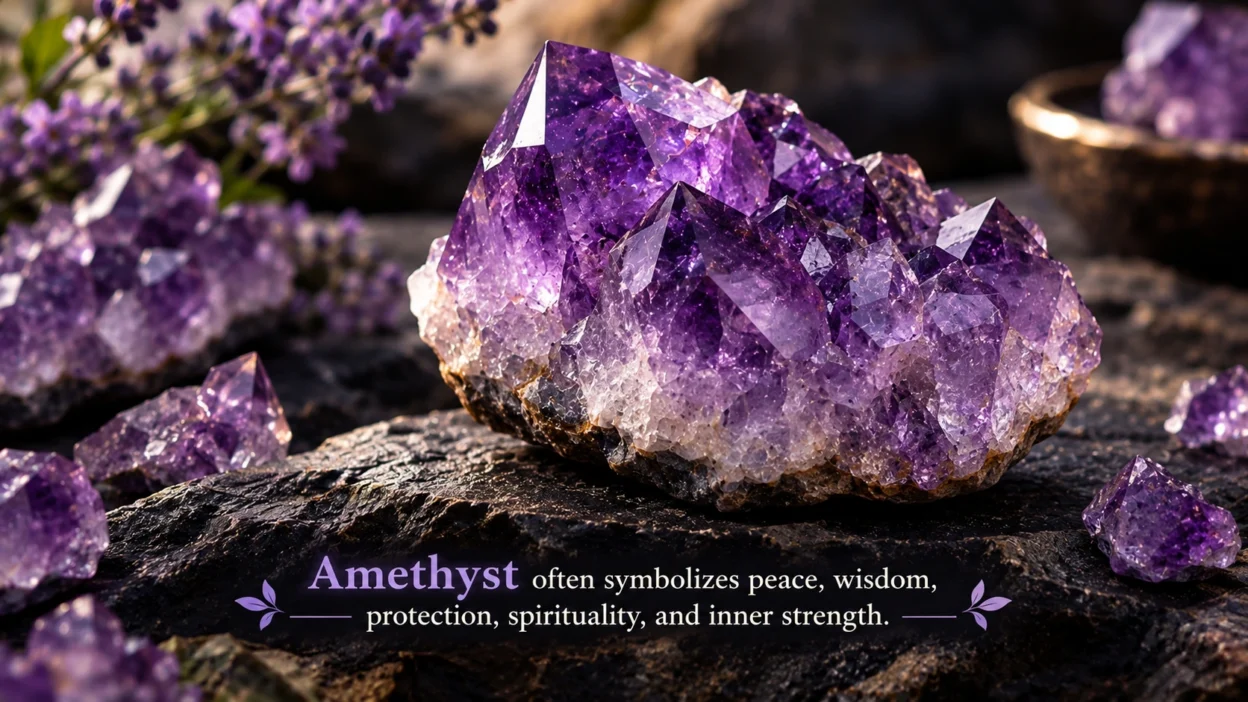
Amethyst Symbolism has fascinated people for centuries because of the gemstone’s striking purple color and long cultural history. From pale lavender stones to deep violet crystals, amethyst has been linked with wisdom, protection, calmness, and spiritual reflection.
Today, Americans encounter amethyst in jewelry, birthstone traditions, home decor, crystal collections, and personal gifts. However, its meaning goes beyond its beautiful appearance. Ancient stories, religious traditions, and modern ideas have all shaped what this purple gemstone represents.
Because symbols can change across cultures and generations, amethyst doesn’t carry one fixed meaning. Instead, its symbolism connects ancient beliefs with modern feelings about peace, identity, beauty, and personal growth.
Quick Answer
In the United States, Amethyst Symbolism commonly represents peace, wisdom, protection, inner strength, and spiritual reflection. More broadly, its purple color has connected the gemstone with royalty, self-control, clarity, and meaningful personal expression.
TL;DR
• Amethyst commonly symbolizes peace, wisdom, protection, and inner strength.
• Its purple color connects it with royalty and spirituality.
• Ancient Greeks linked amethyst with sobriety and self-control.
• Americans often use it in jewelry, gifts, and personal decor.
• Modern crystal traditions connect amethyst with calm and reflection.
• Its meaning continues evolving through fashion and personal identity.
What Is Amethyst and What Does It Look Like?
A Purple Variety of Quartz
Amethyst is a purple variety of quartz, a mineral found naturally in many parts of the world. Its color can range from very light lavender to rich, dark violet.
Some amethysts appear as polished gemstones in rings and necklaces. Others grow as clusters of pointed crystals inside rocky formations called geodes.
For American readers, appearance matters because color strongly shapes symbolism. Purple has long suggested rarity, imagination, dignity, and mystery.
The Meaning Behind Its Appearance
The visual qualities of amethyst help explain why people attach symbolic meanings to it.
• Light purple can suggest gentleness, peace, and imagination.
• Deep violet often suggests mystery, dignity, and spiritual reflection.
• Crystal points can symbolize focus and directed energy.
• Sparkling surfaces can suggest beauty and hidden inner value.
• Natural geodes may represent discovery beneath an ordinary exterior.
Its appearance doesn’t scientifically determine its meaning. Instead, people have built symbolic associations around its color and form over many generations.
The Core Symbolism of Amethyst
Peace, Wisdom, and Protection
Amethyst has several major meanings that remain popular today. Although interpretations differ, certain associations appear again and again.
| Context | Meaning in the USA | Common Associations | Notes |
| Jewelry | Love and personal meaning | Beauty, commitment, identity | Often given as a meaningful gift |
| Birthstone traditions | Personal identity | February, individuality | Connected with birthdays |
| Home decor | Calm surroundings | Peace, beauty, nature | Popular in decorative geodes |
| Spiritual practices | Reflection and awareness | Quiet, balance, mindfulness | Meaning varies by individual |
| Historical symbolism | Self-control and wisdom | Clarity, discipline | Influenced by ancient traditions |
Common Meanings Today
In modern symbolism, amethyst often represents several connected ideas.
• Calmness during stressful or emotionally demanding periods.
• Wisdom gained through patience and reflection.
• Protection from harmful influences or negative surroundings.
• Inner strength during periods of personal change.
• Spiritual curiosity and thoughtful self-examination.
• Beauty connected with individuality and imagination.
These meanings often overlap. For example, someone might wear amethyst jewelry simply because they love purple, while another person may see the same stone as a reminder to stay calm.
Ancient Origins of Amethyst Symbolism
Greek and Roman Associations
One of the best-known historical meanings of amethyst comes from the ancient Greek world. The stone became associated with sobriety and self-control.
Its name is connected with an ancient Greek word referring to avoiding drunkenness. Because of this connection, some people believed amethyst could protect a person from intoxication.
Today, this belief is mainly understood as historical symbolism rather than a proven physical effect. However, the idea of self-control still influences modern interpretations.
A Symbol of Discipline
The ancient association with sobriety gave amethyst a broader meaning. It became connected with keeping a clear mind and avoiding excess.
This helped shape later symbolism around wisdom and emotional balance.
• Clear thinking during difficult decisions.
• Moderation instead of harmful excess.
• Discipline over uncontrolled impulses.
• Awareness of personal choices.
• Wisdom developed through restraint.
The ancient story shows how symbolism can evolve. A specific belief about drinking gradually became a wider symbol of balance and self-control.
Amethyst and the Meaning of Purple
Why Purple Feels Special
Amethyst symbolism cannot be separated completely from the symbolism of purple. Throughout history, purple has often been associated with wealth, power, dignity, and rarity.
For many periods, purple dyes were difficult and expensive to produce. As a result, purple clothing became connected with high social status.
Amethyst carried some of those associations because of its rich violet appearance.
Purple in Modern American Culture
Today, purple remains visually powerful in the United States. However, it has developed more personal and creative meanings.
Purple can suggest imagination, individuality, mystery, and emotional depth. Therefore, amethyst often feels both elegant and unconventional.
For example, a person may choose an amethyst ring because it feels less traditional than a clear diamond. The stone can express a preference for individuality while still looking luxurious.
Amethyst Symbolism in the United States
Jewelry and Personal Expression
In the United States, amethyst is widely recognized as a meaningful gemstone. It appears in rings, necklaces, earrings, bracelets, and personalized gifts.
Its symbolism often depends on the person wearing it. Some see beauty first, while others connect the stone with calmness or personal growth.
Because modern Americans often use jewelry to express identity, amethyst can become a private symbol. Its meaning may come from a birthday, relationship, memory, or important life event.
February Birthstone Traditions
Amethyst is widely known in the United States as February’s birthstone. This gives the gemstone another layer of personal meaning.
Birthstones can connect people with their birth month and personal identity. Many Americans receive birthstone jewelry as birthday gifts.
• A reminder of one’s birth month.
• A personalized gift for family members.
• A symbol of individual identity.
• A connection between jewelry and personal memories.
• A meaningful alternative to purely decorative gemstones.
Because of these traditions, amethyst often represents something personal rather than a universal message.
Amethyst in Religious and Spiritual Traditions
Historical Christian Associations
Amethyst has appeared in Christian religious history, particularly in jewelry and ceremonial objects. Its purple color also connected naturally with themes of dignity, reflection, and spiritual devotion.
In some historical settings, religious leaders wore amethyst jewelry or used stones in ceremonial designs. These uses contributed to its association with humility and spiritual awareness.
However, meanings have varied across different periods and communities.
Modern Spiritual Interpretations
Today, some people include amethyst in meditation, crystal practices, or personal rituals. They may associate it with quiet reflection, emotional balance, or spiritual focus.
These interpretations are matters of personal or spiritual belief. They shouldn’t be understood as scientifically proven effects.
For many people, the stone works symbolically like a meaningful object or reminder. Seeing or holding it may encourage a moment of calm reflection.
Cross-Cultural Meanings of Amethyst
Different Cultures, Different Stories
Amethyst has traveled through many cultures and historical periods. As a result, its meanings aren’t identical everywhere.
Ancient Mediterranean traditions strongly influenced the popular story about sobriety and self-control. Other societies valued purple stones for beauty, rarity, status, or religious decoration.
Therefore, it’s best to avoid assuming every culture gives amethyst the same meaning.
Shared Themes
Despite differences, several broad themes appear across many interpretations.
• Beauty connected with rarity and value.
• Purple associated with dignity and importance.
• Reflection linked with thoughtful self-control.
• Protection expressed through symbolic jewelry.
• Spiritual meaning shaped by local traditions.
These similarities don’t mean every tradition developed from one source. Human beings often create similar meanings around striking colors and unusual natural objects.
The Emotional and Psychological Meaning of Amethyst
A Symbol of Calm
Amethyst’s cool purple tones often create an emotional association with quietness. Compared with bright red or orange, violet may feel more reflective and less urgent.
Because of this, many people associate amethyst with peaceful spaces and thoughtful moments.
The stone can become a visual reminder to slow down. That symbolic role may matter even when someone doesn’t hold spiritual beliefs about crystals.
Inner Strength and Reflection
Amethyst can also symbolize strength, but usually a quieter form of strength. Instead of representing physical force, it may suggest patience and emotional control.
This makes the gemstone meaningful during periods of change.
• Staying calm when life feels uncertain.
• Thinking before reacting emotionally.
• Learning from difficult experiences.
• Trusting personal judgment.
• Finding strength without constant attention.
These meanings explain why amethyst often appears in gifts meant to encourage someone.
Spiritual Meaning of Amethyst Today
Reflection Rather Than One Fixed Definition
Modern spiritual symbolism around amethyst varies greatly. Some people connect it with meditation, intuition, awareness, or inner peace.
Others simply enjoy the stone as part of a peaceful environment. Both approaches can exist without requiring everyone to interpret amethyst the same way.
In American culture, spiritual symbolism has become increasingly personal. People often choose symbols that fit their own experiences.
A Reminder of Personal Values
For some people, amethyst serves as a symbolic reminder.
It may represent:
• Taking time for quiet reflection.
• Maintaining emotional balance.
• Choosing patience during conflict.
• Staying connected to personal values.
• Creating moments of intentional calm.
The power of the symbol often comes from what the person brings to it.
Amethyst in Jewelry and Fashion
A Colorful Alternative
Amethyst offers a strong visual identity. Its purple color can feel bold without being as intense as bright red.
This makes it popular in both vintage-inspired and modern jewelry styles.
Americans may choose amethyst because it feels elegant while remaining distinctive. It can communicate personality through color.
Gifts and Relationships
Gemstones often become symbols through the moments surrounding them. An amethyst necklace from a parent, partner, or friend may gain emotional importance.
Over time, the personal story can become more meaningful than any traditional interpretation.
• Birthday celebrations and February traditions.
• Friendship gifts with personal messages.
• Jewelry marking important life moments.
• Family heirlooms passed between generations.
• Gifts chosen for their favorite color.
This personal layer keeps gemstone symbolism alive in modern life.
Amethyst in Home Decor
Bringing Nature Indoors
Large amethyst clusters and geodes have become popular decorative objects. Their natural crystal shapes make them visually different from manufactured decorations.
A geode can become a conversation piece because it combines geology, color, and natural beauty.
For many American homes, amethyst decor symbolizes an appreciation for nature and individuality.
Calm and Creative Spaces
People often place amethyst in bedrooms, offices, meditation areas, or creative spaces. The choice may be based on symbolism, appearance, or both.
Purple crystals can create a dramatic focal point. At the same time, softer lavender shades may create a gentler atmosphere.
The decorative meaning often depends on context rather than tradition alone.
Amethyst Symbolism in Tattoos and Personal Identity
Permanent Personal Meaning
Amethyst-inspired tattoos can represent a deeply personal story. A crystal design may symbolize growth, strength, calmness, or transformation.
Unlike traditional symbols with one widely recognized meaning, crystal tattoos often allow more freedom.
A person might combine amethyst imagery with flowers, moons, stars, or meaningful words.
Modern Visual Symbolism
On social media and in digital art, crystals often represent personal interests and aesthetic identity. Amethyst stands out because its purple color is immediately recognizable.
• Spiritual curiosity and self-reflection.
• Love of natural beauty.
• Individuality and creative identity.
• Interest in astrology or crystal culture.
• A reminder of personal growth.
However, an image of amethyst doesn’t always carry spiritual meaning. Sometimes, it’s simply chosen because it looks beautiful.
Amethyst in Popular Culture and Modern Life
A Symbol That Fits Many Styles
One reason amethyst remains popular is its flexibility. The same gemstone can fit luxury jewelry, rustic decor, fantasy-inspired art, and modern minimalist spaces.
This allows its symbolism to change with the setting.
In a fine jewelry store, it may suggest elegance. In a crystal collection, it may suggest reflection. In artwork, it may simply add mystery and color.
Social Media and Visual Culture
Modern visual culture has given crystals new popularity. Photographs of colorful geodes and polished stones are widely shared because they are visually striking.
Amethyst works especially well in images because of its dramatic purple shades and sparkling surfaces.
Today, its symbolism can move quickly between ancient stories and modern aesthetics.
Misunderstandings About Amethyst
Symbolism Is Not Scientific Proof
One common misunderstanding involves claims that gemstones physically control emotions or guarantee specific results.
Amethyst has important historical and spiritual symbolism. However, symbolic or spiritual beliefs shouldn’t be confused with established scientific evidence.
People can still find personal meaning in a stone without claiming it has proven supernatural powers.
One Stone Does Not Mean One Thing
Another misunderstanding is assuming amethyst has one universal definition. Symbolism changes according to culture, religion, history, and personal experience.
For example, one person may connect amethyst with peace. Another may think first of February birthdays or purple fashion.
Context matters.
How Amethyst Symbolism Has Changed Over Time
From Sobriety to Personal Wellness
Ancient traditions strongly emphasized self-control and sobriety. Over time, those meanings expanded into broader ideas about wisdom and emotional balance.
Later religious associations added themes of dignity and reflection.
Today, many interpretations focus on calmness, mindfulness, creativity, and personal identity.
A More Personal Symbol Today
Modern Americans often choose their own meanings. This represents an important change in symbolism.
Instead of following one traditional interpretation, people may create meaning through memories and experiences.
• Ancient meanings emphasized restraint and moderation.
• Historical traditions added dignity and spiritual reflection.
• Jewelry traditions encouraged personal identity.
• Modern culture emphasizes individuality and self-expression.
• Personal stories now shape meaning more than fixed rules.
This flexibility helps explain why amethyst remains relevant.
Why Amethyst Still Matters Today
Ancient Symbol, Modern Connection
Amethyst connects the natural world with human imagination. Its meaning has survived because people continue finding new ways to understand its color and beauty.
The stone can represent ancient stories while also fitting modern lifestyles.
For Americans, this makes amethyst especially flexible. It can be a birthstone, fashion choice, family gift, decorative object, or private reminder.
Read More: Jade Symbolism: Meaning, History, and Modern Uses
Meaning Comes From Context
The symbolism of amethyst isn’t locked inside the stone. Meaning develops through history, culture, and personal experience.
That makes each use slightly different.
A small purple ring may represent a birthday. A large geode may represent nature. A tattoo may represent personal growth.
FAQs
What does amethyst symbolize?
Amethyst commonly symbolizes peace, wisdom, protection, self-control, and spiritual reflection. Its meaning can also change depending on cultural and personal context.
What is the spiritual meaning of amethyst?
Some spiritual traditions connect amethyst with meditation, awareness, intuition, and inner calm. These meanings are based on personal and cultural beliefs rather than scientific proof.
Why is amethyst associated with February?
Amethyst is traditionally recognized as February’s birthstone in modern American birthstone traditions. Because of this, it often represents birthdays and personal identity.
Why was amethyst associated with sobriety?
Ancient Greek traditions connected amethyst with avoiding drunkenness and maintaining self-control. Over time, this symbolism expanded into broader ideas about clarity and wisdom.
Is amethyst a symbol of protection?
Yes, many historical and modern traditions associate amethyst with symbolic protection. However, the exact meaning depends on the culture and the individual using it.
What does an amethyst tattoo mean?
An amethyst tattoo can represent calmness, strength, transformation, spirituality, or personal growth. The meaning is usually personal and may differ from traditional interpretations.
Conclusion
Amethyst Symbolism brings together centuries of history, color symbolism, personal meaning, and cultural change. From ancient ideas about self-control to modern associations with peace and individuality, this purple gemstone has developed many layers of meaning. Whether you wear amethyst, decorate with it, or simply admire its violet glow, consider what the symbol means in your own story.