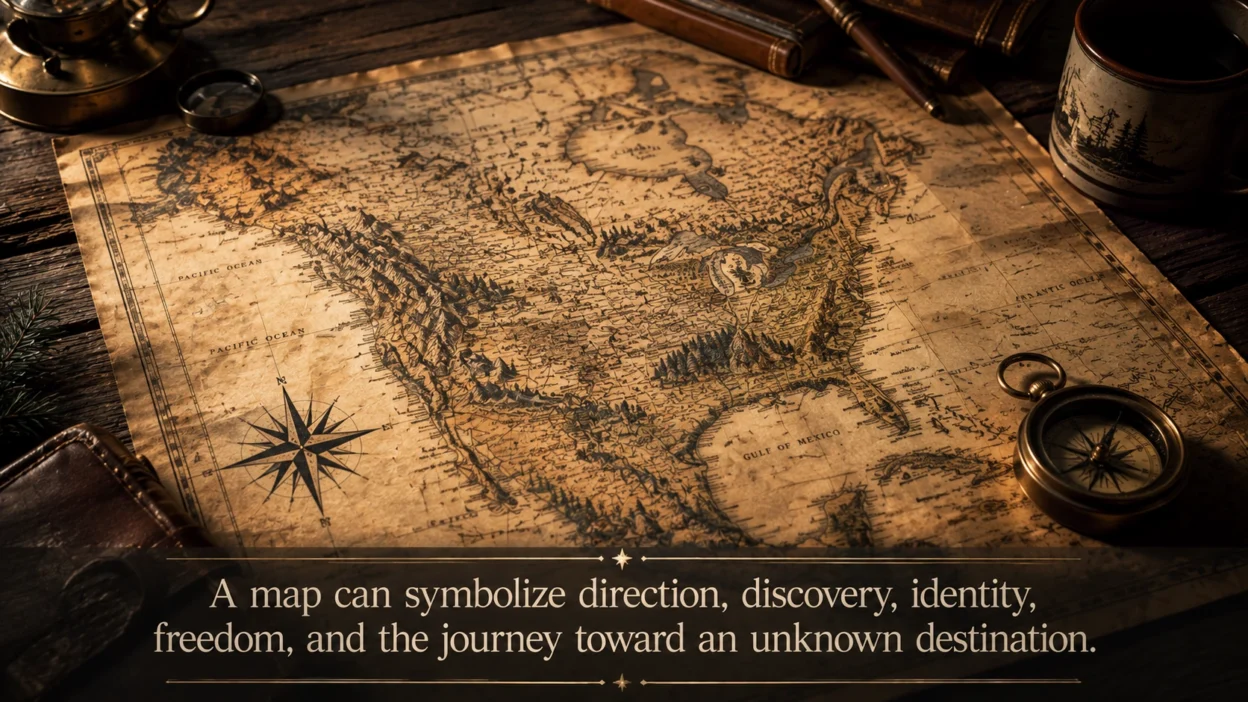
Map Symbolism appears whenever a map means more than a way to find a place. A map can represent direction, discovery, identity, memory, freedom, or the journey through life.
In the United States, maps have a special place in the national imagination. They connect ideas of exploration, migration, expansion, home, borders, and the open road. A simple map can therefore carry both personal and cultural meaning.
Maps also appear in art, tattoos, books, movies, classrooms, offices, and home decor. Even a digital map on a phone can suggest independence and the ability to choose your own path.
What Does Map Symbolism Mean?
Quick Answer
Map Symbolism often represents direction, exploration, identity, and the search for a meaningful path. In the USA, maps also connect with travel, independence, geography, migration, and the idea of discovering new possibilities.
Across cultures, maps can symbolize a desire to understand the world. They can also represent the human need to turn an uncertain journey into something we can understand.
TL;DR
- Maps symbolize direction, exploration, knowledge, and personal journeys.
- American culture often connects maps with travel and independence.
- Ancient maps combined geography with religion, myth, and worldview.
- A map can represent home, identity, memory, or belonging.
- Modern map tattoos often mark journeys, places, or important memories.
- Maps can also symbolize borders, power, conflict, and changing identities.
What Does a Map Symbolize?
Direction and Guidance
At its simplest, a map tells you where you are and where you can go. Because of this, it naturally symbolizes guidance.
A person holding a map may appear prepared rather than lost. The image suggests that uncertainty becomes easier when you have direction.
Maps can therefore represent:
- Guidance during uncertain periods
- A clear path toward a goal
- Knowledge that reduces confusion
- Confidence about future choices
- Preparation before taking action
Exploration and Discovery
A map also points toward places that remain unknown. Blank spaces once represented mysteries waiting to be explored.
Today, that idea remains powerful. A map may symbolize curiosity and the desire to experience something beyond familiar surroundings.
For many Americans, this connects with road trips, hiking, camping, national parks, and long-distance travel.
The History of Maps and Their Symbolism
Ancient Maps
People created maps long before modern geography. Ancient societies used drawings to describe land, rivers, cities, trade routes, and important locations.
Some early maps were practical. Others reflected religious beliefs or ideas about the structure of the universe.
The Babylonian World Map, generally dated to the sixth century BCE, is one famous example. It presents the known world through the geographical understanding of its creators.
Ancient Greek thinkers later developed more mathematical approaches to geography. Claudius Ptolemy, writing in the second century CE, described methods for representing the Earth’s surface with coordinates.
Medieval and Early Modern Maps
During the medieval period, European maps often mixed geographic information with religious ideas. Some maps placed Jerusalem at the center because of its spiritual importance.
Later, improvements in navigation changed mapmaking. European exploration increased demand for more detailed coastlines, routes, and territories.
Maps gradually became tools of science, trade, military planning, government, and empire.
Maps Become Instruments of Power
A map doesn’t only describe the world. It can also influence how people understand it.
Drawing a boundary can define who belongs inside or outside a territory. Naming a place can reflect political authority or cultural influence.
This history gives maps a second symbolic meaning: power over space.
That meaning remains important when Americans think about state lines, national borders, property boundaries, and political maps.
Map Symbolism in American Culture
The American Road
Few American images are more connected to maps than the open road.
Road maps became especially important during the growth of automobile travel in the twentieth century. They helped families plan vacations, businesses organize transportation, and travelers move between unfamiliar towns.
Because of this history, maps can symbolize freedom and movement.
The familiar image of unfolding a road map before a long trip still carries emotional weight. It suggests possibility, adventure, and the excitement of leaving home.
Home and Belonging
A map doesn’t always represent somewhere far away. It can also represent home.
A map of your hometown may remind you of childhood, family, friendships, or important life experiences. Likewise, a state map can express regional pride.
For Americans, map imagery can therefore communicate:
- Connection to a hometown or state
- Pride in a particular landscape
- Memories of childhood and family
- A sense of belonging
- Attachment to a meaningful place
National Identity
Maps also appear in American classrooms, government buildings, museums, news coverage, and educational materials.
The outline of the United States can become a recognizable national symbol. However, its meaning isn’t always simple.
A national map can represent unity and shared identity. It can also bring attention to borders, territorial change, Indigenous lands, migration, and political disagreements.
What Do Different Map Features Symbolize?
Maps contain many visual elements, and each can add another layer of meaning.
| Map Feature | Meaning in the USA | Common Associations | Symbolic Idea |
| Compass rose | Direction and confidence | Navigation, travel | Finding your way |
| Roads | Movement and opportunity | Road trips, adventure | Progress and freedom |
| Borders | Identity and belonging | States, countries | Boundaries and community |
| Mountains | Challenge and achievement | Hiking, wilderness | Strength and endurance |
| Oceans | Distance and possibility | Travel, exploration | Freedom and the unknown |
| Coordinates | Precision and location | GPS, navigation | Knowing where you stand |
The meaning depends heavily on context. A map covered with roads may emphasize travel, while a map showing borders may focus on identity or politics.
The Spiritual Meaning of Maps
A Map as a Life Journey
A map can work as a metaphor for life.
You may know where you started without knowing exactly where you’ll finish. The route can change because of unexpected obstacles, opportunities, or decisions.
In this sense, the map represents the process of finding your way.
It can symbolize:
- A search for purpose
- Personal growth and direction
- A spiritual journey
- Trust during uncertainty
- Movement toward a meaningful destination
Maps and the Search for Meaning
Many spiritual traditions use journeys as metaphors for human development. The traveler leaves one state and moves toward another.
A map fits this pattern naturally. It turns a complicated journey into a visual story.
However, a map doesn’t necessarily promise a fixed destination. For some people, its deeper message is simply that every journey has meaning, even when the final route changes.
Map Symbolism Across Cultures
Maps as Worldviews
Maps reflect the knowledge and assumptions of the people who create them.
Different societies have placed important places at the center of their maps. They have also used different artistic styles, directions, symbols, and systems of measurement.
Therefore, maps can symbolize more than geography. They can reveal how a society understands its place in the world.
East and West
Mapmaking traditions developed differently across Asia, Europe, the Middle East, Africa, and the Americas. Some emphasized administration and travel, while others combined geography with cosmology or religious thought.
Modern digital maps have made these differences less visible. Still, older maps remain valuable cultural records.
They show that there has never been only one way to imagine the world.
The Psychological Meaning of Maps
Maps and Control
People often feel uncomfortable when they don’t know what comes next. A map can reduce that uncertainty.
Psychologically, this makes maps powerful symbols of order. They suggest that a confusing environment can be understood.
That’s why map imagery may appeal to people who value planning, preparation, and independence.
Maps and Personal Identity
A map can also express who you are.
Someone might choose a tattoo showing their birthplace. Another person might display a map of a favorite city or travel destination.
The object becomes personal because the location carries memories.
In this way, a map can symbolize:
- Where you came from
- Where you’ve been
- Where you want to go
- What places shaped you
- What experiences you don’t want to forget
Map Tattoos and Their Modern Meaning
Map tattoos are popular because they can combine geography with personal storytelling.
A tattoo might show an entire country, a state outline, a coastline, or a tiny location marker. The design can remain simple while carrying a private meaning.
Common Map Tattoo Ideas
A map tattoo may symbolize:
- A birthplace or hometown
- A major journey
- A favorite travel destination
- Family roots
- A new beginning
- Independence and adventure
- A connection to nature
Adding a compass, coordinates, mountains, roads, or a date can make the design even more personal.
For example, a map with a compass may emphasize direction. A map with coordinates may focus on one unforgettable place.
Maps in Art, Decor, and Social Media
Home Decor
Vintage maps are common in offices, libraries, bedrooms, and living rooms. Their appeal often comes from both beauty and meaning.
An old map can create a sense of history. A modern city map can feel clean and personal.
For travelers, map decor may serve as a visual record of places visited or dreams for future trips.
Social Media and Digital Life
Modern phones have changed how people interact with maps. Instead of unfolding paper, people now follow moving digital directions.
Location pins, route lines, and navigation screens have become familiar visual symbols.
A simple location pin can mean “I’m here.” A route can mean “I’m going somewhere.”
Together, these images have made location part of everyday digital communication.
Maps, Borders, and Controversies
Maps Are Not Always Neutral
A map can look objective while still reflecting choices.
Someone decides which borders to show, which names to use, what scale to choose, and what information to emphasize. Those decisions can influence how viewers understand a place.
This matters especially when maps involve disputed territories or historical borders.
Indigenous Lands and Historical Change
American maps have also changed as the country developed.
Older maps may leave out Indigenous nations or present territorial expansion from only one viewpoint. Modern historical work often gives more attention to Native nations, changing boundaries, treaties, and the long history of the continent.
That doesn’t make every older map useless. Instead, it reminds us to read maps as historical documents created in particular circumstances.
Political Maps
Political maps can also become emotionally charged.
State boundaries, electoral maps, migration patterns, and changing populations may appear in political discussions. In these settings, a map can symbolize disagreement as easily as unity.
The same image can therefore carry very different meanings for different viewers.
How Map Meaning Has Changed Over Time
From Paper to Digital
For centuries, maps were physical objects. People folded them, marked them, stored them, and passed them between travelers.
Today, most people use digital maps. GPS can show your position instantly and recalculate a route within seconds.
Yet the symbolism remains surprisingly similar.
The technology changed, but the basic human need didn’t. People still want to know where they are and where they can go.
From Unknown Worlds to Personal Worlds
Older maps often focused on documenting unfamiliar territories. Modern map symbolism frequently turns inward.
People use maps to remember where they were born, where they traveled, where they met someone, or where they experienced a major life event.
The map has become both geographic and emotional.
What Map Symbolism Says About Freedom and Adventure
The Road Ahead
In American culture, travel often carries a strong connection with independence.
A person leaving town with a map may symbolize a willingness to make their own choices. The road becomes a visual metaphor for possibility.
This doesn’t mean every map represents rebellion or escape. More often, it represents the freedom to choose a direction.
Adventure and the Unknown
Maps can also suggest that something lies beyond the familiar.
That idea appears in travel photography, outdoor culture, novels, films, and personal stories. A map can invite you to imagine what exists beyond the edge of your current experience.
Its message can be simple: there’s more to discover.
Common Misunderstandings About Map Symbolism
A Map Doesn’t Always Mean Travel
One common mistake is assuming every map symbolizes adventure.
A map of a hometown may represent family. A political map may represent conflict. A historical map may represent memory.
Context determines meaning.
A Map Doesn’t Guarantee Direction
Maps provide information, but they don’t make decisions for you.
Symbolically, this creates an interesting distinction. A map can represent guidance without representing certainty.
You may have a route and still need to choose whether to follow it.
Read More: Compass Symbolism: Meaning, History, and American Culture
Old Maps Aren’t Automatically More Meaningful
Vintage maps can feel mysterious and romantic. However, their age doesn’t automatically make them spiritually or historically significant.
Some old maps were highly practical. Others reflected limited knowledge or political assumptions.
Their value comes from context, design, history, and personal meaning.
FAQs
What does a map symbolize spiritually?
A map can symbolize a spiritual journey, direction, purpose, and personal growth. It may represent the search for a meaningful path through uncertainty.
What does a map symbolize in America?
In America, maps often symbolize travel, independence, exploration, home, and geographic identity. They can also represent borders and national belonging.
What does a map tattoo mean?
A map tattoo commonly represents a meaningful place, travel experience, birthplace, family roots, or personal journey. Its exact meaning depends on the location and design.
What does a compass and map symbolize together?
A compass and map together often symbolize direction and purposeful movement. The map shows possibilities, while the compass suggests choosing a direction.
Why are maps associated with adventure?
Maps reveal routes toward places that may be unfamiliar. As a result, they naturally suggest exploration, curiosity, freedom, and discovery.
Can maps symbolize identity?
Yes. A map can represent where someone comes from, where they belong, or which places shaped their life. This makes maps especially powerful personal symbols.
Conclusion
Map Symbolism reaches far beyond navigation. A map can represent direction, exploration, identity, memory, freedom, and the search for a meaningful path. Perhaps that’s why maps remain powerful even when most of us carry one on a phone. They don’t simply show where we are. They invite us to consider where we’ve been, where we belong, and where we might go next.