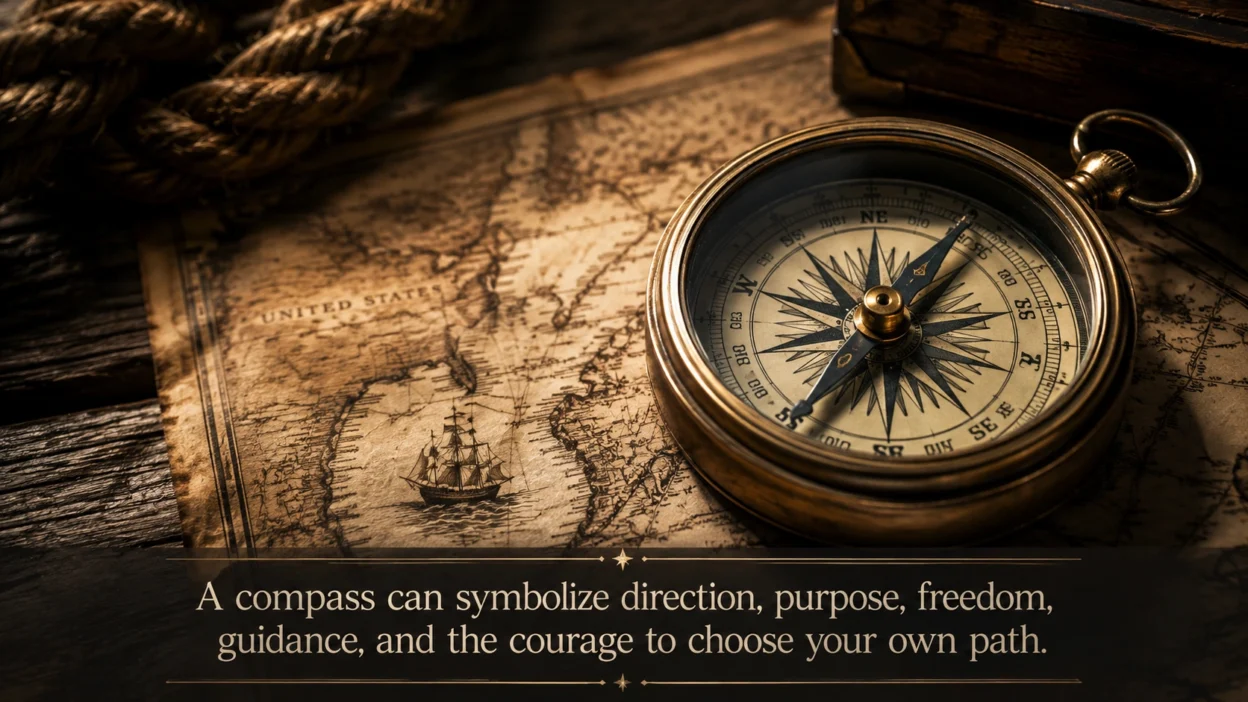
A compass has always been more than a tool for finding direction. Compass Symbolism connects the simple needle and four cardinal points with ideas of purpose, freedom, guidance, and finding your way through uncertainty.
In the United States, the compass carries strong ties to exploration and independence. It can remind people of pioneers, sailors, travelers, soldiers, and anyone facing an unfamiliar path.
Today, you might see a compass on a tattoo, necklace, classroom wall, business logo, or social media post. Its meaning often depends on the person using it. For one person, it may represent adventure. For another, it may represent home, faith, personal values, or a commitment to never lose direction.
Quick Answer
Compass Symbolism usually represents direction, guidance, purpose, independence, and the journey through life. In American culture, it often connects with exploration, freedom, self-reliance, and finding your own path.
TL;DR
- A compass traditionally represents direction and reliable guidance.
- In America, it often reflects exploration, independence, and freedom.
- Its four directions can suggest balance, choices, and life paths.
- Spiritual interpretations often connect it with inner guidance.
- Compass tattoos commonly represent journeys, identity, or personal purpose.
- Modern meanings depend heavily on personal experience and context.
What Does a Compass Symbolize?
A compass looks simple, but its symbolic power comes from what it does. It helps people move forward when familiar landmarks disappear.
That practical function makes the compass a natural symbol for life decisions. You may not know exactly where the road leads, yet you can still choose a direction.
Direction and Guidance
The most direct meaning is guidance.
A compass tells you where you are going without physically carrying you there. Symbolically, that makes it a powerful image for wisdom, values, and personal judgment.
It can represent:
- Knowing your direction during uncertain times
- Staying focused when circumstances become confusing
- Following personal values instead of outside pressure
- Finding your way back after losing your path
Purpose and Choice
A compass doesn’t decide your destination. It simply helps you understand direction.
That distinction gives the symbol another important meaning: personal choice. You still have to decide where you want to go.
The Four Directions and Their Meaning
The four cardinal directions—north, south, east, and west—give the compass much of its symbolic structure.
Because these directions form a complete system, they can suggest balance and wholeness. They also create a visual reminder that life offers many possible paths.
North as a Symbol
North often carries the strongest association with guidance.
Because many traditional compasses point toward magnetic north, north can symbolize a fixed reference point. It may represent stability, truth, or a personal standard.
East, South, and West
The other directions can take on different meanings depending on cultural and personal context.
East is often connected with beginnings because the sun rises there. West may suggest endings because the sun sets there. South can evoke warmth, distance, or movement toward another region.
These meanings aren’t universal rules. Instead, they show how people naturally connect physical direction with life experience.
Ancient Roots of Directional Symbolism
The modern compass developed much later than humanity’s fascination with direction.
Long before magnetic compasses existed, people watched the sun, stars, winds, rivers, and landscape. These natural guides helped communities travel and understand their surroundings.
Early Navigation
Ancient travelers used celestial bodies to maintain direction.
The North Star became especially useful in the Northern Hemisphere because its position appears relatively fixed in the night sky. Sailors could use it as a guide across unfamiliar waters.
Directional symbolism therefore existed before the compass itself.
The Chinese Magnetic Compass
Magnetism played a major role in the development of the physical compass.
Ancient Chinese societies used magnetized materials for directional purposes centuries before the compass became common in Europe. Over time, the technology developed into a practical navigation instrument.
Its spread changed travel dramatically.
From Navigation to Symbol
As compass technology became more useful, the object gained cultural meaning.
A tool that helped people cross oceans naturally became connected with exploration, discovery, courage, and uncertainty.
Those associations remain strong today.
Compass Symbolism in American History
Few cultures connect more strongly with the idea of exploring unknown territory than the United States.
American history contains many stories of migration, settlement, westward movement, sea travel, and exploration. As a result, directional tools easily became connected with independence and adventure.
Exploration and Expansion
For sailors and travelers, navigation could mean survival.
A compass helped people travel through places where familiar landmarks were unavailable. In American imagination, that practical role became part of a larger story about entering unknown territory.
The compass can therefore symbolize the willingness to move forward despite uncertainty.
The American Idea of Independence
The compass also fits a familiar American ideal: choosing your own path.
That doesn’t mean every use has a political meaning. Instead, the image often expresses personal independence.
For modern Americans, it may suggest:
- Freedom to choose a personal direction
- Confidence while entering unfamiliar territory
- Independence from outside expectations
- Courage to pursue a different path
What Does a Compass Mean in American Culture?
In the United States, a compass often represents a mixture of adventure and personal direction.
Its meaning can shift depending on where you see it. A compass in a military setting differs from one in a travel photograph or tattoo.
Everyday American Associations
Outdoor culture has helped keep the compass meaningful.
Hiking, camping, hunting, sailing, scouting, and wilderness travel all involve navigation. Even when modern technology handles the actual navigation, the compass remains a familiar symbol of preparedness.
A Symbol of the American Journey
The compass also works as a metaphor for the American journey.
People often talk about finding their direction, following their path, or staying true to themselves. These phrases make the compass feel almost natural as a personal symbol.
| Context | Meaning in the USA | Common Associations | Notes |
| Travel | Finding direction | Adventure, exploration | Often linked with unfamiliar places |
| Tattoos | Personal path | Identity, freedom, purpose | Meaning is usually deeply personal |
| Military | Navigation and readiness | Discipline, service | Context determines the exact meaning |
| Outdoor life | Preparedness | Hiking, camping, survival | Connects the object with practical skill |
| Personal growth | Inner direction | Goals, values, confidence | Often used as a life metaphor |
Spiritual Meaning of a Compass
A compass can also carry spiritual meaning without belonging to one specific religion.
Its central idea is guidance. For some people, that guidance represents faith, conscience, wisdom, or an inner sense of right and wrong.
Inner Guidance
The compass can represent an internal guide.
In this interpretation, the needle becomes a metaphor for conscience or personal values. Life may become confusing, but a person can still return to what matters most.
A Symbol of Faith and Trust
Some people use directional imagery to express trust in a higher power.
The compass itself doesn’t prove or prescribe any religious belief. Instead, it can visually express the idea of seeking guidance beyond immediate circumstances.
Broader Cultural Connections
Directional symbolism appears in many traditions.
Different cultures have attached meanings to the four directions, sacred landscapes, celestial navigation, and the movement of the sun. However, these traditions aren’t identical, so their meanings shouldn’t be treated as one universal system.
Psychological Meaning of the Compass
The compass has a strong psychological appeal because people naturally want a sense of direction.
Uncertainty can feel uncomfortable. A compass offers a simple visual answer to that feeling: choose a direction and keep moving.
Stability During Uncertainty
A compass doesn’t remove obstacles.
Instead, it provides a reference point. Psychologically, that can represent confidence during periods of change.
People may connect with compass imagery when starting a new career, moving somewhere new, ending a relationship, or rebuilding their identity.
Identity and Personal Values
The symbol can also suggest a strong personal center.
Someone who chooses a compass may want to communicate that their values guide their decisions. The message can be simple: “I know what matters to me.”
That makes the compass especially useful as a symbol of personal growth.
Compass Tattoos and Their Meaning
Compass tattoos are popular because the image is recognizable and easy to personalize.
The design can remain small and simple or become part of a larger scene involving mountains, waves, maps, stars, or ships.
Common Compass Tattoo Meanings
A compass tattoo can represent many different experiences.
Common interpretations include:
- Remembering where you came from
- Starting a new chapter in life
- Staying loyal to personal values
- Celebrating travel and exploration
- Finding direction after a difficult period
- Honoring someone who provided guidance
Combining Symbols
A compass can change meaning when combined with another image.
A compass and mountain may emphasize adventure. A compass and ocean can highlight travel. A compass and coordinates may connect the design to a specific place or memory.
Therefore, the surrounding imagery often matters as much as the compass itself.
Compass Symbolism in Fashion, Decor, and Social Media
Today, compass imagery appears far beyond navigation.
You can find it in jewelry, wall art, clothing, stationery, travel photography, and decorative objects. Its clean shape makes it especially adaptable.
Home Decor
In American homes, a compass design may create a nautical, rustic, or adventurous atmosphere.
It can also work as a reminder of travel or family history. A vintage compass displayed on a shelf may suggest stories of journeys and discovery.
Social Media
Online, compass imagery can support messages about travel, personal growth, and independence.
A compass photograph may accompany a post about starting over. A tattoo image may represent a personal milestone. A travel post may use it to suggest adventure.
The meaning usually comes from the caption and surrounding story.
Compass Symbolism in Military and Nautical Culture
The compass has practical importance in military and maritime settings.
Before modern digital navigation became widespread, knowing how to use a compass could be essential. Even now, traditional navigation skills remain useful in situations where electronic devices may fail.
Navigation and Discipline
In these settings, the compass is less abstract.
It represents accuracy, preparedness, training, and the ability to operate without constant technological support.
That practical meaning can strengthen its symbolic connection with competence and self-reliance.
The Nautical Compass
A ship’s compass naturally evokes the sea.
Because sailors travel through environments with few fixed landmarks, navigation becomes central to survival. The compass therefore carries strong associations with voyages, distant places, risk, and homecoming.
Compass Symbolism in Literature and Popular Culture
Writers and filmmakers often use navigation as a metaphor for life.
A character may lose a literal path while also experiencing an emotional crisis. Finding direction can then become part of the character’s larger journey.
The Journey Metaphor
The compass works well because life itself often feels like a journey.
People encounter crossroads, unexpected turns, setbacks, and new destinations. A compass provides a visual shorthand for making choices within that journey.
Adventure and Discovery
Adventure stories frequently use maps and navigational objects.
A compass can immediately suggest hidden places, exploration, danger, or discovery. Its appearance can create a sense that something lies beyond the familiar.
Misunderstandings and Controversies Around Compass Symbols
Compass imagery is generally viewed as a positive symbol.
Still, no symbol has one fixed meaning. Context, design, and surrounding imagery can change how people interpret it.
Not Every Compass Has a Spiritual Meaning
A compass may simply represent travel.
Someone wearing a compass necklace doesn’t necessarily follow a particular spiritual tradition. Likewise, a compass tattoo may commemorate a trip rather than express a philosophy.
Directional Symbols Can Have Cultural Context
The four directions have special meanings in various cultures and traditions.
However, those meanings differ. It can be misleading to combine several traditions and present them as one universal belief system.
Context Matters
A symbol should be understood alongside its setting.
A historical navigation instrument, a military emblem, a spiritual artwork, and a fashion design may all contain compass imagery while communicating very different ideas.
How Compass Meaning Has Changed Over Time
The compass began as a practical answer to a practical problem.
People needed to know where they were going. Over centuries, however, the object accumulated emotional and cultural meanings.
From Tool to Metaphor
Early users valued the compass because it worked.
Later generations increasingly used direction as a metaphor for life. “Finding your way” could describe both physical travel and personal development.
From Exploration to Self-Discovery
Older associations often emphasized navigation and exploration.
Modern interpretations frequently emphasize identity and self-discovery. Today, someone may choose a compass because they’re searching for purpose rather than planning a voyage.
That shift shows how symbols evolve with society.
Why the Compass Still Matters Today
The compass remains powerful because its message is easy to understand.
Everyone faces moments when the next step isn’t obvious. The compass offers a calm image of direction without promising an easy journey.
A Simple Message
Its appeal comes partly from its simplicity.
The compass doesn’t promise that you won’t get lost. Instead, it suggests that you can regain your direction.
That idea feels relevant in a world filled with constant choices and changing expectations.
Read More: Ship Symbolism: Meaning, History, and American Culture
A Personal Reminder
For many people, the compass becomes a reminder rather than decoration.
It can represent a promise to stay connected with personal values, remember home, explore confidently, or keep moving forward.
FAQs
What Does a Compass Symbolize Spiritually?
A compass can symbolize inner guidance, faith, purpose, and a search for direction. Its spiritual meaning depends on the person’s beliefs and the context of the design.
What Does a Compass Tattoo Mean?
A compass tattoo often represents guidance, travel, independence, or finding one’s path. Some people also use it to remember a journey, person, place, or major life change.
What Does a Compass Mean in Love?
In romantic symbolism, a compass can represent finding your way back to someone or having a partner who provides emotional direction. It may also symbolize loyalty and staying connected through change.
What Does a Compass Symbolize in the Military?
A compass can represent navigation, preparedness, discipline, and confidence in difficult environments. Its meaning is usually practical first, with symbolic interpretations depending on context.
What Does a Compass Symbolize in American Culture?
In American culture, the compass often represents exploration, independence, freedom, adventure, and choosing your own path. These meanings connect naturally with America’s long history of travel and exploration.
What Does a Compass and Anchor Symbolize Together?
A compass and anchor can represent direction combined with stability. The compass suggests movement and purpose, while the anchor suggests grounding, loyalty, and staying connected to what matters.
Conclusion
A compass has traveled far beyond its original role as a navigation tool. It can represent guidance, freedom, exploration, purpose, stability, and the courage to keep moving when the destination isn’t clear. In American culture, Compass Symbolism is especially connected with adventure and independence. Yet its most meaningful interpretation may be personal. One person sees a journey, another sees home, and another sees the values that keep them on course.