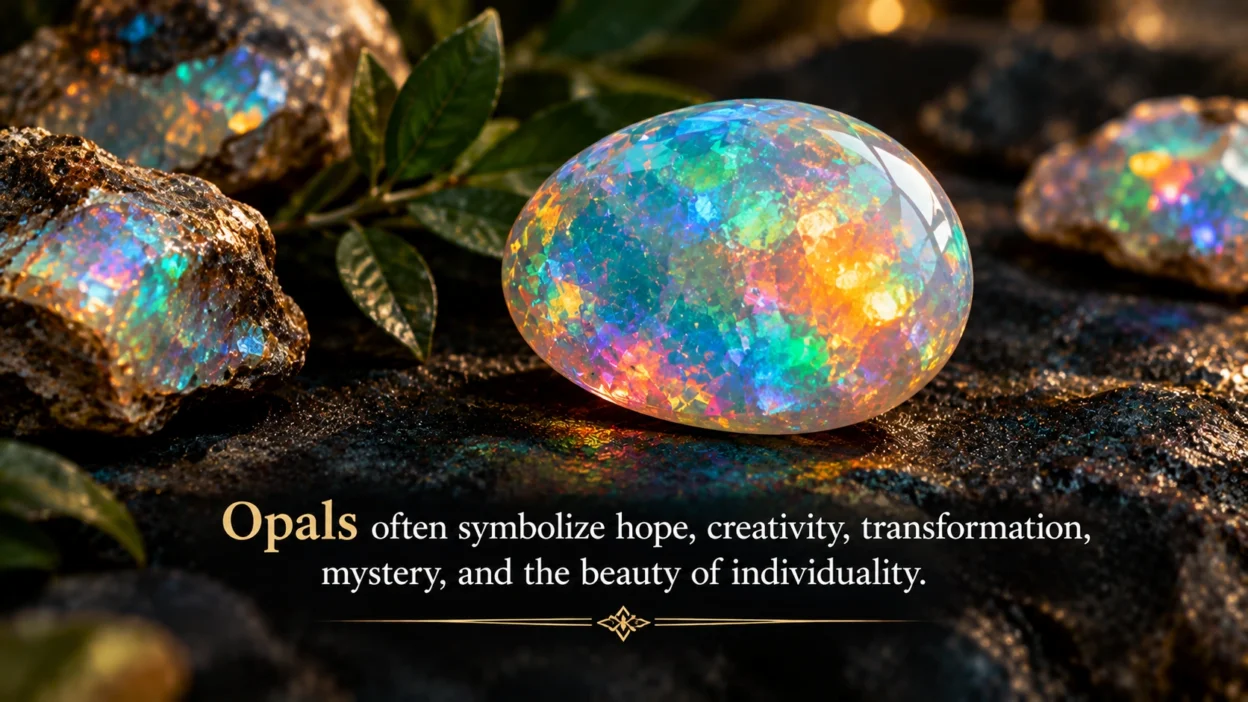
Opals are among the world’s most visually unusual gemstones. Their surfaces can flash with many colors, making Opal Symbolism closely connected with mystery, imagination, change, and individuality.
Unlike a gemstone with one steady color, an opal can appear different as it moves. Blue, green, red, orange, pink, and gold may suddenly shine across its surface. Because of this changing appearance, people have often connected opals with transformation and hidden possibilities.
In the United States today, opals are popular in jewelry, birthstone traditions, fashion, and personal symbolism. Their meaning can feel especially personal because no two natural opals look exactly alike.
Quick Answer
In the USA, Opal Symbolism often represents creativity, hope, individuality, and transformation. More broadly, its shifting colors have connected it with mystery, imagination, emotional depth, and changing life journeys.
TL;DR
• Opals often symbolize creativity, hope, mystery, and transformation.
• Their changing colors represent individuality and life’s unexpected changes.
• Ancient cultures connected opals with beauty and extraordinary powers.
• Americans often value opals as personal and meaningful gemstones.
• Modern opals appear in jewelry, fashion, gifts, and self-expression.
• Old superstitions about bad luck are now widely questioned.
What Does an Opal Symbolize?
An opal’s symbolism often begins with its appearance. Its changing flashes of color make it different from most gemstones, which is why people have given it many meanings.
For American readers, the opal often represents something personal and unique. Its beauty can suggest that identity and value don’t need to remain fixed.
Creativity and Imagination
The many colors inside an opal often connect it with creative thinking. Artists and imaginative people may see the stone as a symbol of inspiration.
Because the colors can appear unexpectedly, the opal may also represent new ideas. Something beautiful can emerge when you look from a different angle.
Hope and Possibility
Opals can symbolize hope because their bright colors seem to appear from within darkness. This creates a strong image of possibility and discovery.
Today, people may wear opals during important life changes. The stone can serve as a reminder that difficult periods don’t always remain unchanged.
Individuality
Every natural opal has its own pattern. Therefore, the gemstone has become an easy symbol of uniqueness.
• Personal identity and self-expression
• Creativity without strict rules
• Finding beauty in differences
• Accepting change and unpredictability
• Discovering hidden strengths
The Colors and Appearance Behind Opal Meaning
Understanding how an opal looks helps explain its symbolism. Its famous flashes of color create much of its emotional and cultural appeal.
Opals can range from pale white to deep black. Some show many bright colors, while others have softer and more subtle patterns.
The Meaning of Changing Colors
The shifting colors are often called a play of color. As the stone moves, light can reveal different flashes.
Symbolically, this changing appearance can represent transformation. It may suggest that life looks different as circumstances change.
White, Black, and Fire Opals
Different types of opals can create different emotional impressions. However, these associations are usually modern interpretations rather than fixed universal rules.
• White opals often suggest softness, hope, and innocence.
• Black opals can suggest mystery, depth, and hidden power.
• Fire opals often suggest passion, energy, and confidence.
• Blue flashes may suggest calmness and imagination.
• Green flashes can suggest renewal and growth.
Opal Symbolism in Ancient History
Opals have fascinated people for centuries. Their unusual appearance encouraged stories, legends, and symbolic interpretations long before modern gem science.
Ancient people didn’t always understand why opals changed color. As a result, their appearance could seem magical or extraordinary.
Ancient Roman Views
The Romans valued opals highly and connected them with beauty and good fortune. Their mixture of colors made them especially impressive.
Some ancient writers described opals as combining the beauty associated with several other precious stones. Therefore, the gem could represent abundance and many desirable qualities at once.
Ancient Greek Associations
Greek traditions included stories linking unusual stones with supernatural abilities. Opals later became associated with imagination and special forms of perception.
However, historical claims about magical powers should be understood as cultural beliefs. They don’t represent scientific facts about the gemstone.
A Gemstone That Inspired Wonder
Ancient symbolism often developed from mystery. Since opals looked unlike ordinary stones, people naturally created stories to explain them.
• Wonder about nature’s hidden processes
• Beauty created through changing light
• Mystery beyond ordinary understanding
• Imagination inspired by unusual appearances
Opal Meaning During the Middle Ages
During medieval Europe, opals continued to attract attention because of their many colors. Some people considered them especially fortunate and beautiful.
Their reputation, however, changed over time. This shows how strongly cultural stories can influence the meaning of an object.
A Symbol of Beauty and Fortune
For part of European history, opals were associated with good luck and desirable qualities. Their variety of colors made them seem unusually complete.
People could see several gemstone-like colors within one stone. Therefore, the opal gained a reputation for richness and possibility.
How Negative Superstitions Developed
The idea that opals bring bad luck became popular much later and wasn’t an ancient universal belief. Literature, fashion changes, and commercial circumstances helped spread negative stories.
This history is important because many people still hear the old superstition today. However, there is no scientific reason to believe an opal causes bad luck.
Opal Symbolism in the United States
In American culture, opals are usually associated with jewelry, individuality, creativity, and special occasions. Their meaning is often personal rather than tied to one national tradition.
The United States has also embraced gemstones as tools of self-expression. Therefore, an opal can communicate personality without needing words.
Opals as Personal Jewelry
Americans often choose gemstones because of color preferences, birthdays, anniversaries, or emotional meaning. Opals fit especially well with this personal approach.
An opal ring or necklace may represent a memory. It might also mark a new chapter or celebrate someone’s individuality.
The October Birthstone Connection
Opal is traditionally associated with October in modern birthstone traditions. This gives it an additional role in American gift culture.
People born in October may wear opals as a personal symbol. Others simply choose the gemstone because they enjoy its appearance.
Opals in Everyday American Culture
| Context | Meaning in the USA | Common Associations | Notes |
| Birthstone jewelry | Personal identity | October birthdays | Often given as meaningful gifts |
| Engagement jewelry | Individuality | Unconventional love | Chosen for distinctive appearance |
| Fashion | Creativity | Color and self-expression | Popular for unique visual effects |
| Personal gifts | Hope | New beginnings | Meaning depends on the relationship |
| Home displays | Beauty | Wonder and nature | Appreciated as decorative objects |
Spiritual Meaning of Opals
Many modern spiritual interpretations connect opals with emotions, intuition, and personal transformation. These meanings can vary greatly between individuals and traditions.
It’s helpful to separate spiritual symbolism from scientific claims. A gemstone can hold personal meaning without having proven supernatural powers.
Intuition and Inner Reflection
Because an opal seems to reveal hidden colors, some people connect it with discovering hidden thoughts or feelings. It can symbolize looking beneath the surface.
This interpretation may appeal during periods of self-reflection. The changing colors become a metaphor for complex emotions.
Transformation and Personal Growth
Opals can also symbolize change. Their appearance seems different depending on movement and light.
Therefore, some people see them as reminders that growth isn’t always predictable. A changing life can still contain beauty and meaning.
• Listening more closely to personal feelings
• Accepting unexpected changes
• Exploring creativity and imagination
• Recognizing emotional complexity
• Beginning a new personal chapter
Opal Meanings in Different Cultures
Opals have appeared in stories and traditions across different regions. However, their meanings aren’t identical everywhere.
It is important not to treat all cultural interpretations as one shared belief. Symbolism depends on history, religion, community, and personal experience.
Australian Cultural Importance
Australia is especially important in the modern history of opals because of its major opal-producing regions. The gemstone has become strongly connected with the country’s natural landscape and mining heritage.
For many people, Australian opals represent remarkable natural beauty. Their colors can also symbolize the extraordinary diversity found in nature.
European Traditions
European meanings have shifted dramatically over time. Opals were admired as beautiful and fortunate in some periods but later became linked with superstition.
Today, many of those negative associations have weakened. Modern jewelry culture often focuses more on beauty and individuality.
Personal Meaning Matters Most
Modern symbolism is increasingly individual. Two people can own similar opals while giving them completely different meanings.
One person may see creativity. Another may see hope, memory, love, or personal transformation.
The Emotional and Psychological Meaning of Opals
Gemstones can affect people emotionally because humans naturally respond to color, light, and beauty. Opals are especially striking because their appearance changes.
Psychologically, the stone can become a useful symbol for complex experiences. Its colors may remind people that identity contains many layers.
A Symbol of Complexity
An opal doesn’t show everything at once. Different colors become visible under different conditions.
This can make it a powerful metaphor for personality. People also reveal different qualities in different situations.
Wonder and Curiosity
The unexpected flashes of color can create surprise. Because of this, opals may encourage curiosity and appreciation for small details.
Their appearance reminds viewers to look carefully. Sometimes something ordinary-looking contains unexpected beauty.
Emotional Associations
• Wonder and curiosity about the unknown
• Confidence in personal uniqueness
• Hope during periods of transition
• Appreciation for emotional complexity
• Inspiration for creative expression
Opal Symbolism in Jewelry and Fashion
Opals are widely used in rings, necklaces, earrings, and other accessories. Their unusual appearance makes them popular with people who want something different.
In modern American fashion, an opal often communicates individuality. The stone doesn’t need a fixed message to feel meaningful.
Opal Rings
An opal ring can symbolize love, creativity, or personal identity. Its meaning usually depends on why someone chose it.
Some people prefer opals because they don’t look like traditional diamonds. Therefore, the stone can represent an unconventional personal style.
Opals as Gifts
Giving an opal can carry emotional meaning. It may celebrate a birthday, anniversary, friendship, or important transition.
The gemstone’s changing colors also make it memorable. A gift can become a lasting reminder of a particular moment.
Opal Symbolism in Tattoos
Opal-inspired tattoos are increasingly connected with individuality and creativity. Artists can recreate the gemstone’s colorful appearance through abstract designs.
A tattoo may use an opal as the main image or combine it with other symbols. For example, flowers, moons, butterflies, and crystals can add additional personal meaning.
Why People Choose Opal Tattoos
The design can represent something that constantly changes. It may also symbolize beauty that cannot be reduced to one simple identity.
Because every tattoo has a personal story, there is no single universal meaning. The symbolism belongs largely to the wearer.
Common Tattoo Associations
• Transformation after a difficult experience
• Pride in being different
• Creative identity and imagination
• Hidden beauty beneath ordinary appearances
• Personal memories and meaningful relationships
Opals in Modern Decor and Design
Opal colors have influenced jewelry design, interiors, digital art, and decorative objects. Their soft rainbow effect can create a dreamy or imaginative atmosphere.
Today, the word “opal” may describe an aesthetic as well as a gemstone. This shows how symbolism can move beyond the original object.
An Opalescent Aesthetic
Opalescent surfaces often suggest softness and changing light. They can appear futuristic while also feeling connected to nature.
This combination makes the style flexible. It can work in elegant, playful, or imaginative spaces.
Modern Visual Associations
People may connect opalescent designs with:
• Dreamlike and imaginative environments
• Soft, changing rainbow colors
• Modern individuality and creativity
• Natural beauty with a futuristic feeling
Does Opal Bring Bad Luck?
The belief that opals bring bad luck remains one of the gemstone’s best-known misunderstandings. However, this idea developed through particular historical circumstances rather than universal tradition.
For many earlier periods, opals were admired and considered desirable. Therefore, calling them universally unlucky oversimplifies their history.
Why the Superstition Survived
Stories can spread quickly when they are dramatic. Once a negative reputation became popular, it continued through books, conversations, and popular culture.
Today, many jewelers and gemstone lovers reject the superstition. Most people choose opals for beauty and personal meaning instead.
Separating Belief From Fact
A symbolic belief can be meaningful to someone personally. However, symbolism isn’t evidence that a stone controls future events.
The healthiest approach is to understand the history. Then, people can decide what meaning feels right to them.
Misunderstandings and Controversies Around Opal Meaning
Opals can attract exaggerated claims because they look unusual. Some advertisements and online content may describe them as guaranteed sources of luck or emotional power.
It’s useful to distinguish symbolic language from factual promises. A gemstone can inspire someone without controlling their life.
No Single Universal Meaning
One common misunderstanding is that every culture gives opals the same meaning. In reality, symbolism changes across time and place.
Modern interpretations also continue to develop. Therefore, meanings like creativity or transformation may feel important without being ancient universal beliefs.
Commercial Symbolism
Businesses sometimes attach emotional meanings to gemstones to make products feel more personal. These messages can be meaningful, but they are also part of modern marketing traditions.
Readers can enjoy symbolic interpretations while remaining thoughtful. A beautiful story doesn’t automatically become historical fact.
How Opal Symbolism Has Changed Over Time
The meaning of opals has never remained completely fixed. Their symbolism has moved from ancient wonder to medieval admiration, later superstition, and modern self-expression.
This changing history is actually part of the gemstone’s appeal. The opal itself becomes a symbol of changing meaning.
From Mystery to Personal Expression
Earlier societies often explained unusual objects through myths and legends. Today, people are more likely to choose an opal for personal reasons.
Modern symbolism focuses heavily on identity. The gemstone can represent whatever important experience someone connects with it.
Older Ideas and Modern Interpretations
Some older superstitions still survive. However, creativity, individuality, and transformation now appear more strongly in contemporary interpretations.
• Ancient wonder inspired legendary explanations
• Historical fashion changed public attitudes
• Superstitions created lasting negative associations
• Modern culture emphasizes personal meaning
• Individuality has become a powerful contemporary theme
What Does an Opal Mean in Love?
In love and relationships, an opal can symbolize uniqueness and emotional depth. Its changing colors may represent the many experiences shared between two people.
For American couples, the gemstone can also represent choosing a less traditional path. An opal may feel meaningful because it stands apart from more conventional jewelry.
Read More: Diamond Symbolism: Meaning, History, and Modern Uses
Love That Changes and Grows
Relationships don’t remain exactly the same over time. Therefore, an opal can become a fitting symbol for growth and adaptation.
Its shifting appearance suggests that change doesn’t always weaken beauty. Sometimes, change reveals something new.
FAQs
What does an opal symbolize spiritually?
Spiritually, opals are often associated with intuition, creativity, emotional reflection, and transformation. However, these meanings vary between individuals and traditions.
What does an opal symbolize in love?
An opal can symbolize unique love, emotional depth, and a relationship that grows through change. Its meaning often depends on the person giving or wearing it.
Are opals considered lucky or unlucky?
Opals have been considered lucky in some historical traditions and unlucky in later superstitions. There is no scientific evidence that an opal affects someone’s luck.
Why are opals associated with October?
Opal is traditionally recognized as one of October’s birthstones. This connection makes it popular in birthday jewelry and personal gifts.
What do the colors in an opal mean?
People often give colors symbolic meanings, such as blue for calm or red for passion. However, these interpretations aren’t fixed rules and can vary widely.
Why do people wear opals?
People wear opals for their unusual beauty, personal meaning, birthstone connection, or symbolic associations. Their changing colors make them especially appealing to those who value individuality.
Conclusion
Opals have inspired wonder for centuries because they never seem to show just one face. Their changing colors have helped create associations with creativity, hope, mystery, transformation, and individuality. Today, Opal Symbolism is especially meaningful because it allows room for personal interpretation. Whether you see an opal as a sign of creativity, a reminder of change, or simply a beautiful natural wonder, its shifting colors invite you to look again and perhaps discover something new.