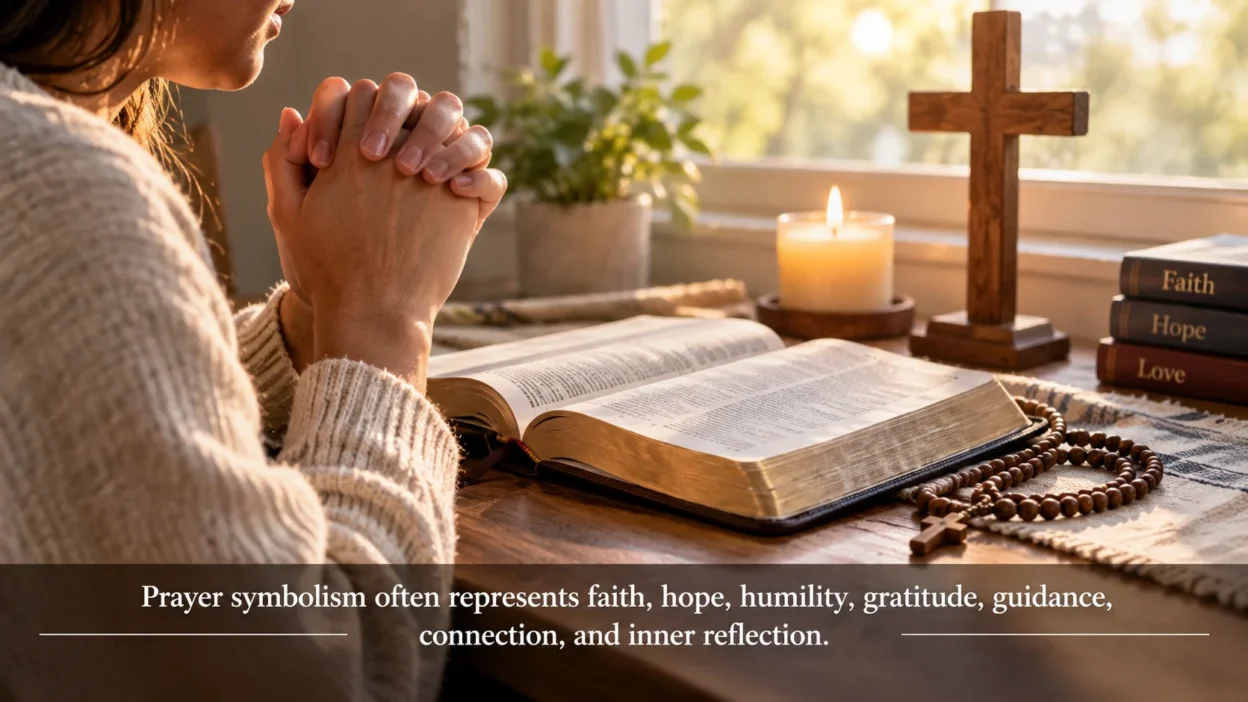
Prayer symbolism appears wherever people use prayer to express faith, hope, gratitude, or a search for guidance. In the United States, prayer can be represented through clasped hands, bowed heads, prayer beads, candles, crosses, sacred books, and quiet places of worship.
However, prayer is more than a religious action. Its symbols can also express comfort, remembrance, humility, patience, and emotional strength. A person may use prayer imagery to represent a personal belief, family tradition, cultural identity, or difficult moment.
Today, prayer symbolism appears in churches, homes, jewelry, tattoos, artwork, memorials, social media posts, and holiday traditions. Its meaning can change depending on the person, setting, religion, and intention behind it.
Quick Answer
Prayer symbolism in the USA commonly represents faith, hope, humility, guidance, gratitude, and connection with the sacred. More broadly, prayer symbols can express reflection, devotion, comfort, and a desire for meaning or help.
TL;DR
- Prayer often symbolizes faith, hope, humility, gratitude, and spiritual connection.
- Folded hands and bowed heads are widely recognized prayer images.
- American prayer traditions reflect many religious and cultural histories.
- Candles, crosses, beads, and sacred books add layers of meaning.
- Modern prayer imagery can represent identity, remembrance, comfort, or devotion.
What Is Prayer Symbolism?
Prayer symbolism refers to objects, gestures, images, and settings that communicate ideas connected with prayer. These symbols can be highly religious, but they can also carry personal or emotional meanings.
For Americans, the most familiar examples often come from Christian traditions. However, the broader idea of prayer symbolism reaches across many faiths and communities.
Common Prayer Symbols
Some symbols appear repeatedly in American religious and cultural settings:
• Clasped hands can suggest devotion, humility, or focused prayer.
• A bowed head often represents respect, reflection, or submission.
• A candle can represent hope, remembrance, or spiritual presence.
• A prayer bead strand can represent repetition, discipline, and devotion.
• A sacred book can represent religious teaching and personal guidance.
• A quiet sanctuary can symbolize peace, refuge, and spiritual attention.
The meaning isn’t always fixed. For example, clasped hands may represent religious devotion for one person and emotional support for another.
Historical Roots of Prayer Symbols
Prayer is ancient, and humans have used physical gestures to express communication with the divine for thousands of years. Long before modern churches existed, people created rituals around offerings, sacred places, gestures, words, and repeated movements.
However, today’s familiar prayer images developed through many different historical periods. Ancient Mediterranean, Near Eastern, Jewish, Christian, Islamic, Asian, and Indigenous traditions all contributed different forms of devotional practice.
Ancient and Early Traditions
Ancient people often raised their hands toward the sky, bowed, knelt, or approached sacred spaces during prayer and ritual. These gestures connected the human body with ideas of reverence and communication with higher powers.
Over time, religious communities developed distinctive forms of prayer. Repeated words, sacred objects, clothing, buildings, gestures, and bodily positions became recognizable signs of devotion.
The Development of Familiar Christian Imagery
In European Christian art, praying figures became common subjects. Artists frequently showed people kneeling, bowing, raising their hands, or bringing their palms together.
Eventually, these images became part of Western visual culture. American religious art inherited many of these conventions through European settlement and later religious communities.
Prayer Symbolism in the United States
In the USA, prayer symbolism is closely connected with religious life, family traditions, public ceremonies, and personal identity. Christianity has strongly influenced familiar American prayer imagery, although the country contains many other faith traditions.
Prayer may appear in a church service, family meal, wedding, funeral, military setting, hospital visit, or private home. Therefore, the same gesture can communicate different emotions depending on its setting.
American Associations
Prayer symbolism in American life can suggest:
• Faith during periods of uncertainty or hardship.
• Gratitude before meals or during family gatherings.
• Hope during national or community tragedies.
• Remembrance during funerals and memorial services.
• Guidance during important personal decisions.
• Solidarity when communities face difficult events.
Prayer also appears in American political and civic life. Public officials sometimes participate in prayers or moments of reflection, while debates can arise about the proper role of religious expression in public institutions.
Prayer in Family Life
Many Americans encounter prayer through family traditions. Children may learn prayers before meals, bedtime, religious holidays, or important family events.
As a result, prayer imagery can evoke childhood memories even when someone no longer follows the same religious practice. The symbol may therefore carry both spiritual and emotional meaning.
What Do Folded Hands Symbolize?
Folded or clasped hands are among the most recognizable visual symbols of prayer in Western culture. They create a simple image that immediately communicates focused attention and devotion.
However, their meaning developed gradually rather than coming from one single ancient source.
Meaning of Clasped Hands
Clasped hands can symbolize:
• Devotion toward a higher power or sacred ideal.
• Humility before something considered greater than oneself.
• Concentration during personal reflection or worship.
• Hope for help during difficult circumstances.
• Gratitude for blessings, relationships, or experiences.
In American popular culture, the gesture is also used outside formal religion. Someone might clasp their hands while silently hoping for good news.
What Does a Bowed Head Symbolize?
A bowed head is another powerful prayer image. The physical movement lowers the face and changes the person’s posture, creating a visual impression of quietness and humility.
For many Americans, the gesture is strongly associated with Christian prayer. Yet similar forms of respectful bowing appear in numerous religious and cultural traditions.
Humility and Reflection
A bowed head can communicate several ideas at once:
• Respect for the sacred or spiritually important.
• Humility rather than personal pride.
• Quiet attention during prayer or meditation.
• Mourning and remembrance after loss.
• Submission to religious teachings or personal values.
Because the gesture is visually simple, artists often use it when they want to communicate prayer without showing a specific religion.
Religious Symbols Associated With Prayer
Prayer rarely appears as an isolated symbol. Instead, it often appears alongside objects that identify a particular religious tradition.
In the United States, crosses, Bibles, prayer beads, candles, churches, and religious clothing can immediately create a prayer-related context. Other communities use different sacred objects and visual traditions.
Common Objects and Their Meanings
| Symbol or Object | Meaning in the USA | Common Association | Notes |
| Folded hands | Devotion and humility | Personal prayer | Often used in art and digital communication |
| Cross | Christian faith and sacrifice | Churches and worship | Meaning varies by Christian tradition |
| Prayer beads | Repetition and devotion | Structured prayer | Used in several religious traditions |
| Candle | Hope and remembrance | Prayer services and memorials | Can carry both religious and secular meanings |
| Sacred book | Guidance and faith | Worship and personal study | The specific book depends on the tradition |
These objects shouldn’t be treated as interchangeable. Each has its own history and religious context.
Spiritual Meaning of Prayer
Prayer can have a spiritual meaning beyond a particular building, object, or gesture. Many people understand it as a way to communicate with God, a sacred presence, ancestors, or a higher reality.
At the same time, different religions understand prayer differently. Some emphasize spoken petitions, while others emphasize praise, contemplation, repetition, silence, or communal worship.
Prayer Across Traditions
Jewish, Christian, Muslim, Hindu, Buddhist, Sikh, and other traditions contain diverse forms of devotional or contemplative practice. Indigenous communities also have varied prayer traditions connected with community, land, ancestors, ceremony, and spiritual relationships.
These traditions shouldn’t be reduced to one universal definition. The same symbol can also carry very different meanings across communities.
Emotional and Psychological Meaning of Prayer
Prayer imagery often carries strong emotional associations because people encounter it during important moments. Births, weddings, illness, grief, celebrations, uncertainty, and loss can all become connected with prayer.
However, the emotional meaning isn’t necessarily the same for everyone. Someone may see prayer as comforting, while another person may associate it with difficult religious experiences.
Common Emotional Associations
Prayer symbolism may evoke:
• Comfort during grief or personal uncertainty.
• Hope when circumstances feel difficult or unpredictable.
• Peace through quiet reflection and familiar rituals.
• Gratitude for people, experiences, or perceived blessings.
• Belonging through shared family or community traditions.
• Strength when facing fear, loss, or major change.
For this reason, prayer imagery can feel deeply personal even when the image itself is simple.
Prayer Symbolism in Art and Architecture
American churches have made prayer symbolism highly visible through architecture and interior design. Crosses, stained glass, altars, pews, candles, religious paintings, and sacred texts can create environments associated with worship.
However, prayer symbolism also appears outside traditional churches. Homes, gardens, memorial spaces, retreat centers, and personal altars can provide quieter settings for reflection.
Visual Elements
Light is especially important in prayer imagery. Sunlight through stained glass, candle flames, and soft window light can create a sense of peace or transcendence.
Architecture also matters. High ceilings, arches, quiet rooms, and long pathways can make a person feel small, focused, or separated from everyday distractions.
Prayer Symbolism in Tattoos and Jewelry
Prayer imagery has become common in American tattoos and jewelry. People may choose these designs to represent faith, family, remembrance, protection, or a major personal experience.
However, the meaning depends heavily on the wearer. A pair of praying hands may express Christian faith for one person, while another may use the image to remember someone who encouraged them to pray.
Popular Designs
Common choices include:
• Praying hands representing devotion or personal faith.
• Crosses representing Christian belief and spiritual identity.
• Prayer beads representing repeated devotion or religious heritage.
• Small candles representing hope, remembrance, or guidance.
• Sacred words representing personal beliefs or family traditions.
These designs can also become memorial tattoos. In those cases, prayer imagery often connects spirituality with memory and grief.
Prayer Symbols in Social Media and Digital Culture
Prayer has gained new visual forms through phones and social media. People may use prayer-related emojis, images, quotes, or short messages when responding to difficult news.
The folded-hands emoji is especially recognizable in American digital communication. However, its meaning can range from prayer and gratitude to asking for support or expressing appreciation.
Changing Digital Meaning
Online communication can simplify complex symbols. A person may use a prayer image without belonging to a particular religion.
Likewise, phrases such as “thoughts and prayers” can be sincere expressions of sympathy. In other situations, the phrase may be used critically when people believe words were offered without meaningful action.
Prayer and American Holidays
Prayer symbolism appears during several American religious and family holidays. Christmas and Easter often feature Christian prayer imagery, while other religious communities maintain their own holiday traditions.
Thanksgiving also has strong connections with prayer for many American families. Some households begin the meal with a spoken blessing or moment of gratitude.
Ceremonies and Gatherings
Prayer can also appear during weddings, funerals, baptisms, graduations, sporting events, and community gatherings. These moments show how prayer can function as both a religious practice and a social ritual.
Still, American ceremonies are diverse. Not everyone shares the same beliefs, so public and mixed-group settings may use inclusive moments of silence or reflection instead.
Misunderstandings and Controversies
Prayer symbolism can sometimes become controversial because religion and public life overlap in complicated ways. The USA protects religious freedom while also containing people with many different beliefs and nonreligious perspectives.
Public Prayer
Prayer at government events, schools, sporting events, and public ceremonies can raise questions about inclusion and religious freedom. The specific circumstances matter, including who leads the prayer, whether participation is voluntary, and the legal setting.
It is therefore misleading to treat every public prayer situation as identical. American communities continue to negotiate the balance between religious expression and an inclusive public environment.
The “Praying Hands” Misunderstanding
The familiar praying-hands image is often treated as a universal religious symbol. However, its meaning can change depending on culture and context.
Some people interpret similar hand gestures as gratitude, pleading, greeting, or appreciation. Digital communication makes these differences even more noticeable.
How Prayer Symbolism Has Changed Over Time
Prayer symbolism has moved from ancient ritual gestures to paintings, architecture, printed illustrations, photography, jewelry, tattoos, and digital communication.
However, its central ideas remain surprisingly stable. People continue to connect prayer with hope, humility, connection, remembrance, and a search for guidance.
From Sacred Spaces to Everyday Life
In earlier periods, prayer symbols were strongly connected with temples, churches, mosques, shrines, monasteries, and other sacred places. Today, they can appear almost anywhere.
A necklace, tattoo, phone image, bedroom corner, or memorial card can carry prayer symbolism. This shift has made prayer imagery more personal and less dependent on formal religious spaces.
Why Prayer Symbols Remain Powerful
Prayer symbols work because they communicate complex feelings through simple forms. A bowed head can suggest humility without words, while a candle can suggest hope without explaining the story behind it.
For Americans, these symbols can also connect private belief with shared cultural memory. They may remind people of grandparents, family ceremonies, religious communities, or moments of crisis.
Read More: Altar Symbolism: Meaning, History, and Modern Use
Personal Meaning Matters
The strongest meaning often comes from personal experience. Someone who grew up praying with family may see clasped hands as a comforting childhood image.
Another person may view the same image as an expression of spiritual curiosity. Therefore, prayer symbolism should be understood through both cultural history and individual experience.
FAQs
What does prayer symbolize?
Prayer commonly symbolizes faith, hope, humility, gratitude, guidance, and spiritual connection. Its meaning can also include comfort, remembrance, and personal reflection.
What do praying hands symbolize?
Praying hands usually represent devotion, humility, hope, or a request for guidance. In modern American communication, the gesture can also express gratitude or support.
What does a prayer candle symbolize?
A prayer candle can represent hope, remembrance, devotion, or spiritual presence. Its meaning depends on the religious tradition and the setting where it appears.
What does prayer symbolize in Christianity?
In Christianity, prayer can represent communication with God, worship, gratitude, repentance, confession, and requests for guidance. Different Christian traditions emphasize these purposes in different ways.
Why are prayer symbols used in tattoos?
People often choose prayer tattoos to represent faith, family, protection, remembrance, or a meaningful personal experience. The design may also commemorate someone who influenced their spiritual life.
Does prayer symbolism always have a religious meaning?
No. Prayer imagery can also represent hope, reflection, comfort, remembrance, or emotional support. Its meaning depends on the person and context.
Conclusion
Prayer symbolism connects simple gestures and objects with deep ideas about faith, hope, humility, gratitude, guidance, and connection. In the United States, its forms have been shaped by religious traditions, family customs, art, architecture, public life, and modern digital culture. Today, Prayer Symbolism can appear in a church, home, tattoo, memorial, necklace, photograph, or simple message of support. Its meaning becomes most powerful when you consider the person, tradition, and moment behind the symbol. Whether you encounter praying hands, a candle, a cross, beads, or a bowed head, the image can invite a simple question: what does this person hope to express, remember, or seek through prayer?