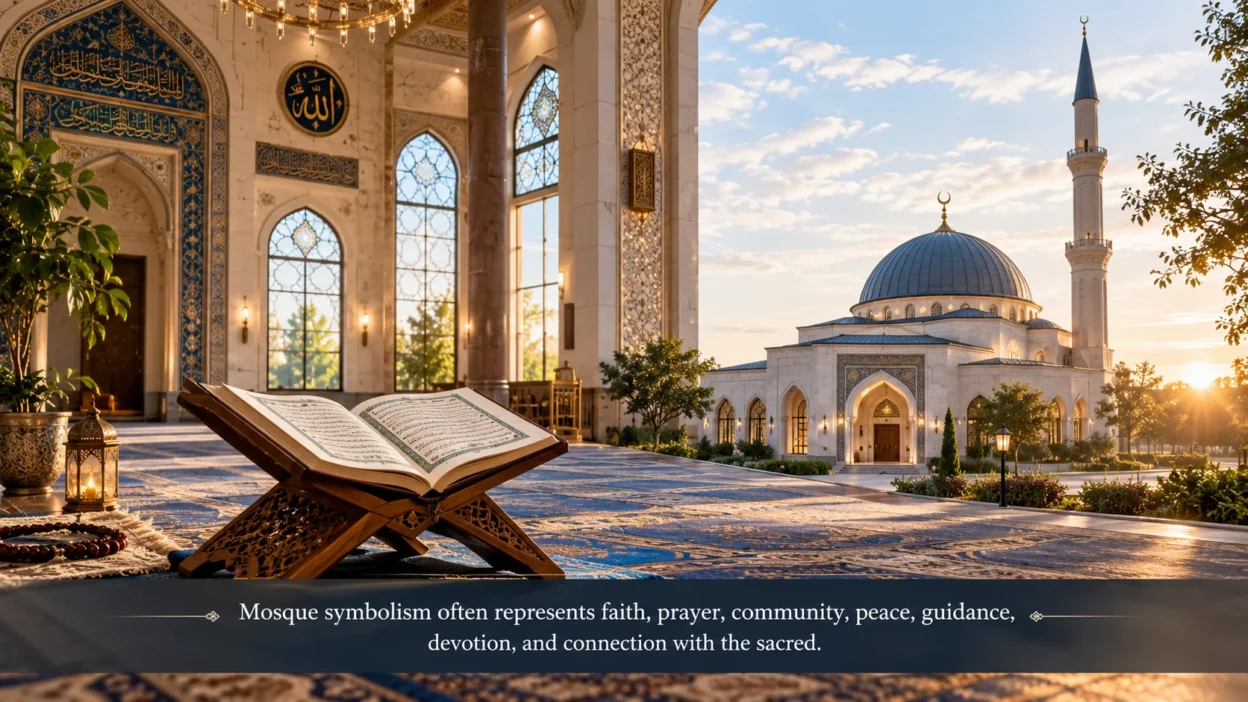
Mosque symbolism reflects the meanings people connect with Muslim houses of worship. In the United States, a mosque can symbolize faith, community, peace, learning, identity, and a place of spiritual reflection.
Its visual language is also distinctive. Domes, arches, minarets, geometric patterns, calligraphy, prayer spaces, and carefully arranged entrances can all carry cultural or religious meaning. However, not every feature has one fixed interpretation.
Today, mosques can look very different from historic examples. Some occupy traditional buildings, while others use modern architecture adapted to local communities. Understanding mosque symbolism therefore means looking at both Islamic tradition and the changing American experience.
Quick Answer
Mosque symbolism in the USA commonly represents faith, prayer, community, peace, spiritual guidance, and Muslim identity. Domes, arches, calligraphy, prayer spaces, and geometric designs can reinforce these associations, while their meanings vary across cultures and architectural traditions.
TL;DR
- Mosques symbolize worship, community, learning, peace, and spiritual connection.
- Domes often create a strong visual association with Islamic architecture.
- Minarets historically connected architecture with the call to prayer.
- Geometric patterns can suggest order, balance, and artistic beauty.
- American mosques often combine Islamic traditions with local architecture.
- Modern mosque imagery can express faith, identity, heritage, and belonging.
What Does a Mosque Look Like?
A mosque is a place where Muslims gather for prayer, worship, learning, and community life. Its appearance can range from a simple converted building to a large architectural complex.
Common Visual Features
Several features frequently appear in mosque architecture, although none are required in every mosque.
- Domes create a recognizable architectural profile.
- Minarets provide a distinctive vertical element.
- Arches frame doors, windows, and interior spaces.
- Geometric designs add rhythm and visual balance.
- Arabic calligraphy may display religious passages or devotional phrases.
- Prayer halls usually emphasize openness and shared worship.
A mosque’s interior may include prayer rugs arranged toward the qibla, the direction of the Kaaba in Mecca. Many mosques also avoid religious statues and figurative imagery in worship spaces.
Instead, architecture often becomes the main visual language. Light, patterns, writing, proportion, and repeated forms can create a calm environment for prayer.
What Does a Mosque Symbolize?
For many Americans, a mosque immediately signals Muslim worship and community. However, its symbolism extends beyond the building itself.
Faith and Worship
The central meaning is worship of God, known in Arabic as Allah. Muslims may gather at a mosque for daily prayers, Friday congregational prayer, religious education, and special occasions.
The building can therefore symbolize devotion and a shared commitment to religious practice.
Community and Belonging
A mosque is also a social space. Families may meet there, children may attend classes, and community members may organize charitable activities.
This gives mosque symbolism an important American dimension. The mosque can represent belonging while also reflecting the diverse backgrounds of Muslims living in the United States.
The Historical Origins of Mosque Architecture
Mosque architecture developed over many centuries. It doesn’t come from one single architectural style.
Early Islamic Roots
The Arabic word masjid is commonly understood as referring to a place of prostration. Early Muslim worship spaces emphasized prayer rather than a fixed architectural formula.
The Prophet Muhammad’s mosque in Medina became an important early model. Its courtyard, covered prayer area, and community functions influenced later Islamic architecture.
Over time, Muslim societies adapted mosque design to local materials, climates, artistic traditions, and political settings.
From Simple Spaces to Landmark Buildings
As Muslim communities expanded, mosques developed many regional forms. Persian, Ottoman, North African, Central Asian, South Asian, and other traditions contributed distinctive designs.
Domes, courtyards, monumental entrances, minarets, tilework, and decorative calligraphy became prominent in different periods. However, these elements weren’t all present everywhere.
Why Do Mosques Have Domes?
The dome is probably the feature most strongly associated with mosque imagery in popular culture. Yet its meaning is more complicated than simply “Islamic symbol.”
Architectural Meaning
Domes create large interior spaces and can help shape the acoustics of a prayer hall. They also provide a strong visual focal point.
Historically, dome construction existed long before Islam. Islamic architects adopted and developed dome traditions from earlier architectural cultures.
Symbolic Associations
In modern visual culture, a dome can suggest heaven, openness, transcendence, or sacred space. These associations are common artistic interpretations rather than universal religious rules.
In the United States, a dome often helps viewers identify a building as a mosque. However, many American mosques have no dome at all.
What Do Minarets Symbolize?
Minarets are tall towers traditionally associated with mosques. Their forms vary widely across regions and historical periods.
Call to Prayer
Historically, minarets became associated with the adhan, or call to prayer. A muezzin traditionally announced prayer from the mosque or its surroundings.
Modern technology has changed how many communities make announcements. Even so, the minaret remains an important architectural marker.
A Visible Community Presence
In the United States, a minaret can also symbolize Muslim presence within a wider community. It may visually communicate that a mosque is both a religious institution and a local gathering place.
However, not every Muslim community views a minaret as necessary. Many contemporary mosques use different architectural solutions.
Islamic Patterns, Arches, and Calligraphy
Mosque symbolism often depends as much on decoration as architecture. Repeated patterns and carefully designed surfaces can create a distinctive visual atmosphere.
Geometry and Repetition
Geometric patterns are common in many forms of Islamic art. Repetition can create a sense of rhythm, balance, and visual order.
These patterns can also connect architecture with mathematics and craftsmanship. Their meaning varies, so it’s better not to assign one universal interpretation.
Calligraphy
Arabic calligraphy is another major feature of Islamic visual culture. Religious passages, devotional phrases, and other forms of writing may appear in mosque architecture.
For many viewers, calligraphy combines language, beauty, memory, and religious devotion. Its presence can turn written words into an important part of the building’s visual identity.
Mosque Symbolism in the USA
American mosque symbolism has developed within a diverse religious and cultural environment. Mosques may reflect Middle Eastern, South Asian, African, European, Southeast Asian, African American, or mixed American influences.
Faith and Religious Freedom
In the United States, a mosque can represent the freedom to practice Islam openly. This association became especially meaningful as Muslim communities established permanent institutions across the country.
Mosques can therefore symbolize both religious devotion and participation in American civic life.
Community Life
American mosques frequently serve purposes beyond formal prayer.
| Context | Meaning in the USA | Common Associations | Notes |
| Friday prayer | Shared worship | Community, devotion, fellowship | A major weekly gathering |
| Ramadan | Spiritual renewal | Fasting, generosity, reflection | Often includes evening gatherings |
| Education | Religious learning | Knowledge, guidance, tradition | Includes children and adults |
| Charity | Service to others | Compassion, generosity, responsibility | Activities may extend beyond Muslims |
| Community events | Social connection | Belonging, friendship, identity | Often reflects local culture |
This broader role makes the mosque an important community symbol. It can represent a place where religious, family, educational, and social life meet.
Spiritual and Cross-Cultural Meanings
Mosques have a specific place within Islam, but mosque architecture also appears within a wider history of sacred buildings.
Sacred Space
Across many religions, houses of worship create spaces separated from ordinary daily activity. They can encourage reflection, community gathering, and ritual.
In Islam, the mosque provides a setting for communal prayer and other religious activities. Its symbolism therefore centers on worship and connection with God.
Regional Diversity
Muslim communities around the world have developed different mosque traditions. A mosque in Turkey may look very different from one in Indonesia, Morocco, Pakistan, Nigeria, or the United States.
This diversity matters because there is no single “Muslim architectural style.” Mosque symbolism is shaped by both shared religious traditions and local history.
What Does a Mosque Represent Emotionally?
A mosque can evoke feelings connected with safety, belonging, reflection, discipline, and spiritual calm. Personal experiences strongly influence these associations.
Peace and Reflection
Quiet prayer spaces can create an atmosphere of stillness. Soft lighting, repeated patterns, open floors, and organized rows may reinforce this feeling.
For someone who regularly attends a mosque, the building may also hold memories of family, childhood, friendships, celebrations, and important life events.
Identity and Belonging
For Muslim Americans, a mosque may represent cultural identity as well as religious practice. It can provide a familiar community within a diverse society.
For others, the mosque may simply symbolize religious diversity and the presence of Islam in American life.
Mosque Symbolism in Modern Life
Today, mosque imagery appears far beyond physical architecture. It can be used in education, travel photography, religious art, social media, and cultural conversations.
Tattoos and Personal Art
Mosque imagery can appear in personal artwork, although its use varies considerably among Muslims. Some people choose architectural images to express heritage, family history, travel memories, or cultural identity.
Others may avoid permanent religious imagery because of personal or religious preferences.
Social Media and Digital Design
A mosque silhouette, crescent-and-dome illustration, or geometric pattern can quickly communicate Muslim identity online. Such imagery often appears around Ramadan, Eid, educational posts, and community announcements.
However, simplified graphics can sometimes blend different symbols together. A crescent, for example, isn’t a universal requirement for mosque architecture or Islamic belief.
Home Decor
Mosque-inspired arches, geometric designs, calligraphy, and architectural photography may appear in homes. These elements can connect decoration with heritage, spirituality, or appreciation for Islamic art.
Mosque Symbolism During Ramadan and Eid
Ramadan and Eid give mosque imagery strong visibility in American communities. During these periods, mosques often become especially active gathering places.
Ramadan
During Ramadan, mosques can symbolize discipline, worship, generosity, and community. Evening prayers and shared meals can make the mosque a major part of the month.
The building may also represent a transition from individual religious practice to communal experience.
Eid
Eid celebrations can give mosque symbolism a joyful dimension. Families may gather for prayer, greetings, food, charity, and social activities.
Therefore, mosque imagery doesn’t always communicate solemnity. It can also represent celebration, friendship, gratitude, and family connection.
What Does the Mosque Mean in American Identity?
The meaning of a mosque in America can depend on who is viewing it. For Muslims, it may be a deeply personal place of worship. For others, it may represent religious diversity or a local cultural institution.
Muslim American Identity
Mosques can provide spaces where different cultural backgrounds meet. A single American mosque may include families whose heritage comes from several continents.
This creates an identity that is both Muslim and American. Architecture can reflect that combination through traditional details alongside modern American building forms.
Interfaith Understanding
Some mosques participate in interfaith events and community programs. In those settings, the building may become a symbol of dialogue and peaceful coexistence.
However, the meaning should come from the community itself rather than assumptions made from the outside.
Misunderstandings and Controversies
Religious symbols can become misunderstood when visual shortcuts replace historical context. Mosque imagery is no exception.
Not Every Dome Is a Religious Requirement
A dome is strongly associated with mosques, but Islam doesn’t require every mosque to have one. Many mosques have simple roofs or contemporary designs.
Likewise, the absence of a dome doesn’t make a building less authentically Muslim.
The Crescent and Star
The crescent and star are widely associated with Islam in popular culture. However, they weren’t established as universal symbols of Islam itself.
The imagery became particularly prominent through historical Muslim states and later national traditions. Today, people may use it as a broad cultural shorthand for Islam.
Avoiding Stereotypes
Reducing Islam to a dome, crescent, or minaret can flatten a diverse tradition. These images are useful visual references, but they don’t capture the full meaning of Muslim life.
A respectful interpretation recognizes architecture, worship, history, and community together.
How Mosque Symbolism Has Changed Over Time
Mosque architecture has never remained completely fixed. Its forms have changed as Muslim societies encountered new technologies, environments, and artistic traditions.
From Local Tradition to Global Imagery
Historically, mosque designs often reflected their immediate region. Today, images travel rapidly through television, photography, social media, and tourism.
As a result, one architectural style can become globally recognizable even though it originated in a particular region.
Modern American Mosques
Contemporary American mosques may use glass, steel, brick, wood, concrete, and traditional decorative details. Some are purpose-built, while others occupy adapted buildings.
This evolution shows how religious identity can remain recognizable while architecture changes with time.
How to Interpret Mosque Symbolism Respectfully
The best interpretation begins with context. A mosque isn’t simply an architectural object; it’s a functioning religious and community space.
Look Beyond Individual Features
Instead of assigning one meaning to a dome or arch, consider the complete setting.
- Architecture can communicate religious identity.
- Prayer spaces emphasize worship and community.
- Patterns can express artistic tradition and craftsmanship.
- Calligraphy can connect visual beauty with sacred language.
- Community rooms can reflect education and social life.
- Entrances can symbolize welcome and gathering.
The same feature can also have practical and aesthetic purposes. Symbolism doesn’t always replace function.
Read More: Temple Symbolism: Meaning, History, and Modern Uses
Consider the People
A mosque’s most important meaning comes from the people who use it. Their experiences can include prayer, family, friendship, education, charity, grief, celebration, and belonging.
That human context makes mosque symbolism much richer than a simple architectural definition.
FAQs
What does a mosque symbolize?
A mosque commonly symbolizes worship, faith, community, prayer, learning, and spiritual connection. In the United States, it can also represent Muslim identity, religious freedom, and community belonging.
Why do mosques have domes?
Domes became common through the development of Islamic architecture and earlier architectural traditions. They can create useful interior spaces while also giving a mosque a distinctive visual appearance.
What does a minaret symbolize?
A minaret is traditionally associated with the mosque and the call to prayer. Today, it can also serve as a recognizable architectural marker of a Muslim community.
Is the crescent a symbol of Islam?
The crescent is strongly associated with Islam in modern popular culture, but it isn’t a universal requirement or foundational symbol of Islamic belief. Its prominence developed through historical Muslim states and later cultural traditions.
Why do mosques use geometric patterns?
Geometric patterns are an important part of many Islamic artistic traditions. They can create rhythm, balance, repetition, and visual beauty while demonstrating skilled craftsmanship.
Can a mosque have modern architecture?
Yes. Mosques can use contemporary architectural materials and designs while maintaining spaces for Islamic worship and community life. American mosques especially show a wide range of architectural approaches.
Conclusion
Mosque symbolism brings together ideas of faith, prayer, community, peace, learning, identity, and spiritual reflection. Domes, minarets, arches, geometric patterns, calligraphy, and prayer spaces can all contribute to its visual language, but none should be treated as having only one fixed meaning. Ultimately, a mosque is best understood through both its design and its people. Its deepest symbolism comes from the lives, memories, worship, relationships, and sense of belonging created within its walls.