Turquoise Symbolism has fascinated people for thousands of years. Its distinctive blue-green color makes it easy to recognize, while its long history gives it deeper meaning. Across time, people have connected turquoise with protection, peace, wisdom, friendship, and renewal.
In the United States, turquoise has a particularly strong connection with the American Southwest. Native American jewelry, Western fashion, silverwork, and desert art have helped shape its modern image. However, turquoise carries meanings that reach far beyond one region or tradition.
Today, people wear turquoise rings, necklaces, bracelets, and other jewelry for both beauty and personal meaning. Some choose it because they associate the stone with calm and protection. Others simply love its natural color and connection to the landscapes of the Southwest.
Quick Answer
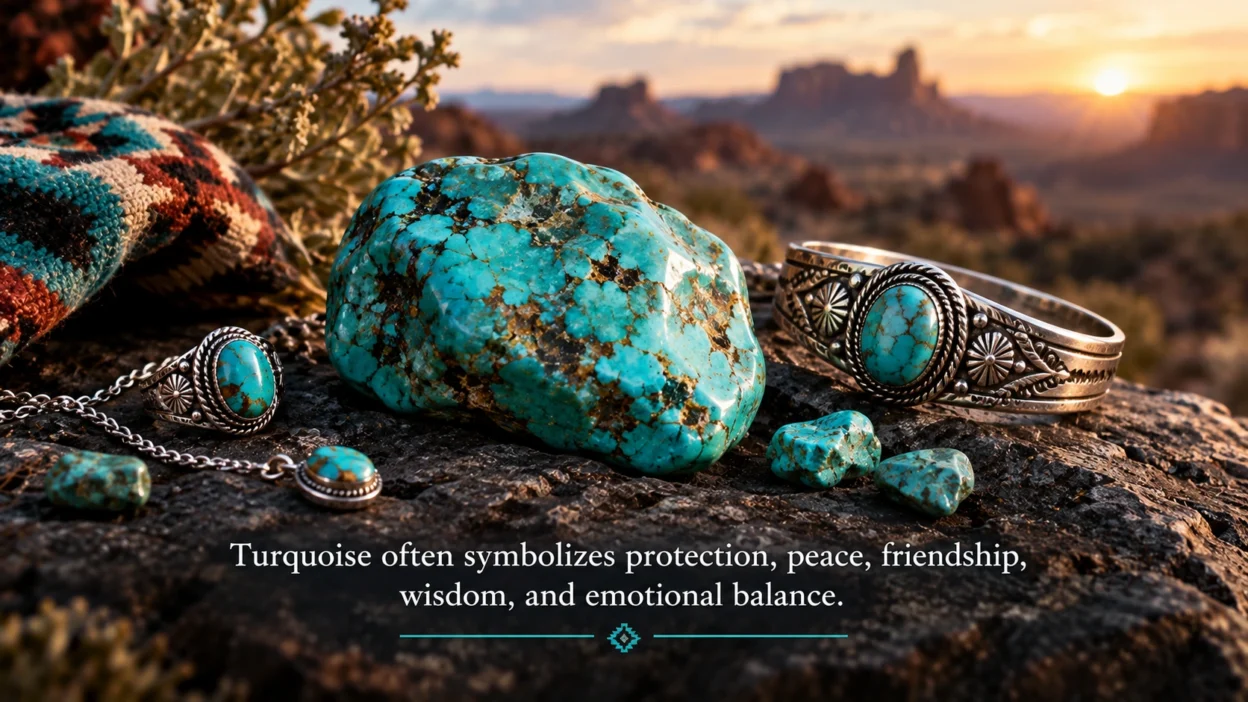
Turquoise Symbolism in the USA commonly represents protection, peace, friendship, wisdom, and a connection with nature. More broadly, turquoise has been associated with good fortune, spiritual protection, healing, and safe journeys across many historical traditions.
TL;DR
- Turquoise commonly symbolizes protection, peace, wisdom, and friendship.
- Ancient cultures valued turquoise for beauty, status, and spiritual protection.
- American turquoise has strong ties to the Southwest and Indigenous artistry.
- Its blue-green color often suggests calm, water, sky, and nature.
- Modern wearers may choose turquoise for identity, heritage, or personal meaning.
What Does Turquoise Symbolize?
Turquoise has several connected meanings, and its color plays an important role. The stone can range from pale blue to greenish blue, sometimes with dark veins called matrix.
For American readers, its symbolism often combines natural beauty with Western and Southwestern traditions. However, its meaning can change depending on the setting, design, and cultural background.
Protection and Safety
Protection is one of turquoise’s oldest and most widespread associations. Historically, people sometimes carried or wore turquoise because they believed it could guard against danger or misfortune.
Today, that idea often appears in a softer form. Someone might wear a turquoise pendant as a personal reminder to stay grounded, safe, and confident.
Peace and Calm
Its blue-green appearance also encourages associations with peaceful natural settings. Think of clear skies, quiet water, desert horizons, and open landscapes.
As a result, turquoise can symbolize emotional balance and calmness. It may appeal to people who want jewelry that feels peaceful rather than dramatic.
Friendship and Connection
Turquoise is also associated with friendship and meaningful relationships. In modern American jewelry, its approachable color can suggest warmth, trust, and companionship.
Because of this, turquoise can make a thoughtful gift between friends or family members.
Turquoise Meaning in the United States
In the USA, turquoise has a distinctive cultural identity. Its strongest regional connection is the American Southwest, where turquoise jewelry became closely connected with Native American and Western artistic traditions.
However, this history is not one simple story. Different Indigenous nations have their own traditions, artistic practices, and relationships with turquoise.
The American Southwest
Arizona, New Mexico, Nevada, and other Southwestern areas have long been important to American turquoise mining and jewelry production. Silver-and-turquoise jewelry became especially recognizable in Southwestern design.
Today, turquoise may appear in rings, squash blossom necklaces, belt buckles, bracelets, and decorative objects.
Western Identity
Turquoise also became part of America’s broader Western image. Ranch culture, Western clothing, rodeo fashion, and desert-inspired design helped bring turquoise to audiences across the country.
Therefore, a turquoise ring may suggest more than spirituality. It can also evoke independence, open landscapes, craftsmanship, and Western heritage.
A Symbol of American Nature
Turquoise often feels connected to the landscape itself. Its colors resemble a meeting point between blue sky, water, and earthy desert tones.
| Context | Meaning in the USA | Common Associations | Notes |
| Southwestern jewelry | Heritage and craftsmanship | Silver, desert, artistry | Often linked with regional design |
| Western fashion | Individuality and tradition | Ranch life, independence | Popular beyond the Southwest |
| Gifts | Friendship and care | Trust, affection, protection | Meaning depends on the giver |
| Personal jewelry | Identity and confidence | Calm, beauty, self-expression | Often chosen for its color |
| Home decor | Natural beauty | Desert landscapes, warmth | Works with rustic and modern styles |
The Ancient History of Turquoise
Turquoise has one of the longest histories of any decorative gemstone. Archaeological discoveries show that humans valued it thousands of years before modern jewelry traditions developed.
Ancient people often prized turquoise because its unusual color stood out against metals, stone, and other natural materials. Its rarity also helped give it status.
Ancient Egypt
Ancient Egyptians used turquoise in jewelry, ornaments, and ceremonial objects. Turquoise appeared alongside gold and other precious materials.
The stone was connected with ideas of life, protection, and divine power. Egyptian artisans also used its blue-green color to create striking visual contrasts.
Persia and the Ancient Near East
Turquoise became especially important in Persian culture. The Persian region was historically famous for high-quality turquoise, and the stone traveled widely through trade.
Its blue color became associated with the heavens and protection. Persian architectural traditions also used turquoise-colored tiles, creating a lasting visual connection between turquoise and sacred spaces.
Trade and Cultural Exchange
Turquoise traveled across large trade networks. As a result, its symbolism did not develop in only one place.
Different societies gave the stone their own meanings while also valuing its beauty and rarity. This long exchange helps explain why turquoise has such a wide symbolic history.
Turquoise and Native American Traditions
Turquoise holds important cultural and artistic significance for many Indigenous peoples of the American Southwest. However, there isn’t one universal Native American meaning.
Different nations have distinct languages, histories, beliefs, and artistic traditions. Therefore, broad claims about what “Native Americans” believe about turquoise can be misleading.
Jewelry and Craftsmanship
Turquoise became an important material in Southwestern Indigenous jewelry. Artisans combined it with silver and other materials to create distinctive necklaces, bracelets, earrings, rings, and other forms.
These works can represent artistic skill, cultural continuity, personal identity, and connection to community.
Respecting Cultural Differences
Modern readers should avoid treating Indigenous turquoise traditions as a single spiritual system. The meaning of a particular piece may depend on its maker, community, design, and purpose.
For example, purchasing authentic Indigenous-made jewelry can support living artistic traditions. At the same time, copying sacred or culturally specific designs without understanding their context can be disrespectful.
What Is the Spiritual Meaning of Turquoise?
Turquoise has spiritual associations in many historical and modern traditions. These meanings often involve protection, peace, communication, and connection with the natural world.
However, spiritual interpretations aren’t universal facts. They reflect particular beliefs and traditions rather than scientifically established properties of the stone.
Protection and Guidance
Many historical traditions treated turquoise as a protective material. Some people believed it could help guard travelers or protect the wearer from harmful forces.
Modern spiritual practices sometimes continue this idea. A person may carry turquoise as a symbolic reminder of safety and inner strength.
Connection With Nature
The stone’s blue-green color makes it especially easy to connect with nature. It can suggest clear skies, water, plants, and distant horizons.
Because of this, turquoise often feels refreshing and grounding. Its symbolism can remind people to slow down and reconnect with their surroundings.
Communication and Wisdom
Some modern spiritual interpretations associate turquoise with honest communication and wisdom. The idea fits its long history as a valued and meaningful stone.
For some wearers, a turquoise necklace becomes a personal symbol of speaking clearly and living with greater awareness.
Turquoise Color Meaning
Color strongly influences how people understand turquoise. Its unusual position between blue and green gives it a flexible symbolic character.
Blue often suggests calmness and openness, while green can suggest nature, renewal, and growth. Turquoise brings these ideas together.
Blue Turquoise
Blue turquoise often creates stronger associations with peace, trust, clarity, and protection. Its appearance can also suggest water and sky.
As a result, brighter blue stones may feel especially calming or uplifting.
Green Turquoise
Green turquoise can feel more connected to earth and nature. It may suggest growth, renewal, stability, and natural beauty.
However, green turquoise isn’t necessarily less valuable or meaningful. Natural turquoise occurs in many colors, and individual preference matters.
Natural Matrix Patterns
Dark veins or patches in turquoise are called matrix. These patterns can come from the surrounding rock in which the turquoise formed.
Instead of being a flaw, matrix can become part of the stone’s character. Many people appreciate turquoise precisely because every piece looks different.
Emotional and Psychological Meaning of Turquoise
Turquoise often creates a calm emotional impression. Its color is bright enough to feel lively but soft enough to remain peaceful.
For this reason, people may choose turquoise when they want jewelry that communicates confidence without appearing aggressive.
Calm and Emotional Balance
Turquoise can symbolize emotional steadiness. Its natural colors may remind people of quiet water, wide skies, and peaceful outdoor spaces.
That association can make turquoise appealing during periods of change or uncertainty.
Confidence and Self-Expression
Turquoise jewelry is often visually distinctive. A large turquoise ring or necklace can become a noticeable part of someone’s style.
Therefore, the stone can also represent individuality. Wearing it may communicate a willingness to stand out while staying connected to tradition.
Personal Meaning
Not every turquoise wearer follows a specific symbolic tradition. Sometimes the meaning is simply personal.
A turquoise ring might remind someone of a loved one, a trip, a family tradition, or an important stage of life.
Turquoise in Jewelry and Fashion
Turquoise remains popular in American jewelry because it works across many styles. It can look traditional, rustic, artistic, elegant, or contemporary.
Silver and turquoise are especially recognizable together. However, designers also combine turquoise with gold, leather, beads, and modern minimalist settings.
Rings and Bracelets
Turquoise rings can symbolize confidence, protection, or personal style. Large stones often create a bold Southwestern appearance.
Bracelets provide a subtler way to wear the color. Stacked turquoise bracelets can also create a relaxed, layered look.
Necklaces and Pendants
Turquoise pendants often place the stone close to the heart or center of the body. Symbolically, this can make the jewelry feel more personal.
A pendant may represent protection, friendship, heritage, or simply a favorite connection to nature.
Birthstone and Gift Culture
Turquoise isn’t the traditional birthstone for every month, but it is associated with December in some modern birthstone traditions.
Because of this, turquoise jewelry can carry an additional birthday connection. Its long history also makes it appealing as a meaningful gift.
Turquoise in Tattoos, Decor, and Social Media
Turquoise symbolism has moved well beyond traditional jewelry. Today, people use turquoise-inspired colors and imagery in tattoos, interiors, artwork, clothing, and digital spaces.
Modern use often focuses less on ancient beliefs and more on personal identity.
Turquoise Tattoos
A turquoise-colored tattoo can represent peace, protection, nature, or individuality. Some people also choose turquoise imagery because of its connection to Southwestern art.
However, cultural designs deserve special care. Using a culturally specific Indigenous symbol without understanding its meaning can reduce a living tradition to decoration.
Home Decor
Turquoise works especially well in Southwestern and desert-inspired interiors. It can appear in cushions, ceramics, wall art, textiles, furniture, and painted surfaces.
The color can also brighten neutral rooms. As a result, it has become popular in both rustic and contemporary American interiors.
Social Media and Digital Style
Online, turquoise often communicates freshness, calm, creativity, and individuality. Its bright appearance makes it useful for profile graphics, fashion posts, artwork, and lifestyle imagery.
Unlike some symbols, its digital meaning is usually flexible. Context matters more than any single fixed interpretation.
Turquoise in American Culture and Pop Culture
American media helped turn turquoise into a recognizable symbol of the Southwest. Western movies, travel imagery, fashion photography, and tourism often use turquoise alongside desert landscapes.
This created a strong visual shortcut. A turquoise necklace can immediately suggest the American West even when the wearer lives thousands of miles away.
Western Fashion
Turquoise became closely associated with boots, denim, leather, silver jewelry, and Western clothing. Country music and rodeo culture also helped keep these combinations visible.
However, modern fashion doesn’t limit turquoise to Western settings. Designers now use it in casual, luxury, and contemporary styles.
Art and Design
Turquoise has also influenced American painting, architecture, crafts, and interior design. Its connection with desert landscapes gives it a distinctive regional feeling.
At the same time, its color works well in modern design because it feels both natural and energetic.
Misunderstandings and Controversies Around Turquoise
Turquoise symbolism is generally positive, but some misunderstandings deserve attention. The biggest issue involves treating complex cultural traditions as simple universal meanings.
One Meaning Doesn’t Fit Everyone
There is no single meaning of turquoise shared by every culture or individual. Historical interpretations changed across time and place.
Therefore, phrases such as “turquoise always means protection” oversimplify its history.
Cultural Appropriation
Turquoise jewelry itself isn’t automatically cultural appropriation. The concern usually involves copying specific cultural designs, sacred imagery, or ceremonial forms without understanding their origins.
A respectful approach recognizes Indigenous artists and living traditions rather than treating them as something belonging only to the past.
Claims About Healing
Some modern sources claim turquoise can physically heal illness or protect health. Such claims belong to spiritual or traditional belief systems, not established medical evidence.
It is reasonable to discuss these beliefs as symbolism. However, they shouldn’t replace professional medical care.
How Turquoise Symbolism Has Changed Over Time
Turquoise has never had one permanent meaning. Instead, its symbolism developed as people carried the stone across regions, cultures, and generations.
Ancient societies valued it for status and protection. Later traditions added ideas about travel, friendship, nature, spirituality, and personal identity.
From Sacred Object to Fashion
In earlier societies, turquoise could have ceremonial or protective significance. Today, many people wear it simply because they enjoy its color and craftsmanship.
However, older meanings haven’t disappeared. They continue to influence how people describe turquoise in jewelry and popular culture.
Read More: Sapphire Symbolism: Meaning, History, and Modern Uses
A Living Symbol
Turquoise remains useful because it can carry several meanings at once. It can represent heritage for one person and personal style for another.
That flexibility explains its continued popularity in the United States. The stone connects history, nature, craftsmanship, and self-expression without requiring everyone to share the same belief.
FAQs
What does turquoise symbolize?
Turquoise commonly symbolizes protection, peace, friendship, wisdom, and connection with nature. Its exact meaning depends on cultural and personal context.
What does turquoise mean spiritually?
Spiritually, turquoise is often associated with protection, guidance, calmness, communication, and natural connection. These interpretations come from particular traditions and personal beliefs.
Why is turquoise important in Native American culture?
Turquoise has important artistic and cultural roles among several Indigenous peoples, especially in the American Southwest. However, traditions differ between nations and shouldn’t be treated as one universal belief system.
What does the color turquoise represent?
The color turquoise often suggests calmness, freshness, emotional balance, nature, and openness. Its meaning combines common associations with both blue and green.
Is turquoise a symbol of protection?
Yes, protection is one of turquoise’s longstanding symbolic associations. Historically, some people wore or carried it as a protective object.
What does wearing turquoise jewelry mean?
Wearing turquoise can express personal style, heritage, friendship, protection, calmness, or appreciation for Southwestern craftsmanship. For many people, its meaning is simply personal.
Conclusion
Turquoise has carried many meanings throughout human history, but protection, peace, wisdom, friendship, and natural connection remain especially strong. Its blue-green color adds to these associations by bringing together the visual qualities of sky, water, and earth. In the United States, Turquoise Symbolism is especially connected with the Southwest, Indigenous artistry, Western fashion, and personal expression. Yet its meaning continues to evolve as people use the stone in new ways. Whether you wear turquoise for its history, beauty, cultural connection, or personal memories, its appeal comes from that combination of color and meaning. A single stone can carry a long history while still becoming something uniquely your own.