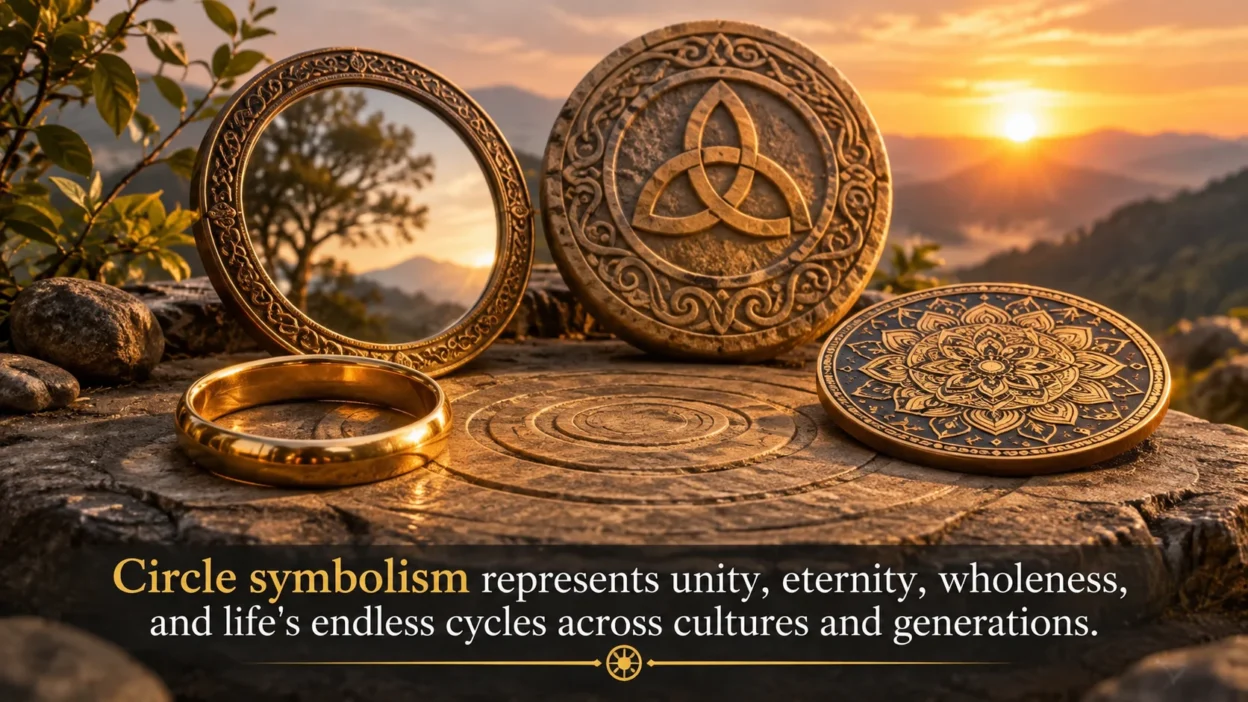
A circle is one of the simplest shapes in the world, yet its meaning can reach far beyond geometry. Circle symbolism often represents unity, eternity, wholeness, and the natural cycles that connect different stages of life. Because a circle has no obvious beginning or end, people have long used it to express ideas that feel complete or everlasting.
In 2026, circles appear everywhere, from wedding rings and family gatherings to community emblems, religious artwork, and modern design. A circle might represent lasting love in one setting and cooperation or belonging in another. Its meaning often depends on the object, the surrounding imagery, and the person interpreting it.
However, circles aren’t always symbols of comfort or harmony. A boundary drawn in a circle can suggest protection, separation, or exclusion. Understanding these different meanings helps explain why this familiar shape continues to influence American culture, personal identity, spiritual traditions, and everyday life.
Quick Answer
Circle symbolism in the United States most commonly represents unity, wholeness, eternity, and connection. Its unbroken shape also suggests continuity, protection, equality, and life’s repeating cycles across many cultures and spiritual traditions.
TL;DR
- Circles symbolize unity, completeness, eternity, and connection.
- Ancient societies used circular forms in monuments, art, and sacred objects.
- In America, circles appear in wedding rings, community groups, and national imagery.
- Spiritually, circles can represent life’s cycles, balance, and the universe.
- Psychologically, their smooth curves may suggest safety, harmony, and inclusion.
- Today, circles remain popular in tattoos, jewelry, logos, and home decor.
What Does a Circle Symbolize?
The circle carries several closely related meanings because of its smooth, unbroken form. In American culture, it often expresses ideas that are difficult to show with words, such as lasting love, belonging, and the connection between people.
Unity and Connection
A circle has no corners or obvious starting point. This makes it a natural symbol of togetherness and shared purpose.
For example, people sitting in a circle can see one another and participate in a conversation. The arrangement may suggest that everyone deserves a place and a voice.
Eternity and Wholeness
Unlike a straight line, a circle has no endpoint. This quality makes it a powerful image of eternity, continuity, and lasting commitment.
A wedding ring is a familiar American example. Its circular shape can represent a relationship that continues through changing circumstances.
Balance and Protection
A circle can also represent harmony, safety, and a sense of completion. When it surrounds an object or person, it creates a visible boundary.
Common associations include:
- Unity between individuals, families, or communities.
- Eternity and promises that extend beyond the present moment.
- Wholeness through the connection of different parts.
- Protection through a defined and enclosed space.
- Balance between opposing forces or different aspects of life.
However, these meanings aren’t automatic. A circle’s symbolism changes according to its setting, design, and cultural background.
Historical Origins of Circle Symbolism
Circular forms appeared in human life long before modern branding, jewelry, or written explanations of symbols. Early people observed the Sun, Moon, seasons, and repeating patterns in nature, making the circle an understandable way to express continuity.
Ancient Civilizations and Pre-Christian Roots
Ancient Egyptian, Mesopotamian, Greek, and other societies used circles in art, architecture, astronomy, and religious settings. Their specific interpretations differed, but circular forms often connected earthly life with the heavens.
Stone circles and circular monuments also became important in various prehistoric societies. Stonehenge in Britain, for example, demonstrates how circular arrangements could organize ceremonial spaces and align with significant seasonal events.
These structures shouldn’t all be assigned the same meaning. Their original purposes varied, and archaeologists continue to study the evidence behind their use.
The Circle in Ancient Philosophy
In ancient Greek thought, circles became important in mathematics and discussions about the natural world. Philosophers explored the relationship between geometric order, beauty, and the structure of the cosmos.
Because a circle maintains a consistent distance from its center, it became associated with symmetry and ideal form. Later thinkers also used circular imagery to discuss the heavens, perfection, and the order of existence.
From Sacred Art to Everyday Objects
As religions, societies, and technologies changed, circular forms acquired additional meanings. Rings, coins, wheels, seals, and architectural details made the shape increasingly familiar in daily life.
In medieval European Christian art, halos appeared as circles or discs around sacred figures. They communicated holiness through visual convention rather than simply representing the geometric shape.
Today, these historical uses help explain why circles can feel timeless. However, modern interpretations often combine several traditions rather than preserving one original meaning.
Circle Symbolism in American Culture
In the United States, circles are closely connected with relationships, community, identity, and shared experiences. Their meaning often comes from everyday customs rather than formal explanations of symbolism.
Wedding Rings and Lasting Commitment
Wedding rings remain one of the clearest examples of circle symbolism in American life. Their unbroken shape offers a simple image of an ongoing relationship.
Engagement rings and anniversary jewelry can also express commitment, remembrance, or personal milestones. Although traditions vary, the circular form makes the idea of continuity easy to recognize.
Community and Equality
American schools, workplaces, and community groups sometimes arrange meetings in circles. This setup can encourage conversation and reduce the visual distance between participants.
The circle also appears in expressions such as “circle of friends” and “family circle.” These phrases suggest belonging, emotional support, and relationships that hold people together.
National and Public Imagery
Circles appear in public monuments, institutional emblems, official seals, and civic artwork. Their meaning depends on the symbols placed inside or around them.
For example, stars arranged in a circle may communicate collective identity. A circular seal may suggest authority, continuity, or the formal identity of an organization.
The circle itself isn’t an exclusive symbol of American national identity. Instead, it becomes meaningful through the imagery, history, and shared values attached to it.
Spiritual Meaning of the Circle
Across spiritual traditions, the circle can represent wholeness, sacred space, the universe, or the repeating nature of existence. These meanings overlap in some places, but each tradition gives the shape its own context.
The Circle as a Sacred Space
Some spiritual practices use circles to mark a meaningful or protected area. The enclosed shape can distinguish a ceremonial space from its surroundings.
In certain contemporary pagan and Wiccan practices, for example, practitioners may cast a circle as part of a ritual. This practice has its own modern religious context and shouldn’t be treated as identical to every ancient circular monument.
Mandalas and Spiritual Reflection
Related visual tradition
Mandalas use circular arrangements, often combined with squares, repeated patterns, and carefully organized details. In Hindu and Buddhist traditions, particular mandalas can serve as sacred representations connected with cosmology, ritual, or spiritual practice.
Modern American audiences may also encounter mandala-inspired designs in coloring books, meditation spaces, and decorative art. However, a decorative mandala isn’t automatically equivalent to a traditional religious mandala.
Cycles of Life and Renewal
Circular imagery can represent birth, growth, death, and renewal. Its continuous outline offers a way to imagine life as a connected process rather than a collection of isolated events.
Some Native American traditions use circular forms to express relationships among people, nature, and the cycles of life. Specific meanings vary among Indigenous nations and communities, so no single interpretation represents all Native American cultures.
The Psychological Meaning of Circles
Circles can influence how people perceive an image, object, or space. Their rounded edges create a different visual impression from sharp corners, although individual reactions depend on experience and context.
Why Circles Can Feel Welcoming
Rounded shapes are often associated with softness, friendliness, and approachability. In graphic design, they can make an object or interface feel less severe than one dominated by sharp angles.
For example, a circular icon may appear playful or inviting. A circular seating arrangement may also encourage a sense of participation because people can face one another.
Wholeness and Personal Growth
The circle can represent a feeling of being complete or bringing different parts of life together. In personal symbolism, it may express the desire to feel balanced, grounded, or connected.
A person might choose a circular tattoo after overcoming a difficult period. For that individual, the design could represent growth, recovery, or a new understanding of personal identity.
These associations are interpretations, not universal psychological rules. A circle doesn’t reveal someone’s personality or emotional state on its own.
Different Types of Circles and Their Meanings
Small changes in a circle’s appearance can shift its symbolic message. Color, line thickness, surrounding shapes, and the presence of a center all affect how viewers interpret it.
Common Circular Forms
- Solid circle: Wholeness, unity, focus, or a central point.
- Open circle: Possibility, incompleteness, change, or an unfinished journey.
- Concentric circles: Layers of meaning, growth, focus, or interconnectedness.
- Spiral: Development, movement, transformation, or inward reflection.
- Circle with a dot: A center, origin, focus, or point of awareness.
- Interlocking circles: Partnership, shared identity, or relationships between connected parts.
Color and Material
Color can add another layer of meaning, but it doesn’t have one fixed interpretation across all settings.
A gold circle might suggest value, achievement, or celebration. A white circle may evoke simplicity, peace, or openness, while a black circle can communicate elegance, mystery, mourning, or contrast.
Material matters, too. A carved stone circle can feel ancient and enduring, whereas a thin neon circle may appear modern, energetic, or technological.
Circle Symbolism in Different Contexts
The following table shows how the same basic shape can communicate different ideas in American life. These are common interpretations, not strict definitions.
| Context | Common Meaning | Additional Association |
|---|---|---|
| Wedding ring | Lasting commitment | Partnership and loyalty |
| Group seating | Inclusion | Cooperation and shared responsibility |
| Circular clock | Repeating time | Daily routines and life’s cycles |
| Mandala artwork | Wholeness | Spiritual reflection and focus |
| Circular emblem | Shared identity | Unity or institutional authority |
| Protective boundary | Safety | Separation from outside influences |
The most useful question is always: what does the circle surround, and where does it appear? A ring on someone’s finger communicates something different from a circle painted around a restricted area.
Modern Uses of Circle Symbolism
Today, circles appear in fashion, social media, interior design, advertising, and personal expression. Their simple form works well across different materials and visual styles.
Tattoos and Personal Identi
Circle tattoos appeal to people who want a simple design with personal meaning. Some choose a single outline, while others combine circles with dates, names, celestial imagery, or geometric patterns.
Common motivations include:
- Remembering a lasting relationship or important person.
- Representing personal growth and a new beginning.
- Expressing balance, mindfulness, or a connection with nature.
- Marking a meaningful transition or chapter of life.
A circle tattoo doesn’t have one universal message. Its significance often comes from the wearer’s own story.
Home Decor and Interior Design
Circular mirrors, round tables, wreaths, and circular wall art can add visual softness to a room. A round dining table may also encourage conversation because everyone gathers around a shared center.
In American home decor, circles can fit minimalist, rustic, traditional, and contemporary styles. Some people choose them for symbolic reasons, while others simply enjoy their shape.
Social Media and Digital Design
Circular profile pictures, icons, buttons, and interface elements are common in digital spaces. A circular frame can help isolate a person’s image or distinguish one control from surrounding information.
In these cases, circles may communicate simplicity, recognition, or focus. However, many digital circles are practical design choices rather than intentional symbolic statements.
Misunderstandings and Controversies About Circles
Although circles often suggest harmony and inclusion, they can also represent boundaries, control, or exclusion. Their meaning depends on how people use them and who is included.
The Difference Between Protection and Exclusion
A circle can create a sense of safety by defining a shared space. However, the same boundary can keep outsiders away or establish a division between groups.
For example, an invitation to join a circle may represent friendship and acceptance. In another setting, describing someone as outside the circle may suggest that they’re excluded from important relationships or decisions.
Neither interpretation is inherent in the shape itself. The social context determines which meaning becomes more relevant.
Cultural Symbols Need Cultural Context
Some circular designs carry specific meanings within Indigenous, Asian, African, or religious traditions. Reproducing a design without understanding its background can strip it of its original significance.
The medicine wheel, for example, has particular importance in some Indigenous traditions, with meanings and practices that vary among communities. It shouldn’t be treated as a generic decorative circle or assumed to represent every Indigenous nation.
Likewise, traditional mandalas and other sacred circular designs may carry meanings beyond their appearance. Learning about their origins helps distinguish respectful appreciation from careless imitation.
Why a Circle Doesn’t Always Mean Eternity
The idea that a circle has no beginning or end makes eternity a common interpretation. However, circles can also serve practical functions, mark a location, or simply provide an attractive design.
A circle on a map, for example, may identify a service area. A ring on a machine may have no intended spiritual significance.
It’s helpful to avoid assigning a deep symbolic meaning to every circular object. Sometimes the shape is symbolic, and sometimes it’s simply useful.
How Circle Symbolism Has Changed Over Time
The circle’s basic form has remained recognizable, but its uses and associations have expanded throughout history. Ancient celestial observations, sacred spaces, and philosophical ideas now coexist with modern design and personal expression.
From Nature to Religion and Philosophy
Early societies could observe circular forms in the sky, natural cycles, and everyday objects. Over time, different communities incorporated circles into ceremonies, monuments, art, and explanations of the world.
Religious and philosophical traditions developed their own interpretations. Some emphasized eternity and divine order, while others connected circular forms with cycles, meditation, or sacred space.
From Tradition to Popular Culture
Industrial production made circular objects even more widespread. Wheels, clocks, buttons, coins, and manufactured goods made the shape a routine part of modern life.
Later, graphic design and digital technology brought circles into logos, screens, and interfaces. Their clean outlines work well at different sizes, making them useful even when no deeper meaning is intended.
Read More:Lagoon Mirror Symbolism: Meaning, History, and Spiritual Significance
Meanings That Continue to Evolve
Today, circles can represent personal identity, community, environmental awareness, or spiritual reflection. They may also appear in movements that emphasize cooperation and shared responsibility.
Older meanings haven’t disappeared, but they aren’t always understood in the same way. A modern viewer might interpret an ancient circular design through contemporary ideas about mindfulness or personal growth.
This flexibility helps explain the circle’s lasting appeal. Its form stays simple while its meaning continues to develop.
FAQs
What Does a Circle Symbolize Spiritually?
A circle can symbolize wholeness, eternity, sacred space, or the repeating cycles of life. Its specific spiritual meaning depends on the tradition and the context in which it appears.
Why Is a Circle a Symbol of Eternity?
A circle has no natural starting or ending point along its outline. This makes it a useful visual representation of continuity, lasting commitment, and existence without a defined endpoint.
What Does a Circle Mean in a Relationship?
In relationships, a circle often represents unity, trust, and lasting connection. Wedding rings are a familiar example, although the meaning of a particular ring ultimately depends on the people who exchange or wear it.
What Does a Circle Tattoo Mean?
A circle tattoo may represent wholeness, personal growth, continuity, or a meaningful relationship. Some people choose it for spiritual reasons, while others prefer its clean and balanced appearance.
What Does a Circle With a Dot in the Center Mean?
A circle with a central dot can represent a point of origin, focus, or the relationship between a center and the surrounding universe. Its interpretation changes with the design and the cultural or artistic tradition behind it.
Are Circles Considered Symbols of Protection?
Yes, circles can symbolize protection because their boundaries enclose or surround a space. Some spiritual traditions use circular boundaries in rituals, but the meaning and purpose differ among practices.
Conclusion
Circle symbolism connects a simple geometric shape with ideas of unity, eternity, wholeness, balance, and belonging. From ancient monuments and spiritual art to American wedding rings and modern tattoos, circles help people express connections that may be difficult to describe in words. However, the circle doesn’t carry one fixed meaning. Its color, setting, cultural background, and intended use can change its message from protection to exclusion or from spiritual reflection to everyday practicality. The next time you notice a circle in art, jewelry, or your surroundings, consider what it encloses and what it connects. That small detail may reveal why the shape feels so meaningful.