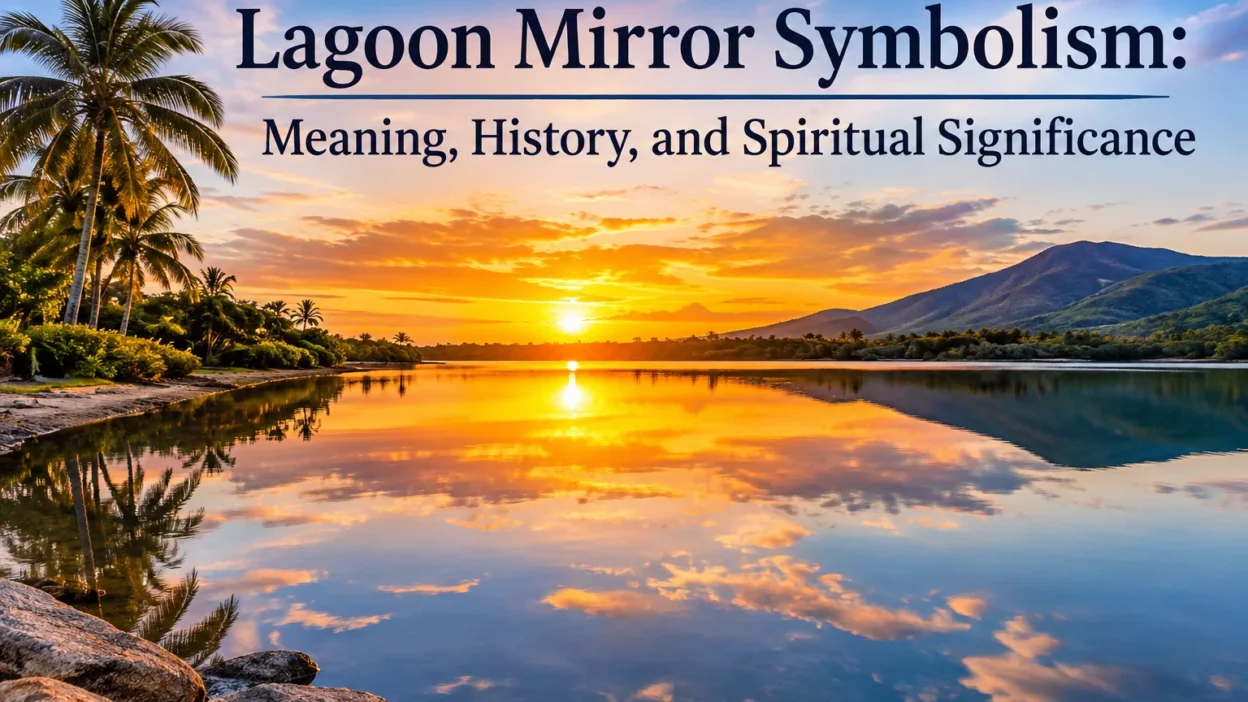
Lagoon mirror symbolism brings together two powerful images: the calm beauty of a lagoon and the reflective quality of a mirror. Together, they suggest self-discovery, emotional balance, hidden truths, and the quiet connection between the outer world and inner life. A still lagoon can resemble a natural mirror, reflecting the sky, surrounding trees, distant mountains, and even the face of someone standing beside it.
In 2026, this image fits naturally into a culture that often connects water with renewal, freedom, solitude, and personal growth. From peaceful coastal landscapes to reflective scenes in movies and nature photography, still water can encourage people to slow down and consider their feelings. However, its meaning can change when the water appears dark, disturbed, or unusually deep.
A lagoon mirror isn’t a universally established historical symbol with one fixed definition. Instead, it combines the traditional associations of water, mirrors, and natural landscapes into a meaningful image. Understanding these connections helps explain why a quiet body of water can represent both peaceful awareness and the mysteries hidden beneath the surface.
Quick Answer
Lagoon mirror symbolism in the United States commonly suggests self-reflection, emotional calm, inner truth, and personal renewal. More broadly, it can represent the boundary between the visible world and hidden feelings, reminding us that appearances may reveal only part of a deeper reality.
TL;DR
- A still lagoon represents peace, emotional balance, and quiet reflection.
- A mirror-like surface symbolizes self-awareness and the search for truth.
- Together, they suggest personal growth and a connection with nature.
- Dark or disturbed water may represent uncertainty and hidden emotions.
- Modern art and photography use reflective lagoons to create contemplative moods.
- The symbol’s meaning depends on the setting, culture, and personal experience.
What Is Lagoon Mirror Symbolism?
Lagoon mirror symbolism describes the meanings people may find in a lagoon that reflects its surroundings like a mirror. The image combines the natural qualities of enclosed or sheltered water with the familiar idea of reflection. For American readers, it can evoke peaceful landscapes, personal discovery, and the desire to escape everyday noise.
The Appearance of a Lagoon Mirror
A lagoon mirror usually appears as a quiet stretch of water with a smooth surface. It might reflect palm trees, reeds, mountains, clouds, a sunset, or a person standing along the shore.
The colors help shape its meaning. Blue and turquoise water often suggest peace and openness, while green reflections can evoke renewal and natural harmony. Golden reflections may suggest warmth, hope, or a meaningful moment.
However, a lagoon doesn’t need to be perfectly still to carry symbolic meaning. Small ripples can create a fragmented reflection, suggesting changing emotions or an incomplete understanding of oneself.
The Main Symbolic Elements
The image combines three related ideas:
- Lagoon: A sheltered space associated with protection, rest, and natural beauty.
- Mirror: A reflective surface associated with identity, truth, and self-examination.
- Reflection: An image that resembles reality but may change with light, movement, and perspective.
Together, these elements create a symbol of looking inward while remaining connected to the outside world.
Historical Background of Lagoon Mirror Symbolism
The exact phrase lagoon mirror symbolism doesn’t have a widely documented ancient origin. Its meaning is better understood through the longer histories of water symbolism, reflective surfaces, and human relationships with coastal environments.
Ancient Connections Between Water and Reflection
Ancient societies often depended on rivers, lakes, springs, and coastal waters for food, travel, agriculture, and survival. As a result, water gained practical, spiritual, and mythological importance across many civilizations.
In ancient Greek mythology, water could connect the human world with divine powers and mysterious realms. The story of Narcissus, who becomes captivated by his reflection in the water, later became an influential image of self-absorption and the dangers of confusing an appearance with reality.
Although this myth doesn’t specifically concern a lagoon, it demonstrates how reflective water has long encouraged people to think about identity, beauty, and perception.
The Development of Mirrors
Before modern glass mirrors became common, people used polished metal and reflective water to see their faces. Bronze mirrors appeared in several ancient civilizations, including Egypt, Greece, and China.
Mirrors gradually acquired associations beyond physical appearance. Depending on the culture and setting, they could suggest status, beauty, spiritual insight, vanity, or the ability to recognize hidden truths.
A lagoon that reflects the world combines these older associations without necessarily belonging to one specific tradition.
From Myth to Modern Imagery
Over time, artists, writers, and photographers increasingly used reflective landscapes to communicate feelings that are difficult to express directly. Still water became a way to show solitude, memory, longing, and contemplation.
Today, a lagoon reflecting the sky can function as a visual metaphor for the mind. The surface shows what is visible, while the water’s depth suggests experiences and feelings that remain unseen.
Lagoon Mirror Symbolism in the United States
In the United States, lagoon mirror symbolism connects with familiar ideas about nature, personal freedom, and emotional renewal. The image may remind people of tropical vacations, quiet parks, coastal wetlands, or moments spent away from crowded cities.
Nature, Escape, and Personal Freedom
American culture often celebrates outdoor recreation and the opportunity to find peace in natural spaces. A secluded lagoon can represent a temporary escape from demanding schedules, technology, and social pressure.
For example, someone who photographs still water during a trip to Florida or Hawaii might associate the scene with freedom, rest, or a fresh start. The reflection becomes a reminder of a moment when life felt less complicated.
However, these associations aren’t universal. Someone who grew up near coastal wetlands may connect a lagoon with home, family memories, fishing, or environmental responsibility instead.
Reflection and the American Idea of Reinvention
Personal growth and reinvention are familiar themes in American storytelling. People often describe major life changes as opportunities to rediscover themselves, reconsider their values, or begin again.
A lagoon mirror fits this theme because it invites a person to pause and examine their life. Its reflection can represent the person someone believes they are, while the water beneath it suggests experiences that have shaped them.
This interpretation works especially well in stories about moving to a new place, recovering from disappointment, changing careers, or learning to accept oneself.
Common American Associations
| Context | Possible Meaning | Common Association |
|---|---|---|
| Tropical lagoon | Relaxation and escape | Vacations and freedom |
| Still water at sunrise | Renewal and hope | Fresh beginnings |
| Reflection in a quiet park | Self-awareness | Personal growth |
| Dark lagoon at night | Mystery and uncertainty | The unknown |
| Polluted or damaged lagoon | Loss and responsibility | Environmental protection |
These are interpretive associations rather than official meanings. The setting and the viewer’s experience determine which interpretation feels most relevant.
Spiritual Meaning of Lagoon Mirror Symbolism
Spiritually, a lagoon mirror can represent inner awareness, stillness, and the search for meaning. Its reflective surface encourages a person to look beyond immediate distractions and consider what may be happening beneath the surface of everyday life.
Inner Peace and Spiritual Awareness
Still water often appears in spiritual imagery because it provides a simple picture of calmness. When the surface becomes quiet, its reflections become clearer.
By comparison, moving or turbulent water may suggest a mind filled with worry, confusion, or competing desires. This doesn’t mean that emotional movement is bad. Instead, the contrast illustrates how different states of mind can influence what a person notices.
A lagoon mirror can therefore symbolize the value of patience, quiet thought, and honest self-examination.
The Boundary Between the Visible and Invisible
A reflection looks like the real world but isn’t the world itself. This creates a natural metaphor for the difference between outward appearances and inner experience.
Someone might seem confident while privately feeling uncertain. Likewise, a beautiful lagoon may conceal deep water, shifting currents, or living creatures beneath its surface.
In spiritual interpretation, this contrast can encourage humility. What people see first may be meaningful, but it rarely tells the entire story.
Personal Interpretations Without Fixed Rules
There isn’t one universal spiritual message attached to a lagoon mirror. Some people may interpret it through prayer or meditation, while others may approach it through personal reflection or a connection with nature.
The image can be meaningful without requiring a supernatural explanation. Its power may come simply from the experience of watching a landscape become visible on the water.
Emotional and Psychological Meaning of a Lagoon Mirror
A lagoon mirror can evoke calmness, curiosity, nostalgia, or uneasiness, depending on its appearance. Psychologically, the image works because it combines a familiar reflection with an environment that can feel both safe and mysterious.
Self-Reflection and Identity
Looking at a reflection can encourage people to consider how they see themselves. A lagoon adds another layer because its reflection changes with light, weather, and movement.
This makes it a useful metaphor for identity. People remain themselves while also changing through relationships, experiences, mistakes, and new knowledge.
For instance, a person revisiting a childhood lake might recognize the landscape immediately but feel different about the memories attached to it. The water becomes a reminder that personal identity includes both continuity and change.
Calmness, Solitude, and Emotional Balance
Quiet natural scenes can provide a welcome break from busy surroundings. A smooth lagoon may evoke a feeling of mental space, especially when its reflection creates a balanced, symmetrical composition.
Common emotional associations include:
- Peace: A sheltered body of water suggests a pause from daily pressure.
- Clarity: A clear reflection can represent a better understanding of one’s feelings.
- Nostalgia: Familiar landscapes may bring back memories of childhood or travel.
- Mystery: Dark or deep water can evoke curiosity about what remains unseen.
- Acceptance: A changing reflection can remind people that change is natural.
These feelings depend on individual experience. A lagoon that feels peaceful to one person might remind another of isolation or danger.
What Does a Lagoon Mirror Mean in Dreams?
A lagoon mirror in a dream can be interpreted as an image of self-reflection, emotional awareness, or uncertainty. However, dream symbols don’t have scientifically established universal meanings, and a dream alone cannot reliably reveal a hidden truth about someone.
Calm and Clear Lagoon Water
A peaceful lagoon may reflect a person’s wish for rest, clarity, or emotional stability. If the dream feels comforting, the scene might connect with a current need for space or a desire to slow down.
The reflection itself may also draw attention to self-image. Consider whether you recognized yourself, saw something unexpected, or simply watched the landscape.
Dark or Disturbed Reflections
Dark water might create a feeling of uncertainty, while broken reflections could represent confusion or a changing perspective. However, these interpretations aren’t predictions of future events.
The most useful approach is to consider the dream’s emotional tone and your recent experiences. Ask yourself what the lagoon reminded you of and whether that connection feels relevant to your waking life.
Lagoon Mirror Symbolism Across Cultures
Reflective water appears in many cultural and spiritual traditions, but its meanings vary. Understanding these differences helps distinguish broad human themes from beliefs that belong to particular communities.
East Asian Traditions
In several East Asian philosophical and artistic traditions, still water serves as an image of calm observation and natural harmony. In Chinese landscape painting, reflective lakes and rivers can help express the relationship between people and the wider natural world.
In Japanese gardens, ponds may reflect surrounding plants, rocks, and buildings, creating a sense of changing beauty and careful balance. These interpretations offer useful comparisons, but they shouldn’t be treated as a single belief shared by every person in either culture.
Indigenous Relationships With Water
Indigenous communities in the United States have diverse relationships with lakes, wetlands, rivers, and coastal environments. Water may hold cultural, practical, spiritual, and ancestral importance, depending on the specific nation and place.
It would be misleading to assign one spiritual meaning to all Indigenous traditions or assume that a lagoon mirror is a traditional Indigenous symbol. Respectful interpretation requires attention to the particular community, its history, and its own teachings.
European Folklore and Reflective Water
European folklore often portrays water as a threshold between familiar places and mysterious realms. Legends may connect lakes, pools, or springs with supernatural encounters, hidden treasures, or beings that live beyond ordinary human experience.
Mirrors also appear in folklore as objects associated with beauty, truth, vanity, and the supernatural. Combining these ideas can make a lagoon mirror feel like a doorway to the unknown, even though that combination isn’t a single established folklore tradition.
Lagoon Mirror Symbolism in Art, Literature, and Photography
Artists use reflective water to create visual balance and suggest meanings that extend beyond the landscape itself. In the United States, this imagery appears naturally in travel photography, environmental art, landscape painting, and stories about personal change.
Reflection as a Literary Device
In literature, a reflective landscape can mirror a character’s emotional state without directly explaining it. A peaceful surface may accompany a moment of acceptance, while a distorted reflection might appear during a period of uncertainty.
For example, a character standing beside a lagoon after a difficult conversation could see the sky reflected in the water. That scene might suggest a growing awareness of their feelings or a new way of understanding an old problem.
The meaning comes from the surrounding story rather than the water alone.
Visual Balance and Natural Beauty
Photographers often place the horizon near the center of an image to emphasize symmetry between the landscape and its reflection. Soft light, muted colors, and a lack of movement can create a quiet, contemplative mood.
However, perfect symmetry isn’t necessary. A single ripple or floating leaf may make the image feel more natural and remind viewers that stillness is temporary.
Modern Uses of Lagoon Mirror Symbolism
Today, the image can appear in home decor, creative projects, personal photography, and designs inspired by nature. Its appeal lies in its ability to suggest calmness and depth without relying on complicated imagery.
Tattoos and Personal Identity
A lagoon mirror tattoo may represent a personal turning point, a connection with a meaningful place, or a desire for emotional balance. Some designs include mountains, trees, moonlight, or a sunrise reflected in the water.
Others may use a simple horizontal line and a small reflection to suggest stillness or self-awareness. The intended meaning depends on the wearer, not on a fixed tattoo dictionary.
Home Decor and Interior Design
Reflective water imagery can bring a quiet, natural atmosphere into a living space. Prints of still lagoons, coastal scenes, and mirrored landscapes often suit rooms designed for rest or contemplation.
Common design choices include:
- Blue-green water paired with neutral walls for a relaxed atmosphere.
- Golden sunrise reflections to suggest warmth and renewal.
- Misty lagoons for a softer, more mysterious mood.
- Dark water imagery for dramatic contrast and visual depth.
These choices are aesthetic interpretations rather than formal symbolic rules.
Social Media and Digital Creativity
On social media, reflective landscapes often accompany captions about growth, gratitude, solitude, or new beginnings. A lagoon mirror can communicate a mood without requiring a long explanation.
However, the image doesn’t automatically reveal the creator’s emotional state. A person may post a peaceful lagoon simply because they enjoy its colors, composition, or natural beauty.
Misunderstandings and Controversies
Because lagoon mirror symbolism is an interpretive combination rather than a universally recognized traditional symbol, misunderstandings can arise when people present personal readings as established historical facts. A thoughtful explanation separates documented traditions from creative interpretations.
Is a Lagoon Mirror an Ancient Sacred Symbol?
There isn’t strong evidence that lagoon mirror was a widely recognized ancient symbol with one consistent meaning. Ancient cultures did attach significance to water and mirrors, but those histories don’t prove that this exact combination had a shared, formal meaning.
It’s more accurate to describe lagoon mirror symbolism as a modern interpretive image rooted in older symbolic themes.
Does a Lagoon Mirror Always Mean Peace?
No. A clear lagoon may suggest calmness, but dark water can feel threatening, and a distorted reflection may suggest uncertainty.
Context matters. A lagoon in a joyful travel photograph communicates something different from a deserted lagoon in a suspenseful film.
Avoiding Cultural Misrepresentation
Designers and writers should avoid assigning a lagoon mirror meaning to a specific religious or Indigenous tradition without reliable evidence. Broad similarities between water symbols don’t establish that different cultures share the same beliefs.
Personal interpretation remains valid when presented honestly as personal interpretation. The problem arises when an invented meaning is promoted as an ancient fact or used to misrepresent a living tradition.
How Lagoon Mirror Symbolism Has Changed Over Time
The underlying ideas of reflection and meaningful water are old, but their modern combination continues to evolve. Changes in art, photography, travel, and digital communication influence how people experience the image.
Read More: Infinity Symbolism: Meaning, History, and Modern Uses
From Practical Reflection to Inner Awareness
Historically, reflective surfaces helped people observe their appearance and surroundings. Water also supported daily life and carried different meanings within local stories, religious practices, and cultural traditions.
Over time, writers and artists increasingly used reflections as metaphors for identity, memory, and perception. Modern interpretations build on those themes while adding personal ideas about emotional health, self-understanding, and connection with nature.
The Influence of Photography and Digital Media
Modern cameras can capture a lagoon’s reflection with striking detail. Images of turquoise water, misty horizons, and mirrored skies circulate widely because they are visually appealing and easy to connect with emotionally.
Digital culture also encourages short symbolic readings. A photograph may become shorthand for peace, a fresh start, or the desire to disconnect from daily pressures.
Still, modern popularity doesn’t establish an ancient origin. The meaning continues to develop through individual experience and creative use.
FAQs
What Does a Lagoon Mirror Symbolize?
A lagoon mirror commonly symbolizes self-reflection, emotional calm, inner awareness, and the relationship between appearances and deeper feelings. Its meaning depends on the water’s condition and the context in which it appears.
What Is the Spiritual Meaning of a Lagoon Mirror?
Spiritually, it may represent stillness, personal awareness, and a search for deeper understanding. However, there is no single established spiritual interpretation shared by all traditions.
What Does a Mirror-Like Lagoon Mean in Dreams?
It may reflect a desire for peace, a period of self-examination, or uncertainty about a situation. Dream meanings are personal, so your feelings and recent experiences matter more than a universal interpretation.
Does Lagoon Mirror Symbolism Have Ancient Origins?
The exact phrase doesn’t have a widely documented ancient history. Its themes draw on older associations of reflective water, mirrors, mythology, and natural landscapes.
What Does Dark Lagoon Water Symbolize?
Dark water may suggest mystery, uncertainty, hidden feelings, or the unknown. However, it can also represent depth, quietness, or the dramatic beauty of a nighttime landscape.
Why Is a Lagoon Mirror Used in Art and Photography?
Its reflective surface creates visual balance and can communicate peace, nostalgia, mystery, or personal change. Artists can also use ripples and distorted reflections to suggest that perception changes with circumstances.
Conclusion
Lagoon mirror symbolism offers a meaningful way to explore self-awareness, emotional balance, natural beauty, and the difference between appearances and deeper truths. In the United States, it connects especially well with ideas about personal growth, freedom, solitude, and renewal. Its interpretation may also draw on broader cultural associations with water and reflection. Although the exact phrase isn’t a universally established ancient symbol, its individual elements carry long histories. Today, their combination can inspire art, photography, personal expression, and quiet moments of reflection. The next time you see a lagoon reflecting the sky, consider what stands out to you. The image may remind you of peace, a meaningful memory, or something you still hope to understand.