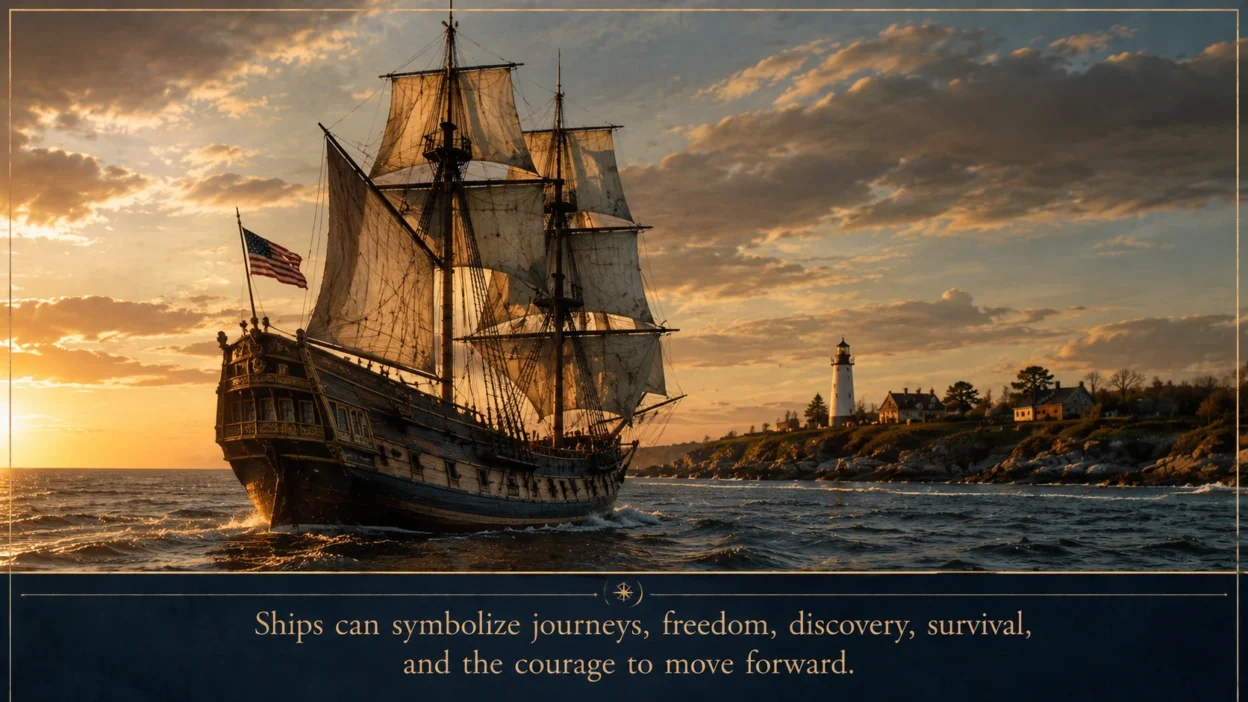
Ships have carried people across oceans for thousands of years. Because of that, they became more than tools for travel. They often represent Ship Symbolism, including journeys, freedom, discovery, survival, and change.
In the United States, ships connect strongly with exploration and immigration. They also recall naval history, trade, coastal life, and the search for a new beginning. For many Americans, a ship can suggest both physical travel and a personal journey.
However, ship symbolism isn’t limited to American history. Across cultures, ships have represented passage, hope, adventure, spiritual movement, and the unknown. Their meaning often changes with the setting, design, and direction of travel.
Quick Answer
Ship Symbolism in the USA often represents journey, freedom, exploration, independence, and resilience. More broadly, ships can symbolize life’s passage, transition, discovery, and movement toward an uncertain future.
TL;DR
- Ships commonly symbolize journeys, exploration, freedom, and personal growth.
- American history connects ships with immigration, trade, exploration, and naval power.
- Ancient cultures used ships as symbols of travel and spiritual passage.
- A ship moving forward can suggest hope and confidence about the future.
- Ship tattoos often represent adventure, family heritage, survival, or independence.
- Modern ship imagery still carries strong emotional and cultural meaning.
What Does a Ship Symbolize?
A ship is one of the clearest symbols of movement. It leaves one shore behind while heading toward another, making it a natural image for transition.
For a USA reader, this symbolism can feel especially familiar. American history contains countless stories of people crossing oceans for trade, exploration, safety, work, or a new life.
Core Meanings of Ships
A ship may symbolize:
- A journey into a new stage of life
- Freedom from familiar limits
- Courage when facing uncertainty
- Exploration of unknown places
- Survival through difficult conditions
- Hope for a better destination
The surrounding details matter, too. A calm sea can suggest peace, while rough waves can represent struggle. A damaged ship may symbolize endurance, loss, or survival.
Historical Origins of Ship Symbolism
Ships have carried symbolic meaning since ancient civilizations depended on waterways. Long before modern nations existed, people used boats and ships to connect distant communities.
Early sailors faced storms, unfamiliar waters, and limited navigation tools. As a result, ships naturally became associated with courage, risk, and trust in forces larger than oneself.
Ancient Maritime Traditions
Ancient Egyptians used boats in both practical and religious settings. Boats appeared in funerary traditions and were linked with movement between realms.
In the ancient Mediterranean, ships became closely connected with commerce, warfare, migration, and exploration. Greek and Roman stories also used sea voyages as settings for danger, transformation, and heroic adventure.
Medieval and Early Modern Meaning
During the medieval period, ships remained important in trade, pilgrimage, warfare, and exploration. Religious art sometimes used a ship as an image of a community moving through danger toward safety.
Later, the great voyages of the 15th and 16th centuries gave ships an even stronger association with discovery. However, those voyages also involved conquest, forced movement, and exploitation, so their historical meaning isn’t purely heroic.
Ship Symbolism in the United States
Ships hold a special place in American history. The country’s geography, economy, immigration story, and military development all involved waterways.
For many Americans, ships bring to mind the Atlantic and Pacific oceans, the Great Lakes, major ports, river systems, and generations of maritime workers.
Ships and American Identity
Ships can represent several parts of the American experience:
- Immigration and the arrival of new communities
- Ocean trade connecting America with other nations
- Naval service and national defense
- Exploration of distant waters
- Coastal communities and working waterfronts
- Personal independence and adventure
The ship also fits a broader American idea of starting over. Someone who leaves one shore for another can become a symbol of courage, possibility, and self-direction.
Ships in American Memory
Historic ships often become floating museums and public landmarks. They preserve stories about sailors, workers, wars, migration, technology, and commerce.
As a result, ship imagery can feel both adventurous and nostalgic. It may remind people of family histories connected to the sea, even when they don’t personally work on boats.
Ships, Freedom, and Independence
The open ocean creates a powerful image of freedom. A ship can move beyond familiar boundaries and choose a new direction.
In American culture, this connects naturally with independence. A ship sailing toward the horizon can represent someone making their own way.
The Open Sea
The sea has no visible road in the usual sense. A ship must find its route through changing conditions.
That makes the ship a useful metaphor for personal independence. You may not know every part of the journey, but you can still choose a direction and keep moving.
The Ship as a Personal Symbol
People sometimes choose ship imagery when they want to express:
- Independence from past limitations
- A desire for adventure
- Confidence during major change
- A willingness to accept uncertainty
- A strong connection with the sea
Ship Symbolism of Journeys and Life Changes
A ship naturally represents a journey because it physically carries people from one place to another. This makes it a common metaphor for life’s major transitions.
For example, a ship can represent leaving home, beginning a career, entering adulthood, or starting a new relationship.
Leaving and Arriving
The departure and destination both matter. A ship leaving a harbor can suggest separation or courage.
By contrast, a ship arriving safely can suggest completion, reunion, or achievement. The same image can therefore carry different meanings depending on its position.
The Voyage as a Life Metaphor
A voyage often mirrors human experience. There are calm periods, unexpected storms, wrong turns, repairs, and moments when the destination becomes clear.
That makes the ship especially useful as a symbol of resilience. It doesn’t need perfect weather to keep moving.
Spiritual and Cross-Cultural Meanings of Ships
Ship symbolism appears in many cultures and spiritual traditions. These meanings vary widely, so no single interpretation applies everywhere.
Still, one common pattern appears repeatedly: the ship carries people through a difficult or uncertain passage.
Spiritual Passage
In some traditions, water represents transformation, mystery, or a boundary between different states of existence. A boat or ship crossing water can therefore represent spiritual movement.
Ancient Egyptian traditions included boats in ideas surrounding the journey after death. In other traditions, water crossings became images of moving from danger toward safety or from one stage of existence to another.
A Symbol of Guidance
A ship also depends on navigation. Historically, sailors used stars, landmarks, compasses, maps, and other tools to find their way.
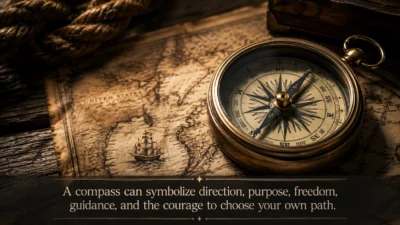
Because of this, ship imagery can suggest guidance and trust. A compass beside a ship often strengthens this meaning.
Emotional and Psychological Meaning of Ships
Ship imagery often creates a feeling of possibility. It suggests that the current situation isn’t permanent and that another destination exists.
At the same time, ships can represent uncertainty. The ocean can be beautiful, but it can also become dangerous without warning.
What a Ship Can Express Emotionally
A ship may evoke:
- Hope during a major transition
- Nostalgia for home or family
- Courage in uncertain circumstances
- Curiosity about unfamiliar experiences
- Relief after surviving hardship
- Longing for freedom and escape
The emotional effect depends heavily on the scene. A bright sailboat feels very different from a broken vessel in a storm.
Ship Symbolism in Tattoos
Ship tattoos remain popular because they combine personal meaning with strong visual imagery. A person may choose a ship to represent travel, heritage, survival, or a significant life transition.
The design can add another layer of meaning. Traditional sailing ships often suggest maritime heritage, while minimalist vessels may represent a simpler idea of movement.
Common Ship Tattoo Elements
A ship tattoo may include:
- An anchor representing stability
- A compass suggesting direction
- Waves representing life’s challenges
- A lighthouse symbolizing guidance
- Stars representing navigation and hope
- A storm suggesting hardship overcome
For some people, the tattoo honors a family member who worked at sea. For others, it marks a difficult chapter that they successfully survived.
Ships in American Art, Decor, and Popular Culture
Ship imagery appears frequently in American homes, coastal design, museums, films, illustrations, and vintage decor.
It can create a sense of adventure without requiring a literal connection to sailing. A framed ship painting may simply make a room feel historic, peaceful, or connected to the coast.
Modern Visual Uses
Today, ships commonly appear in:
- Coastal home decor
- Maritime artwork
- Travel photography
- Clothing and accessories
- Children’s illustrations
- Social media travel imagery
Movies and television also use ships to create stories about exploration, danger, romance, war, and escape. These repeated images keep older symbolic meanings familiar to modern audiences.
Ship Symbolism in American Holidays and Traditions
Ships aren’t tied to one single American holiday. However, maritime imagery appears in events and traditions connected with military service, coastal communities, historical remembrance, and exploration.
Independence-related imagery can sometimes include ships because American history developed through ports, trade routes, naval conflict, and Atlantic travel.
Maritime Memorials
Ships also appear in memorial settings. Historic vessels can preserve memories of military service, immigration, industrial work, and technological change.
This gives the ship another meaning: remembrance. It can represent the people who traveled, worked, served, or struggled aboard it.
Ship Symbolism by Context
The meaning of a ship changes considerably depending on its setting. A ship under full sail doesn’t communicate exactly the same idea as a wrecked ship.
| Context | Meaning in the USA | Common Associations | Notes |
| Ship at sea | Adventure and independence | Travel, freedom | Often emphasizes the journey |
| Ship in a storm | Resilience | Courage, struggle | Focuses on surviving hardship |
| Ship in harbor | Safety and belonging | Home, return | Suggests rest or completion |
| Historic sailing ship | Heritage and exploration | Tradition, discovery | Often carries nostalgic meaning |
| Ship with compass | Direction and purpose | Guidance, decisions | Common in tattoos and artwork |
This is why symbolic interpretation should consider the whole image. The ship itself is only one part of the message.
Ships, Storms, and Resilience
A ship becomes especially powerful when surrounded by rough water. Storm imagery turns a simple journey into a story about endurance.
For American audiences, this can connect with a familiar cultural idea: hardship doesn’t necessarily mean the journey has failed.
Surviving the Storm
A ship that remains afloat during severe weather can symbolize resilience. It may represent someone who has faced loss, uncertainty, or major change and continued forward.
A broken ship creates a different message. It can suggest vulnerability, failure, grief, or the lasting effects of difficult experiences.
Calm Water After Difficulty
A ship emerging from a storm can symbolize recovery. The image suggests that difficult conditions can eventually give way to calmer waters.
That message explains why ships appear in inspirational art and personal tattoos. They offer a simple visual story about endurance.
Misunderstandings and Controversies
Ship symbolism is generally broad and positive, but historical ship imagery can carry complicated meanings.
Some famous voyages are remembered as stories of discovery. Yet those same voyages could involve colonization, violence, forced labor, displacement, or exploitation.
Looking at History Carefully
It helps to separate the symbolic idea of exploration from the full history behind individual voyages. A ship can represent adventure while also being connected to painful historical events.
Similarly, military ship imagery can express service and sacrifice for one person while reminding another person of war. Context and personal experience shape interpretation.
Traditional Symbols and Misuse
A ship isn’t inherently tied to one political or ideological meaning. However, any symbol can be adopted by different groups for particular purposes.
Therefore, the surrounding text, imagery, setting, and historical context matter more than the ship alone.
How Ship Meanings Have Changed Over Time
Ship symbolism has shifted as technology and society changed. Ancient boats were closely tied to survival and local travel, while later ships enabled global trade and long-distance exploration.
Modern ships now include enormous cargo vessels, cruise ships, submarines, research vessels, and advanced naval craft. Each type carries different associations.
From Survival to Adventure
For ancient sailors, a voyage could be a serious survival challenge. Today, a cruise ship may suggest relaxation, tourism, and leisure.
Even so, the older symbolism hasn’t disappeared. Images of sailing ships still evoke courage, discovery, distance, and the unknown.
Why the Old Symbol Still Works
The basic image remains simple. One vessel crosses a huge body of water toward somewhere else.
That visual story still resembles human change. We leave familiar places, face uncertainty, adapt to conditions, and hope to reach a meaningful destination.
What Ships Can Symbolize Today
Modern ship symbolism brings old ideas into everyday life. A person doesn’t need to be a sailor to connect with the image.
Someone beginning a new career might see a ship as a symbol of direction. Someone recovering from hardship might see a storm-tossed vessel as proof of endurance.
Read More: Boat Symbolism: Meaning, History, and American Culture
Personal Meanings
Today, ships can represent:
- Starting a completely new chapter
- Honoring family or maritime heritage
- Seeking freedom and independence
- Remembering someone connected with the sea
- Surviving a difficult period
- Following a personal goal despite uncertainty
Ultimately, the strongest meaning often comes from the person’s own story.
FAQs
What does a ship symbolize spiritually?
A ship can symbolize passage, transformation, guidance, and movement through uncertainty. In some spiritual traditions, crossing water represents moving from one state to another.
What does a ship symbolize in America?
In the United States, ships often represent exploration, freedom, immigration, trade, naval service, and personal journeys. They can also symbolize the country’s long relationship with oceans and waterways.
What does a ship tattoo mean?
A ship tattoo can represent adventure, independence, survival, travel, or family heritage. Anchors, compasses, waves, and storms can add more specific meanings.
What does a ship symbolize in a dream?
A ship in a dream may be interpreted as a journey or major life transition. However, dream meanings aren’t universal, so the dreamer’s emotions and circumstances matter.
What does a ship in a storm symbolize?
A ship in a storm often represents resilience and the ability to face difficult circumstances. It can also express fear, uncertainty, or a struggle that hasn’t ended yet.
What does a ship symbolize in literature?
In literature, ships often represent journeys, discovery, escape, danger, or transformation. A voyage can mirror a character’s emotional or personal development.
Conclusion
Ships have carried symbolic meaning from ancient waterways to modern American culture. They can represent Ship Symbolism through ideas of freedom, exploration, resilience, direction, and change. For many people, the ship remains powerful because its story is easy to understand. It leaves one shore, faces uncertain waters, and keeps moving toward another destination. Whether you see a ship in a tattoo, painting, historic vessel, or coastal home, its meaning can be deeply personal. Sometimes the most meaningful symbol is simply a reminder that your journey is still underway.