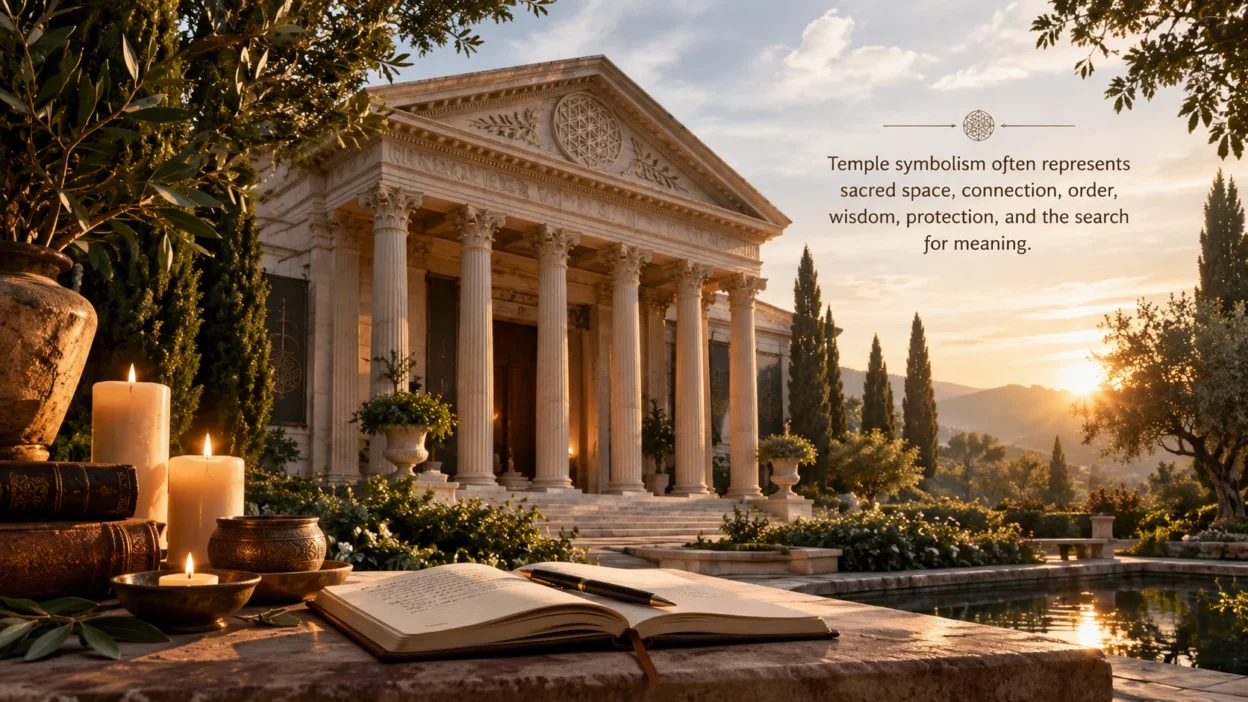
Temples are more than buildings. Across history, people have used them to mark places as sacred, meaningful, or set apart from ordinary life. Temple symbolism can appear through columns, doorways, steps, domes, towers, light, water, and carefully planned spaces.
In 21st century, temples appear in many forms. They can represent religious devotion, history, architecture, community, memory, or personal reflection. Even people who don’t practice a religion may recognize the temple as a powerful image of peace and sacred space.
The meaning becomes richer when you look at how temples developed. Ancient societies built them around gods, ancestors, nature, kingship, and cosmic order. Later traditions gave temple spaces new meanings, while modern culture often uses temple imagery to suggest wisdom, discipline, mystery, or inner peace.
Quick Answer
In the USA, temple symbolism often represents sacred space, spiritual connection, wisdom, order, and a search for deeper meaning. More broadly, temples can symbolize a meeting place between the human world and the divine.
TL;DR
- Temples often symbolize sacred space and spiritual connection.
- Columns, doors, steps, light, and height can carry symbolic meaning.
- Ancient temples connected religion, community, nature, and political power.
- Americans may associate temples with faith, history, architecture, and reflection.
- Modern temple imagery can express peace, wisdom, identity, or mystery.
What Does a Temple Symbolize?
A temple usually represents a space separated from ordinary life. Its walls and boundaries can create a physical reminder that certain activities, beliefs, or experiences deserve special attention.
However, the exact meaning depends on the tradition. A temple may honor a deity, preserve sacred objects, support prayer, mark important ceremonies, or provide a place for meditation.
Sacred Space
The basic idea is simple: the temple creates a special space.
Crossing its entrance can symbolize moving from the ordinary world into a more meaningful environment. This idea appears in many religious traditions.
Common Symbolic Meanings
Temple imagery can suggest several ideas at once:
• Sacred connection between people and the divine
• Wisdom gained through reflection and devotion
• Protection from ordinary distractions and disorder
• Community built around shared beliefs and practices
• A journey toward personal or spiritual transformation
Because of this flexibility, temple imagery remains powerful even outside formal religion.
Ancient Roots of Temple Symbolism
The history of temples reaches deep into the ancient world. Early monumental sacred structures appeared in societies across the Middle East, North Africa, Asia, Europe, and the Americas.
These buildings weren’t simply places to gather. They often represented the structure of the universe as people understood it.
Early Sacred Buildings
Ancient Mesopotamian societies built temples connected with particular deities and cities. Egyptian temples developed elaborate gateways, courtyards, halls, and sanctuaries.
Meanwhile, Greek temples became strongly associated with proportion, columns, and idealized architectural order. Roman builders later adapted many Greek forms while creating their own religious and civic traditions.
Height and the Divine
Height has long carried symbolic power.
A raised platform, staircase, tower, or mountain-like structure can suggest movement toward heaven or a higher reality. This helps explain why elevated sacred buildings appear in many different cultures.
However, these traditions developed independently in many places. Similar shapes don’t always mean identical beliefs.
Temple Architecture and Symbolic Design
Temple architecture communicates through more than religious decoration. The structure itself can tell a story about movement, order, power, and sacredness.
For American readers, this is especially visible in historic architecture. Classical columns, domes, symmetrical entrances, and monumental steps often communicate importance even when the building isn’t religious.
Columns and Entrances
Columns can suggest stability and endurance. They also create a visual sense of order.
Likewise, a large doorway can symbolize transition. Entering through it may represent leaving one state behind and entering another.
Light, Water, and Space
Light often suggests knowledge, hope, purity, or divine presence. Water can represent cleansing, renewal, life, or transformation.
Open courtyards can also create a connection with nature. In contrast, darker inner rooms may encourage quietness, mystery, or focused attention.
Temple Symbolism in the United States
American culture contains many different understandings of temples. Some are connected directly with religious communities, while others appear through architecture, art, literature, and popular culture.
The USA’s religious diversity has also shaped how people encounter temple imagery. Hindu, Buddhist, Latter-day Saint, and other communities have established temple traditions in American communities.
Temples and American Identity
For many Americans, a temple can represent faith and community. It may also become an important landmark within a city or region.
At the same time, Americans sometimes use classical temple designs for government buildings, memorials, museums, universities, and monuments. These structures can borrow temple-like features to communicate permanence and importance.
Common American Associations
| Context | Meaning in the USA | Common Associations | Notes |
| Religious temple | Sacred devotion | Prayer, ritual, community | Meaning varies by tradition |
| Classical building | Stability and importance | Columns, order, heritage | Often inspired by Greece or Rome |
| Memorial structure | Memory and honor | Permanence, sacrifice, respect | Usually symbolic rather than devotional |
| Meditation space | Reflection and peace | Silence, balance, nature | Can be religious or secular |
| Fiction and media | Mystery and discovery | Ancient knowledge, secrets | Often highly imaginative |
Spiritual Meanings of Temples
Temples have important spiritual meanings across many traditions. However, no single definition applies to every religion.
In Hindu traditions, temples can serve as places where devotees encounter and honor divine forms. Buddhist temple complexes can support meditation, teaching, devotion, and community life.
Sacred Connection
A temple can symbolize a connection between visible and invisible realities. The building becomes a setting where people express beliefs that extend beyond everyday material life.
In some traditions, the temple is also understood as a representation of cosmic order. Its layout, images, directions, or rituals can carry layers of meaning.
A Note on Religious Differences
It’s important not to treat all temples as interchangeable.
Hindu temples, Buddhist temples, ancient Greek temples, and other sacred buildings developed within different traditions. Their similarities can be visually interesting, but their religious meanings may differ greatly.
Psychological Meaning of Temple Imagery
Temple imagery can affect people even when they don’t share the religious tradition behind it. Symmetry, height, enclosure, silence, and natural materials can create strong emotional impressions.
For example, a tall structure may make someone feel small or reflective. A quiet interior may encourage calm and focused attention.
Common Emotional Associations
Temple imagery often suggests:
• Peace during periods of stress or uncertainty
• Wisdom developed through reflection and experience
• Stability when life feels unpredictable
• Mystery surrounding questions without simple answers
• Belonging through shared traditions and community
These responses aren’t universal. Personal experience, culture, religion, and memories all influence how someone interprets a temple.
Temple Symbolism in Art and Literature
Artists and writers have long used temples as settings for important encounters. A temple can become a place where characters discover knowledge, face a challenge, or confront the unknown.
In American storytelling, ancient temples often appear in adventure, fantasy, horror, and historical fiction. These fictional versions may include hidden chambers, lost civilizations, sacred objects, or mysterious guardians.
The Temple as a Journey
A temple can represent more than a destination.
A character who travels toward a temple may also be moving toward knowledge or self-understanding. The journey becomes symbolic because reaching the building requires effort, patience, or courage.
Mystery and Ancient Knowledge
Modern entertainment sometimes presents temples as containers of forgotten knowledge. This is a creative convention rather than a reliable description of real religious history.
Still, it works because temples already carry associations with memory, tradition, and things considered sacred.
Temple Symbolism in Tattoos and Personal Identity
Temple imagery can appear in tattoos as an expression of personal values. Someone may choose a temple to represent spirituality, discipline, heritage, peace, or a personal turning point.
However, the meaning depends heavily on the specific design.
Common Tattoo Elements
• Columns can emphasize strength, order, or endurance.
• Steps can represent growth and a personal journey.
• Mountains can connect temples with spiritual elevation.
• Sunlight can suggest hope, awareness, or renewal.
• Doors can symbolize opportunity, transition, or discovery.
People may also combine temple imagery with flowers, animals, geometric patterns, or religious symbols.
Because sacred images can carry specific meanings, thoughtful research helps prevent accidental misuse.
Temples in Home Decor and Modern Culture
Temple-inspired design has become a recognizable visual language. Arches, columns, stone textures, symmetry, candles, and peaceful gardens can create a sense of calm.
In American homes, these elements may be used without a direct religious meaning. They can suggest classical beauty, retreat, meditation, or timelessness.
Social Media and Visual Culture
Online imagery often presents temples against mountains, forests, oceans, or dramatic skies. These scenes can communicate escape and reflection.
However, social media can simplify complex traditions. A sacred building may become an aesthetic image without its original religious context.
That isn’t automatically disrespectful, but context matters when sacred symbols are involved.
Temples, Holidays, and Community Life
Temples can become especially visible during religious festivals and major community events. Decorations, ceremonies, gatherings, and seasonal traditions can bring sacred spaces into public attention.
In the United States, this visibility reflects the country’s religious diversity. Local temple communities may also participate in cultural events, educational programs, charitable activities, and neighborhood life.
Beyond Religious Ceremonies
Temples can function as community anchors.
They may preserve language, art, music, food traditions, and family customs. For immigrants and later generations, a temple can therefore represent both spiritual belonging and cultural continuity.
Misunderstandings and Misuse of Temple Imagery
Temple symbols sometimes become simplified in popular culture. A building may be described as an ancient temple even when its design is modern or fictional.
Another common problem is treating different religious traditions as if they share one universal system. They don’t.
Respectful Use
When using temple imagery, context makes a difference. A fictional building inspired by ancient architecture isn’t the same as reproducing a living religious site as decoration.
People should also avoid presenting invented rituals or symbols as authentic traditions. This is particularly important when commercial or entertainment settings borrow sacred imagery.
How Temple Meanings Have Changed
Temple symbolism has never had one fixed meaning. Its associations have shifted as societies, religions, governments, and artistic movements changed.
Ancient temples could connect religion with political authority and the life of a city. Later traditions developed different ideas about sacred buildings, while modern societies often use temple-like architecture in secular settings.
From Sacred Building to Cultural Symbol
Today, temple imagery can represent spirituality without belonging to one specific religion.
It can also symbolize history, wisdom, peace, discipline, or the preservation of tradition. This broader use explains why temple designs appear in architecture, tattoos, films, games, gardens, and artwork.
What Has Stayed Consistent?
Despite these changes, several themes remain remarkably durable.
Sacredness, order, transition, community, and connection to something greater than ordinary life continue to shape temple imagery. The details change, but the basic idea of a meaningful space remains powerful.
Why Temple Symbolism Still Matters Today
Modern life is often fast, noisy, and highly connected. As a result, images of quiet sacred spaces can feel especially appealing.
A temple can represent the desire to pause and step away from constant demands. It can also remind people that some values are built slowly through tradition, practice, and reflection.
Read More: Church Symbolism: Meaning, History, and Modern Use
A Symbol of Inner Space
Some modern interpretations treat the temple as a metaphor for the human mind or inner life.
In that reading, caring for your inner world resembles caring for a sacred space. The idea doesn’t require a particular religious belief, but it borrows the temple’s long association with attention and meaning.
FAQs
What does a temple symbolize spiritually?
A temple can symbolize sacred connection, devotion, reflection, and contact with the divine. Its specific spiritual meaning depends on the religious tradition.
What does a temple represent in America?
In the United States, temples can represent religious faith, cultural heritage, community, history, architecture, and personal reflection. Classical temple-inspired buildings can also symbolize permanence and civic importance.
Why are temples often built with columns?
Columns can communicate strength, order, stability, and grandeur. Classical Greek and Roman architecture strongly influenced the use of columns in later Western buildings.
What does a temple tattoo mean?
A temple tattoo can represent spirituality, wisdom, strength, heritage, peace, or a personal journey. The meaning often changes depending on accompanying symbols and the wearer’s story.
Are temples always religious?
No. Historically, temples were strongly connected with religious practices, but modern temple-like designs can also appear in secular architecture, art, fiction, and personal symbolism.
Why are temples associated with mountains and high places?
Height can symbolize closeness to heaven, spiritual elevation, or separation from ordinary life. However, this association differs across cultures and shouldn’t be treated as a universal religious rule.
Conclusion
Temple symbolism brings together ideas of sacred space, wisdom, protection, order, community, and connection with something greater. Its visual language often comes through architecture, light, height, entrances, columns, water, and carefully arranged spaces. Ultimately, the temple remains powerful because it suggests that some places, moments, and values deserve our full attention. That simple idea continues to give temple imagery meaning in modern life.