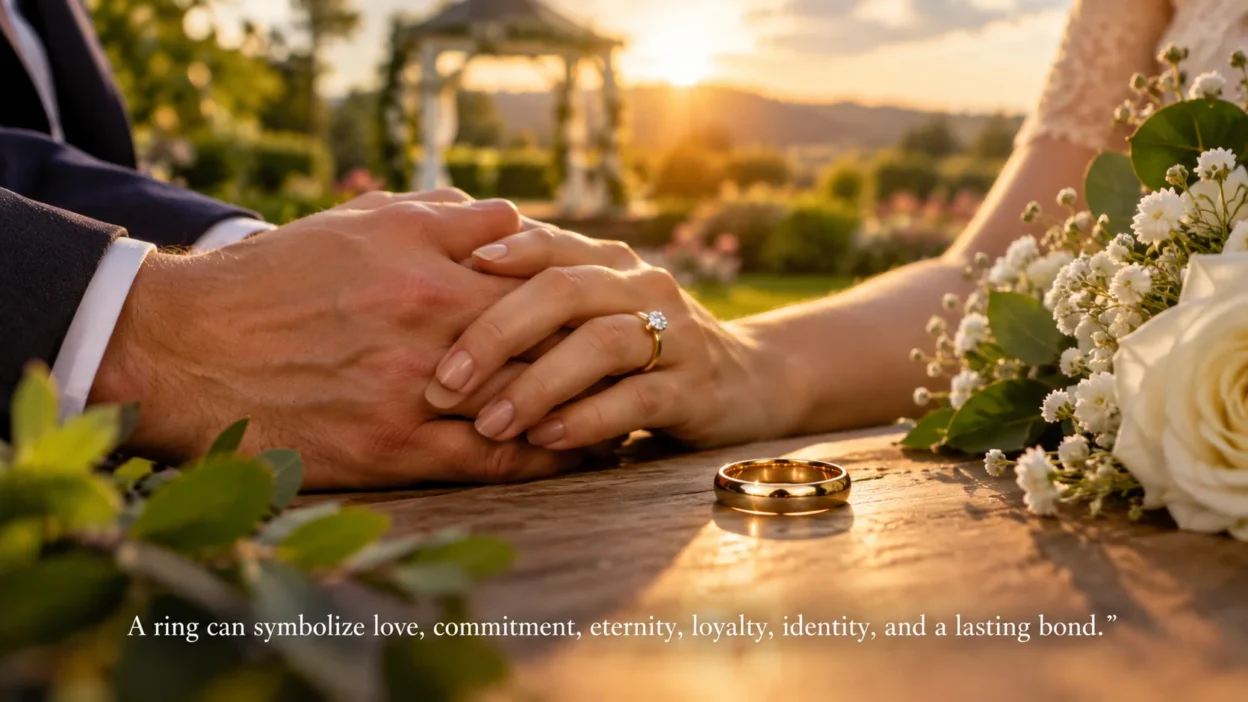
A ring is more than a piece of jewelry. Ring Symbolism often connects the simple circular shape with love, commitment, eternity, identity, and belonging.
In the world, rings appear in weddings, engagements, graduations, family traditions, memorials, and everyday fashion. A person may wear one to mark a relationship, remember someone, celebrate an achievement, or express personal style.
The meaning depends strongly on the ring’s material, design, and setting. A plain gold band can suggest commitment, while a signet ring may express family history or identity.
Quick Answer
Ring Symbolism in the USA commonly represents love, commitment, continuity, loyalty, identity, and lasting connection. The circle’s unbroken form makes it especially powerful as a symbol of eternity, while its personal use can also represent family, achievement, memory, or status.
TL;DR
- Rings often symbolize commitment, connection, and lasting relationships.
- The circle can represent eternity because it has no visible beginning.
- Wedding and engagement rings strongly connect rings with romantic commitment.
- Gold and gemstones can add meanings of value, beauty, or status.
- Family rings may represent heritage, memory, and belonging.
- Modern rings can also express identity, style, achievement, or remembrance.
What Does a Ring Symbolize?
A ring can symbolize different things depending on who wears it and why. However, several meanings appear repeatedly across American culture.
The most familiar meanings involve relationships and commitment. At the same time, rings can communicate family heritage, social identity, personal achievement, or remembrance.
Common Ring Meanings
- Love: affection and emotional attachment
- Commitment: dedication to a person, promise, or purpose
- Eternity: continuity and an enduring bond
- Loyalty: faithfulness and trust
- Marriage: partnership and shared life
- Identity: personal, family, professional, or cultural belonging
- Status: achievement, wealth, or social position
- Memory: remembrance of a person or meaningful period
Because the same object can carry several meanings, context remains important.
A wedding band worn by a married person has a different message from a decorative fashion ring. Likewise, a class ring can represent achievement rather than romance.
Why Does a Ring Symbolize Eternity?
The circle is central to ring symbolism. It has no obvious beginning or ending, which makes it a natural image for continuity and eternity.
This idea became especially powerful when rings were exchanged as promises. The circular form could represent a bond that continues beyond a single moment.
The Meaning of the Circle
The circle can suggest:
- continuity
- wholeness
- unity
- balance
- infinity
- protection
- completeness
- lasting connection
However, a ring doesn’t automatically symbolize eternity. Its meaning comes from the combination of shape, cultural tradition, personal intention, and context.
What Is the History of Ring Symbolism?
Rings have a long history stretching across ancient societies. People used them for practical purposes, decoration, identification, social signaling, and ceremonial exchange.
Ancient Egyptians used rings and other circular objects as meaningful forms of jewelry. Some rings incorporated materials such as leather, bone, or metal, while scarab rings could carry religious or protective associations.
Ancient Roman society also gave rings important social and practical roles. Rings could mark identity, wealth, social position, or agreements.
Ancient Rings and Identity
Signet rings are especially important in the history of symbolism. Their engraved surfaces could create an identifying mark when pressed into wax or another material.
As a result, the ring could represent authority as well as identity.
This connection between jewelry and identity continued through later European societies. Rings became associated with family names, institutions, professions, and important life events.
Medieval and Renaissance Traditions
During medieval Europe, rings became increasingly connected with religious ceremonies, marriage, social status, and personal devotion.
Some rings carried inscriptions or symbolic designs. Others included religious images, gemstones, or decorative patterns.
Over time, rings became an increasingly familiar part of courtship and marriage traditions.
How Did Wedding Rings Become Symbols of Marriage?
Wedding rings are among the clearest examples of symbolic jewelry in American culture. The circular form naturally supports ideas of continuity, while the exchange itself represents a shared promise.
However, wedding-ring traditions developed over many centuries rather than appearing in their modern form all at once.
Ancient and Medieval Connections
Ring exchanges existed in ancient Roman marriage customs. Later European traditions also connected rings with betrothal, marriage, and religious ceremony.
Different societies gave these practices different meanings. Therefore, today’s wedding ring should not be treated as a direct copy of one ancient custom.
Instead, it reflects layers of traditions that developed and changed over time.
Modern American Weddings
In the United States, couples commonly exchange wedding rings during marriage ceremonies. Many people also wear them every day as visible reminders of their relationship.
Some couples choose matching bands. Others select different designs that reflect their individual tastes.
The symbolism can therefore combine shared commitment with personal identity.
What Do Engagement Rings Symbolize?
An engagement ring generally symbolizes a promise or intention connected with marriage. In modern American culture, it often marks the period between deciding to marry and the wedding ceremony.
The center stone can add another layer of meaning. Diamonds are commonly associated with durability, rarity, value, and lasting love, although other gemstones are also widely used.
Engagement Ring Meanings
An engagement ring can represent:
- romantic commitment
- intention to marry
- shared future plans
- trust between partners
- celebration of a relationship
- personal taste and identity
Today, couples also make individual choices about who proposes, which ring to choose, and whether to exchange rings at all.
These choices show how older traditions can adapt to modern relationships.
What Do Different Ring Materials Symbolize?
Materials can influence how people interpret a ring. Gold, silver, platinum, and gemstones each carry their own cultural associations.
However, these meanings are not universal rules. A person’s reason for choosing a material may be practical, sentimental, financial, or purely aesthetic.
| Ring Material or Design | Common Meaning in the USA | Common Associations | Context |
| Gold | Value and lasting commitment | Warmth, prosperity, tradition | Weddings and heirlooms |
| Silver | Elegance and simplicity | Clarity, modern style | Everyday and fashion rings |
| Platinum | Durability and luxury | Strength, rarity, permanence | Fine jewelry and wedding rings |
| Diamond | Enduring love and value | Rarity, brilliance, durability | Engagement and wedding jewelry |
| Family signet | Heritage and identity | Family history, status, belonging | Heirlooms and formal wear |
Gold Rings
Gold has long been connected with value, wealth, beauty, and permanence. Its resistance to corrosion also makes it a fitting material for jewelry intended to last.
In American weddings, gold bands can therefore carry both traditional and personal meanings.
Silver Rings
Silver often creates a cooler, simpler appearance. Modern wearers may choose it for affordability, style, versatility, or personal preference.
Its symbolism is less fixed than that of a wedding band. Context usually tells you more than the metal alone.
What Do Rings Symbolize in American Culture?
In the United States, rings appear in many areas of everyday life. Their meaning extends well beyond marriage.
For example, class rings can represent education and achievement. Championship rings can mark athletic success, while family rings can preserve memories across generations.
Rings as American Milestones
Common examples include:
- engagement rings
- wedding bands
- class rings
- championship rings
- graduation rings
- memorial rings
- family heirloom rings
- friendship or promise rings
These examples show why ring symbolism is so flexible. The same circular object can mark romance, achievement, memory, or belonging.
Family and Heirloom Rings
An inherited ring can become a physical link between generations. Its value may come from the person who owned it rather than its material price.
For some families, passing down a ring becomes a way to preserve stories and memories.
The symbolism therefore moves beyond jewelry. The ring becomes a small object carrying a larger family history.
What Is the Spiritual Meaning of Rings?
Rings can have spiritual meanings in several traditions. Their circular form can suggest unity, continuity, wholeness, and an unbroken relationship.
Religious communities have also used rings in different ceremonial and symbolic ways. However, these meanings vary considerably, so no single spiritual interpretation applies everywhere.
Rings in Religious Traditions
Some Christian traditions use rings in marriage ceremonies as visible signs of commitment. Clergy and religious communities have also used special rings connected with office or authority.
In other traditions, rings may carry protective inscriptions, sacred imagery, or devotional meanings.
These uses show how jewelry can become part of a larger symbolic language.
Broader Spiritual Associations
Outside specific religious traditions, people may interpret rings as symbols of:
- unity between people
- continuity through change
- personal wholeness
- spiritual commitment
- cycles of life
- connection with something larger
These interpretations are personal and can differ greatly between individuals.
What Is the Psychological Meaning of Wearing a Ring?
A ring can serve as a physical reminder of an idea, relationship, or personal goal. Because people see and touch it regularly, the object can become connected with memory and emotion.
For example, someone may touch a wedding band during a stressful moment because it reminds them of a partner or shared life.
Rings and Emotional Connection
A ring may communicate:
- security through a meaningful relationship
- pride in an achievement
- comfort through remembrance
- confidence through personal style
- belonging within a group
- connection to family history
However, wearing a ring doesn’t always reveal what someone feels. Some people wear rings simply because they enjoy the design.
Symbolism can suggest meaning without proving personal beliefs or emotions.
What Do Rings Mean in Tattoos and Modern Fashion?
Rings have moved beyond traditional jewelry into tattoos, graphic design, fashion, and digital culture.
A ring tattoo may represent commitment, remembrance, independence, or a permanent personal decision. Unlike removable jewelry, the tattoo can emphasize permanence.
Rings on Social Media
People also use ring imagery in digital posts about engagements, weddings, anniversaries, and relationships.
Emojis and simple ring illustrations can communicate romantic milestones quickly. Meanwhile, minimalist ring designs often appear in fashion and lifestyle imagery.
Modern users can therefore combine traditional symbolism with highly personal meanings.
What Do Promise Rings Symbolize?
Promise rings usually represent a meaningful commitment between two people. The commitment may involve romance, future plans, friendship, or another personal promise.
In American culture, promise rings are often associated with young couples, although adults may also use them.
Promise Ring Meanings
A promise ring may represent:
- dedication to a relationship
- a personal promise
- future intentions
- friendship and loyalty
- a meaningful milestone
- commitment without marriage
Because the meaning isn’t standardized, couples usually define the promise themselves.
That flexibility distinguishes promise rings from wedding rings, whose social meaning is generally clearer.
Are There Misunderstandings About Ring Symbolism?
Rings can be misunderstood because people often attach strong social meanings to them. A ring on a particular finger may suggest marriage or commitment, but that assumption isn’t always correct.
People wear rings for fashion, comfort, family tradition, religion, work, or personal expression.
Symbolism Depends on Context
A few common misunderstandings include:
- assuming every ring represents romantic commitment
- treating one finger placement as universally meaningful
- assuming expensive rings always indicate greater love
- believing one gemstone has only one fixed meaning
- confusing cultural traditions with universal rules
- treating fashion choices as statements of personal beliefs
Modern ring culture is increasingly diverse. Therefore, personal context matters more than simple visual assumptions.
How Has Ring Symbolism Changed Over Time?
Ring symbolism has shifted from practical identification and social status toward a wider mix of personal meanings.
Marriage remains one of the strongest associations in the United States. However, rings now also represent graduation, professional achievement, family heritage, friendship, remembrance, and fashion.
From Status to Self-Expression
Earlier societies often used rings to communicate social position, authority, wealth, or identity.
Today, those meanings still exist. However, personal expression has become equally important.
Someone might choose a simple band because it feels meaningful. Another person might choose an unusual gemstone because it reflects their personality.
Read More: Love Symbolism: Meanings, History, and Modern Uses
The Meaning of Rings Today
Modern ring symbolism often combines several layers at once:
- Tradition: connection with established customs
- Relationship: love, partnership, or loyalty
- Identity: personal style and self-expression
- Memory: connection with people or important moments
- Achievement: recognition of education or success
- Heritage: family history and cultural belonging
This combination makes the ring one of the most adaptable symbolic objects in everyday life.
FAQs
What does a ring symbolize in love?
A ring commonly symbolizes commitment, loyalty, connection, and lasting affection. In romantic relationships, its circular shape can also suggest continuity and an enduring bond.
Why does a ring represent eternity?
A ring has a continuous circular form without a visible beginning or ending. Because of this, people often use it as an image of continuity, infinity, and lasting connection.
What does a wedding ring symbolize?
A wedding ring generally represents marriage, partnership, commitment, and mutual promises. In the United States, wearing one can also serve as a visible sign of marital status.
What does an engagement ring symbolize?
An engagement ring usually represents an intention or promise connected with marriage. Its meaning can also include love, future plans, trust, and celebration.
What does a ring symbolize spiritually?
Spiritually, a ring may represent unity, wholeness, continuity, devotion, or an enduring commitment. Specific meanings vary among religions, traditions, and individuals.
What does a ring symbolize in a family?
A family ring can represent heritage, belonging, memory, and connection between generations. When inherited, its emotional value may come from its history rather than its material worth.
Conclusion
Ring Symbolism connects a simple circular object with some of life’s most meaningful ideas. Love, commitment, eternity, loyalty, identity, achievement, memory, and family heritage can all become part of a ring’s meaning. A ring may be small, but its symbolism can carry a lifetime of memories. That is what makes this familiar piece of jewelry so enduring.