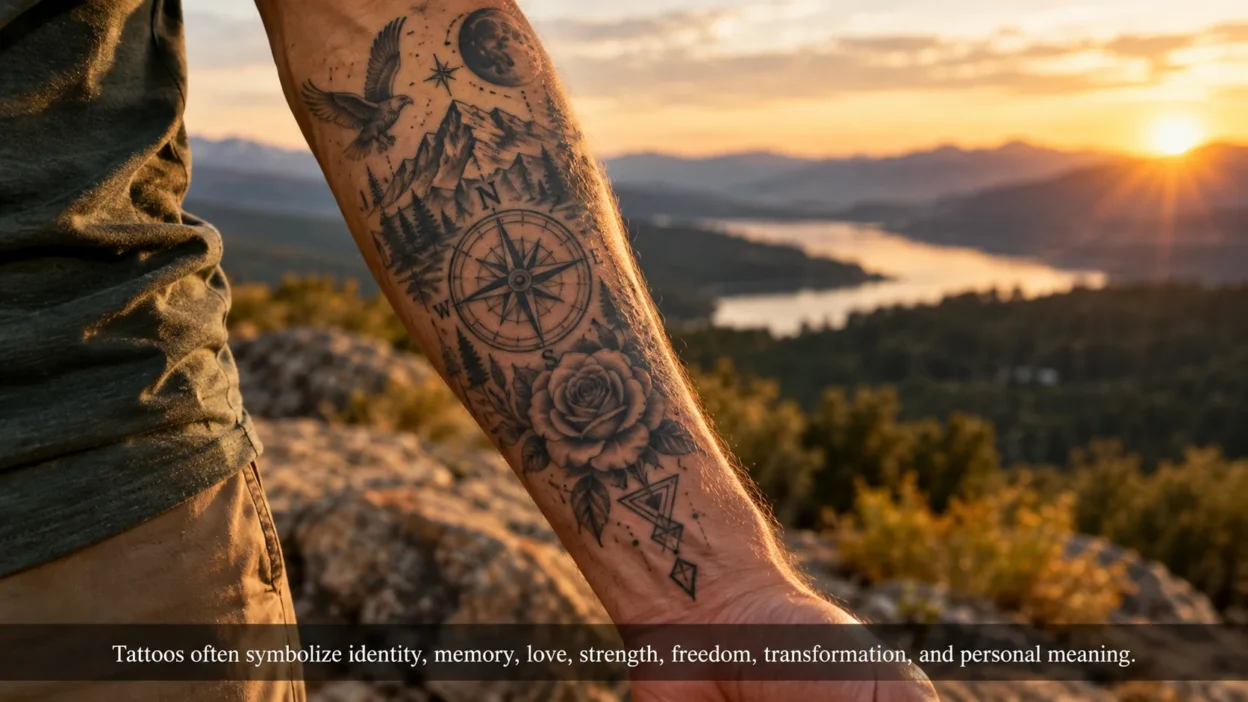
Tattoos are more than permanent artwork on the skin. Tattoo symbolism can turn an image into a reminder of a person, belief, experience, relationship, or important stage of life.
In the 2026, tattoos have become a common form of personal expression. A small symbol can represent family, courage, freedom, grief, faith, travel, or a fresh beginning.
However, tattoo meanings aren’t fixed. The same image can mean different things to different people. Its meaning often depends on the design, placement, personal story, culture, and time period.
Quick Answer
Tattoo symbolism in the USA commonly represents identity, memory, love, strength, freedom, protection, transformation, or important life experiences. More broadly, tattoos can connect the body with cultural traditions, spirituality, personal stories, and social identity.
TL;DR
- Tattoos can preserve memories, relationships, beliefs, and personal milestones.
- Ancient tattooing served social, spiritual, protective, and cultural purposes.
- American tattoo culture grew through Indigenous, maritime, military, and popular traditions.
- Animals, flowers, symbols, and words can carry different meanings.
- Modern tattoos often combine traditional symbols with deeply personal stories.
- Meanings can change as cultures, individuals, and social attitudes change.
What Does Tattoo Symbolism Mean?
Tattoo symbolism begins with the idea that an image can communicate something beyond decoration. A tattoo may carry a personal message even when another person doesn’t understand it.
For American readers, context is especially important. A rose might represent love for one person and remembrance for another.
Symbols and Personal Stories
Common symbolic tattoo themes include:
• Love represented through hearts, roses, names, or paired designs
• Strength expressed through mountains, lions, swords, or powerful animals
• Freedom represented through birds, wings, roads, or open landscapes
• Transformation shown through butterflies, snakes, flames, or changing forms
• Protection expressed through shields, guardian figures, or meaningful symbols
Why Meaning Matters
A tattoo becomes especially meaningful when its design connects with lived experience. Someone might choose a mountain after overcoming a difficult period.
Likewise, a person might tattoo a flower associated with a loved one. The image becomes a visual reminder rather than simply an attractive design.
How Tattoos Appear and What They Communicate
Tattoo symbolism depends partly on appearance. Color, line style, size, placement, and surrounding imagery can all change how a design is understood.
For example, black ink often creates a bold or timeless appearance. However, color can add emotional associations or distinguish specific elements.
Common Visual Elements
• Black and gray designs often create a classic, serious appearance
• Red ink can emphasize passion, love, energy, or danger
• Blue designs may suggest calmness, loyalty, water, or freedom
• Circular shapes can suggest unity, cycles, wholeness, or continuity
• Vertical designs may emphasize growth, movement, strength, or spiritual ideas
Placement Adds Context
Tattoo placement can also carry personal meaning. A visible tattoo may communicate identity openly, while a covered tattoo may remain more private.
However, placement doesn’t have one universal meaning. Personal preference, occupation, comfort, and fashion often matter just as much.
History of Tattoo Symbolism
Tattooing has a long history that reaches far beyond modern American tattoo shops. Archaeological evidence shows that people in different regions used permanent body marking thousands of years ago.
The meanings varied widely. Tattoos could mark identity, social position, spiritual beliefs, healing traditions, group membership, or important life events.
Ancient Roots
One famous example is Ötzi, a naturally preserved man who lived more than 5,000 years ago. His body contains numerous tattoo marks, showing that tattooing existed in prehistoric Europe.
Ancient cultures across Africa, Asia, Oceania, and other regions also practiced forms of tattooing. The reasons differed according to local traditions.
Indigenous Traditions
Many Indigenous communities developed their own forms of body marking. These practices could connect with ancestry, identity, adulthood, community, spirituality, or social roles.
It’s important not to treat these traditions as one single system. Indigenous cultures have distinct histories and meanings.
Tattooing in American History
Tattoo culture in the United States developed through several overlapping traditions. Indigenous practices, maritime communities, military culture, immigration, and popular entertainment all influenced American tattooing.
During the nineteenth and early twentieth centuries, tattoos became strongly associated with sailors and military personnel. Certain designs became recognizable parts of American tattoo culture.
Traditional American Designs
Classic American tattoo styles often feature bold outlines and clear imagery. Popular subjects have included anchors, hearts, roses, eagles, ships, banners, and other recognizable forms.
These images could represent relationships, travel, service, patriotism, courage, or personal experiences. However, individual meanings always varied.
From Subculture to Mainstream
For much of American history, tattoos were sometimes viewed as unconventional or associated with particular social groups. That perception gradually changed.
Today, tattoos appear across many professions and communities. They are used for personal expression, art, remembrance, fashion, and identity.
What Do Tattoos Symbolize in America?
In the United States, tattoos often function as visual storytelling. They can mark important moments without requiring a person to explain everything verbally.
American tattoo culture also reflects the country’s mix of cultural influences. Traditional designs exist alongside minimalist artwork, lettering, realism, abstract forms, and culturally specific imagery.
Common American Associations
• Memorial tattoos can honor deceased relatives, friends, or important relationships
• Military tattoos can represent service, sacrifice, pride, or belonging
• Travel tattoos can mark places, journeys, adventures, or personal discoveries
• Family tattoos can express love, ancestry, connection, and lasting remembrance
• Nature tattoos can reflect freedom, resilience, beauty, or personal renewal
Tattoos and Individual Identity
Modern American tattooing often emphasizes individuality. People may combine several symbols to create a design that belongs specifically to them.
For example, a person could combine a compass, mountain, and date. Together, those elements might represent a difficult journey and the direction they chose afterward.
Common Tattoo Symbols and Their Meanings
Some tattoo images have become widely recognizable. However, their meanings should be treated as common associations rather than universal rules.
| Tattoo Symbol | Meaning in the USA | Common Associations | Notes |
| Rose | Love, beauty, remembrance | Romance, family, grief | Color can change the association |
| Compass | Direction and guidance | Travel, purpose, exploration | Often connected with life journeys |
| Butterfly | Transformation and change | Growth, freedom, rebirth | Frequently chosen after major life changes |
| Anchor | Stability and grounding | Sailors, home, loyalty | Strong maritime connection |
| Mountain | Strength and endurance | Challenges, adventure, achievement | Can represent overcoming obstacles |
Why Familiar Symbols Remain Popular
Familiar symbols communicate quickly. A heart can suggest love without words, while a compass can suggest direction.
However, personal context can completely change the message. A traditional symbol may become meaningful because of one specific memory.
Spiritual and Cross-Cultural Tattoo Meanings
Tattooing has appeared in many spiritual and cultural settings. Some traditions have connected body marking with protection, religious devotion, identity, rites of passage, or relationships with ancestors.
These meanings should be understood within their original cultural contexts. A symbol used in one tradition shouldn’t automatically be assigned the same meaning elsewhere.
Spiritual Themes
• Symbols may represent faith, devotion, protection, or spiritual identity
• Sacred geometry can express ideas about balance, order, or interconnectedness
• Religious imagery can serve as a visible expression of personal belief
• Nature symbols may connect with cycles, renewal, creation, or life
Cultural Respect
Some tattoo designs have specific cultural or religious importance. Using such imagery without understanding its background can create confusion or offense.
Learning about a symbol’s history helps separate appreciation from careless imitation. It also gives the design greater meaning for the person wearing it.
Emotional and Psychological Meaning of Tattoos
Tattoos can carry strong emotional associations because they place a memory or idea directly on the body. The permanence of tattooing can make the chosen image feel especially significant.
For some people, getting tattooed also marks a transition. The process can represent leaving one period behind and entering another.
Tattoos as Emotional Reminders
A memorial tattoo may keep someone’s memory physically present. Similarly, a tattoo celebrating recovery, achievement, or personal change can serve as a reminder of progress.
However, there is no single psychological meaning behind getting tattooed. People choose tattoos for many different reasons, including art, fashion, identity, friendship, and simple personal preference.
Identity and Self-Expression
Tattoos can communicate aspects of identity without spoken explanations. They may show interests, values, relationships, experiences, or aesthetic preferences.
At the same time, people can intentionally choose designs whose meanings remain private. Not every tattoo is meant for public interpretation.
Tattoo Symbolism in Love and Relationships
Love is one of the most common themes in tattoo culture. People may choose hearts, flowers, initials, dates, portraits, or matching designs.
However, relationship tattoos don’t always represent romantic love. They can also honor parents, children, siblings, friends, or other important people.
Common Relationship Designs
• Hearts can represent affection, devotion, or emotional connection
• Names and initials can honor people with lasting personal importance
• Matching tattoos can represent friendship, partnership, or shared experiences
• Birth flowers can connect designs with loved ones and important dates
• Portraits can preserve the visual memory of someone significant
Relationship tattoos can also change meaning after circumstances change. A tattoo created during one stage of life may later represent memory rather than an ongoing relationship.
Tattoos, Memory, and Major Life Events
Many tattoos act like visual milestones. People often choose them after important experiences, achievements, losses, travels, or personal transitions.
The symbol doesn’t need to describe the event literally. A person might choose a tree to represent growth after a difficult period.
Memorial and Remembrance Tattoos
Memorial tattoos can include names, dates, handwriting, portraits, flowers, animals, or meaningful objects. These designs often combine symbolism with personal memories.
Because grief is personal, memorial tattoos can look very different. One person may choose a detailed portrait, while another prefers a tiny symbol known only to them.
Milestones and Transformation
Tattoos can also mark positive transitions. Graduation, marriage, parenthood, travel, recovery, and other milestones can inspire permanent designs.
The important part is often the story behind the image rather than the image itself.
Tattoos in Fashion, Social Media, and Pop Culture
Tattoos have become increasingly visible in American fashion and popular culture. They appear in music, sports, television, film, social media, and everyday life.
Social platforms also allow people to share tattoo designs and the stories behind them. As a result, certain styles can become widely recognizable.
Modern Tattoo Trends
• Minimalist tattoos use small designs and simple lines
• Fine-line tattoos emphasize delicate details and lighter visual weight
• Realistic tattoos recreate portraits, animals, objects, or landscapes
• Geometric tattoos use repeated shapes, symmetry, and structured patterns
• Botanical tattoos use flowers, leaves, trees, and other natural forms
Digital Influence
Social media has made tattoo inspiration easier to discover. People can compare styles, collect ideas, and share completed designs.
However, online popularity doesn’t automatically determine personal meaning. A design can be visually fashionable while still carrying a deeply individual story.
Tattoos and Gender, Identity, and Self-Expression
Tattoo culture has become less restricted by traditional gender expectations. People of different genders increasingly choose similar subjects and artistic styles.
Likewise, tattoos can help people express individuality without following conventional expectations about appearance.
Personal Identity
A tattoo might communicate heritage, interests, beliefs, relationships, or life experiences. It can also simply represent an individual’s preferred visual style.
Because identity changes over time, tattoo meanings can evolve. A design that once represented one part of someone’s life may later become a symbol of growth.
Misunderstandings, Misuse, and Controversies
Tattoo symbols can sometimes be misunderstood because viewers bring their own assumptions. A design that seems ordinary to one person may have a specific meaning in another setting.
Some symbols have also been used by extremist or criminal groups. In those cases, context matters greatly because the same basic image may have unrelated traditional meanings.
Why Context Matters
A symbol shouldn’t automatically be treated as harmful because it has appeared in a negative context. The design, surrounding imagery, location, accompanying text, and stated intent can all matter.
At the same time, some symbols have developed strong associations with particular movements or groups. Understanding those associations can prevent accidental miscommunication.
Cultural Appropriation Concerns
Certain traditional tattoo practices carry deep cultural meaning. Using sacred or culturally specific designs without understanding their history can raise concerns about appropriation.
Respectful research can help people understand whether a symbol is broadly shared or closely connected with a particular community.
How Tattoo Meanings Change Over Time
Tattoo symbolism is not frozen in history. Meanings shift as societies change, artistic styles develop, and people reinterpret older symbols.
A design once associated mainly with sailors or soldiers may later become common among people with no connection to those groups.
From Traditional to Personal
Older tattoo traditions often relied on recognizable visual languages. Modern tattooing frequently combines those traditions with individual storytelling.
This creates a mixture of shared symbolism and private meaning. A rose may have a familiar cultural association while representing something completely personal to its wearer.
Symbols Can Have Multiple Meanings
The same tattoo may communicate different things depending on who sees it. A snake can represent danger, healing, transformation, wisdom, or rebirth.
Likewise, a skull can symbolize mortality, remembrance, rebellion, humor, or acceptance of life’s temporary nature. Context gives the symbol its direction.
How to Choose a Tattoo With Meaning
Choosing a symbolic tattoo can begin with the story rather than the picture. Think about the experience, relationship, value, or idea you want the design to represent.
Then consider whether the symbol has meanings beyond your personal interpretation. This is especially useful when choosing religious, cultural, or historically significant imagery.
Read More: Wedding Symbolism: Meanings, History, and Modern Traditions
Questions to Consider
• What personal experience do you want the tattoo to represent?
• Do you want the meaning to be obvious or private?
• Could the symbol have another important cultural meaning?
• Will the design still matter if your circumstances change?
• Does the visual style match the meaning you want to communicate?
A meaningful tattoo doesn’t have to use a famous symbol. Sometimes a simple object carries the strongest personal story.
FAQs
What is the most common meaning of a tattoo?
There isn’t one universal meaning. In the USA, tattoos commonly express identity, memories, relationships, beliefs, experiences, or personal style.
What does a tattoo symbolize spiritually?
Spiritual tattoos can represent faith, protection, devotion, transformation, or connection with sacred ideas. Their meaning depends heavily on the specific tradition and person.
Why do people get tattoos to remember someone?
A tattoo can provide a permanent visual reminder of a loved one or important relationship. Names, dates, portraits, handwriting, flowers, and personal objects are common choices.
What tattoo symbolizes strength?
Mountains, lions, bears, swords, trees, and other powerful images are often associated with strength. However, the personal story behind the design usually matters more than the symbol itself.
What tattoo symbolizes new beginnings?
Butterflies, flowers, rising birds, sunrise imagery, and growing plants can represent new beginnings. These designs often connect with transformation, renewal, or personal growth.
Can a tattoo have more than one meaning?
Yes. A single tattoo can combine several meanings through its imagery, placement, colors, and personal history. Its meaning can also change as the wearer moves through life.
Conclusion
Tattoo symbolism gives ordinary images a deeper personal dimension. In the United States, tattoos commonly express love, memory, identity, strength, freedom, transformation, family, and important life experiences. At the same time, tattoo meanings aren’t universal. History, culture, personal experience, design, and context can all change what an image communicates. Whether a tattoo marks a person, place, belief, achievement, or new chapter, its meaning often comes from the story behind it. The most meaningful symbol is usually the one that continues to speak to the person wearing it.