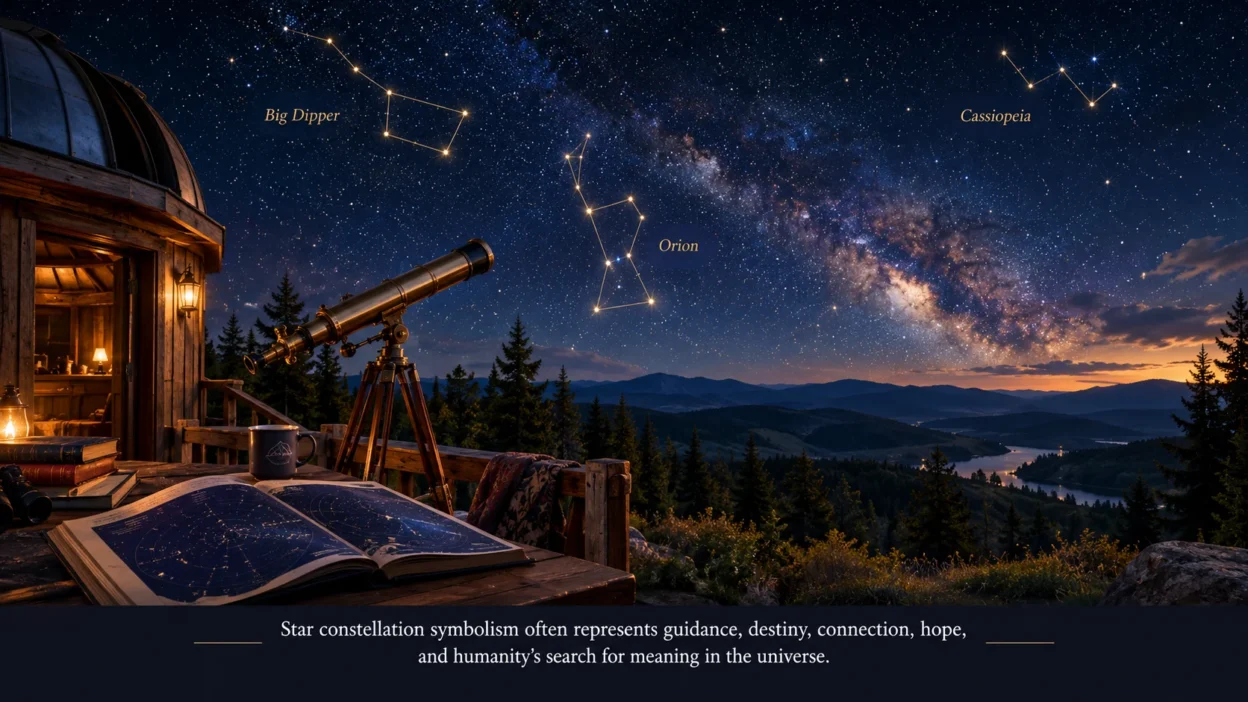
When you look up at the night sky, individual stars can seem like distant points of light. However, when you connect them into recognizable patterns, they become stories, guides, and symbols. Star Constellation Symbolism explores how these celestial patterns represent guidance, identity, destiny, hope, and humanity’s relationship with the universe.
In the United States, constellations appear in astronomy, literature, tattoos, jewelry, astrology, and popular culture. Some people admire them for their scientific beauty, while others connect them with personal memories or spiritual beliefs. For example, the Big Dipper can help observers find the North Star, making the night sky feel like a natural compass.
Yet constellations mean more than navigation. Ancient civilizations connected star patterns with gods, animals, heroes, and seasonal changes. Today, people continue these traditions in new ways, choosing constellation designs to represent loved ones, personal growth, or a sense of belonging. Understanding their symbolism reveals how humanity has used the stars to make sense of life on Earth.
Quick Answer
Star constellation symbolism in the United States commonly represents guidance, hope, destiny, exploration, and personal identity. Across cultures, constellations also connect with mythology, seasonal cycles, spiritual beliefs, and humanity’s search for meaning in the universe.
TL;DR
- Constellations symbolize guidance, hope, destiny, connection, and exploration.
- Ancient civilizations used star patterns for navigation, storytelling, and seasonal calendars.
- American culture connects constellations with discovery, independence, science, and personal identity.
- Spiritual interpretations often associate stars with higher purpose, cosmic order, and transformation.
- Constellation tattoos and jewelry can honor loved ones or meaningful life experiences.
- Astronomy identifies constellations as defined sky regions, not simply connected star shapes.
What Are Star Constellations?
Constellations are named regions of the sky that help people identify and organize celestial objects. Their familiar patterns have inspired symbolic meanings for thousands of years.
How Constellations Appear
Most constellation designs feature bright stars connected by imaginary lines. However, the patterns themselves vary across star maps, cultural traditions, and artistic styles.
Common examples include:
- Orion: A recognizable hunter figure associated with strength, adventure, and mythology.
- Ursa Major: A large constellation containing the Big Dipper, often linked with navigation.
- Cassiopeia: A W-shaped constellation connected with a queen in Greek mythology.
- Leo: A constellation representing a lion, frequently associated with courage and leadership.
- Scorpius: A constellation shaped like a scorpion, connected with danger and transformation in some interpretations.
Why Constellations Become Symbols
Humans naturally recognize patterns and attach stories to them. Consequently, constellations can turn distant stars into familiar images that express ideas about life, nature, and human experience.
Their meanings depend on context. A constellation on a scientific chart identifies a region of space, while the same pattern on a necklace might represent family, adventure, or personal identity.
Historical Origins of Constellation Symbolism
Constellation symbolism developed across many civilizations rather than originating from one single culture. Ancient people observed the sky to track time, understand their surroundings, and preserve stories.
Ancient Roots
Early sky watchers noticed that certain stars appeared in predictable seasonal patterns. These observations helped communities recognize planting seasons, anticipate weather changes, and plan journeys.
Ancient Mesopotamian civilizations developed influential systems of celestial observation. Later, Greek astronomers preserved and organized many constellation traditions, connecting star patterns with mythological figures.
Ancient Egyptian communities also associated celestial observations with religious beliefs and timekeeping. Some stars and star groups held connections with gods, the afterlife, and the annual cycle of the Nile.
Greek and Roman Influence
Greek mythology gave many familiar constellations recognizable stories. Orion became a hunter in the sky, while Leo represented a powerful lion associated with the hero Heracles.
Roman writers and astronomers preserved many Greek constellation names and stories. Through later European astronomy, these traditions became influential in star charts used in America.
However, these are not the only ways people have interpreted the heavens. Different societies developed their own patterns, names, and stories based on their environments and cultural knowledge.
3. Star Constellation Symbolism in the USA
In American culture, constellations often represent discovery, freedom, hope, and the desire to explore beyond familiar boundaries. Their symbolism connects the natural night sky with national history, personal experience, and scientific curiosity.
Exploration and Independence
The American story includes westward travel, ocean navigation, scientific expeditions, and space exploration. Against this background, stars often suggest the possibility of reaching something new.
The night sky also evokes the idea of independence. Someone looking at a vast field of stars might associate it with freedom, possibility, and a world larger than everyday responsibilities.
The North Star and American Identity
The North Star, also called Polaris, has long served as a navigational reference in the Northern Hemisphere. It lies close to the north celestial pole, making it useful for identifying north.
In American history, the North Star also became a powerful symbol of freedom for enslaved people seeking liberation. Its significance appears in accounts of escape, abolitionist traditions, and cultural expressions of hope.
However, the history is more complex than a single symbol or story. Not every account of escape involved the same routes or navigational methods, and the North Star was one element within a broader history of resistance and liberation.
Common American Associations
Constellations can carry several overlapping meanings in the United States:
- Discovery: Exploring unfamiliar places, ideas, and possibilities.
- Freedom: Finding direction while moving toward a more independent life.
- Family: Remembering loved ones through shared celestial designs.
- Ambition: Connecting distant stars with dreams and future goals.
- Wonder: Recognizing the enormous scale and beauty of the universe.
These associations aren’t universal rules. Personal memories, family traditions, and individual beliefs often shape a constellation’s meaning more strongly than its traditional symbolism.
Spiritual Meaning of Star Constellations
Many spiritual traditions interpret the night sky as a place of order, mystery, and connection. Constellations can therefore symbolize a relationship between human life and something greater than the individual.
Guidance and Higher Purpose
Some people view constellations as reminders that life contains direction even when the next step feels uncertain. Their steady patterns can represent patience, trust, and the search for purpose.
Others interpret the stars as signs of divine creation or cosmic harmony. These meanings reflect personal or religious beliefs rather than scientific conclusions.
Light in Darkness
A constellation remains visible against a dark sky, creating a natural contrast between light and shadow. Symbolically, this contrast often suggests hope during hardship.
For someone experiencing a difficult transition, a constellation tattoo or artwork might represent the belief that meaningful direction remains possible. The image can serve as a personal reminder without requiring a particular religious interpretation.
Spiritual Meanings at a Glance
- Guidance through uncertainty or major life changes.
- Connection with the universe or a higher power.
- Hope during periods of grief, struggle, or transition.
- Harmony between individual experience and the wider world.
- Reflection on life’s mysteries and the limits of human knowledge.
Spiritual interpretations differ among individuals and communities. It’s best to understand them as meaningful beliefs rather than universal facts about the stars.
Constellation Symbolism Across Cultures
Constellations carry different meanings because cultures have developed their own relationships with the sky. Although some traditions share similar themes, their stories and knowledge systems shouldn’t be treated as interchangeable.
Indigenous Sky Traditions
Indigenous peoples across North America have diverse astronomical traditions. Stars and constellations can relate to seasonal knowledge, oral histories, animals, community teachings, and relationships with the land.
For example, some Indigenous traditions connect celestial observations with hunting seasons and ecological cycles. However, specific stories and interpretations vary among nations and communities.
These traditions deserve recognition on their own terms rather than being reduced to general spiritual ideas. When learning about a particular constellation story, it’s important to consider the community that preserves it.
Chinese and Other Asian Traditions
Traditional Chinese astronomy organized the sky through systems that differ from the familiar Western constellation framework. Some celestial groups were connected with imperial order, seasonal cycles, and ideas about harmony.
In parts of South Asia, astronomical traditions also developed alongside religious literature, calendars, and astrology. Their celestial systems reflect distinct histories and philosophical frameworks.
African and Other Global Traditions
African societies have developed varied traditions of sky observation, seasonal knowledge, and celestial storytelling. These practices reflect local environments and long histories of observation.
Likewise, Pacific Islander navigators used stars and other natural signs to guide ocean voyages. In these settings, the sky served practical and cultural purposes rather than functioning only as a source of mythology.
Across these traditions, constellations may symbolize knowledge, continuity, direction, and relationships between people and their environment. Still, each culture’s interpretation should be understood within its own context.
Psychological and Emotional Meanings of Constellations
Constellations can feel emotionally powerful because they combine familiar patterns with the immense scale of the night sky. Their symbolism often helps people express feelings that are difficult to communicate directly.
Hope and Comfort
Stars appear distant, yet their patterns can feel familiar. For some people, this familiarity offers comfort during lonely periods or major life changes.
A constellation associated with a loved one may become a private reminder of that relationship. Looking at it can help someone preserve a memory without needing a physical object nearby.
Identity and Belonging
A constellation can represent the idea that separate parts form a meaningful whole. This makes it a natural symbol for families, friendships, and communities.
For example, siblings might choose individual stars from one constellation for matching jewelry. Together, the stars represent their shared history, while each design maintains a sense of individuality.
Wonder and Perspective
The night sky can inspire awe, a feeling that arises when something seems larger than ordinary experience. This sense of wonder may encourage people to reconsider their problems or appreciate their place in the world.
However, constellations don’t produce one fixed emotional response. One person may experience peace, while another feels curiosity, sadness, or excitement.
Star Constellation Tattoo Symbolism
Constellation tattoos are popular choices for people who want a design with personal meaning. They combine simple celestial imagery with opportunities to represent identity, memory, or ambition.
Popular Tattoo Meanings
The meaning often depends on the constellation selected and the story behind it.
- Zodiac constellation: Personal identity, astrology, or connection with a birth date.
- Orion: Adventure, resilience, strength, or fascination with mythology.
- Ursa Major: Direction, exploration, and a lasting connection with the night sky.
- A custom star pattern: Family relationships, friendship, or remembrance.
- A constellation with a date: A birth, anniversary, personal milestone, or meaningful loss.
Choosing a Meaningful Design
Some people prefer fine black lines and tiny stars, while others choose colorful celestial artwork. A minimalist design can feel subtle, whereas a larger piece may include the Milky Way, the moon, or surrounding natural elements.
Before choosing a tattoo, consider whether the constellation has a specific cultural, historical, or astrological meaning that matters to you. A design becomes more personal when you understand why it represents your story.
Constellations in Astrology and Zodiac Symbolism
Astronomy and astrology both involve the sky, but they answer different questions. Astronomy studies celestial objects through scientific observation, while astrology interprets celestial positions as meaningful in human life.
Zodiac Constellations
The traditional zodiac includes twelve familiar signs, such as Aries, Taurus, Gemini, Cancer, Leo, and Pisces. In popular American astrology, people often associate their zodiac sign with personality, relationships, and life themes.
However, zodiac signs and astronomical constellations aren’t exactly the same thing. Western astrology generally uses twelve equal sections of the ecliptic, while the actual constellations differ in size and position.
What Zodiac Constellations Symbolize
Within astrological traditions, zodiac constellations and signs are linked with different symbolic qualities. For example, Leo is commonly associated with confidence, while Pisces is associated with sensitivity and imagination.
These associations are part of an interpretive belief system. Scientific evidence doesn’t establish that zodiac signs determine personality or predict individual events.
For many Americans, astrology remains a form of entertainment, self-reflection, or spiritual exploration. Others enjoy the constellations without accepting astrological interpretations.
Constellation Symbolism in Art, Jewelry, and Home Decor
Constellation designs appear in everyday objects because their simple shapes are easy to recognize and adapt. They can feel elegant, mysterious, modern, or deeply personal depending on their presentation.
Jewelry and Fashion
Star patterns appear on necklaces, rings, bracelets, scarves, and clothing. A person might wear a birth constellation to represent identity or choose a different pattern to honor someone important.
Gold and silver designs often create a refined celestial look. Meanwhile, black linework and small star details suit minimalist styles.
Home Decor
Constellation imagery can transform a room into a quiet reminder of the wider universe. It appears in framed star maps, bedding, wall art, lamps, and decorative objects.
| Context | Common symbolic meaning | Typical design |
| Bedroom decor | Peace, dreams, and wonder | Deep blue sky with fine golden stars |
| Family artwork | Connection and belonging | A custom arrangement of meaningful stars |
| Jewelry | Identity and remembrance | Small constellation pendant |
| Office decor | Ambition and discovery | Star chart or astronomical print |
| Children’s rooms | Curiosity and imagination | Illustrated planets and constellations |
Digital Culture and Personal Expression
On social media, constellation imagery can suggest mystery, individuality, or an interest in astrology. People also use celestial illustrations in digital artwork, profile backgrounds, invitations, and personal projects.
However, a star pattern doesn’t always communicate a deep spiritual belief. Sometimes people simply enjoy its visual balance, delicate lines, or association with the beauty of space.
Constellations in American Holidays and Popular Culture
American popular culture frequently uses stars to communicate wonder, exploration, and possibility. Constellations extend these themes by giving the stars recognizable shapes and stories.
Astronomy Events and Stargazing
Public observatories, planetariums, science museums, and astronomy clubs introduce Americans to recognizable constellations. Events such as meteor showers and seasonal stargazing gatherings can encourage families to explore the night sky together.
These experiences often connect scientific learning with personal wonder. A constellation becomes both an object of study and a reminder of the stories people have told about the heavens.
Fiction, Film, and Literature
Constellations frequently appear in fantasy, science fiction, and adventure stories. Characters may follow stars to reach a destination, search the sky for answers, or interpret celestial patterns as clues.
Such scenes reinforce associations with destiny, mystery, and exploration. However, fictional meanings depend on the story rather than representing a single traditional interpretation.
Holidays and Celebrations
Celestial imagery also appears in seasonal decorations, greeting cards, and celebrations centered on night skies. Stars can evoke hope, celebration, and a sense of wonder during these occasions.
It’s worth distinguishing individual stars from constellations, though. American flags, holiday decorations, and many celebratory designs feature stars without referring to any particular constellation.
Negative Meanings, Misunderstandings, and Controversies
Constellation symbolism is generally associated with curiosity, guidance, and beauty. However, misunderstandings can arise when people treat symbolic interpretations as universal or confuse different uses of celestial imagery.
Astronomy Versus Symbolism
One common misconception is that constellations are physical groups of stars located close together. In reality, stars within a constellation may lie at very different distances from Earth.
The familiar shapes depend largely on our viewing position. Their symbolic meanings arise from human interpretation, not from the stars physically forming pictures in space.
Cultural Appropriation and Oversimplification
Using celestial imagery from another tradition isn’t automatically disrespectful. Problems can arise when someone presents a sacred cultural design without understanding its meaning or claims ownership over traditions belonging to a particular community.
A respectful approach involves learning the design’s origin and avoiding misleading claims. It also means recognizing that Indigenous and other cultural sky traditions contain specific knowledge that shouldn’t be treated as interchangeable decoration.
Astrology and Unsupported Claims
Some people use constellations to explore identity or spirituality. However, symbolic interpretations shouldn’t be presented as scientifically proven explanations of personality, destiny, or future events.
Likewise, an ordinary constellation tattoo doesn’t automatically indicate a particular belief system. Meaning depends on the person, design, and context.
How Constellation Meanings Have Changed Over Time
Constellation symbolism has evolved alongside changes in science, religion, travel, and popular culture. Older meanings haven’t simply disappeared; many continue beside modern interpretations.
From Practical Guides to Scientific Maps
For ancient communities, observing the sky could support navigation, seasonal planning, and storytelling. Over time, astronomers developed increasingly organized systems for describing celestial patterns.
In 1922, the International Astronomical Union adopted a list of 88 constellations. By 1930, astronomers had established official boundaries for these sky regions, creating a consistent framework for modern astronomical maps.
These definitions differ from traditional stories, which can vary across cultures. Today, a constellation has a precise scientific meaning while retaining its cultural and symbolic significance.
From Mythology to Personal Identity
Earlier European traditions often emphasized gods, heroes, and legendary creatures. Modern American interpretations frequently add personal themes such as individuality, family connection, self-expression, and exploration.
Astrology and spiritual practices have also helped keep celestial symbolism visible in contemporary life. Meanwhile, astronomy offers another way to appreciate constellations through observation and scientific discovery.
What Has Stayed the Same?
Despite these changes, several themes remain recognizable across many interpretations:
- People continue to seek direction when facing uncertainty.
- Celestial patterns still inspire stories about identity and belonging.
- The night sky remains a source of curiosity and wonder.
- Stars continue to connect personal memories with larger ideas.
The meanings change, but humanity’s interest in finding patterns in the sky remains remarkably persistent.
How to Interpret a Constellation’s Personal Meaning
There isn’t one correct symbolic meaning for every constellation. Instead, interpretation often depends on its history, the setting in which it appears, and the experiences of the person using it.
Consider Three Questions
When interpreting a constellation, ask yourself:
- Which constellation is it? Research its astronomical identity and any relevant historical stories.
- Where does it appear? A tattoo, family heirloom, scientific chart, and religious artwork may communicate different ideas.
- What does it mean to the person? Their memories, values, and beliefs may explain the design better than a general symbol guide.
For example, Orion might represent mythology to one person and a memorable childhood stargazing experience to another. Neither interpretation has to cancel out the other.
Read More: Zodiac Symbolism: Meanings, History, and Spiritual Signs
Balance Tradition With Personal Experience
Traditional meanings provide helpful context, but they don’t have to dictate personal interpretation. You can appreciate a constellation’s history while connecting it with your own experiences.
However, when a symbol belongs to a specific cultural or religious tradition, understanding that context helps prevent confusion. Personal meaning and cultural history can coexist without being treated as identical.
FAQs
What Do Star Constellations Symbolize?
Constellations commonly symbolize guidance, hope, exploration, identity, and connection. Their meaning depends on cultural traditions, personal experiences, and the context in which the pattern appears.
What Is the Spiritual Meaning of Constellations?
In some spiritual interpretations, constellations represent cosmic order, higher purpose, and a connection with the universe. Others view them as reminders of hope or direction during uncertain times.
What Does a Constellation Tattoo Mean?
A constellation tattoo may represent a zodiac sign, family bond, personal milestone, or loved one. Its meaning usually depends on the chosen pattern and the story behind it.
What Does Orion Symbolize?
Orion is associated with a hunter in Greek mythology and can represent strength, adventure, and determination. In modern life, it may also symbolize curiosity, exploration, or a personal connection with stargazing.
What Does the North Star Symbolize?
The North Star commonly represents guidance, direction, and hope. In American history, it also became associated with freedom and liberation through its place in narratives about escape from slavery.
Are Constellations Connected to Astrology?
Yes, constellations have historical connections with astrological traditions, especially the zodiac. However, modern astronomy and astrology differ: one studies celestial objects scientifically, while the other interprets celestial positions symbolically.
Conclusion
Star constellation symbolism brings together ancient mythology, practical navigation, cultural traditions, and modern personal expression. In the United States, constellations often represent hope, freedom, exploration, identity, and the search for direction. Next time you see a familiar constellation, consider both its history and your own connection to it. Sometimes, the most meaningful symbol is the one that helps you see your place in a much larger universe.