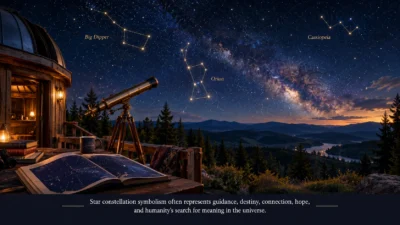
Zodiac symbolism gives people a familiar way to connect the stars with human life. In the United States, zodiac signs appear in personality quizzes, social media profiles, tattoos, jewelry, and conversations about relationships. Each sign carries distinctive images, elements, and traits that help people express how they see themselves.
The zodiac consists of twelve signs associated with different periods of the year. Astrology connects these signs with personality patterns, emotional tendencies, and life experiences. Although modern astronomy studies celestial objects through scientific methods, astrology interprets their positions through a symbolic tradition. However, zodiac meanings extend beyond daily horoscopes. Their symbols preserve ideas from ancient civilizations, including Babylonian star traditions and Greek mythology. Today, some Americans approach astrology as a spiritual practice, while others enjoy it for entertainment or self-reflection.
Understanding these symbols means looking at their history, cultural influence, and personal appeal. It also means recognizing that astrological interpretations are beliefs rather than scientifically established descriptions of personality or destiny.
Quick Answer
In the United States, zodiac symbolism represents personality, identity, relationships, and the search for meaning through the twelve astrological signs. More broadly, these signs connect celestial patterns with mythology, seasonal cycles, spiritual reflection, and traditional ideas about human nature.
TL;DR
- The twelve zodiac signs symbolize different personality traits and life themes.
- Ancient Babylonian and Greek traditions helped shape the Western zodiac.
- Americans use zodiac signs for identity, entertainment, relationships, and self-expression.
- Fire, earth, air, and water group the signs into four elements.
- Tattoos, jewelry, horoscopes, and social media keep zodiac symbols popular.
- Astrology offers symbolic interpretations, not scientifically proven personality predictions.
What Is Zodiac Symbolism?
Zodiac symbolism is the system of meanings associated with twelve astrological signs. Each sign has a name, a recognizable symbol, a traditional date range, and associations with elements, planets, and personality traits.
In American culture, these symbols often serve as shorthand for identity. Someone might describe themselves as a Leo to suggest confidence or a Cancer to communicate emotional sensitivity.
The Twelve Zodiac Signs and Their Symbols
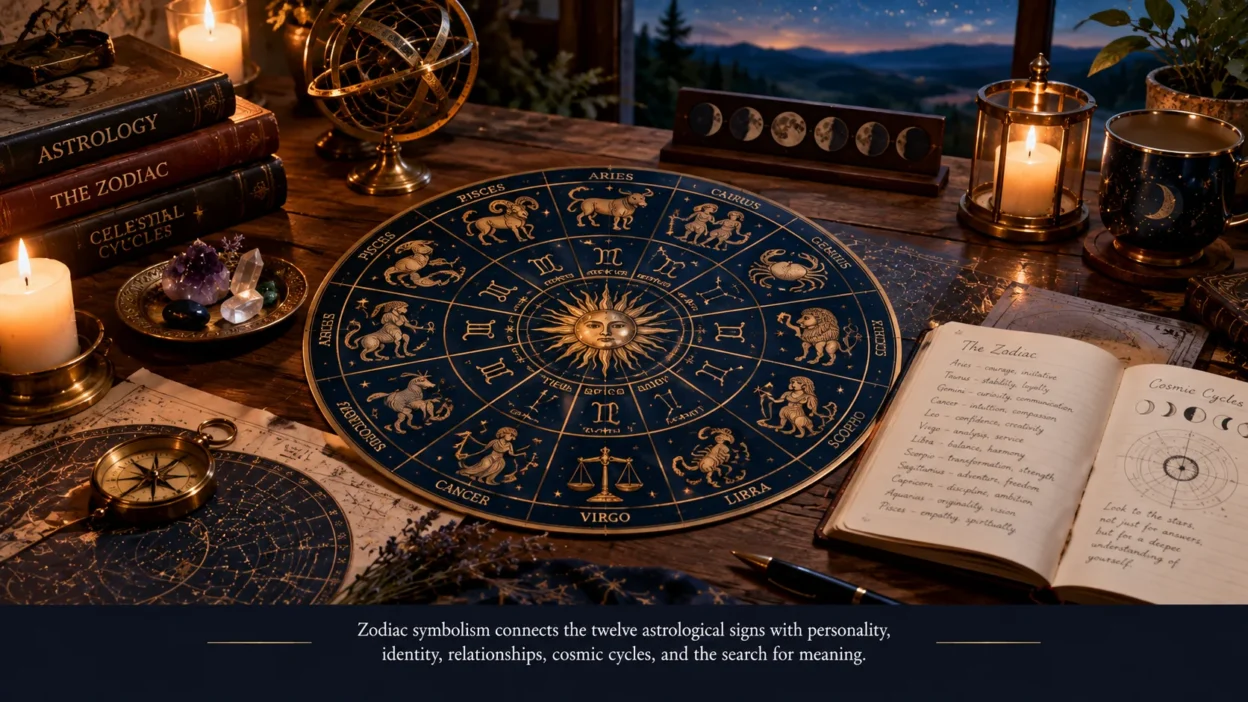
The Western zodiac contains twelve signs. Each has a distinctive image or glyph, ranging from animals and human figures to objects.
- Aries (♈): The ram represents initiative, courage, and action.
- Taurus (♉): The bull represents stability, patience, and determination.
- Gemini (♊): The twins represent communication, curiosity, and duality.
- Cancer (♋): The crab represents protection, emotion, and belonging.
- Leo (♌): The lion represents confidence, creativity, and leadership.
- Virgo (♍): The maiden represents careful observation, service, and refinement.
- Libra (♎): The scales represent fairness, harmony, and balance.
- Scorpio (♏): The scorpion represents intensity, secrecy, and transformation.
- Sagittarius (♐): The archer represents exploration, freedom, and truth-seeking.
- Capricorn (♑): The sea-goat represents ambition, discipline, and perseverance.
- Aquarius (♒): The water-bearer represents ideas, independence, and collective progress.
- Pisces (♓): The fish represent imagination, compassion, and spiritual sensitivity.
These meanings reflect common Western astrological interpretations. They aren’t fixed descriptions of every person born under a particular sign.
How Zodiac Symbols Work
Each sign combines several symbolic layers. Its glyph provides a visual identity, while its element and ruling planet add traditional associations.
For example, Leo connects with the lion, the Sun, and the fire element. Together, these images suggest warmth, visibility, creativity, and personal expression.
Historical Origins of Zodiac Symbolism
The zodiac developed through centuries of observing the sky and organizing celestial patterns. Its history connects ancient astronomy, seasonal calendars, mythology, and religious ideas.
For American readers, this history explains why today’s horoscope symbols contain images and meanings inherited from many different societies.
Ancient Babylonian Roots
Ancient Mesopotamian astronomers carefully recorded celestial movements. Babylonian scholars developed important traditions of dividing the zodiacal path into twelve sections, drawing on earlier Mesopotamian observations and star traditions.
These divisions helped organize the sky and relate celestial events to calendars and predictions. Over time, the twelve-part zodiac became a foundation for later astrological systems.
Greek and Roman Influence
Greek scholars adopted and developed Babylonian zodiac traditions. During the Hellenistic period, astrology increasingly connected the twelve signs with mathematical models, planetary positions, and interpretations of individual lives.
Greek mythology also shaped the imagery attached to several signs. Later, Roman culture helped spread familiar names and representations throughout the Mediterranean world.
From Ancient Charts to Modern Horoscopes
Astrological traditions continued through medieval Arabic-speaking scholarship and European intellectual life. During the modern period, astrology gradually reached wider audiences through newspapers, magazines, books, and popular entertainment.
In the twentieth century, newspaper horoscope columns made zodiac interpretations easy to access. Later, websites and social platforms brought personalized charts and sign-based content to millions of readers.
Today, zodiac symbolism combines ancient imagery with modern ideas about identity, emotional awareness, and personal growth.
What Does Zodiac Symbolism Mean in America?
In the United States, zodiac signs often function as a language of personality and self-expression. People use them to start conversations, describe relationships, and explore different sides of their identities.
Unlike formal religious symbols, zodiac signs can move easily between entertainment, personal belief, and everyday fashion.
Zodiac Signs in American Popular Culture
Astrology has a visible place in American media and social life. Horoscopes appear in lifestyle publications, while zodiac memes turn traditional traits into jokes and relatable observations.
For many Americans, these signs offer an easy way to discuss complicated feelings. A person might blame a fictional character’s stubbornness on Taurus symbolism or celebrate a friend’s adventurous spirit through Sagittarius.
Identity, Community, and Belonging
Zodiac signs can also help people find others with similar interests. Online communities share birth charts, compare signs, and discuss how astrological placements might influence relationships.
Common American uses include:
- Adding a zodiac sign to a social media biography.
- Choosing gifts based on a friend’s birth sign.
- Discussing compatibility during dating conversations.
- Using astrological themes in parties and birthday celebrations.
- Sharing zodiac memes to describe everyday experiences.
However, identifying with a sign doesn’t require believing astrology predicts the future. Some people simply enjoy the language and imagery.
The Four Elements in Zodiac Symbolism
The four elements provide one of the main ways Western astrology organizes the zodiac. Fire, earth, air, and water connect groups of signs through shared symbolic qualities.
In American astrology content, these elements often provide a simple starting point for understanding differences between signs. Their meanings are traditional interpretations, not scientific personality categories.
Fire, Earth, Air, and Water
Fire signs include Aries, Leo, and Sagittarius. Fire symbolizes enthusiasm, movement, courage, and creative energy.
Earth signs include Taurus, Virgo, and Capricorn. Earth represents practicality, patience, stability, and material concerns.
Air signs include Gemini, Libra, and Aquarius. Air symbolizes ideas, communication, curiosity, and social connection.
Water signs include Cancer, Scorpio, and Pisces. Water represents emotion, intuition, imagination, and depth.
How the Elements Shape Interpretation
Astrologers use these groups to compare different approaches to life. Fire may suggest taking action, while earth emphasizes building something lasting.
Similarly, air connects with thinking and discussion, whereas water focuses on feelings and inner experience. These contrasts create a symbolic framework for exploring different human tendencies.
What Do Zodiac Planets and Modalities Symbolize?
Zodiac signs gain additional meanings through ruling planets and three traditional modalities. These systems explain how astrologers distinguish signs that share an element.
For Americans exploring a birth chart, they also show why two signs associated with the same element can have very different interpretations.
Planetary Associations
In Western astrology, each sign has a traditional ruling planet or luminary. These associations add themes to the sign’s basic symbolism.
- Mars: Action, courage, desire, and conflict.
- Venus: Love, attraction, beauty, and harmony.
- Mercury: Communication, learning, and thought.
- Moon: Emotions, habits, and familiar comforts.
- Sun: Vitality, identity, and self-expression.
- Jupiter: Growth, opportunity, and exploration.
- Saturn: Discipline, boundaries, and responsibility.
Modern Western astrology also associates Uranus with Aquarius, Neptune with Pisces, and Pluto with Scorpio. Traditional systems instead use Saturn, Jupiter, and Mars as those signs’ respective rulers.
Cardinal, Fixed, and Mutable Signs
The modalities describe three symbolic approaches to change.
- Cardinal signs: Aries, Cancer, Libra, and Capricorn represent beginnings and initiative.
- Fixed signs: Taurus, Leo, Scorpio, and Aquarius represent persistence and stability.
- Mutable signs: Gemini, Virgo, Sagittarius, and Pisces represent adaptation and transition.
Together, elements, planets, and modalities create a more detailed astrological vocabulary. However, their meanings vary somewhat between astrological schools.
Spiritual Meaning of Zodiac Symbolism
For some people, zodiac symbolism provides a spiritual framework for exploring purpose, timing, and personal growth. The stars become symbolic reference points rather than merely distant objects in the night sky.
In the United States, astrology sometimes overlaps with meditation, journaling, tarot, and other contemporary spiritual interests. Yet not everyone who enjoys zodiac imagery considers themselves spiritual.
The Zodiac as a Symbol of Cosmic Order
The zodiac’s circular arrangement can suggest cycles, continuity, and the relationship between human life and the changing sky. Its twelve signs also connect with the yearly passage of seasons in the tropical zodiac.
Some practitioners interpret birth charts as maps for reflection. They may use planetary placements to consider recurring patterns, personal challenges, or meaningful transitions.
Cross-Cultural Interpretations
Astrological systems differ across cultures. Chinese astrology, for example, uses a twelve-animal cycle connected with years, alongside other traditional systems of interpretation.
Indian astrology, commonly called Jyotisha, has its own historical methods, calculations, and spiritual context. Although it shares some ancient planetary and zodiac concepts with Western traditions, the systems aren’t interchangeable.
In many religious communities, beliefs about astrology also differ. Some people incorporate astrological ideas into their spiritual lives, while others reject them because of their religious teachings.
Respectful interpretation means recognizing these differences instead of treating every tradition as one universal system.
Psychological Meaning of Zodiac Signs
Zodiac symbolism appeals to people because it offers familiar language for describing personality and relationships. Labels such as adventurous, sensitive, loyal, or independent can help people reflect on how they see themselves.
However, these descriptions shouldn’t be treated as psychological assessments. Scientific evidence hasn’t established that zodiac signs reliably determine personality or predict individual behavior.
Self-Reflection and Personal Identity
Reading about a sign can encourage someone to consider personal strengths and weaknesses. For example, a person reading about Virgo symbolism might reflect on whether their attention to detail sometimes becomes perfectionism.
This process can be useful as a journaling exercise, even without accepting the astrological explanation. The important distinction is between asking thoughtful questions and assuming a label defines the answer.
Why Zodiac Descriptions Can Feel Accurate
Broad personality descriptions can feel unusually personal because people naturally notice details that match their experiences. Psychologists call one related effect the Barnum effect: people may view general statements as uniquely accurate descriptions of themselves.
For example, someone might relate to a horoscope that describes them as independent but occasionally in need of support. Many people experience both tendencies, regardless of their birth date.
Zodiac symbolism can therefore offer an engaging starting point for reflection. It becomes less helpful when people use it to excuse harmful behavior or judge others without knowing them.
Modern Uses of Zodiac Symbolism
Zodiac imagery has moved well beyond printed horoscopes. Today, it appears in fashion, entertainment, home decor, digital communication, and personal accessories.
In the United States, its flexibility helps people use the same symbol for different purposes. One person may see a spiritual reminder, while another simply likes its design.
Tattoos, Jewelry, and Fashion
Zodiac tattoos often combine a sign’s glyph with stars, flowers, moons, or constellation patterns. Minimalist line art offers a subtle look, while detailed celestial designs create a more dramatic effect.
Jewelry provides another way to express a sign. Pendants, rings, bracelets, and birth-chart designs can represent birthdays, personal identity, or connections with loved ones.
Social Media and Home Decor
Digital platforms have made zodiac imagery easy to share. People post sign comparisons, birth-chart interpretations, humorous compatibility lists, and themed illustrations.
At home, zodiac motifs can create a celestial atmosphere. Star maps, constellation prints, metallic glyphs, and midnight-blue decor often combine astrology with broader interest in astronomy and space.
Zodiac Symbolism Across Everyday Life
| Context | Common symbolic meaning | Typical American use |
| Tattoos | Identity and personal expression | Permanent body art |
| Jewelry | Connection and individuality | Gifts and daily accessories |
| Social media | Humor and community | Profiles, memes, and discussions |
| Journaling | Reflection and growth | Prompts and personal notes |
| Home decor | Cosmic wonder and beauty | Prints, textiles, and celestial themes |
These examples show how zodiac symbolism can carry personal meaning without requiring a shared belief system.
Zodiac Compatibility and Relationship Symbolism
Zodiac compatibility is popular in American dating culture and relationship discussions. Astrological traditions compare signs, elements, planetary placements, and birth charts to explore possible areas of harmony or tension.
For some people, these comparisons make conversations about emotional needs and communication easier. However, they can’t reliably determine whether a relationship will succeed.
How Compatibility Is Traditionally Interpreted
Astrologers often begin by comparing elements. Fire and air are traditionally described as mutually energizing, while earth and water are frequently portrayed as complementary.
These are symbolic patterns, not universal rules. Individual astrologers may interpret compatibility differently, especially when they consider a full birth chart rather than just a Sun sign.
Using Zodiac Symbols Without Stereotyping
A zodiac label shouldn’t replace honest communication or careful judgment. Someone described as a Scorpio isn’t automatically secretive, just as a Libra isn’t guaranteed to be diplomatic.
Instead, compatibility discussions can inspire useful questions:
- How does each person express affection?
- What helps each partner feel understood?
- How do both people respond to disagreements?
- Which personal boundaries matter most?
These questions remain useful regardless of astrological beliefs. Real relationships depend on people’s choices, circumstances, communication, and mutual respect.
Misunderstandings and Controversies About Zodiac Symbolism
Zodiac symbols have different meanings depending on their historical, cultural, and personal context. Problems arise when people treat one interpretation as universal or confuse symbolic beliefs with established scientific findings.
In the United States, discussions about astrology often range from enthusiastic spiritual practice to skeptical criticism. Understanding the distinction helps keep conversations respectful and grounded.
Astrology Versus Astronomy
Astronomy is the scientific study of celestial objects, space, and the physical universe. Astrology interprets celestial positions as symbolically connected with human affairs.
The two have historical connections, but they aren’t equivalent disciplines. Astrological personality claims and predictions haven’t gained reliable scientific support.
Sun Signs Versus Complete Birth Charts
Popular horoscopes usually focus on the Sun sign, determined by the Sun’s apparent position within the zodiac. A complete astrological chart may also consider the Moon, planets, houses, and aspects.
Consequently, people following astrology may consider their Sun sign only one part of a larger interpretation. Even so, greater chart complexity doesn’t establish that astrological claims are scientifically valid.
Common Misunderstandings
- Zodiac signs don’t scientifically determine a person’s character or moral worth.
- A horoscope isn’t a guaranteed prediction of future events.
- Different astrological traditions use distinct systems and interpretations.
- A person’s sign shouldn’t justify prejudice, controlling behavior, or relationship abuse.
- Zodiac imagery doesn’t automatically indicate someone’s religion or spiritual beliefs.
Some religious communities discourage astrology, while others approach it differently. It’s best to discuss those differences without mocking personal beliefs or presenting any single viewpoint as universal.
How Zodiac Symbolism Has Changed Over Time
Zodiac symbolism has never remained completely fixed. Its imagery and interpretations have changed as societies developed new calendars, scientific knowledge, religious ideas, and forms of popular entertainment.
This evolution explains why contemporary American astrology can look different from ancient celestial traditions.
From Celestial Observation to Personal Horoscopes
Early zodiac traditions helped organize observations of the sky and interpret celestial events. Hellenistic astrology expanded the connection between the zodiac and individual birth charts.
Later, astrological ideas traveled through different intellectual and cultural settings. Print publications eventually turned horoscopes into a familiar part of popular media.
The Digital Age and Renewed Interest
Today, websites and social platforms make birth-chart interpretations widely accessible. Younger audiences often encounter zodiac symbolism through memes, relationship discussions, short videos, and visually appealing celestial art.
At the same time, people increasingly encounter competing interpretations of the same sign. Some emphasize traditional mythology, while others focus on modern psychological language or personal spirituality.
Read More: Nightmare Symbolism: Meaning, History, and Hidden Messages
What Has Stayed the Same?
Despite these changes, several themes remain recognizable:
- Celestial patterns provide a framework for interpreting human experience.
- Mythological images connect abstract ideas with memorable figures.
- The signs offer a shared vocabulary for discussing identity.
- Seasonal cycles reinforce the relationship between the zodiac and time.
The symbols endure partly because people can reinterpret them without abandoning their familiar imagery.
FAQs
What does zodiac symbolism mean?
Zodiac symbolism connects twelve astrological signs with traditional ideas about personality, emotions, relationships, and life experiences. People interpret these signs through their glyphs, mythological associations, elements, and planetary rulers.
What are the twelve zodiac symbols?
The twelve Western zodiac symbols represent Aries, Taurus, Gemini, Cancer, Leo, Virgo, Libra, Scorpio, Sagittarius, Capricorn, Aquarius, and Pisces. Their images include a ram, bull, twins, crab, lion, maiden, scales, scorpion, archer, sea-goat, water-bearer, and fish.
What is the spiritual meaning of zodiac signs?
Some spiritual practitioners view zodiac signs as symbols of cosmic patterns, personal growth, and self-understanding. Interpretations vary, and astrology isn’t a universal spiritual belief or a requirement of any single faith.
What are the four elements of the zodiac?
The four elements are fire, earth, air, and water. Each groups three signs and represents a traditional set of symbolic qualities, such as action, stability, communication, or emotion.
Are zodiac signs scientifically accurate?
Scientific evidence doesn’t establish that zodiac signs reliably determine personality or predict future events. People may still find astrology meaningful as entertainment, cultural tradition, or a tool for personal reflection.
Why are zodiac signs popular in America?
Zodiac signs offer recognizable images and an accessible vocabulary for identity and relationships. Social media, popular horoscopes, fashion, and personalized gifts have helped keep them visible in American culture.
Conclusion
Zodiac symbolism connects the night sky with familiar questions about identity, emotion, relationships, and personal growth. Its twelve signs carry meanings shaped by ancient Babylonian traditions, Greek and Roman influences, and later cultural developments. Ultimately, zodiac signs are best understood as a symbolic language rather than fixed definitions of human character. Exploring their imagery and history can offer a fresh perspective on how people search for meaning in the stars and in themselves.