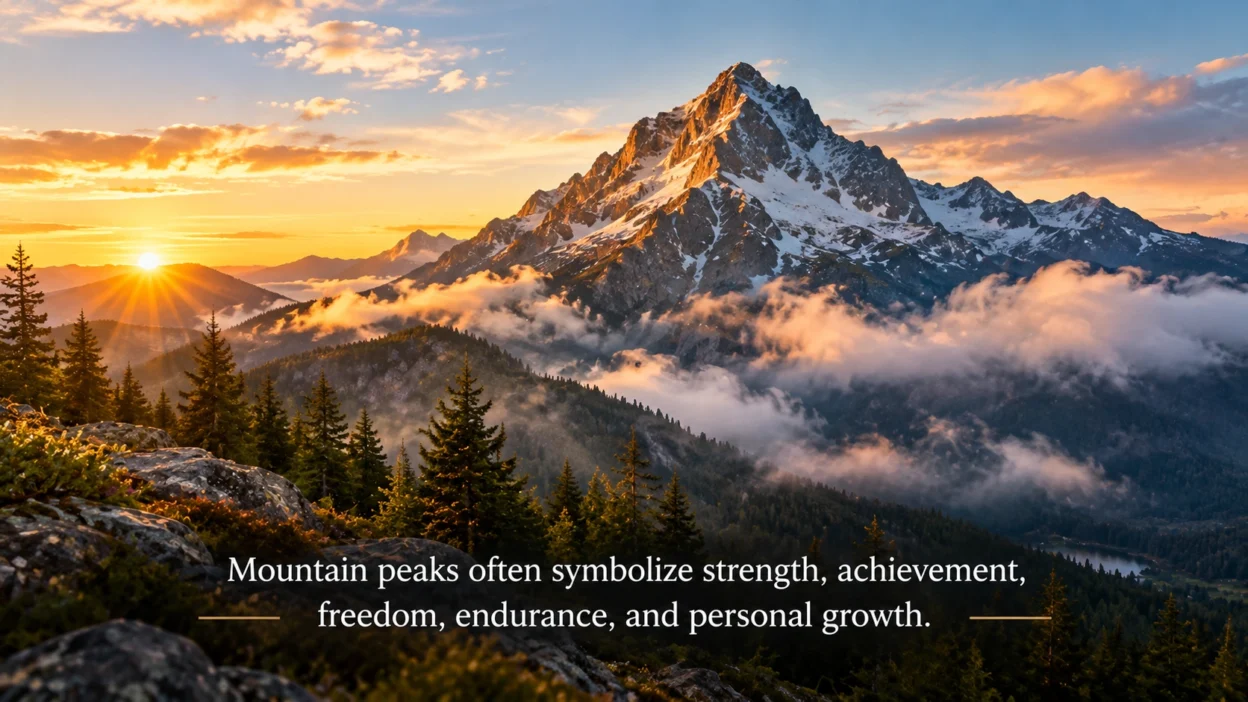
Mountains have always attracted human attention. Their height, strength, and distance from everyday life make them powerful symbols. Mountain Peak Symbolism often connects the highest point of a mountain with achievement, courage, freedom, and the effort required to overcome challenges.
In the modern world, mountains appear throughout outdoor culture, national parks, travel photography, literature, advertising, tattoos, and personal artwork. A peak can represent reaching a goal after a difficult climb. It can also suggest independence, adventure, or a desire to rise above ordinary limits.
However, mountain symbolism isn’t limited to physical achievement. Across history, people have viewed high places as sacred, mysterious, or close to the divine. Today, the same image can carry a quieter meaning: patience, perspective, resilience, and personal transformation.
Quick Answer
Mountain Peak Symbolism in the USA commonly represents strength, achievement, freedom, endurance, and overcoming obstacles. More broadly, mountain peaks can symbolize spiritual elevation, wisdom, stability, and a journey toward a higher goal.
TL;DR
- Mountain peaks commonly represent strength, ambition, endurance, and achievement.
- Ancient cultures often connected mountains with sacred or elevated places.
- American culture strongly links peaks with wilderness, freedom, and exploration.
- A summit can symbolize reaching an important personal goal.
- Tattoos and artwork often use peaks to express resilience and growth.
- Meanings change depending on culture, context, and personal experience.
What Does a Mountain Peak Symbolize?
A mountain peak is more than the highest point of a landscape. Symbolically, it represents something difficult to reach but visible from a distance. Because of this, people often connect it with goals, progress, and perseverance.
For American readers, the image can feel especially familiar. The country’s national parks and western landscapes have helped make mountains part of the American imagination.
Strength and Stability
Mountains appear solid and difficult to move. Therefore, they naturally suggest strength, stability, and endurance.
A peak can represent standing firmly through difficult circumstances. It may also suggest emotional steadiness when life feels uncertain.
Achievement and Ambition
The summit provides a clear image of completion. Reaching it means passing through distance, effort, weather, and uncertainty.
For that reason, a mountain peak can symbolize:
• Reaching a difficult personal goal
• Completing a demanding journey
• Building confidence through challenges
• Rising beyond previous limitations
• Turning ambition into visible achievement
Mountain Peaks in Ancient Symbolism
Long before modern hiking culture, mountains carried symbolic importance. Their height and unusual landscapes made them natural places for stories about gods, spirits, ancestors, and sacred encounters.
However, ancient mountain meanings varied widely. There wasn’t one universal mountain tradition, and different societies gave particular peaks their own identities.
Sacred Mountains
In several ancient traditions, mountains served as meeting places between earthly and heavenly realms. Their height made them powerful images of separation and connection.
Mountains also appeared in mythology as places where important events occurred. High ground could represent authority, mystery, protection, or divine presence.
Mountains in Greek Tradition
Greek mythology associated Mount Olympus with the gods. Its legendary status helped connect a mountain summit with divine authority and an elevated realm.
This idea influenced later Western artistic traditions. High mountains could suggest greatness, distance, mystery, or something beyond ordinary human life.
Mountains in Ancient Near Eastern Traditions
Mountains also held important roles in ancient Near Eastern religious traditions. High places could serve as sacred settings, and mountains sometimes appeared in creation stories or accounts of divine encounters.
Therefore, the mountain’s symbolic power existed well before modern ideas about climbing or exploration.
Mountain Symbolism in Native American Traditions
Mountain meanings among Indigenous peoples of North America are diverse. There is no single Native American interpretation that applies to every nation or community.
However, particular mountains have deep cultural, spiritual, historical, and geographical significance for specific Indigenous peoples. These relationships can include sacred stories, ceremonies, ancestral connections, and responsibilities toward the land.
Place Matters
A mountain shouldn’t automatically be treated as a generic spiritual symbol. For many Indigenous communities, a specific mountain is connected to a particular people and place.
Today, respectful discussion should recognize those distinct traditions rather than combining them into one generalized belief.
A Living Relationship With Land
In some Indigenous contexts, mountains can represent relationships between people, land, history, and spiritual life. This differs from treating a mountain simply as a decorative image.
For American audiences, this distinction matters when using mountain imagery connected with particular sacred places.
Mountain Peaks in American Culture
The mountain became especially powerful within American ideas about wilderness and the frontier. As Americans encountered and documented western landscapes, dramatic peaks became symbols of vast land and exploration.
Later, national parks helped bring these landscapes into everyday American culture. Photographs, posters, travel guides, films, and outdoor brands all helped strengthen the association.
Wilderness and Freedom
A mountain landscape can suggest escape from crowded cities and busy routines. It often creates an emotional picture of open space and independence.
In American culture, mountain imagery commonly connects with:
• Wilderness and outdoor adventure
• Personal independence and freedom
• Exploration of unfamiliar places
• Connection with natural landscapes
• Escape from everyday pressures
• Appreciation of national parks
The American West
The Rocky Mountains and other western ranges became especially important in American visual culture. Their peaks appeared in paintings, photography, tourism materials, maps, and popular entertainment.
As a result, the mountain became part of a larger American story about exploration, landscape, and possibility.
Mountain Peaks and Personal Growth
A mountain is often used as a metaphor for life itself. The path upward can represent difficulty, while the summit represents progress or a meaningful goal.
However, this symbolism doesn’t always mean winning. Sometimes the journey matters more than reaching the highest point.
The Climb as a Metaphor
Imagine someone working toward a degree, career goal, recovery from a difficult period, or personal milestone. The mountain provides a simple visual comparison.
The climb represents effort. The changing terrain represents setbacks. The summit represents a moment of perspective.
What the Summit Can Represent
A mountain peak may symbolize:
• Personal growth after hardship
• Patience during a long process
• Courage when progress feels uncertain
• Perspective gained through experience
• Confidence after overcoming obstacles
This interpretation explains why mountain imagery appears so often in motivational artwork.
Spiritual Meaning of Mountain Peaks
Mountains have spiritual associations in many parts of the world. Their height can represent movement from ordinary life toward a higher state of awareness or sacred experience.
Still, spiritual meanings differ greatly between traditions. A mountain image doesn’t automatically carry one religious message.
Higher Perspective
A summit gives a person a wider view of the landscape. Symbolically, this can represent gaining wisdom or seeing life differently.
The idea is simple: distance can create perspective.
Sacred Elevation
Some religious traditions associate mountains with revelation, prayer, pilgrimage, or encounters with the sacred. Mountains can therefore symbolize a connection between earthly and transcendent realms.
In modern secular settings, however, the same image may simply represent peace, reflection, or inner growth.
Emotional Meaning of Mountain Peaks
Mountain imagery often creates strong emotional responses. A huge peak can make someone feel small, but that feeling isn’t necessarily negative.
Instead, the scale can encourage wonder, humility, calm, or curiosity. The meaning often depends on the surrounding image.
Common Emotional Associations
A peaceful mountain scene may communicate calm and stability. A dramatic peak under storm clouds can instead suggest danger, struggle, or uncertainty.
Common associations include:
• Awe created by enormous natural landscapes
• Calm from quiet wilderness surroundings
• Courage inspired by difficult climbs
• Humility when facing nature’s scale
• Hope represented by reaching higher ground
• Determination during difficult periods
Psychological Perspective
People often use mountains to represent challenges because the metaphor is easy to understand. A difficult climb requires repeated effort rather than one dramatic action.
Therefore, mountain imagery can reinforce ideas about patience and persistence without requiring a specific religious meaning.
Mountain Peaks and Their Meanings in Different Contexts
The same peak can communicate different ideas depending on how it’s shown. Context is therefore essential when interpreting mountain symbolism.
| Context | Meaning in the USA | Common Associations | Notes |
| Summit at sunrise | Hope and achievement | New beginnings, optimism | Often used for inspirational imagery |
| Snow-covered peak | Endurance and majesty | Strength, purity, permanence | Can create a grand or distant mood |
| Mountain trail | Personal journey | Growth, effort, discovery | Emphasizes the process over the destination |
| Lone peak | Independence | Freedom, solitude, confidence | Meaning depends on surrounding imagery |
| Mountains with wildlife | Wilderness connection | Nature, conservation, adventure | Common in outdoor and park imagery |
This is why symbolic interpretation should consider the entire image. Color, weather, location, and human presence can all change the message.
Mountain Peaks in Tattoos and Body Art
Mountain tattoos are popular because they can express a personal story without using many words. A simple triangular outline may represent an important challenge, while a detailed landscape can commemorate a particular place.
For many Americans, the design can also connect with hiking, travel, national parks, family memories, or outdoor identity.
Common Tattoo Designs
Minimal mountain outlines often communicate simplicity and determination. A detailed range can instead emphasize a specific landscape or personal memory.
Sunrise, forests, rivers, stars, and trails are also frequently combined with peaks. Each addition can change the overall meaning.
Personal Meaning
Someone might choose a mountain tattoo after completing a difficult stage of life. Another person may choose it simply because mountains remind them of home.
Therefore, there isn’t one fixed interpretation. The wearer’s story remains an important part of the symbol.
Mountain Peaks in Home Decor and Social Media
Mountain imagery has become common in American home decor. Prints, wall art, photographs, blankets, mugs, and decorative signs often use peaks to create an outdoors-inspired atmosphere.
On social media, mountain photographs can communicate travel, adventure, solitude, achievement, or appreciation for nature.
Visual Style
Minimalist mountain designs usually use clean lines and simple shapes. Photorealistic images create a stronger sense of place and natural grandeur.
Dark silhouettes can suggest mystery or strength. Warm sunrise scenes usually feel more hopeful and peaceful.
Digital Symbolism
A mountain photograph may also represent a personal milestone. Someone might post a summit photograph after completing a demanding hike.
In that setting, the mountain becomes both a landscape and a record of achievement.
Mountain Peaks in Literature, Art, and Media
Artists and writers have long used mountains to represent forces larger than individuals. Their size creates a natural contrast between human beings and the environment.
American landscape painting played an important role in shaping public ideas about wilderness. Later, photography and film made dramatic mountain scenery even more familiar.
The Mountain as a Character
In stories, a mountain can function almost like a character. It may create an obstacle, provide shelter, reveal a destination, or force someone to change.
This makes the peak useful for stories about transformation. The character who reaches the summit may not be the same person who began the journey.
Adventure and Exploration
Modern movies and outdoor media often associate peaks with discovery. However, real mountains can also involve serious physical and environmental challenges.
The symbolic image is therefore usually simpler than the reality behind it.
Misunderstandings and Controversies
Mountain symbolism is generally positive, but context can change its meaning. Problems can arise when specific sacred landscapes or Indigenous traditions are treated as generic decorations.
Sacred Places and Cultural Respect
A mountain may have a deep cultural meaning for a particular community. Using its image without understanding that background can remove the place from its real history.
Respectful interpretation avoids claiming that all cultures share identical mountain beliefs.
The Myth of Effortless Achievement
Modern motivational culture sometimes presents the summit as proof that determination always produces success. Real life is more complicated.
Access, health, money, geography, opportunity, and social circumstances can affect people’s ability to pursue goals. Therefore, mountain symbolism works best as a metaphor rather than a promise.
How Mountain Symbolism Has Changed Over Time
Mountain meanings have shifted as societies changed. Ancient traditions often emphasized sacred power, while later Western art frequently focused on grandeur and the natural world.
In modern America, the symbol can combine several layers. A single mountain photograph may suggest wilderness, freedom, adventure, personal growth, and peace at the same time.
From Sacred Height to Personal Achievement
Earlier traditions often placed importance on mountains as sacred locations. Modern culture frequently turns the summit into a metaphor for individual goals.
However, the older idea of elevation remains visible. Whether the goal is spiritual wisdom or personal achievement, the basic image is similar: moving upward toward something important.
Read More: Quartz Symbolism: Meaning, History, and Modern Uses
A More Personal Symbol Today
Today, people often choose mountain imagery because it fits their own experiences. The meaning may involve travel, family, grief, ambition, healing, or a love of nature.
As a result, mountain symbolism has become flexible enough to carry both public and private meanings.
FAQs
What does a mountain peak symbolize?
A mountain peak commonly symbolizes strength, achievement, endurance, freedom, and personal growth. In spiritual contexts, it can also represent wisdom or elevation.
What does a mountain symbolize in American culture?
In the United States, mountains often represent wilderness, exploration, independence, and adventure. They can also symbolize national parks and appreciation for the natural landscape.
What does reaching a mountain summit symbolize?
Reaching a summit can represent completing a difficult goal. It may also symbolize persistence, confidence, and the perspective gained through a long journey.
What does a mountain tattoo mean?
A mountain tattoo can represent resilience, adventure, freedom, personal growth, or a meaningful place. Its exact meaning usually depends on the person’s own experience.
What is the spiritual meaning of a mountain?
Mountains can symbolize sacred space, higher awareness, wisdom, or connection with the divine. However, interpretations differ among religions and cultures.
Why are mountains associated with strength?
Mountains appear permanent, massive, and difficult to move. These physical qualities naturally support symbolic ideas of stability, endurance, and strength.
Conclusion
Mountains combine physical power with emotional depth. Their peaks can represent strength and stability, while the climb can suggest patience, courage, and personal growth. In the United States, Mountain Peak Symbolism also connects strongly with wilderness, freedom, exploration, national parks, and outdoor life. Yet its meaning can remain deeply personal, whether it appears in a tattoo, photograph, piece of art, or quiet moment in nature. The next time you see a mountain peak, consider both the destination and the journey. Sometimes the most meaningful part of the symbol isn’t standing at the top, but continuing upward.