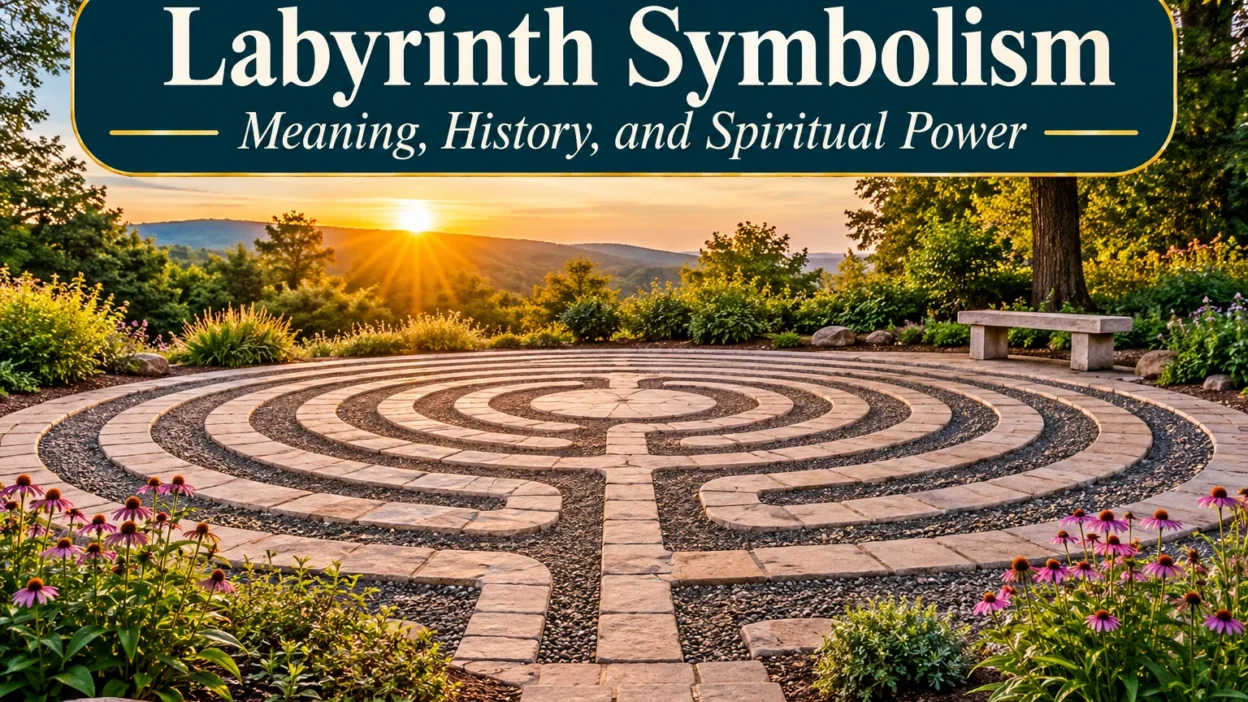
A labyrinth is more than a winding path. It can represent the journey through life, the search for meaning, and the patience needed to reach a deeper understanding. Labyrinth Symbolism explores how this ancient design connects with human experiences, from uncertainty and change to hope and personal discovery.
A labyrinth usually features a single winding route that leads toward a central point. Although its turns may seem confusing, a traditional labyrinth generally has no branching paths or dead ends. This makes it different from a maze, where people must choose between routes and find their way out.
Today, the labyrinth remains a powerful image because life rarely follows a straight line. Its winding path reminds us that progress can include delays, unexpected turns, and moments of doubt. Even so, each step can become part of a meaningful journey.
Quick Answer
Labyrinth Symbolism in the United States commonly represents life’s journey, spiritual reflection, patience, and personal transformation. More broadly, labyrinths can symbolize a search for truth, a journey toward the self, or the relationship between confusion and clarity.
TL;DR
- A labyrinth symbolizes life’s journey, discovery, and personal growth.
- Its winding path represents patience and progress through uncertainty.
- Ancient Greek mythology connects labyrinths with the story of the Minotaur.
- Christian traditions sometimes use labyrinths for prayer and spiritual reflection.
- Modern Americans encounter labyrinths in gardens, churches, parks, and meditation spaces.
- Labyrinth tattoos often express resilience, transformation, and a search for meaning.
What Is Labyrinth Symbolism?
Labyrinth symbolism comes from the meaning people attach to a winding path that leads toward a center. Its design creates a visual journey, encouraging people to think about direction, purpose, and the experiences between beginning and destination. In American culture, it often appears in spiritual settings and spaces devoted to reflection.
The Shape and Its Meaning
A labyrinth may be circular, oval, square, or arranged in a more complex geometric pattern. Many traditional designs use a single continuous path, with repeated turns that eventually guide the walker toward the center.
The center is especially important because it can represent a goal, an inner truth, a place of peace, or a moment of understanding. Meanwhile, the winding route represents everything experienced along the way.
Common design features include:
- Circular paths: Wholeness, continuity, and the cycles of life.
- Winding turns: Change, patience, and unexpected experiences.
- Central spaces: Discovery, reflection, completion, or inner peace.
- Repeated patterns: Balance, order, and the connection between different stages of life.
Labyrinth Versus Maze
Although people sometimes use the words interchangeably, a labyrinth and a maze have different traditional designs. A maze usually offers branching routes, dead ends, and choices that challenge navigation.
A labyrinth generally follows one continuous route toward its center. Therefore, its symbolism often emphasizes experiencing the journey rather than solving a puzzle.
This difference explains why labyrinths are frequently used for reflection. The walker doesn’t need to choose the correct turn; instead, the path invites attention to each step.
The Ancient Origins of Labyrinth Symbolism
Labyrinth designs have appeared in ancient cultures for thousands of years. Their original purposes weren’t always recorded, so historians distinguish between documented uses and later interpretations.
Ancient Designs and Early Evidence
Some of the earliest known labyrinth-like patterns appear in ancient Mediterranean and other archaeological traditions. These designs occur on objects, coins, and other materials, although their exact meanings vary and are sometimes uncertain.
The word labyrinth is strongly associated with ancient Crete and Greek mythology. The famous Cretan labyrinth became a lasting image of a complicated structure that concealed a dangerous secret.
However, not every ancient pattern had the same purpose. Some may have served decorative, ritual, protective, or symbolic roles, but interpretations depend on the specific object and historical evidence.
The Story of Theseus and the Minotaur
In Greek mythology, King Minos of Crete kept the Minotaur inside a labyrinth built by the craftsman Daedalus. The creature was part human and part bull, and the structure made escape difficult.
The hero Theseus entered the labyrinth to defeat the Minotaur. With Ariadne’s help, he used a thread to find his way back after completing his task.
This story gave the labyrinth several lasting associations:
- Facing danger or a powerful personal challenge.
- Entering the unknown to discover something hidden.
- Finding guidance when a situation feels overwhelming.
- Returning from a difficult experience with new understanding.
The myth also connects the labyrinth with courage and intelligence. Theseus succeeds not through strength alone but through assistance, planning, and a way to retrace his steps.
Why Ancient Roots Still Matter
Modern interpretations often draw inspiration from these stories, especially when exploring personal struggles. The labyrinth can represent the difficult process of confronting fear or finding a way through uncertainty.
Still, it helps to separate ancient mythology from modern spiritual meanings. A contemporary interpretation may be meaningful without being the original purpose of an ancient design.
Labyrinth Symbolism in Christianity and Medieval Europe
One of the most influential chapters in labyrinth history comes from medieval Christianity. During this period, labyrinths appeared on the floors of several European churches and cathedrals, where they became connected with prayer and pilgrimage.
The Labyrinth of Chartres Cathedral
The famous labyrinth at Chartres Cathedral dates to the early 13th century. Its circular pattern contains a long, winding route that leads toward the center.
For Christian pilgrims, walking a labyrinth could represent a spiritual journey. It offered a way to reflect on faith and life’s difficulties without traveling to a distant holy place.
The path also became a reminder that spiritual growth might involve patience and humility. Reaching the center could represent a moment of prayer, reflection, or closeness to God.
The Journey as a Spiritual Pilgrimage
A pilgrimage is a journey undertaken for religious or spiritual reasons. Medieval labyrinths allowed worshippers to express this idea through movement rather than travel alone.
However, not every historical labyrinth had a clearly documented religious purpose. Some modern explanations also give symbolic meanings to particular design features that scholars cannot confirm as original intentions.
Today, Christian communities continue to use labyrinths for prayer and quiet reflection. Other people appreciate them without adopting a religious belief.
What Does a Labyrinth Symbolize Spiritually?
The spiritual meaning of a labyrinth often centers on the relationship between the individual, the journey, and a deeper sense of purpose. In the United States, people encounter this symbolism in churches, retreat centers, meditation gardens, and interfaith spaces.
A Journey Toward Inner Truth
Walking toward the center can represent a search for wisdom or a better understanding of yourself. Each turn offers a reminder to slow down rather than rush toward an answer.
The center may represent different things to different people. For one person, it might suggest divine presence; for another, it could mean clarity, acceptance, or a renewed sense of direction.
Letting Go and Returning
The journey outward can be just as meaningful as reaching the center. Some walkers use this stage to consider how they might carry new insights into everyday life.
Common spiritual interpretations include:
- Inner peace: Making space for silence and reflection.
- Surrender: Accepting that not every answer arrives immediately.
- Renewal: Leaving old concerns behind and beginning again.
- Connection: Exploring relationships with faith, nature, or personal values.
- Purpose: Reflecting on the direction of one’s life.
These are possible interpretations rather than universal rules. A labyrinth doesn’t require a specific belief system, and its meaning can remain personal.
What Does a Labyrinth Mean in American Culture?
In the United States, labyrinths bring ancient patterns into modern spaces for reflection, remembrance, and community. Their meaning often depends on where they appear and how people use them.
Labyrinths in Churches and Public Spaces
American churches, colleges, retreat centers, and community gardens have incorporated labyrinths into their grounds. Some are built from stone or brick, while others use grass, painted lines, or temporary materials.
At Boston College, for example, a memorial labyrinth honors alumni who died in the September 11 attacks. Its design connects remembrance with reflection on life’s journey.
This illustrates how labyrinth symbolism can extend beyond personal spirituality. A shared path may also create a quiet place to remember people, consider loss, or express collective hope.
The American Interest in Personal Growth
American culture often emphasizes self-discovery, resilience, and finding a meaningful direction in life. The labyrinth fits naturally into these themes because its winding route suggests that growth rarely happens in a straight line.
For some people, it represents the courage to continue despite uncertainty. For others, it challenges the idea that every delay means failure.
The following table shows how its meaning can change across everyday American settings.
| Context | Common meaning | Main association |
|---|---|---|
| Church garden | Prayer and spiritual reflection | Faith and devotion |
| Memorial space | Remembrance and contemplation | Loss and connection |
| Retreat center | Mindfulness and self-exploration | Stillness and awareness |
| Personal artwork | Life’s winding journey | Growth and resilience |
| Public garden | A quiet place to walk | Nature and reflection |
Labyrinths and American Identity
Unlike national flags or official emblems, labyrinths don’t have one fixed meaning in American identity. Instead, they offer a flexible symbol that people can adapt to personal, spiritual, and community experiences.
This flexibility helps explain their continued appeal. The same pattern can support a religious pilgrimage, a memorial, or a quiet walk through a garden without requiring everyone to interpret it identically.
Labyrinth Symbolism Across Different Cultures
Labyrinth-like designs appear in different places and periods, but similar shapes don’t always share the same history. Understanding this distinction helps readers appreciate cultural connections without treating every tradition as identical.
European and Mediterranean Traditions
Ancient Greek stories connected the labyrinth with the Minotaur, danger, and the challenge of finding a way through a complicated space. Later, Roman art included labyrinth designs in mosaics, sometimes alongside imagery from the Greek myth.
Medieval European Christians developed their own uses for labyrinths. These often emphasized pilgrimage, prayer, and the journey of faith.
Patterns in Other Traditions
Labyrinth-like patterns also appear in various forms of art and spiritual practice around the world. However, a spiral, a mandala, and a labyrinth are not automatically interchangeable.
For example, mandalas in Hindu and Buddhist traditions have their own religious and philosophical meanings. Their circular arrangements may encourage contemplation, but their symbolism shouldn’t be reduced to the same meaning as a European cathedral labyrinth.
Likewise, Indigenous American designs belong to distinct cultural traditions. Similar visual forms don’t prove a shared origin or identical spiritual purpose.
Finding Common Themes Without Erasing Differences
Some broad themes appear repeatedly in human interpretations of winding patterns. People may associate them with movement, cycles, order, or a journey through life.
However, those similarities don’t mean every culture uses the same symbol in the same way. The most respectful approach is to understand each design within its own historical and cultural setting.
The Psychological Meaning of a Labyrinth
A labyrinth can encourage people to think differently about uncertainty, patience, and progress. Its visual structure offers a simple image of a journey that may feel complicated while we’re experiencing it.
Why the Winding Path Feels Meaningful
People often expect progress to move directly from a problem toward a solution. A labyrinth challenges that expectation by repeatedly turning away from the center before eventually moving closer again.
This pattern can serve as a metaphor for real experiences. Learning a skill, rebuilding confidence, changing careers, or developing a relationship may involve revisiting familiar questions.
The labyrinth can remind us that an indirect route isn’t necessarily a failed journey. Sometimes, progress becomes clearer only when we look back.
Emotional Associations
Different people may experience the labyrinth as comforting, challenging, mysterious, or hopeful. These reactions depend on personal memories, beliefs, and the context in which the design appears.
Common psychological associations include:
- Patience: Accepting that meaningful progress takes time.
- Resilience: Continuing despite setbacks and uncertainty.
- Self-awareness: Making room to notice thoughts and feelings.
- Acceptance: Recognizing that some situations cannot be rushed.
- Hope: Trusting that a difficult period can lead somewhere meaningful.
These meanings are reflective rather than diagnostic. A labyrinth symbol doesn’t reveal someone’s personality or guarantee an emotional outcome.
The Value of Walking Slowly
Walking a physical labyrinth can give people a structured opportunity to pause. Instead of focusing on a destination alone, they can notice their steps, surroundings, and thoughts.
Some people use the experience as a form of mindfulness or prayer. Others simply enjoy the quiet movement and the chance to step away from everyday distractions.
However, a labyrinth isn’t a guaranteed treatment for emotional or mental health concerns. Its value is best understood as a personal or spiritual practice that some people find meaningful.
Labyrinth Symbolism in Dreams
When a labyrinth appears in a dream, its meaning depends on the dreamer’s experiences and feelings. There is no single interpretation that applies to everyone.
Searching for Direction
A dream about walking through a labyrinth may reflect a situation that feels complicated. It might bring to mind a difficult decision, a period of change, or the desire to understand an uncertain relationship.
However, the image doesn’t necessarily predict future events. Dreams can combine memories, emotions, and ordinary experiences in unexpected ways.
Reaching the Center or Finding the Exit
Reaching the center might feel like discovering an answer or arriving at an important personal realization. Getting lost, meanwhile, could reflect frustration or uncertainty about a current challenge.
Consider the emotional details rather than relying on a fixed dream dictionary. Ask yourself what the labyrinth reminded you of and whether any part of your life feels similarly winding.
Ultimately, dream symbolism works best as a prompt for reflection, not as proof of a hidden message or a prediction.
Labyrinth Tattoos and Their Modern Meanings
Labyrinth tattoos appeal to people who want a design with layers of meaning. Their geometry can look striking on its own, while their symbolism offers room for a personal story.
Popular Labyrinth Tattoo Ideas
A tattoo’s meaning often comes from the wearer’s experiences rather than the pattern alone. Some people choose a traditional circular design, while others combine the path with additional symbols.
Common approaches include:
- Circular labyrinth: A reminder of life’s ongoing journey.
- Minimal line design: A symbol of simplicity, focus, and direction.
- Labyrinth with a heart: A personal journey involving love or relationships.
- Labyrinth with a star: Hope, guidance, or a meaningful destination.
- Labyrinth with a date: A reminder of a turning point or personal milestone.
These combinations are modern creative choices, not fixed historical meanings.
Choosing a Personal Interpretation
Before choosing a tattoo, consider what the center represents to you. It might symbolize a goal you’ve reached, a person you’ve lost, or a journey that continues.
You can also decide whether the design should feel spiritual, historical, or purely personal. A simple pattern may communicate your intended meaning without additional imagery.
Because labyrinths appear in several cultural and religious settings, it’s worth understanding the source of a particular design before adopting a highly specific traditional form.
Labyrinth Symbolism in Art, Gardens, and Home Decor
Labyrinths bring movement and visual balance to spaces that might otherwise feel static. In American homes and gardens, they can serve as decorative patterns, quiet walking areas, or reminders to approach life with patience.
Labyrinths in Gardens
Garden labyrinths use hedges, stones, gravel, grass, or flowers to create a winding path. Unlike hedge mazes designed to challenge visitors, walking labyrinths generally provide one route toward the cente.
The natural setting can strengthen associations with balance, renewal, and connection to the outdoors. Meanwhile, walking the route provides a reason to slow down and notice the changing surroundings.
Using Labyrinths in Interior Design
Inside the home, labyrinth patterns appear in wall art, rugs, ceramics, jewelry, and decorative objects. Their repeating lines can create a sense of order while suggesting a journey that unfolds over time.
A small labyrinth print might represent personal growth. A stone design in a garden could serve as a quiet place for reflection.
However, decorative use doesn’t automatically make an object religious. Some people choose labyrinth designs for their appearance, while others value their historical or spiritual associations.
Labyrinths in Digital Art and Social Media
Digital artists often use geometric patterns to explore ideas about identity, memory, and personal change. A labyrinth can illustrate a complicated decision or the search for direction without needing a lengthy explanation.
On social media, people may pair the image with reflections about healing, patience, or new beginnings. Still, these captions reflect individual interpretations rather than a universal definition.
Labyrinth Misunderstandings and Controversies
Although labyrinths often represent peace and discovery, their meanings aren’t always positive. Historical stories, spiritual associations, and modern interpretations can create confusion when people treat them as interchangeable.
Labyrinths Are Not Always Mazes
The most common misunderstanding is that every labyrinth is designed to confuse people. In modern usage, the terms sometimes overlap, but traditional walking labyrinths usually have a single route to the center.
A maze emphasizes choices and navigation. A labyrinth often emphasizes following a path and experiencing the journey.
This distinction matters when interpreting artwork or deciding whether a design represents confusion or contemplation.
Are Labyrinths Religious Symbols?
Some labyrinths have clear Christian associations, especially those modeled on medieval cathedral designs. Others appear in secular gardens, community spaces, and personal artwork.
Therefore, a labyrinth shouldn’t automatically be labeled Christian, pagan, or connected to a particular spiritual movement. Its context and documented history matter.
People can respectfully use a labyrinth for personal reflection without adopting the beliefs associated with another setting. However, designs taken from specific cultural or religious traditions deserve informed and thoughtful treatment.
Ancient Origins and Modern Claims
Some modern interpretations describe labyrinths as universal symbols with one ancient spiritual meaning. The historical record is more complicated.
Labyrinth-like patterns developed in different settings, and researchers don’t know the precise origin or purpose of every early example. Similar designs may express different ideas across cultures and periods.
It is reasonable to find personal meaning in an ancient pattern. However, personal meaning should not be presented as proven historical fact.
How Labyrinth Symbolism Has Changed Over Time
The labyrinth has shifted from an image associated with ancient stories to a design used in religious buildings, art, gardens, and personal reflection. Each period has added new interpretations while preserving the idea of a winding journey.
From Ancient Myth to Medieval Faith
In ancient Greek tradition, the labyrinth became famous through the story of Theseus and the Minotaur. Its associations included danger, confinement, cleverness, and escape.
During the Middle Ages, European Christians adapted labyrinth designs for church floors. These patterns gained associations with pilgrimage and the journey of faith.
From Sacred Buildings to Modern Reflection
Over time, many historic church labyrinths disappeared or fell out of use. Interest later returned, and contemporary communities began creating labyrinths for spiritual practice, meditation, and public reflection.
In the United States, this renewed interest has helped bring labyrinths into gardens, universities, memorial spaces, and retreat centers.
Read More: Potion Symbolism: Magic, Healing, Power, and Transformation
What Has Stayed the Same?
Despite these changes, several themes remain recognizable. The path still suggests movement through uncertainty, while the center offers a possible destination for reflection.
The meaning has also become more personal. Someone might interpret the labyrinth through religious faith, another person through psychological reflection, and someone else through art or design.
This flexibility is one reason the symbol continues to appeal to modern audiences.
FAQs
What does a labyrinth symbolize spiritually?
A labyrinth can symbolize a journey toward inner peace, spiritual understanding, or a closer connection with one’s beliefs. Its meaning depends on the tradition and the individual’s experience.
What is the difference between a labyrinth and a maze?
A traditional labyrinth has one continuous path leading toward the center. A maze usually contains multiple routes, choices, and dead ends that make finding the correct way more difficult.
What does walking a labyrinth mean?
Walking a labyrinth can represent a journey through life or a period of personal reflection. Some people use the experience for prayer, meditation, or simply enjoying a quiet walk.
What does a labyrinth tattoo symbolize?
A labyrinth tattoo often represents personal growth, resilience, patience, or the search for direction. Some people also choose it to remember a challenging period or a meaningful turning point.
What does a labyrinth symbolize in Christianity?
In some Christian traditions, a labyrinth represents pilgrimage, the journey of faith, and reflection on one’s relationship with God. Medieval cathedral labyrinths, including the one at Chartres, are important examples.
Is a labyrinth a symbol of protection?
Some modern interpretations associate labyrinths with protection or safe passage through difficult experiences. However, this isn’t a universal historical meaning, and the design shouldn’t be assumed to provide supernatural protection.
Conclusion
Labyrinth symbolism offers a powerful way to think about life’s winding journey. From ancient Greek mythology to medieval Christian churches and modern American gardens, the design has represented challenges, spiritual reflection, patience, and the search for understanding. Its greatest appeal may be the reminder that progress doesn’t always follow a straight line. The path can turn, double back, and seem to move away from its destination before drawing closer again. Whether you encounter a labyrinth in a garden, choose it for a tattoo, or simply admire its geometry, consider what the center represents in your own life. Sometimes, the journey itself provides the meaning we were looking for.