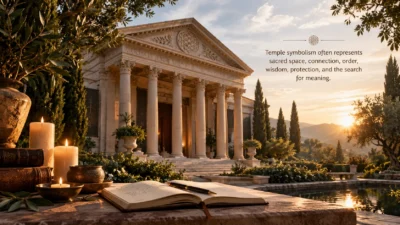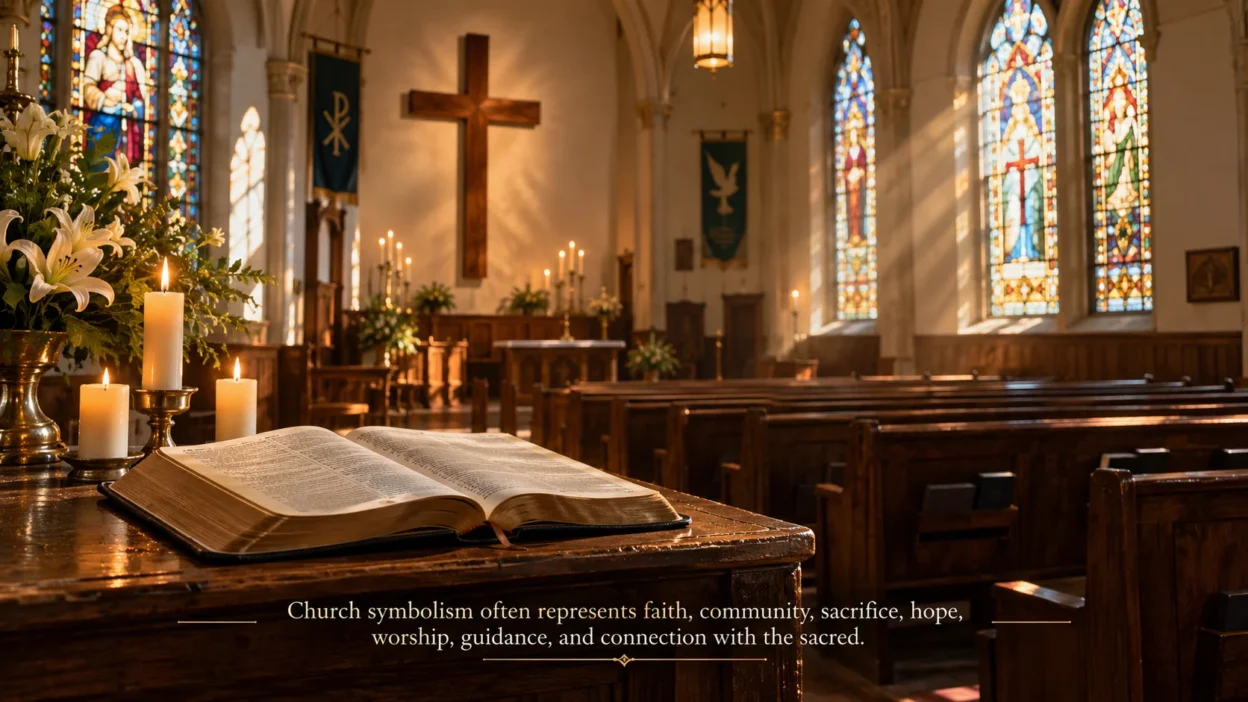
Church symbolism includes the visual signs, objects, colors, buildings, gestures, and spaces associated with Christian worship. In the United States, these symbols appear in churches, homes, cemeteries, artwork, jewelry, holidays, and public life.
For many people, church symbols carry personal meaning even when they aren’t regular churchgoers. A cross may suggest faith or remembrance, while stained glass can evoke beauty, mystery, and sacred history.
However, church symbolism isn’t limited to one object. Architecture, light, candles, water, bread, wine, bells, and even the arrangement of seats can communicate ideas. Their meanings have also changed across centuries.
Quick Answer
Church symbolism in the USA commonly represents faith, sacrifice, hope, community, worship, and a connection with the sacred. Across Christianity, specific symbols can also represent Jesus, resurrection, baptism, salvation, or spiritual guidance.
TL;DR
- The cross is one of Christianity’s most recognizable symbols.
- Church buildings can symbolize community, refuge, worship, and sacred space.
- Light often represents hope, divine presence, knowledge, or spiritual guidance.
- Water commonly represents baptism, cleansing, renewal, and new life.
- American churches combine ancient Christian imagery with local architectural traditions.
- Modern people use church symbols in jewelry, tattoos, art, decor, and memorials.
What Is Church Symbolism?
Church symbolism gives visible form to ideas that are often difficult to see or explain. A symbol can turn an abstract idea such as faith into something recognizable.
For Americans, this symbolism can appear in both religious and cultural settings. A cross necklace, church steeple, stained-glass window, or candle may communicate meaning without words.
Common Church Symbols
Several symbols appear repeatedly in Christian traditions.
• Crosses often represent sacrifice, faith, redemption, and hope.
• Fish symbols can refer to early Christian identity and Jesus.
• Doves commonly suggest peace, the Holy Spirit, or spiritual purity.
• Light can represent hope, truth, divine presence, or guidance.
• Water can symbolize baptism, renewal, cleansing, and spiritual transformation.
• Bread and wine can represent Christian communion and remembrance.
Why Context Matters
The same symbol can carry different meanings depending on its setting. For example, a cross on a church may communicate worship, while a cross on a gravestone may emphasize remembrance and eternal hope.
Likewise, candles can simply create a peaceful atmosphere. In a religious service, however, they may also suggest prayer, sacred presence, or remembrance.
What Does a Church Building Symbolize?
A church building often represents more than a place where people meet. Its architecture can create a physical sense of separation between everyday life and worship.
In the United States, churches range from small rural chapels to large urban cathedrals. Their styles reflect different periods, denominations, communities, and regional traditions.
Sacred Space
A church can symbolize refuge, belonging, prayer, and community. The building becomes meaningful through repeated gatherings, rituals, memories, and relationships.
The entrance can also carry symbolic weight. Moving from the outside into the sanctuary may represent leaving ordinary concerns behind and entering a dedicated space for worship.
Steeples and Towers
Church steeples became highly recognizable features of Christian architecture. Their height naturally draws the eye upward.
In American towns, steeples have also become cultural landmarks. They can represent continuity, local identity, and the long presence of a congregation.
Light and Windows
Stained glass transforms ordinary sunlight into colored patterns. Traditionally, religious scenes and figures could also teach stories to worshippers.
Today, Americans may appreciate stained glass for both spiritual and artistic reasons. Its changing colors can create a sense of beauty, reflection, and mystery.
What Does the Cross Symbolize in Christianity?
The cross is the central visual symbol of Christianity for many communities. Its meaning comes primarily from the crucifixion of Jesus and later Christian understandings of sacrifice, redemption, and resurrection.
However, the cross did not begin as a uniquely Christian shape. Cross-like forms existed in many ancient cultures before Christianity, although their meanings varied greatly.
Ancient Roots of the Cross
Simple crossed lines and four-part designs appeared in ancient art and religious traditions. These earlier forms had meanings connected with directions, nature, astronomy, or sacred geometry.
Their existence does not mean they had the same meaning as the Christian cross. Christianity gave the form a specific theological association with Jesus’ crucifixion.
The Cross in American Life
The cross is widespread in American churches and religious communities. It also appears on jewelry, clothing, artwork, gravestones, tattoos, and personal keepsakes.
For some people, it represents active religious belief. For others, it may symbolize family heritage, remembrance, personal struggle, or cultural identity.
How Did Church Symbolism Develop Historically?
Church symbolism developed over many centuries rather than appearing all at once. Early Christians gradually developed visual ways to express beliefs and identify their communities.
In the Roman world, Christians used symbols such as the fish, anchor, dove, and shepherd. These images could communicate ideas about faith, safety, peace, and salvation.
Early Christian Symbols
Early Christian art often used indirect imagery. The fish, for example, became an important Christian sign associated with Jesus.
The anchor could suggest hope and stability. The shepherd could represent care, protection, and the relationship between Christ and believers.
Medieval Churches
During the Middle Ages, church buildings became increasingly rich in visual symbolism. Sculptures, paintings, stained glass, and architectural forms helped communicate biblical stories and religious ideas.
Because many people could not read, images served as an important teaching tool. Church interiors therefore became visual environments filled with meaning.
Reformation and Later Changes
The Protestant Reformation changed how many Christians viewed religious images. Some traditions reduced elaborate imagery and emphasized preaching and scripture.
Other Christian traditions continued using icons, statues, stained glass, candles, and richly decorated interiors. These differences still influence American churches today.
What Does Church Symbolism Mean in America?
In the United States, church symbolism operates at both religious and cultural levels. America contains many Christian traditions, so no single interpretation represents every community.
For some Americans, church symbols express personal faith. For others, they connect to family history, childhood memories, weddings, funerals, holidays, or local community life.
Symbolism in American Communities
Church buildings have often served as community gathering places. Their symbols can therefore become connected with neighborhood identity.
A familiar church may remind someone of family celebrations, seasonal services, friendships, or important life events. These associations can remain meaningful even after someone’s religious practices change.
Church Symbols in American Holidays
Christian symbols appear strongly during Christmas and Easter. Crosses, stars, candles, angels, lilies, and nativity imagery can all become part of seasonal decoration.
However, American holiday culture often mixes religious symbolism with broader family and cultural traditions. As a result, the same image can carry different meanings for different people.
Church Symbolism in Everyday American Culture
| Context | Meaning in the USA | Common Associations | Notes |
| Cross necklace | Faith or personal identity | Belief, devotion, remembrance | Meaning depends on the wearer |
| Church steeple | Community or worship | Tradition, hometown, continuity | Often a local landmark |
| Stained glass | Sacred beauty | History, reflection, artistry | May also have cultural value |
| Church bells | Worship and gathering | Community, ceremony, tradition | Meaning varies by church |
| Candle | Prayer or remembrance | Hope, peace, memory | Also common outside churches |
What Are the Spiritual Meanings of Church Symbols?
Christian symbols often point beyond themselves toward spiritual ideas. Their purpose can be devotional, educational, ceremonial, or reflective.
Across different Christian traditions, the same object may receive slightly different emphasis. Therefore, it’s useful to describe these meanings broadly rather than assuming every church interprets them identically.
Light as Spiritual Guidance
Light frequently represents hope, truth, goodness, or divine presence. Candles can therefore create an atmosphere of prayer and reflection.
This symbolism also connects with a much older human association between light and safety. Darkness can represent uncertainty, while light makes the unknown easier to navigate.
Water and Renewal
Water has powerful religious meaning in Christianity, especially through baptism. It can suggest cleansing, renewal, transformation, and entry into a community of faith.
Water symbolism also appears throughout human history. Many cultures have connected water with life, purification, fertility, and renewal.
Bread and Wine
Bread and wine hold an important place in Christian communion traditions. They can represent remembrance, fellowship, sacrifice, and participation in sacred worship.
Different denominations understand communion in different ways. Therefore, their symbolism should be understood within each church’s specific beliefs.
What Colors Symbolize in Churches?
Color can quietly influence how a church feels. Christian traditions developed systems in which certain colors became associated with particular seasons, celebrations, or ideas.
However, color meanings aren’t completely universal. Denominations and congregations may use different traditions.
Common Church Colors
• White often suggests purity, celebration, holiness, and joy.
• Red can represent sacrifice, passion, fire, or the Holy Spirit.
• Purple often connects with preparation, repentance, royalty, or solemnity.
• Green commonly suggests growth, life, and an ongoing spiritual journey.
• Gold can communicate glory, celebration, sacred honor, or majesty.
• Black may express mourning, seriousness, death, or solemn reflection.
Color and American Church Design
American churches may use these colors through banners, altar cloths, stained glass, flowers, clothing, and seasonal decorations.
Modern churches sometimes use color more freely as part of interior design. As a result, decorative and religious meanings can overlap.
What Do Church Symbols Mean Emotionally?
Church symbolism can produce strong emotional responses because symbols become connected with memories. A person’s reaction may depend more on experience than on formal religious definitions.
For one person, a church may feel comforting and familiar. For another, it may represent family expectations, childhood, loss, or a complicated personal history.
Comfort and Belonging
Church imagery often communicates stability. Repeated rituals, familiar architecture, and recognizable symbols can create a sense of continuity.
This is especially powerful when people associate churches with important family moments. Weddings, funerals, baptisms, and holiday gatherings can give symbols deep emotional weight.
Mystery and Reflection
Dim lighting, candles, stained glass, music, and tall ceilings can create an atmosphere of wonder. These features encourage people to slow down and pay attention.
Even outside religious belief, sacred architecture can encourage quiet reflection. The setting itself can become a symbol of stillness.
How Is Church Symbolism Used Today?
Church symbolism continues to appear in American life, both inside and outside formal worship. Its modern use ranges from deeply religious expressions to artistic and personal choices.
Today, people may use religious imagery in jewelry, tattoos, home decor, photography, fashion, memorials, and social media.
Tattoos and Jewelry
Cross tattoos are among the most recognizable examples. People may choose them to represent faith, family, survival, remembrance, or a personal turning point.
Similarly, necklaces and bracelets can make religious symbolism part of everyday identity. The meaning ultimately depends on the person wearing the item.
Home Decor
Some American homes display crosses, scripture-inspired artwork, angels, candles, or religious paintings.
For religious households, these objects may support devotion. For others, they may represent family heritage, comfort, or traditional aesthetics.
Social Media and Digital Culture
Church imagery also appears in digital spaces. People may share crosses, candles, church photographs, worship scenes, or religious artwork during meaningful moments.
Digital use can make symbols more personal and informal. At the same time, simplified images can lose some of the historical context behind them.
Are Church Symbols Ever Misunderstood or Misused?
Yes. Church symbols can be misunderstood because their meanings depend heavily on context, history, and the person using them.
A symbol that feels sacred to one person may look cultural or decorative to another. Neither reaction automatically explains the symbol’s full meaning.
Cultural vs. Religious Meaning
A cross, for example, can be a statement of Christian faith. It can also represent family tradition, artistic taste, or remembrance.
Because America contains many religious and nonreligious communities, these overlapping meanings are common.
Political Associations
Some religious symbols have occasionally been used alongside political messages. However, political use doesn’t automatically define the religious meaning of the symbol itself.
It helps to separate the traditional history of a symbol from the particular message attached to it in a specific setting.
Commercialization
Religious imagery can also become decorative or commercial. Crosses, angels, candles, and church-inspired designs may appear in fashion or home products.
Some people view this as harmless artistic expression. Others may feel that sacred imagery loses meaning when treated purely as decoration.
How Has Church Symbolism Changed Over Time?
Church symbolism has continually changed as Christianity moved through different cultures and historical periods. Ancient imagery, medieval art, Reformation-era traditions, and modern American culture all contributed to what people see today.
Some symbols became more important, while others became less familiar. New interpretations also developed as churches interacted with changing societies.
From Hidden Signs to Public Symbols
Early Christians sometimes used symbols that communicated faith indirectly. Later, Christianity’s growing public presence allowed churches to display more obvious religious imagery.
Over time, the cross became especially prominent. Today, it is recognized far beyond church interiors.
Read More: Holy Symbolism: Meaning, History, and Modern Use
From Teaching Tool to Personal Identity
Church art once served an important educational purpose. In modern America, symbols also function as personal expressions of identity.
A tattoo, necklace, photograph, or social media image can communicate a person’s connection to faith without being part of a formal worship setting.
What Remains Consistent
Despite these changes, several themes remain remarkably durable. Faith, hope, sacrifice, community, remembrance, and spiritual transformation continue to shape church symbolism.
The visual forms may change, but the human questions behind them often remain familiar.
FAQs
What is the most important symbol in Christianity?
The cross is generally the most recognizable Christian symbol. It is closely connected with Jesus’ crucifixion and Christian ideas about sacrifice, redemption, and resurrection.
What does a church symbolize?
A church can symbolize worship, faith, community, refuge, belonging, and connection with the sacred. Its meaning can also reflect personal memories and local history.
What does a cross symbolize?
A cross commonly symbolizes Christian faith, sacrifice, redemption, hope, and the crucifixion of Jesus. Its personal meaning can vary among individuals.
What do church windows symbolize?
Stained-glass windows can symbolize biblical stories, sacred beauty, light, hope, and spiritual reflection. Historically, they also helped communicate religious stories visually.
What does a church steeple symbolize?
A steeple can suggest worship and a connection between earthly life and heaven. In American communities, it can also symbolize tradition and local identity.
Why are candles used in churches?
Candles can represent light, hope, prayer, remembrance, and sacred presence. Their exact meaning varies among Christian traditions and particular ceremonies.
Conclusion
Church symbolism brings abstract ideas such as faith, hope, sacrifice, community, and renewal into visible form. Crosses, candles, stained glass, water, architecture, and color each add another layer of meaning. Whether you encounter these symbols in a historic church, a family keepsake, a tattoo, or a quiet candlelit space, their meaning often depends on context. Looking closely can reveal how history, belief, memory, and human emotion meet in a single image.