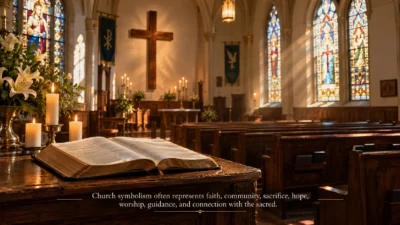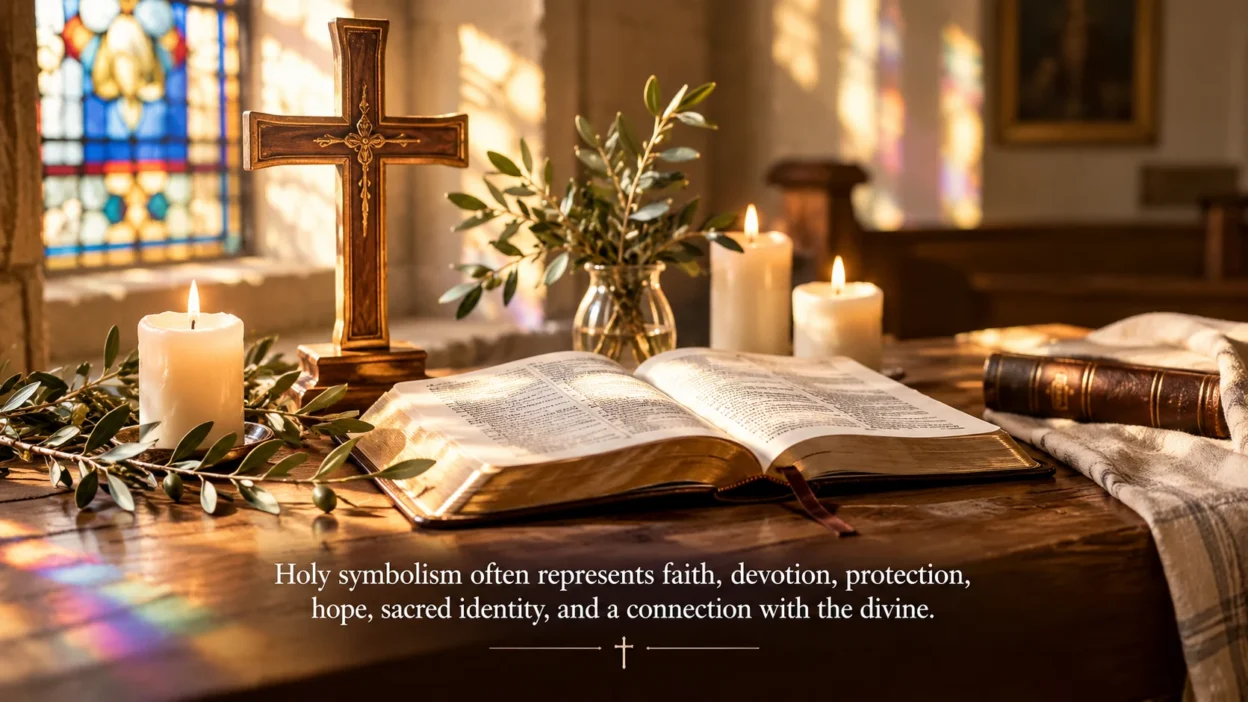
Holy symbolism describes images, objects, colors, gestures, places, and ideas that people connect with the sacred. In the United States, these symbols appear in churches, homes, jewelry, holidays, art, memorials, and personal expressions of faith.
However, holy symbols are not limited to one object or tradition. A cross, halo, candle, dove, sacred text, or gesture can carry different meanings depending on its history and context.
For many Americans, these symbols also express identity and memory. They can mark important life events, provide comfort during difficult times, or connect families with traditions passed down through generations.
Quick Answer
Holy symbolism in the USA commonly represents faith, devotion, hope, protection, sacrifice, and a relationship with the sacred. More broadly, holy symbols help people express ideas about divine presence, spiritual identity, moral values, and the mystery of life.
TL;DR
- Holy symbols represent sacred ideas, beliefs, values, and spiritual relationships.
- Christianity strongly shaped holy symbolism in American public and private life.
- Crosses, candles, halos, doves, and sacred texts remain widely recognized.
- Ancient cultures also used light, circles, animals, and natural elements symbolically.
- Modern Americans use holy symbols in jewelry, tattoos, homes, art, and holidays.
- Meanings can change depending on religion, culture, history, and personal experience.
What Is Holy Symbolism?
Holy symbolism gives visible form to ideas people consider sacred. Instead of explaining faith only through words, people use familiar objects, images, colors, and actions to communicate deeper meanings.
For an American reader, this is especially visible in religious buildings and celebrations. Yet sacred symbolism also appears in personal spaces, family traditions, memorials, and everyday objects.
Common Forms of Holy Symbols
Holy symbols can take many forms. Their meaning often depends on how they are presented.
- Crosses can represent Christian faith, sacrifice, and redemption.
- Halos suggest holiness, spiritual light, or divine favor.
- Candles often represent prayer, hope, remembrance, or sacred light.
- Doves commonly suggest peace, purity, and spiritual presence.
- Sacred books can represent divine teaching, wisdom, and religious identity.
- Water can symbolize cleansing, renewal, life, or spiritual transformation.
Why Context Matters
The same image can mean different things in different settings. A candle at a memorial may express remembrance, while a candle in worship may represent prayer or sacred presence.
Therefore, holy symbolism works through both the object and its context. Personal belief also plays a major role in how people understand it.
What Are the Historical Roots of Holy Symbols?
Holy symbolism has extremely old roots. Long before modern religions developed, people used natural forms and visual signs to express ideas about life, death, fertility, protection, the sky, and unseen powers.
Ancient societies often connected the sun, moon, fire, water, animals, and mountains with sacred forces. These patterns did not always mean the same thing, but they show how humans have long used visible things to represent invisible ideas.
Ancient Sacred Imagery
Circles, rays, trees, animals, and flowing water appeared in many ancient traditions. Light was especially powerful because it naturally suggested life, knowledge, warmth, and something beyond ordinary darkness.
Some symbols later gained new meanings when religious traditions changed. However, similar shapes could survive while their interpretations shifted.
From Ancient Traditions to Organized Religion
As major religions developed, sacred symbolism became more organized. Religious communities established recognizable signs, rituals, colors, buildings, clothing, and artistic traditions.
Christianity became especially important to American religious symbolism. Over centuries, Christian art developed recognizable images such as the cross, halo, fish, lamb, dove, and sacred heart.
What Does Holy Symbolism Mean in Christianity?
Christian symbolism is one of the strongest influences on holy imagery in the United States. Churches, religious art, holidays, jewelry, literature, and family traditions have carried these symbols across generations.
However, Christian symbols can also have layers of meaning beyond simple identification. A cross may identify Christianity while also suggesting sacrifice, suffering, hope, resurrection, or personal faith.
The Cross
The cross is perhaps the most recognizable Christian symbol in America. Its meaning is closely connected with the crucifixion of Jesus and the Christian understanding of sacrifice and redemption.
Its appearance varies widely. Some crosses are simple wooden forms, while others feature elaborate decoration, gemstones, metalwork, or a figure of Christ.
Light, Water, and the Dove
Light frequently represents divine presence, hope, and spiritual understanding. Water can suggest cleansing, renewal, baptism, and new beginnings.
The dove is also widely recognized in Christian imagery. It may represent peace or the Holy Spirit, depending on the surrounding image and tradition.
How Does Holy Symbolism Appear in the USA?
In the United States, holy symbolism exists within a diverse religious culture. Christian imagery is highly visible, but Jewish, Muslim, Hindu, Buddhist, Indigenous, and other traditions also contribute to America’s religious landscape.
American history has shaped where sacred symbols appear. They can be found in houses of worship, cemeteries, public art, private homes, schools, jewelry, clothing, and community celebrations.
Holy Symbols in American Life
People may encounter sacred imagery during major life events and holidays. Weddings, funerals, baptisms, Christmas, Easter, Passover, and other observances can bring religious symbols into everyday spaces.
| Context | Meaning in the USA | Common Associations | Notes |
| Religious worship | Faith and devotion | Prayer, community, ritual | Meaning depends on tradition |
| Jewelry | Personal belief or identity | Crosses, stars, pendants | Can be private or openly displayed |
| Memorials | Remembrance and hope | Candles, angels, crosses | Often connected with grief |
| Holidays | Religious heritage | Nativity scenes, lights | Meanings vary among families |
| Home decor | Spiritual atmosphere | Art, scripture, candles | Often reflects personal values |
Public and Private Meaning
A holy symbol can be deeply personal even when others recognize it immediately. Someone may wear a religious pendant because of family history rather than public religious expression.
In contrast, religious symbols displayed publicly can sometimes become part of wider cultural debates. Their meaning may depend on location, purpose, and community expectations.
What Are the Spiritual Meanings of Holy Symbols?
Holy symbols often help people express ideas that are difficult to describe directly. They can represent connection with the divine, moral direction, protection, gratitude, transformation, or hope.
Different religions have their own sacred languages and traditions. Therefore, it’s important not to treat all holy symbols as interchangeable.
Shared Spiritual Themes
Across different traditions, certain symbolic themes appear repeatedly.
- Light can suggest knowledge, hope, life, or divine presence.
- Water can suggest cleansing, renewal, birth, or transformation.
- Circles can suggest eternity, wholeness, unity, or cycles.
- Mountains can represent spiritual ascent, revelation, or sacred space.
- Fire can represent purification, energy, devotion, or divine power.
- Trees can suggest life, growth, connection, and spiritual continuity.
Respecting Religious Differences
Similar symbols do not necessarily have identical meanings. A symbol’s significance comes from the beliefs and practices surrounding it.
For this reason, cross-cultural comparisons are most useful when they highlight similarities without erasing important differences.
What Do Holy Symbols Represent Emotionally?
Holy symbols can carry strong emotional associations because people often encounter them during meaningful moments. Births, marriages, funerals, celebrations, illness, grief, and personal milestones can all strengthen symbolic connections.
A familiar symbol may therefore trigger feelings of safety, belonging, memory, or hope. However, emotional responses differ greatly between individuals.
Comfort and Belonging
For many people, sacred imagery creates a sense of familiarity. A childhood cross, family Bible, prayer beads, or inherited religious artwork may carry memories of relatives and home.
These objects can become emotional anchors. Their importance may remain strong even when someone’s beliefs or practices change.
Identity and Values
Holy symbols can also communicate personal values. Someone may use sacred imagery to express faith, family heritage, moral commitment, gratitude, or a desire for spiritual direction.
However, wearing a symbol does not always reveal exactly what a person believes. Personal meanings can be private and complex.
How Is Holy Symbolism Used in Tattoos and Jewelry?
Holy symbols have become common in American tattoos and jewelry. People may choose them to represent faith, family, remembrance, protection, transformation, or personal experiences.
Today, designs range from traditional religious artwork to minimalist symbols. Placement, size, material, and surrounding imagery can change the emotional impression.
Tattoos
A cross tattoo may represent religious devotion or a personal turning point. An angel, halo, praying hands, or sacred phrase may similarly connect with faith and memory.
Some people also combine sacred imagery with dates, flowers, names, landscapes, or portraits. These additions make the meaning more personal.
Jewelry
Religious jewelry can be subtle or highly visible. Cross necklaces, medallions, rings, bracelets, and symbolic pendants are often worn as both meaningful objects and personal accessories.
For some Americans, the jewelry is devotional. For others, it primarily represents family heritage, protection, remembrance, or aesthetic appreciation.
How Does Holy Symbolism Appear in Holidays and Decor?
American holidays often make sacred imagery more visible. Christmas and Easter are especially rich in Christian symbols, while other religious communities maintain their own visual traditions.
At home, people may use candles, religious artwork, sacred texts, crosses, stars, flowers, or symbolic colors. These objects can create an atmosphere of celebration, remembrance, or devotion.
Religious Holidays
Christmas imagery may include stars, angels, light, nativity scenes, and evergreen elements. Easter often uses crosses, lilies, eggs, light, and images connected with resurrection.
However, American holiday culture can blend religious and secular traditions. As a result, some symbols have both sacred and cultural meanings.
Home Decoration
Sacred decor can make a home feel connected to family traditions. A framed verse, inherited object, candle, or religious painting may serve as a daily reminder of personal values.
The meaning can be especially strong when an object has been passed through several generations.
Why Do People Find Holy Symbols Powerful?
Holy symbols can make abstract ideas easier to visualize. Concepts such as eternity, sacrifice, hope, forgiveness, and divine presence can feel difficult to explain through ordinary language.
A physical symbol gives those ideas a recognizable form. This can make them easier to remember and emotionally experience.
Symbolism and Memory
Repeated exposure strengthens symbolic associations. A person who sees the same cross during childhood, worship, family gatherings, and difficult moments may develop a powerful emotional connection with it.
Similarly, a memorial candle can become connected with a particular person. The object then carries memories beyond its basic physical appearance.
Personal Interpretation
People also reinterpret symbols as they grow. A symbol that once represented childhood religion may later represent family history, resilience, or personal reflection.
Therefore, symbolic meaning isn’t always fixed. It can develop alongside a person’s experiences.
What Are Common Misunderstandings About Holy Symbolism?
One common misunderstanding is that every religious symbol has one universal meaning. In reality, meanings often vary between denominations, religions, historical periods, and individuals.
Another mistake is assuming that an object’s appearance automatically reveals someone’s beliefs. A person may use a symbol for cultural, artistic, family, or memorial reasons.
Cultural and Religious Appropriation
Some sacred symbols have entered fashion and popular culture. This can create tension when a symbol is used without understanding its religious importance.
The issue becomes more sensitive when sacred objects are treated only as decoration. Respectful use starts with understanding the tradition and context behind the symbol.
Negative or Abusive Uses
Sacred imagery can also be altered or used in hateful, extremist, commercial, or deliberately provocative ways. Such uses do not automatically represent the traditional meaning of the original symbol.
Context matters when interpreting these cases. A symbol’s historical meaning should be distinguished from later misuse.
How Has Holy Symbolism Changed Over Time?
Holy symbols are not frozen in history. Their meanings have changed as religions, societies, art, politics, and popular culture have changed.
In the United States, symbols that once appeared mainly in religious settings can now appear in fashion, entertainment, advertising, tattoos, and social media.
From Sacred Object to Cultural Image
Some symbols now have both religious and cultural meanings. For example, an angel can represent religious beliefs about heavenly beings while also appearing as a general image of innocence or protection.
Likewise, a halo may indicate holiness in religious art but suggest innocence or virtue in modern visual culture.
Revival and Reinvention
Older symbols sometimes return during periods of renewed interest in spirituality, ancestry, traditional crafts, or religious heritage. Modern artists may also reinterpret them through minimalist design or contemporary fashion.
These changes don’t necessarily erase older meanings. Instead, they add new layers to symbols that already have long histories.
Holy Symbolism Across Different Traditions
The United States includes many religious communities, so holy symbolism cannot be understood through Christianity alone. Different traditions use distinct signs, objects, colors, gestures, and sacred spaces.
For example, Judaism includes symbols such as the Star of David and menorah. Islam has important visual traditions involving calligraphy, geometric design, and the crescent and star in some cultural contexts.
Hindu, Buddhist, Sikh, Indigenous, and other traditions also have rich symbolic systems. Their meanings should be understood within their own histories rather than reduced to one universal definition.
Read More: Sacred Symbolism: Meaning, History, and Modern Uses
Shared Human Themes
Despite major differences, sacred symbolism often addresses familiar human questions.
- What gives life meaning?
- How should people remember the dead?
- What does hope look like?
- How can people express devotion?
- How do communities preserve identity?
- What connects ordinary life with the sacred?
FAQs
What does holy symbolism mean?
Holy symbolism refers to objects, images, actions, colors, and places associated with sacred ideas. In the USA, it often relates to faith, devotion, hope, protection, remembrance, and religious identity.
What is the most common holy symbol in America?
The Christian cross is among the most recognizable holy symbols in the United States. Its meanings can include faith, sacrifice, redemption, suffering, hope, and resurrection.
What colors are associated with holiness?
White and gold are commonly associated with purity, light, glory, and sacredness in many Christian settings. However, color meanings vary across religions and traditions.
Can holy symbols have different meanings?
Yes. A symbol can have different meanings across religions, historical periods, and personal experiences. Context is essential when interpreting it.
Why do people wear holy symbols as jewelry?
People may wear sacred jewelry to express faith, remember family members, honor heritage, seek a sense of protection, or mark important experiences. Others may appreciate the design or cultural meaning.
Are holy symbols always religious?
Not necessarily. Some symbols began in religious settings but now have broader cultural meanings. Angels, candles, stars, and halos can appear in both religious and secular contexts.
Conclusion
Holy symbolism gives visible form to ideas such as faith, hope, devotion, protection, sacrifice, and spiritual connection. In the United States, these meanings appear across worship, family traditions, holidays, art, jewelry, tattoos, memorials, and everyday life. At the same time, symbols change as people and cultures change. Understanding holy symbolism means looking beyond the image itself and asking what it means to the person, community, and tradition using it. A sacred symbol can be ancient and personal at once. Its deepest meaning often comes from the memories, values, and beliefs people attach to it.