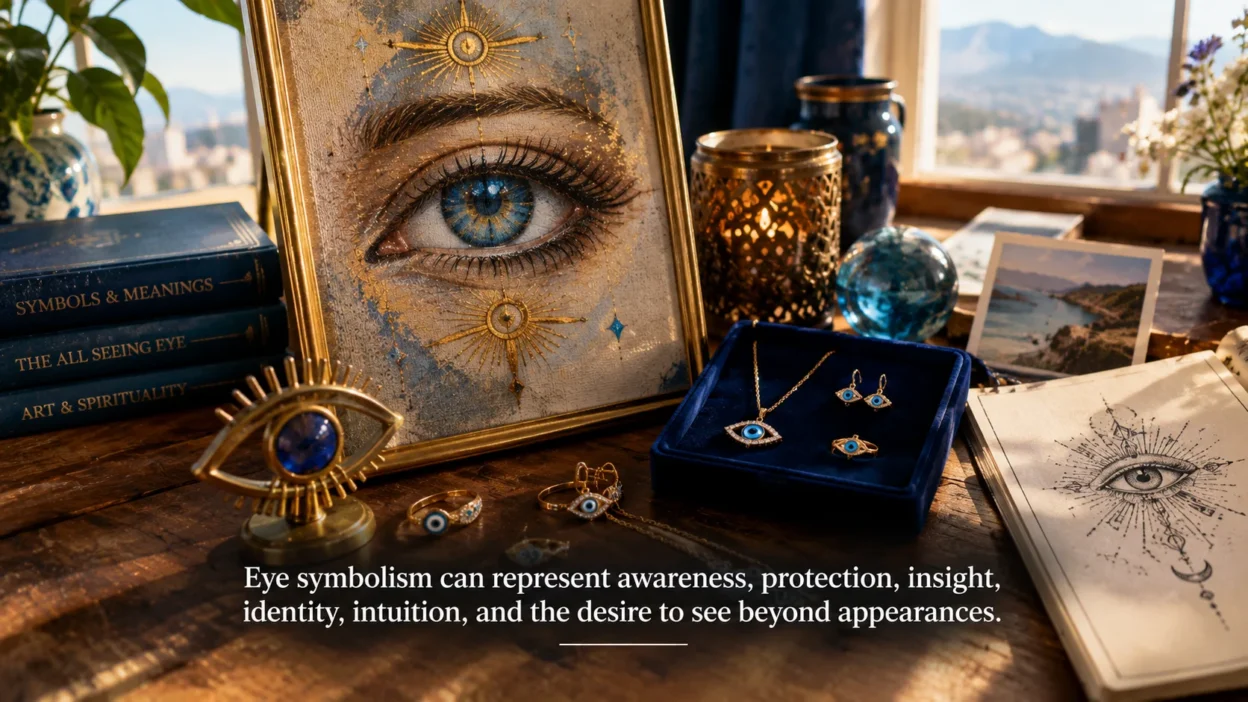
Eye symbolism appears in art, jewelry, architecture, tattoos, religious imagery, and everyday visual culture. The eye often represents seeing, awareness, knowledge, protection, or inner understanding.
You may notice eye imagery in fashion, tattoos, spiritual artwork, logos, home decor, and popular culture. However, its meaning depends strongly on context.
An eye can suggest careful observation in one setting and spiritual protection in another. Because of this flexibility, understanding the symbol requires looking at its history, surrounding imagery, and the intention behind its use.
Quick Answer
Eye symbolism in the USA commonly represents awareness, protection, knowledge, intuition, and personal insight. More broadly, the eye can symbolize spiritual vision, divine observation, truth, or the ability to see beyond ordinary appearances.
TL;DR
- The eye commonly represents awareness, knowledge, protection, and insight.
- Ancient cultures connected eyes with gods, power, healing, and protection.
- American culture uses eye imagery across art, fashion, tattoos, and media.
- Spiritual traditions may connect the eye with divine sight or inner vision.
- Modern tattoos often give the eye deeply personal meanings.
- Its meaning changes according to symbols, colors, and surrounding context.
What Does an Eye Symbolize?
The eye is one of the most recognizable symbols in human culture. Its basic meaning begins with vision, because eyes allow people to observe and understand the world.
However, symbolic meaning goes beyond physical sight. An eye can represent awareness, attention, truth, intuition, or a deeper kind of understanding.
Common Eye Meanings
Different contexts can emphasize different ideas:
• Awareness of people, events, or hidden details
• Protection against danger or harmful intentions
• Knowledge gained through observation and experience
• Intuition and an inner sense of understanding
• Truth, honesty, and the search for clarity
• Spiritual awareness or connection with something greater
The surrounding design often determines which meaning feels strongest. For example, an eye inside a protective charm can suggest safety, while an eye surrounded by stars can suggest spiritual awareness.
Ancient Origins of Eye Symbolism
Eye imagery has extremely old roots. Long before modern religions and popular culture, societies used eyes to express ideas about protection, power, life, and divine observation.
In ancient Egypt, the Eye of Horus became an important protective symbol. It was associated with healing, restoration, and protection after the mythological injury and restoration of Horus.
The Eye of Horus
The Eye of Horus became especially important in Egyptian religious and funerary traditions. Amulets featuring the symbol were associated with protection and well-being.
Another Egyptian symbol, the Eye of Ra, developed different associations. It could represent the power and protective force of the sun and was connected with several Egyptian goddesses.
These symbols show why the eye cannot be given one universal meaning. Even within one ancient culture, different eye images could communicate different ideas.
The Eye in the Ancient Mediterranean
Eyes also appeared in Greek and Roman artistic traditions. Protective imagery sometimes used staring faces or eyes to ward off danger.
Over time, the eye became connected with ideas such as vigilance and supernatural observation. These older patterns helped establish meanings that still appear in symbolic art today.
The Eye in American Culture
In the United States, eye imagery has developed through many cultural and artistic influences. Religious traditions, popular entertainment, advertising, fashion, and individual expression all contribute to its modern meanings.
The eye can feel mysterious because it is both familiar and deeply expressive. A simple change in shape or surrounding imagery can make it appear protective, unsettling, spiritual, elegant, or playful.
American Visual Culture
American artists and designers frequently use eyes to communicate attention or awareness. A large eye can suggest observation, while a stylized eye may communicate personality or mystery.
The eye also appears in jewelry, posters, clothing, tattoos, album artwork, and digital graphics. Today, its meaning often depends more on personal context than on one fixed tradition.
Common American Associations
• Watching carefully before making an important decision
• Staying aware of people and surroundings
• Seeking truth instead of accepting appearances
• Protecting yourself from harmful influences
• Trusting intuition during uncertain situations
Spiritual Meaning of the Eye
The eye has important spiritual meanings across several traditions. However, these meanings aren’t identical, and they shouldn’t be treated as one universal belief.
Some traditions connect the eye with divine observation. Others associate it with inner awareness, spiritual knowledge, or protection from harmful forces.
The All-Seeing Eye
The All-Seeing Eye is often depicted as an eye inside a triangle. In Christian art, a similar image has been used to represent God’s watchful presence and divine providence.
In modern America, however, the image can carry several different associations. Some people recognize it as a religious symbol, while others encounter it through art, conspiracy culture, entertainment, or popular design.
Context therefore matters greatly when interpreting it.
Inner Vision
The eye can also represent a person’s ability to look inward. In modern spiritual language, this may involve intuition, meditation, self-awareness, or personal growth.
These interpretations are often more metaphorical than literal. They describe a way of understanding oneself rather than physical eyesight.
Eye Symbolism Across Cultures
Eye symbols appear in many parts of the world, although their meanings vary. Some traditions emphasize protection, while others focus on divine sight, wisdom, or spiritual awareness.
Protective Eye Traditions
The blue-and-white nazar, commonly called the evil eye, has a long history across regions including the Mediterranean and Middle East. It is associated with protection from the harmful effects of an evil or envious gaze.
In contemporary American culture, nazar imagery is also used as jewelry, wall decoration, and fashion. However, its cultural and religious background is more specific than the broad idea of “eye protection.”
Broader Cross-Cultural Meanings
• Protection from harmful attention or envy
• Divine observation and spiritual awareness
• Wisdom gained through experience and observation
• Healing, restoration, and renewal
• Connection between physical sight and inner knowledge
These traditions overlap in interesting ways. Still, similar-looking symbols don’t necessarily have the same historical origin.
Psychological Meaning of the Eye
Eyes have a powerful emotional effect because humans naturally pay close attention to faces and eye contact. As a result, an eye symbol can feel personal even when it appears in an abstract design.
An eye may create a sense of being watched. Alternatively, it can create comfort when presented as a protective or caring image.
What an Eye Can Express
In personal symbolism, an eye may suggest that someone values awareness and careful observation. It can also represent curiosity, emotional intelligence, or a desire to understand people more deeply.
However, the same symbol can feel unsettling when combined with darkness, surveillance imagery, or distorted features.
Emotional Associations
• Curiosity about hidden information
• Confidence in personal intuition
• Caution around unfamiliar situations
• Desire for honesty and transparency
• Comfort from symbolic protection
Eye Symbolism in Tattoos
Eye tattoos are popular because the design can carry both traditional and highly personal meanings. A person may choose an eye to represent protection, memory, intuition, family, spirituality, or personal awareness.
The design also offers many creative options. Realistic eyes create a different impression from geometric eyes, Egyptian-inspired imagery, or surreal designs.
Popular Eye Tattoo Styles
A realistic eye can emphasize identity and human emotion. An abstract eye may feel more mysterious or artistic.
An eye combined with a clock can suggest time and awareness. An eye with flowers may connect observation with growth, beauty, or remembrance.
The personal story behind the tattoo usually matters more than any dictionary-style definition.
Eye Symbols in Jewelry and Fashion
Eye imagery works especially well in jewelry because the shape is recognizable even when simplified. Pendants, rings, earrings, bracelets, and charms can all incorporate eye designs.
In American fashion, an eye may appear as a spiritual reference, decorative motif, or statement of individuality.
Why People Wear Eye Designs
• To express personal awareness or intuition
• To carry a protective-looking charm
• To reference spiritual or cultural traditions
• To create a mysterious visual identity
• To represent observation and personal insight
However, wearing an eye symbol doesn’t automatically indicate a particular religion or belief. Fashion often separates symbols from their original contexts.
Eye Symbolism in Art, Decor, and Social Media
Eye imagery works well in visual communication because viewers understand its basic meaning immediately. Artists can then alter that meaning through color, scale, placement, and surrounding objects.
In home decor, an eye can create a mystical, artistic, or protective atmosphere. In digital art, it can represent surveillance, curiosity, consciousness, or hidden knowledge.
Modern Digital Meanings
Social media and graphic design have expanded the eye’s visual vocabulary. Stylized eyes may suggest attention, mystery, self-expression, or being watched.
However, digital culture can also turn complex symbols into simple aesthetic elements. This sometimes removes historical or cultural context.
What Different Eye Designs Can Mean
The eye itself is only one part of the message. Shape, color, placement, and surrounding symbols can change how viewers interpret it.
| Eye Design or Context | Common Meaning in the USA | Common Associations | Context Note |
| Realistic eye | Awareness and identity | Emotion, observation | Often personal |
| Eye in a triangle | Divine sight or providence | Spirituality, mystery | Meaning varies by context |
| Eye amulet | Protection | Safety, tradition | May reference specific cultures |
| Egyptian-style eye | Protection and restoration | Ancient Egypt, healing | Historical context matters |
| Eye with flowers | Growth and perception | Beauty, renewal | Often contemporary |
| Eye with stars | Intuition and mystery | Spirituality, imagination | Usually modern and personal |
The Evil Eye and Eye Symbolism
The phrase “evil eye” creates confusion because it can refer to both a belief and a protective symbol.
The evil eye traditionally refers to the idea that a harmful gaze can cause misfortune or harm. Protective eye charms developed in several cultures as ways of guarding against this perceived danger.
Protection Versus Harm
A protective eye symbol doesn’t necessarily represent the evil eye itself. In many contexts, it represents protection from the evil eye.
This distinction matters when interpreting jewelry, artwork, or decorative objects. The same visual category can represent either the feared gaze or protection against it.
Modern American Use
In the United States, evil-eye imagery appears in jewelry, clothing, interior design, and social media aesthetics. Some people use it because of family heritage, while others appreciate its protective symbolism or visual design.
Misunderstandings and Controversies
Eye symbolism sometimes attracts exaggerated interpretations. The most important point is that a symbol’s appearance alone doesn’t prove a particular belief or hidden message.
For example, an eye inside a triangle has been interpreted in many ways. Religious art, historical symbolism, modern entertainment, and conspiracy narratives can all give the image different associations.
Context Changes Meaning
• A religious artwork may use an eye to represent divine observation.
• A tattoo may represent personal intuition or protection.
• A fashion design may use an eye purely for visual appeal.
• A historical object may have a specific cultural meaning.
• A fictional artwork may intentionally create a feeling of surveillance.
Because of these differences, interpreting eye imagery requires attention to its setting and history.
How Eye Symbolism Has Changed Over Time
The eye has moved through many symbolic roles. Ancient protective meanings remain recognizable, while modern culture has added ideas about identity, surveillance, psychology, and self-awareness.
From Protection to Personal Identity
Older eye symbols often served religious, protective, or ceremonial purposes. Today, individuals frequently choose eye imagery to tell a personal story.
A tattoo might represent surviving a difficult experience. A necklace might represent protection. Artwork might use an eye to explore consciousness or perception.
From Sacred Symbol to Pop Culture
Modern media has also made eye imagery more flexible. The symbol can appear in fantasy, horror, fashion, advertising, music, and digital art.
As a result, there is no single modern interpretation. The eye remains powerful partly because viewers can bring their own experiences to it.
Read More: Smile Symbolism: Meaning, History, and Modern Uses
How Colors Change Eye Symbolism
Color can strongly influence the mood of an eye symbol. A blue eye may feel calm or protective, while a red eye can appear intense or threatening.
Gold and yellow often create associations with sunlight, value, power, or sacred imagery. Black-and-white designs can feel more mysterious, traditional, or graphic.
Common Color Associations
• Blue: calm, protection, clarity, and spiritual awareness
• Green: growth, nature, renewal, and intuition
• Gold: power, value, light, and sacred importance
• Red: passion, danger, energy, and intensity
• Black: mystery, depth, secrecy, and the unknown
These associations aren’t universal rules. Artistic style and cultural context can easily change the emotional effect.
FAQs
What does an eye symbolize spiritually?
An eye can symbolize spiritual awareness, divine observation, intuition, or inner knowledge. Its meaning depends on the religious or spiritual tradition involved.
What does an eye tattoo symbolize?
An eye tattoo can represent protection, awareness, intuition, memory, identity, or personal growth. The surrounding imagery often reveals the intended meaning.
What does the All-Seeing Eye mean?
The All-Seeing Eye has been used in religious and symbolic contexts to represent observation or divine providence. Modern interpretations vary considerably depending on the design and setting.
Is the eye a symbol of protection?
Yes, eye imagery has been used as a protective symbol in several cultural traditions. However, specific protective eye symbols have distinct histories and shouldn’t be treated as interchangeable.
What does the evil eye symbolize?
The evil eye refers to a traditional belief involving harmful or envious attention. Protective charms associated with this belief are intended to guard against that perceived harm.
Why are eyes used in tattoos and jewelry?
Eyes are visually striking and can communicate several ideas at once. People often choose them to express awareness, protection, intuition, identity, or mystery.
Conclusion
Eye symbolism connects physical sight with deeper ideas about awareness, protection, knowledge, intuition, and spiritual understanding. Its history stretches from ancient protective imagery to contemporary tattoos, fashion, art, and digital culture. Whether you see an eye as a reminder to stay aware or as a symbol of protection, its lasting power comes from one simple idea: seeing can mean much more than looking.