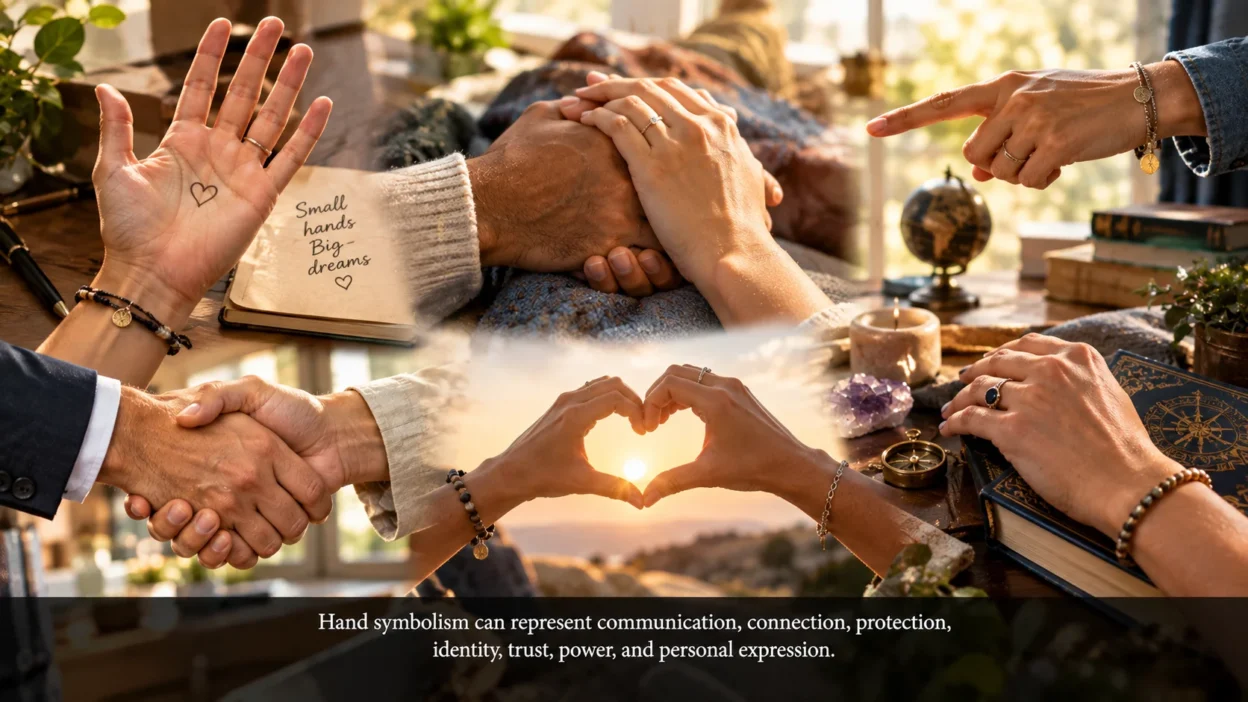
Hands are among the most expressive parts of the human body. Hand symbolism appears through gestures, poses, jewelry, artwork, tattoos, religious traditions, and everyday interactions. A raised palm can signal peace, while a handshake can suggest trust or agreement.
people use their hands constantly to communicate without words. A wave welcomes someone, a thumbs-up signals approval, and an open hand can show friendliness or honesty. However, the meaning can change with culture, situation, and personal experience.
Throughout history, hands have also represented power, blessing, protection, work, creativity, and human connection. Today, those older meanings continue through modern fashion, social media, tattoos, photography, and personal identity.
Quick Answer
Hand symbolism in the USA commonly represents communication, connection, trust, action, protection, identity, and personal expression. Across cultures, hands can also symbolize blessing, authority, healing, creativity, or spiritual connection.
TL;DR
- Hands communicate feelings and intentions without spoken words.
- Open palms often suggest honesty, peace, welcome, or openness.
- Handshakes can represent trust, agreement, respect, or cooperation.
- Ancient traditions connected hands with blessing, power, work, and protection.
- Modern tattoos and gestures give hand symbolism personal meanings.
What Does Hand Symbolism Mean?
Hands carry meaning because people use them to act, communicate, create, and connect. Their symbolism often depends on posture, movement, direction, and social setting.
For American readers, everyday gestures provide the clearest examples. However, a hand doesn’t have one universal meaning.
Common Meanings of Hands
Several meanings appear frequently in American culture:
• Communication through gestures and body language
• Trust formed through physical contact
• Protection shown through an open or raised palm
• Creativity expressed through making, writing, or crafting
• Personal identity expressed through tattoos and jewelry
The same gesture can also mean something different in another country. Therefore, context matters whenever you interpret a symbolic hand.
Why Hands Feel So Personal
Hands directly connect thought with action. You use them to build a house, write a letter, hold someone’s hand, or create art.
Because of this connection, hands often symbolize human agency. They can represent the ability to change something rather than simply observe it.
Ancient Roots of Hand Symbolism
Hand symbolism reaches far into human history. Ancient people depicted hands in art, religious objects, burial spaces, pottery, architecture, and public monuments.
The hand’s meaning often grew from its practical importance. It could create, defend, bless, point, hold, or offer something.
Hands in Ancient Art
Prehistoric hand stencils appear in caves around the world. Some date back tens of thousands of years.
These images are among the oldest known examples of humans representing themselves through the body. Their exact meanings remain uncertain, but they show an early desire to leave a visible human mark.
Hands and Ancient Power
Ancient rulers and religious figures were often shown using specific hand positions. A raised hand could communicate authority or blessing.
In many artistic traditions, gestures became visual languages. Viewers could recognize status or intention without written words.
Hand Symbolism in the USA
American culture gives hands many everyday meanings. Some are formal, while others are casual and highly personal.
For example, the handshake became strongly associated with greeting, business, agreements, and public interaction. Meanwhile, waving remains a simple way to welcome or acknowledge someone.
American Gestures and Their Meanings
| Hand Gesture or Context | Meaning in the USA | Common Association | Notes |
| Handshake | Agreement or respect | Business and introductions | Meaning depends on setting |
| Open palm | Welcome or openness | Greeting and communication | Can have several meanings |
| Wave | Greeting or farewell | Friendship and recognition | Common across ages |
| Raised fist | Solidarity or protest | Collective action | Meaning depends on context |
| Holding hands | Affection or support | Relationships and family | Often emotionally intimate |
American media has also helped spread recognizable hand gestures. Movies, television, sports, advertising, and social platforms can give gestures new associations.
Hands in American Identity
Hands can symbolize independence and work. Expressions such as “hands-on” connect physical effort with practical skill.
The image of hardworking hands also appears in American photography, advertising, labor history, family stories, and rural imagery. In this sense, hands can represent both individual effort and shared work.
Spiritual Meaning of Hands
Hands have important symbolic roles in many religious and spiritual traditions. However, these meanings aren’t identical across faiths.
In Christianity, for example, hands can appear in scenes of blessing, prayer, healing, service, and laying on of hands. Jewish traditions also include important hand-related gestures and practices.
Hands in Religious Art
Artists have long used hand positions to communicate religious ideas. A raised hand might indicate blessing, while touching or extending a hand can suggest healing or compassion.
In Hindu and Buddhist traditions, specific hand gestures called mudras can carry particular symbolic meanings. These gestures can represent qualities such as compassion, meditation, protection, or teaching.
Protective Hand Symbols
Hand-shaped protective symbols appear in several cultures. One well-known example is the Hamsa, an open hand associated in different traditions with protection and blessings.
Its interpretation varies among Jewish, Muslim, and other cultural contexts. Therefore, it shouldn’t be reduced to one single meaning.
Emotional and Psychological Meaning of Hands
Hands can communicate emotions before someone says a word. A gentle touch may feel comforting, while clenched hands can suggest tension.
However, body language isn’t a perfect emotional dictionary. People gesture differently based on personality, culture, situation, and habit.
What Hands Can Communicate
Open gestures can sometimes suggest openness or friendliness. Closed fists may suggest determination, tension, strength, or readiness.
Holding hands can communicate closeness without speech. Similarly, placing a hand on someone’s shoulder can express support or reassurance.
Hands and Human Connection
Touch gives hands a powerful emotional role. Parents hold children’s hands, friends offer supportive touches, and couples may hold hands to show affection.
As a result, hand symbolism often connects physical contact with emotional bonds. The meaning becomes especially strong when the gesture involves someone important.
Hand Gestures and Body Language
Everyday gestures are one of the most visible forms of hand symbolism. Americans learn many gestures naturally through family, school, work, entertainment, and social life.
Positive and Neutral Gestures
A thumbs-up commonly communicates approval in the United States. A wave can mean hello or goodbye, while a pointing gesture can direct attention.
However, these gestures don’t always translate perfectly between cultures. A familiar American gesture may carry a different meaning elsewhere.
Why Context Matters
The same hand position can communicate different things depending on facial expression and situation.
For example, an open palm during a friendly greeting differs from an open palm during a request to stop. Meaning comes from the whole interaction, not the hand alone.
Hand Symbolism in Tattoos
Hands are popular tattoo subjects because they can carry both universal and deeply personal meanings. A tattoo might show a praying hand, helping hand, open palm, fingerprint, or symbolic gesture.
Common Hand Tattoo Themes
• Prayer and spiritual devotion
• Family connection and remembrance
• Strength through difficult experiences
• Creativity and artistic identity
• Love, loyalty, and human connection
Some people also tattoo their own hands or fingerprints as symbols of identity. Others combine hands with flowers, animals, dates, names, or meaningful objects.
Why Hand Tattoos Feel Powerful
Hands are constantly visible and closely connected to action. A hand tattoo can therefore feel like a permanent reminder of something a person values.
However, placement also matters. Hand tattoos are difficult to hide and may carry practical or social considerations in professional settings.
Hands in Fashion, Jewelry, and Decor
Hands appear frequently in American fashion and interior design. Jewelry itself can add another symbolic layer to the hand.
Rings may represent marriage, commitment, heritage, or personal style. Bracelets can symbolize relationships, memories, causes, or simple decoration.
Symbolic Objects on the Hand
A hand holding a flower can suggest love, beauty, or giving. A hand holding a key might represent access, responsibility, or opportunity.
Artists also use sculpted hands in decor. Their meaning can range from classical beauty to mystery, protection, creativity, or human connection.
Hands in Social Media and Digital Culture
Digital communication has expanded hand symbolism. Emojis and reaction icons let people communicate gestures without physically moving.
The waving hand, folded hands, raised hand, thumbs-up, and heart hands can each express different intentions.
Hand Emojis
Hand emojis are especially useful because they compress a larger social gesture into one small image. However, interpretation still depends on the surrounding message.
A folded-hands emoji, for example, may represent prayer, gratitude, thanks, hope, or a request. Its meaning isn’t fixed.
Viral Gestures
Social media can also introduce new gestures quickly. A hand sign may become associated with a particular trend, community, song, challenge, or online joke.
As these associations change, older meanings may remain alongside newer ones.
Hand Symbolism in Art and Literature
Artists often use hands because they show relationships between people. A reaching hand can suggest desire, rescue, separation, or connection.
Paintings may also use hand placement to direct the viewer’s attention. One hand can point toward another person, object, or important part of the scene.
The Hand as a Creative Symbol
Hands represent making things. Writers write with their hands, musicians use their hands, and artists shape their ideas through physical movement.
Because of this, a hand can symbolize creation itself. It may represent skill, craftsmanship, imagination, or the ability to turn an idea into something real.
Reaching Hands
Two reaching hands often create a powerful visual of connection. The distance between them can suggest longing, separation, hope, or reconciliation.
This image works because viewers immediately understand the physical action. The symbolic meaning grows from that recognizable human experience.
Handshakes, Agreements, and Trust
The handshake has a special place in American social life. It can appear during introductions, business meetings, ceremonies, celebrations, and formal agreements.
Historically, handshakes have been interpreted in different ways, and their exact origins aren’t limited to one simple story. Over time, the gesture became strongly associated with social trust and formal interaction.
What a Handshake Can Represent
• Mutual respect between people
• Agreement or cooperation
• Professional introduction
• Friendship or reconciliation
• Completion of a formal interaction
Today, the meaning continues to evolve. Health concerns, personal boundaries, and changing social habits can influence whether people choose to shake hands.
Misunderstandings and Controversies
Hand symbolism can become confusing when gestures cross cultural boundaries. A gesture that seems harmless in one place may be offensive or inappropriate somewhere else.
American readers should therefore avoid assuming that every hand sign has one universal meaning.
Cultural Differences
Some gestures have strong regional meanings. Their interpretation may also change according to religion, generation, social group, or historical context.
Context is especially important with hand signs that have been adopted by different communities. The same visual form can carry unrelated meanings.
Political and Group Associations
Certain hand gestures have become connected with political movements, protest groups, sports communities, or extremist organizations.
However, a gesture shouldn’t automatically be interpreted through its most controversial association. Meaning depends on who uses it, where it appears, and what surrounding symbols communicate.
Read More: Eye Symbolism: Meanings, History, and Modern Uses
How Hand Symbolism Has Changed Over Time
Hand symbolism has moved from ancient art and ritual into everyday American communication. Yet many basic meanings remain recognizable.
Hands still represent work, connection, protection, communication, and action. Modern culture simply gives these old ideas new forms.
From Ritual to Everyday Life
An ancient blessing gesture and a modern wave serve different purposes. Still, both use the hand to communicate something without relying entirely on speech.
Likewise, ancient artistic hand images and modern tattoos both turn the human hand into a lasting visual message.
Modern Personal Meaning
Today, people often choose hand symbols based on personal experiences rather than shared traditions.
A person might see a hand as a reminder of a parent, a friendship, creative work, faith, recovery, or independence. This personal layer is one reason hand symbolism remains flexible.
FAQs
What does a hand symbolize?
A hand can symbolize communication, connection, creativity, protection, strength, trust, or action. The exact meaning depends on the gesture and cultural setting.
What does an open hand symbolize?
An open hand can represent openness, welcome, peace, honesty, or communication. In other situations, it can signal a request to stop or create distance.
What does a raised hand symbolize?
A raised hand can mean attention, participation, greeting, authority, protest, or solidarity. Its meaning depends strongly on the surrounding situation.
What does holding hands symbolize?
Holding hands often represents affection, trust, support, friendship, or romantic connection. Family members and friends may also use the gesture to show comfort.
What does a handshake symbolize?
A handshake commonly represents greeting, respect, agreement, cooperation, or professional trust in the United States. Its importance can vary between social settings.
What does a hand tattoo symbolize?
A hand tattoo can represent identity, memory, faith, creativity, strength, love, or personal experience. The specific image usually matters more than the body part alone.
Conclusion
Hands have always carried meaning because they help people communicate, create, protect, work, and connect. From ancient artwork to American greetings and modern tattoos, hand symbolism remains closely tied to everyday human experience. Today, a hand can represent trust, love, creativity, protection, independence, or personal identity. Its meaning depends on the gesture, culture, relationship, and moment. When you notice a symbolic hand, consider what it is doing and who is using it. Often, the action tells you as much as the image itself.