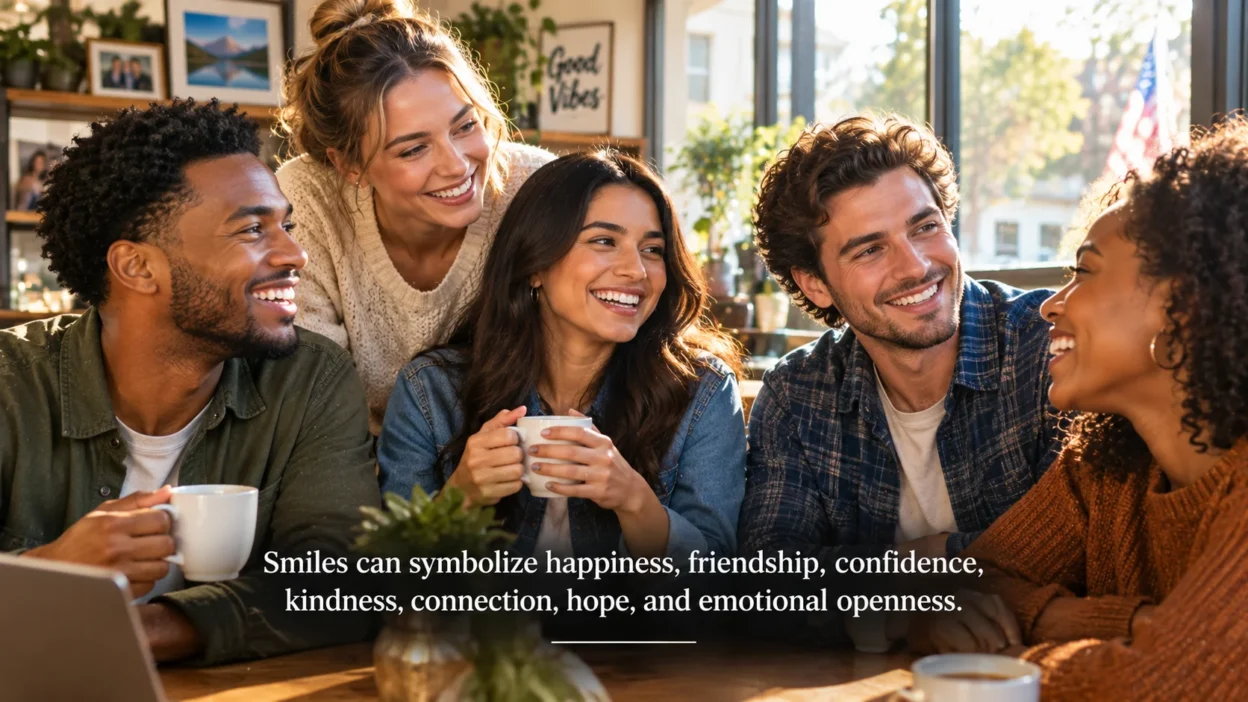
A smile is one of the most recognizable forms of human expression. Smile symbolism often connects this simple facial expression with happiness, friendship, kindness, confidence, and emotional connection.
smiles appear everywhere from family photographs and greeting cards to advertising, social media, and everyday conversations. However, a smile doesn’t always mean simple happiness. It can also communicate politeness, nervousness, relief, affection, confidence, or social acceptance.
The meaning depends strongly on context. A genuine smile between friends can feel very different from a professional smile or a smile used in a difficult moment.
Quick Answer
Smile symbolism in the USA commonly represents happiness, friendliness, kindness, confidence, connection, and emotional warmth. More broadly, smiles can symbolize hope, relief, acceptance, peace, and the desire to connect with others.
TL;DR
- Smiles commonly symbolize happiness, warmth, friendship, and social connection.
- Ancient cultures connected smiling with joy, celebration, and human relationships.
- American culture often treats smiling as a sign of friendliness.
- A smile can communicate emotions beyond happiness.
- Digital emojis have expanded the meanings attached to smiling faces.
- Modern smile imagery often represents optimism, identity, and emotional resilience.
What Does a Smile Symbolize?
A smile is a facial expression created mainly by movement around the mouth and cheeks. Its appearance can range from a small closed-mouth expression to a broad smile showing the teeth.
However, physical appearance alone doesn’t determine meaning. Eye movement, posture, timing, and social context can change what a smile communicates.
Common Symbolic Meanings
In everyday American culture, a smile can suggest:
- Happiness and enjoyment
- Friendship and social warmth
- Kindness and approachability
- Confidence and positive self-expression
- Relief after difficulty
- Hope during uncertain times
A smile can therefore work like a small social signal. It tells another person, “I’m open to this interaction,” even when no words are spoken.
History of Smiling and Its Symbolism
People have expressed positive emotions through facial expressions throughout recorded human history. However, the modern idea of the smile as a universal public sign of friendliness developed gradually.
Ancient artwork from different societies sometimes portrayed smiling or joyful figures. Yet artistic conventions varied widely, and many formal portraits favored calm or serious expressions instead.
Ancient and Classical Roots
In ancient Greek art, the so-called “Archaic smile” appeared on some sculptures from roughly the sixth century BCE. This expression was not necessarily meant to show ordinary happiness. Instead, it could help suggest life, vitality, or presence.
Later artistic traditions developed different approaches to facial expression. In many formal settings, restraint could communicate dignity or status.
The Smile Becomes More Public
During the early modern and modern periods, changing social customs increasingly encouraged visible expressions of friendliness.
By the nineteenth and twentieth centuries, smiling became especially important in American advertising, photography, entertainment, and popular culture. The camera helped transform the smile into a recognizable symbol of personal happiness.
Smile Symbolism in American Culture
The United States has strongly connected smiling with friendliness and positive social behavior. This association appears in workplaces, schools, entertainment, customer service, and family life.
However, American expectations around smiling can differ between communities and situations. A person may smile because they’re genuinely happy, or because social etiquette encourages a pleasant expression.
Everyday American Meaning
A smile may communicate:
- “It’s good to see you.”
- “I’m comfortable talking with you.”
- “Thank you.”
- “I understand.”
- “I’m trying to be friendly.”
- “I’m happy about this moment.”
Because of these meanings, smiling often plays an important role in American social interaction.
Smiles in American Media
Movies, television, magazines, advertisements, and photography have repeatedly used smiling faces to represent desirable emotions.
Bright smiles often appear alongside themes such as family, friendship, success, health, celebration, and personal confidence. As a result, the smile has become closely connected with positive imagery in American visual culture.
Smile Symbolism in Different Contexts
A smile can mean very different things depending on where and how it appears. Understanding context prevents the symbol from becoming too simplistic.
Context Changes the Meaning
| Context | Meaning in the USA | Common Association | Important Note |
| Family photo | Affection and happiness | Belonging | Often reflects shared memories |
| Greeting | Friendliness and openness | Social connection | May follow everyday etiquette |
| Workplace | Professional warmth | Cooperation | Can be partly expected socially |
| Difficult situation | Relief or emotional coping | Resilience | Doesn’t always indicate happiness |
| Social media | Enjoyment or positivity | Self-expression | May represent a selected moment |
The same smile can therefore communicate different emotional messages. A person smiling in a photograph may be celebrating, reassuring someone, or simply following a familiar social convention.
Emotional Meaning of a Smile
Smiles are closely associated with positive emotional experiences. They can accompany happiness, amusement, affection, excitement, gratitude, and relief.
However, people also smile during complicated emotional situations. Someone might smile while feeling embarrassed, nervous, uncomfortable, or overwhelmed.
Why Smiles Feel Positive
A smile often creates an immediate sense of warmth because humans naturally pay attention to facial expressions.
In social situations, a friendly smile can make an interaction feel less threatening. It can also signal recognition and encourage another person to continue communicating.
Smiling and Emotional Resilience
Modern American culture sometimes uses the smile as an image of resilience. A person may smile after surviving a difficult period, symbolizing the ability to continue moving forward.
This interpretation doesn’t mean someone must always appear happy. Instead, the smile can represent a moment of hope after hardship.
Psychological Associations of Smiling
Psychologically, smiling is associated with social communication as well as emotional expression. It can help people signal friendliness, agreement, amusement, or emotional openness.
Genuine and Social Smiles
Not every smile has the same emotional meaning. A spontaneous smile connected with genuine enjoyment can look different from a polite social smile.
For example, someone may smile briefly when meeting a stranger. That expression can communicate courtesy without indicating deep happiness.
What a Smile Can Signal
Depending on the situation, a smile may suggest:
- Emotional warmth
- Social acceptance
- Reduced tension
- Confidence
- Amusement
- Affection
- Nervousness
- Politeness
Because expressions are complex, it’s better to consider the entire situation rather than interpret one facial movement alone.
Spiritual and Cross-Cultural Smile Meanings
Smiling has positive associations in many cultures, but there isn’t one universal symbolic meaning. Social rules surrounding visible emotion vary considerably.
In some traditions, smiling can represent joy, compassion, peacefulness, or spiritual contentment. In others, public emotional restraint may be valued more strongly.
Buddhist and Asian Contexts
Images of Buddhist figures sometimes show calm, gentle expressions associated with peace, compassion, or inner balance. These expressions shouldn’t be reduced to the simple idea of being “happy.”
Across parts of Asia, smiling can also carry social meanings involving politeness and harmony. However, practices differ substantially between countries, communities, and individuals.
Western Religious Traditions
Within Christian-influenced Western cultures, joy and gladness have long been associated with positive facial expression and communal celebration.
Still, religious traditions generally contain many emotional themes beyond happiness, including compassion, sorrow, humility, gratitude, and hope.
Smile Symbolism in Art and Literature
Artists have used smiles to reveal character, mood, mystery, and emotional conflict. A smile can tell a story without requiring dialogue.
A joyful smile may make a character seem welcoming. A subtle smile can create uncertainty, especially when the viewer can’t determine what the person is thinking.
The Mysterious Smile
One of the most famous artistic uses of a subtle smile appears in Renaissance portraiture. The restrained expression creates ambiguity and encourages viewers to wonder about the subject’s emotional state.
This helped establish the smile as more than a symbol of happiness. It could also represent mystery, complexity, privacy, or hidden emotion.
Smiles in Tattoos and Personal Identity
Smile imagery appears in tattoos because it can carry simple but deeply personal meanings. Some people choose smiling faces to represent optimism or a commitment to finding joy.
Others use smile imagery ironically or emotionally. A smile can symbolize surviving difficult experiences while maintaining hope.
Popular Tattoo Interpretations
Common ideas include:
- Choosing happiness after hardship
- Remembering someone who brought joy
- Celebrating friendship or family
- Representing optimism
- Expressing playful personality
- Embracing individuality
The exact design matters. A simple curved line can feel playful, while a detailed portrait smile may carry a more personal story.
Smiles, Emojis, and Social Media
Digital communication has expanded smile symbolism dramatically. A small yellow face can communicate emotions that would otherwise require several sentences.
However, digital smiles aren’t always interpreted literally.
The Rise of the Smiley Face
The familiar smiley face became an important part of modern visual communication during the twentieth century. Its simple circle, eyes, and curved mouth made positive emotion easy to recognize.
Today, similar imagery appears in messages, stickers, clothing, artwork, merchandise, and digital interfaces.
Different Digital Meanings
Online, smiling faces can communicate:
- Genuine happiness
- Friendly agreement
- Gratitude
- Light humor
- Reassurance
- Awkwardness
- Passive emotional distance
Tone matters greatly online because readers can’t hear your voice or see your full expression.
Smile Symbolism in Fashion and Home Decor
Smiling imagery often appears in American clothing, accessories, posters, artwork, children’s spaces, and casual home decor.
Bright yellow is especially common because it creates a cheerful visual association. However, modern designs also use black, white, pastel, metallic, and natural colors.
Why Smile Designs Feel Cheerful
The basic curved-mouth shape is visually simple and easy to recognize. Designers can therefore communicate optimism without adding much detail.
In home decor, smiling imagery may create a playful atmosphere. In clothing, it can suggest humor, youthfulness, casual confidence, or positive energy.
Smiles in Advertising and Popular Culture
American advertising has used smiling faces for decades to create associations with satisfaction and positive experiences. Food, travel, entertainment, family products, and services frequently use cheerful expressions.
This has also created a cultural expectation that smiling represents success or enjoyment.
The Commercial Smile
A professional smile can communicate friendliness and confidence. Yet consumers increasingly recognize that advertising presents carefully selected moments.
As a result, modern audiences may distinguish between genuine emotional expression and a polished commercial image.
Misunderstandings and Controversies
The smile is usually a positive symbol, but its interpretation isn’t always positive. Problems can arise when people assume every smile means happiness.
Someone might smile while feeling anxious, uncomfortable, embarrassed, or socially pressured. Therefore, a smile should not automatically be treated as proof of someone’s emotional state.
Cultural Differences
Expectations about smiling differ across cultures and social settings. A behavior considered friendly in one environment may feel unusual or overly familiar in another.
These differences don’t make one approach correct or incorrect. They show that facial expressions are shaped partly by social learning.
The Pressure to Smile
Modern culture can sometimes create pressure to appear cheerful. Social media may strengthen this effect by encouraging people to share carefully selected positive moments.
However, emotional well-being isn’t measured by how often someone smiles. A person can experience meaningful happiness without constantly displaying it.
Read More: Beard Symbolism: Meaning, History, and Modern Identity
How Smile Symbolism Has Changed Over Time
The symbolic meaning of smiling has expanded considerably. Earlier artistic traditions often used facial expressions selectively, while modern media places smiling at the center of everyday visual communication.
Photography, advertising, film, television, and digital media all contributed to this shift.
From Expression to Symbol
Today, the smile can represent much more than a temporary emotion. It can stand for an attitude toward life.
It may symbolize optimism, resilience, friendliness, identity, humor, or connection. At the same time, people increasingly recognize that a smile can hide complicated feelings.
This makes modern smile symbolism more flexible than the simple equation of “smile equals happiness.”
FAQs
What does a smile symbolize?
A smile commonly symbolizes happiness, friendliness, kindness, connection, and emotional warmth. Depending on context, it can also represent confidence, relief, politeness, or resilience.
What does a smile symbolize in American culture?
In the United States, smiles are strongly associated with friendliness and positive social interaction. They frequently appear in family photographs, advertising, entertainment, workplaces, and everyday greetings.
What does a smile mean spiritually?
Spiritual interpretations vary between traditions. Smiling may represent joy, compassion, peace, gratitude, or inner contentment, depending on the religious or cultural context.
Can a smile symbolize strength?
Yes. A smile can symbolize emotional resilience when someone maintains hope during a difficult period. In this context, the smile represents perseverance rather than simple happiness.
Why is the smiley face associated with happiness?
The simple circular face uses a curved mouth that resembles a human smile. Its visual simplicity makes positive emotion easy to recognize across many forms of communication.
Can a smile have a negative meaning?
Yes. A smile can sometimes communicate nervousness, discomfort, embarrassment, sarcasm, or social pressure. Context, tone, and the surrounding behavior help determine its meaning.
Conclusion
A smile is a simple expression with surprisingly broad symbolic meaning. In American culture, it commonly represents happiness, friendliness, kindness, confidence, connection, and hope. Yet Smile Symbolism goes beyond positive emotion. A smile can represent resilience, social courtesy, personal identity, affection, or even hidden feelings. Its meaning changes with the person, setting, culture, and moment. Whether it appears in a photograph, tattoo, artwork, message, or everyday conversation, the smile remains one of the clearest visual symbols of human connection. Sometimes its meaning is simply joy. Other times, its quiet message is the courage to keep moving forward.