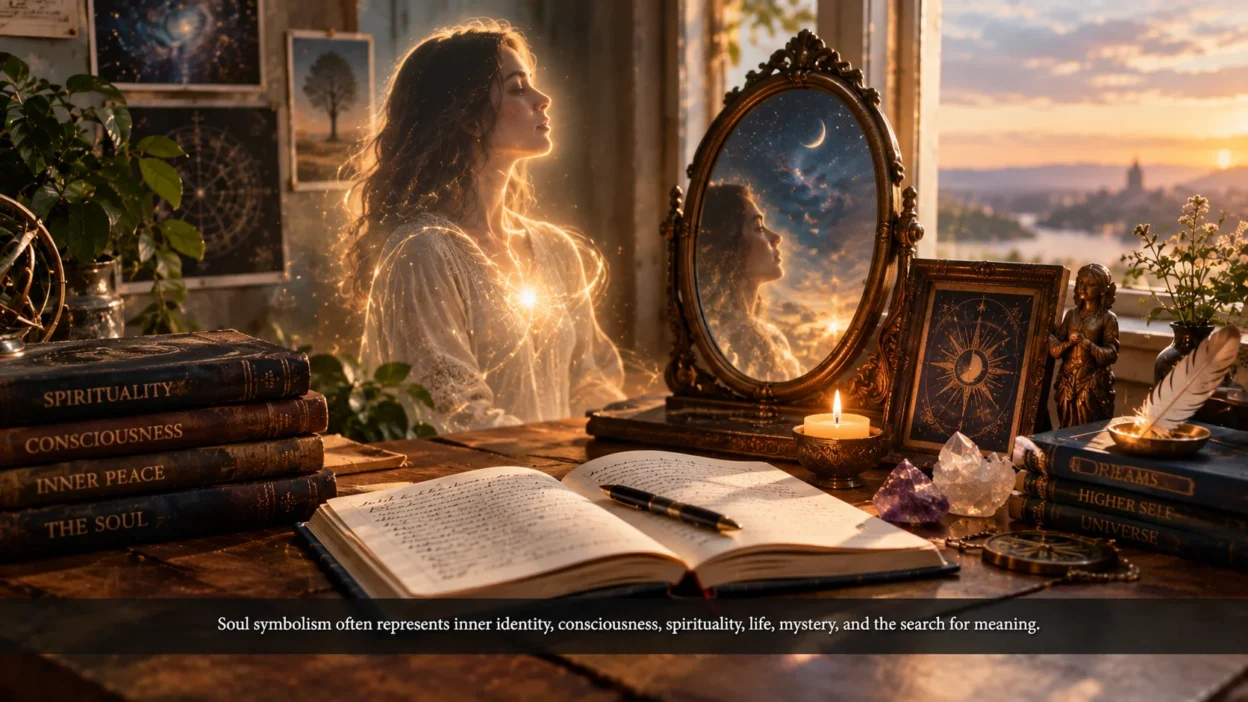
The idea of the soul has fascinated people for thousands of years. Across American culture, it often represents the deepest part of a person, including identity, conscience, spirit, and inner life.
Unlike a single object or shape, soul symbolism appears through many images. Light, breath, hearts, birds, mirrors, wings, flames, stars, and human silhouettes can all suggest the unseen self. Today, people encounter these ideas in religion, art, literature, tattoos, music, movies, jewelry, and personal reflection. However, the meaning can change depending on whether the context is spiritual, emotional, philosophical, or artistic.
Understanding Soul Symbolism means looking at both its ancient roots and its modern uses. It also means recognizing that people use the word “soul” in different ways.
Quick Answer
Soul symbolism in the USA commonly represents inner identity, spiritual life, consciousness, love, and the mystery of human existence. More broadly, the soul can symbolize the unseen part of a person and the search for meaning beyond the physical body.
TL;DR
- The soul often symbolizes inner identity, spirit, consciousness, and life’s deeper meaning.
- Ancient cultures connected the soul with breath, life, death, and the afterlife.
- American culture uses soul imagery in religion, art, music, literature, and personal identity.
- Light, wings, birds, hearts, mirrors, and flames commonly suggest the soul.
- Modern tattoos often use soul imagery to represent memory, healing, freedom, or spirituality.
- Meanings vary widely because “soul” has religious, philosophical, and personal interpretations.
What Does the Soul Symbolize?
The soul is usually understood as something deeper than the physical body. In symbolic language, it can represent the inner self, personal essence, or spiritual dimension of human life.
For American readers, the idea can have religious or completely personal meanings. Someone may use “soul” to describe faith, while another person may use it to describe character or emotional depth.
The Soul as Inner Identity
The soul can symbolize the qualities that make someone feel truly themselves.
These qualities may include:
- Personal identity and individuality
- Conscience and moral character
- Inner wisdom and self-awareness
- Emotional depth and compassion
- Spiritual connection and personal meaning
The symbolism becomes especially powerful when physical appearance is separated from inner character.
The Soul as the Unseen Self
Many traditions use the soul to represent something that cannot be directly seen.
Therefore, artists often use light, shadows, transparent figures, or open spaces to suggest it. These images create a contrast between the visible body and the invisible inner world.
Ancient Roots of Soul Symbolism
Ideas about the soul are far older than modern religious traditions. Ancient peoples often tried to explain dreams, breath, death, memory, and consciousness through concepts resembling a soul.
These early ideas helped establish many symbolic connections still recognized today.
Breath, Life, and Spirit
In several ancient traditions, breath became closely connected with life itself. A living person breathed, while a dead person no longer did.
Because of this connection, breath became a powerful image for spirit or life force. Words for breath and spirit were also linked in several ancient languages and religious traditions.
Ancient Egyptian Ideas
Ancient Egyptian beliefs included several aspects of a person’s spiritual existence rather than one simple concept identical to the modern word “soul.”
The ka was associated with life force, while the ba represented an aspect of individual personality. Egyptian funerary traditions also emphasized the continued existence of a person after death.
Bird imagery became important in these representations. This helped strengthen the later symbolic connection between birds, freedom, and the soul.
Greek and Roman Thought
Ancient Greek thinkers explored the soul through both philosophy and religion. The Greek concept of psyche could refer to life, breath, soul, or the inner self.
Later philosophers developed different ideas about the relationship between body, soul, reason, and moral life. Roman writers inherited and adapted many of these ideas.
As a result, the soul became both a spiritual concept and a subject of philosophical debate.
Soul Symbolism in American Culture
In the United States, soul symbolism comes from many overlapping traditions. Christianity has strongly influenced American ideas about the soul, while philosophy, literature, Indigenous traditions, African American culture, and popular media have added other perspectives.
Therefore, there isn’t one single American meaning.
Religion and Spiritual Life
For many Americans, the soul is connected with spiritual identity and the relationship between human beings and the divine.
Religious art may use light, heaven, angels, wings, or upward movement to suggest spiritual existence. However, interpretations differ between denominations and individual believers.
Music and the “Soul”
American music created another important meaning.
The word soul became strongly associated with African American musical traditions during the 20th century. Soul music combined influences from gospel, rhythm and blues, and other musical forms.
Here, “soul” could suggest emotional honesty, depth, feeling, and expressive performance. The meaning therefore expanded beyond a strictly religious idea.
Literature and Everyday Speech
Americans also use “soul” in ordinary expressions.
Someone may describe another person as having “soul” to suggest warmth, authenticity, creativity, or emotional depth. Similarly, “soul-searching” describes serious personal reflection.
Spiritual Meaning of the Soul
Spiritual traditions often treat the soul as a part of existence that reaches beyond ordinary physical experience. However, different traditions define that idea in very different ways.
For this reason, it helps to avoid treating all spiritual beliefs as interchangeable.
Christian Interpretations
Christian traditions commonly discuss the soul in connection with human life, moral responsibility, salvation, and eternal existence.
Symbols such as light, wings, heavenward movement, and the heart may appear alongside these ideas. However, specific teachings vary among Christian denominations.
Other Spiritual Traditions
Other traditions may describe consciousness, life force, spirit, or personal essence using different concepts.
Some emphasize an enduring spiritual self. Others understand identity and consciousness in ways that don’t match the Western idea of an independent soul.
The important point is that similar imagery doesn’t always carry the same theological meaning.
Soul Symbolism Across Cultures
Soul-related symbolism appears around the world, but its details differ significantly. Birds, breath, light, water, ancestors, and journeys often appear in spiritual imagery.
For American readers, these comparisons show why a symbol should always be understood within its cultural setting.
| Symbolic Image | Meaning in the USA | Common Associations | Important Context |
| Bird | Freedom or spiritual release | Flight, heaven, transformation | Meaning varies by bird and tradition |
| Light | Inner goodness or spiritual awareness | Hope, truth, guidance | Common in religious and artistic settings |
| Flame | Life, spirit, passion | Energy, remembrance, devotion | Can also symbolize creativity |
| Heart | Inner feeling or emotional self | Love, compassion, sincerity | Often overlaps with romantic symbolism |
| Mirror | Inner identity and self-reflection | Truth, self-knowledge, identity | Meaning depends heavily on context |
Ancestors and Spiritual Presence
Many cultures connect spiritual identity with ancestors and remembrance. In these contexts, the soul may symbolize continuity between generations.
However, beliefs about ancestors differ widely. A respectful interpretation should describe the tradition rather than assume one universal explanation.
The Soul as a Journey
Another widespread image presents spiritual existence as a journey.
Roads, doors, rivers, stairs, paths, and flights can therefore symbolize transition. In American art and storytelling, these images often represent personal growth as well as spiritual change.
What Does a Soul Represent Emotionally?
The soul often represents the deepest emotional side of human experience. It can suggest feelings that seem difficult to express through ordinary language.
Because of this, soul imagery frequently appears during major emotional moments.
Common Emotional Associations
Soul symbolism may suggest:
- Deep love and emotional connection
- Grief and remembrance
- Hope after difficult experiences
- Inner peace and acceptance
- Personal healing and transformation
- A search for purpose or belonging
However, these meanings aren’t automatic. A flame might represent grief in one artwork and passion in another.
Why Soul Imagery Feels Personal
The soul is difficult to see or measure. That ambiguity allows people to project their own experiences onto the symbol.
A person recovering from loss may see a bird as freedom. Another person may see the same bird as a spiritual presence.
Psychological Meaning of Soul Symbolism
Psychologically, people often use “soul” as a way to describe their deepest sense of self. It can provide language for identity, values, memories, and personal purpose.
This doesn’t require a particular religious belief.
Inner Self and Authenticity
Modern Americans often use soul language when discussing authenticity.
For example, someone might say they are trying to “find themselves” or “stay true to their soul.” Such expressions usually emphasize personal values rather than a specific religious doctrine.
Reflection and Soul-Searching
Soul-searching describes a period of deep self-questioning.
It can involve asking:
- What values matter most to me?
- What kind of person do I want to become?
- Which experiences shaped my identity?
- What gives my life meaning?
- What do I want to leave behind?
These questions explain why soul imagery frequently appears in journals, personal art, and reflective writing.
Soul Symbolism in Tattoos
Soul symbolism works especially well in tattoos because it can represent deeply personal experiences. People may combine soul imagery with dates, names, animals, religious symbols, or natural elements.
The meaning usually depends more on the complete design than one isolated symbol.
Popular Soul Tattoo Ideas
Common approaches include:
- Wings representing freedom, remembrance, or spiritual connection
- Birds suggesting release, change, or personal independence
- Flames representing passion, life, or enduring memory
- Hearts representing love, emotional identity, or devotion
- Celestial imagery suggesting mystery, spirituality, or existence
Memorial Tattoos
Soul-related tattoos are also common in memorial designs.
A person may use wings, light, birds, stars, or a meaningful object to remember someone who died. These designs can express continuing love without requiring one specific religious interpretation.
Soul Symbolism in Art, Fashion, and Decor
Modern soul imagery appears across visual culture. Artists often use translucent figures, glowing light, mirrors, wings, and celestial scenes to represent inner life.
Home decor can use similar imagery in a quieter way.
Visual Design
A minimalist design might show a simple human outline surrounded by light. A more traditional design might include wings, a heart, a flame, or an ascending bird.
Color also changes the mood:
- White often suggests purity, peace, or transcendence.
- Gold can suggest sacred value, light, or spiritual importance.
- Blue can suggest calm, mystery, or contemplation.
- Black can suggest mystery, grief, depth, or the unknown.
- Red can suggest love, passion, life, or emotional intensity.
These associations are flexible rather than universal.
Jewelry and Personal Objects
Soul-themed jewelry can turn an abstract idea into something physical.
Lockets, pendants, rings, charms, and engraved pieces may represent memory, identity, love, or spiritual connection. Personal objects often become symbolic because of the stories attached to them.
Soul Symbolism in Social Media and Popular Culture
Social media has made abstract symbolism easier to share. A glowing silhouette, moon, wings, stars, or inspirational quote can communicate ideas about identity without lengthy explanations.
Meanwhile, movies, music, and television often portray the soul through visual effects or supernatural storytelling.
Digital Expressions
Online, soul imagery may appear in:
- Profile artwork focused on spirituality or identity
- Inspirational posts about personal growth
- Memorial posts honoring loved ones
- Artistic images about dreams and inner life
- Quotes about authenticity and finding purpose
Modern Language
The word “soul” also appears in phrases such as “soulmate,” “soulful,” “soul-searching,” and “soul food.”
These expressions show how far the concept has moved beyond formal religious settings. In everyday American language, soul can describe emotional depth, cultural identity, connection, or personal character.
Misunderstandings and Controversies Around Soul Symbolism
Soul symbolism can become confusing when different traditions are blended together. A symbol that has one meaning in a specific religion may have another meaning in modern art or popular culture.
Not Every Soul Symbol Is Universal
There is no single universal symbol for the soul.
For example, wings may suggest spiritual freedom in one setting. In another, they may simply represent flight, fantasy, or personal freedom.
Therefore, context matters more than a symbol dictionary.
Cultural Borrowing and Simplification
Modern spiritual artwork sometimes combines symbols from several cultures.
Using another tradition’s imagery without understanding its history can reduce a complex belief system to decoration. Respectful use involves learning what the imagery means within its original setting.
Religious Versus Secular Meaning
A soul symbol doesn’t automatically indicate a person’s religion.
Someone wearing a wing necklace may value remembrance or freedom rather than hold a particular religious belief. Likewise, a flame may represent creativity rather than spirituality.
How Soul Meaning Has Changed Over Time
The meaning of the soul has continually developed. Ancient societies often connected it with breath, death, and spiritual existence.
Later religious traditions gave the concept more specific theological meanings. Philosophy then explored questions about consciousness, reason, identity, and the relationship between mind and body.
Modern American culture has expanded the word even further.
Today, “soul” can describe religious belief, personal identity, emotional depth, music, cultural expression, memory, or authenticity. Older meanings haven’t disappeared, but they now exist alongside newer interpretations.
From Spirit to Identity
One major shift is the movement from strictly spiritual language toward personal language.
Someone can now describe a favorite activity as “good for the soul” without making a formal claim about religion. The phrase usually means that the activity provides emotional satisfaction or a sense of meaning.
Reviving Older Symbols
At the same time, ancient imagery remains popular.
Wings, celestial bodies, flames, birds, sacred geometry, and ancient artistic motifs regularly return in tattoos and contemporary design. Modern creators often reinterpret these symbols rather than reproduce their original meanings exactly.
Why Soul Symbolism Still Matters Today
The idea of the soul remains powerful because people continue to ask questions about identity, mortality, purpose, and connection.
Modern technology has changed how people communicate, but it hasn’t removed the desire to understand inner life. In fact, digital culture often gives people new ways to express these older questions.
A Symbol of What Cannot Be Seen
The soul is especially useful as a symbol because it points toward something difficult to describe.
It can represent personality, memory, conscience, spirituality, or the feeling that a person contains more than their physical appearance suggests.
Read More: Heart Shape Symbolism: Meaning, History & Uses
A Symbol of Human Connection
Soul imagery can also express relationships.
Memorial artwork, family jewelry, love letters, tattoos, and photographs may use soul language to suggest that meaningful connections continue to shape us.
FAQs
What does soul symbolism mean?
Soul symbolism commonly represents inner identity, spiritual life, consciousness, emotional depth, and personal meaning. Its exact interpretation depends on the cultural, religious, or personal context.
What symbolizes the soul?
Common soul symbols include birds, wings, light, flames, hearts, mirrors, stars, and human silhouettes. However, none has one universally accepted meaning.
What does a soul tattoo symbolize?
A soul tattoo may represent spirituality, identity, freedom, remembrance, healing, love, or personal transformation. The meaning usually comes from the person’s story and the complete tattoo design.
What color represents the soul?
White and gold are often associated with spiritual light, while blue can suggest peace and mystery. Black may represent the unknown or grief, but color meanings vary by context.
What does a bird symbolize spiritually?
Birds often symbolize freedom, transcendence, movement, or spiritual release. Their meaning changes across cultures and can also depend on the specific bird.
Is the soul the same as the mind?
Not necessarily. Religious and philosophical traditions have different ideas about the relationship between soul, mind, consciousness, and body. In everyday American speech, however, these concepts can sometimes overlap.
Conclusion
The soul has become one of humanity’s most enduring symbols of the unseen self. It can represent identity, spirit, consciousness, love, memory, purpose, and the mystery surrounding human existence. Ultimately, soul imagery invites reflection on what makes a person feel truly alive and connected. Whether represented by a bird, flame, heart, light, or simple human silhouette, its power comes from the meaning people attach to it.