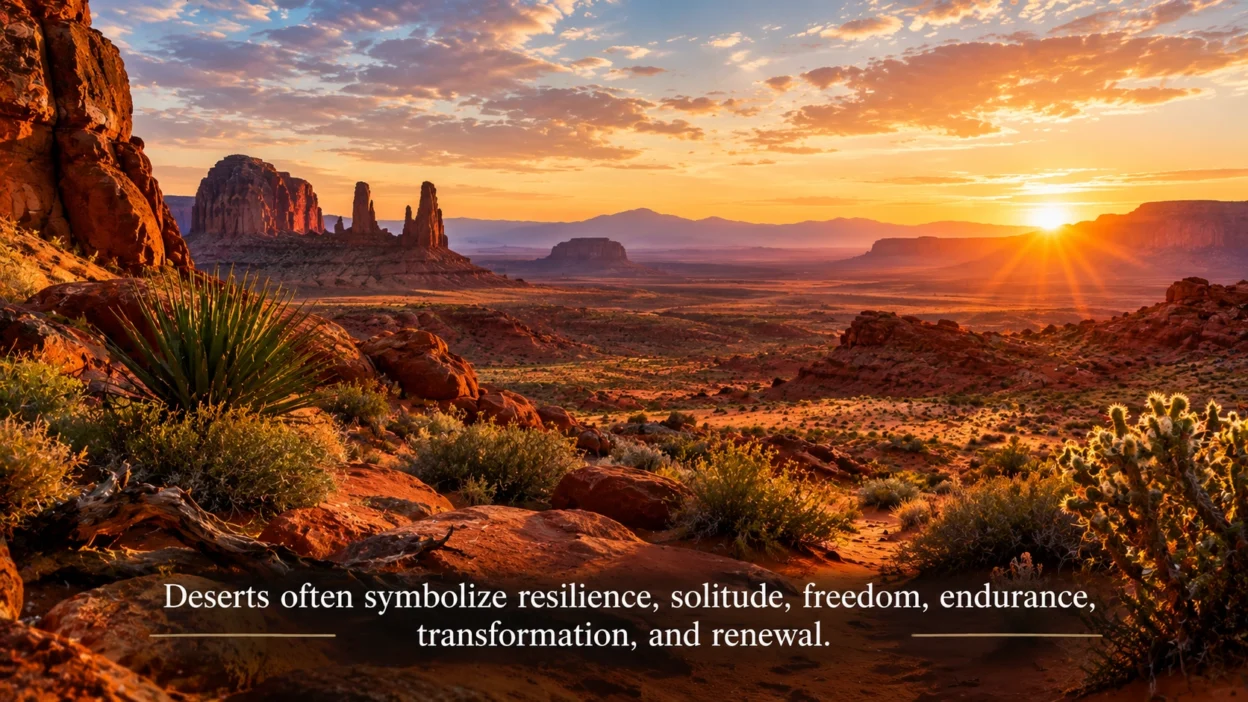
Desert symbolism connects a dry landscape with ideas of resilience, solitude, freedom, endurance, and transformation. In the United States, deserts appear in art, films, literature, travel, architecture, tattoos, and everyday ideas about the American West.
However, a desert can represent more than emptiness or hardship. Its open horizons may suggest independence, while its ability to support life can symbolize strength and renewal.
Across history, people have viewed deserts as places of testing, spiritual reflection, danger, beauty, and discovery. Today, Americans may see the desert as both a harsh environment and a powerful symbol of personal freedom.
Quick Answer
Desert symbolism in the USA commonly represents resilience, independence, solitude, endurance, freedom, and transformation. More broadly, deserts can symbolize spiritual testing, simplicity, survival, mystery, and renewal.
TL;DR
- Deserts often symbolize endurance because life survives in difficult conditions.
- American culture connects deserts with freedom, independence, and the open frontier.
- Ancient traditions often viewed deserts as places of testing and spiritual encounters.
- Empty horizons can suggest solitude, reflection, or personal discovery.
- Desert imagery appears in tattoos, fashion, art, films, and home decor.
- Modern meanings also include environmental awareness, beauty, and respect for nature.
What Does Desert Symbolism Represent?
The desert is a landscape shaped by limited water, intense sunlight, and sparse vegetation. Yet its appearance varies widely, from sandy plains to rocky mountains and dry grasslands.
For American readers, that variety matters. The desert isn’t simply an empty place, because many deserts contain rich ecosystems, communities, and long cultural histories.
Common Symbolic Meanings
People commonly associate desert imagery with:
- Resilience through survival under difficult conditions
- Freedom through wide, unobstructed landscapes
- Solitude through distance from crowded places
- Transformation through journeys across challenging environments
- Endurance through heat, drought, and changing conditions
- Mystery through silence, distance, and unfamiliar terrain
A desert can therefore carry both positive and difficult meanings. Its harshness may represent struggle, while its beauty may suggest hidden strength.
Ancient Roots of Desert Symbolism
Deserts have influenced human stories for thousands of years. Ancient civilizations often lived beside or within arid regions, making dry landscapes part of everyday life.
However, deserts could also feel mysterious and dangerous. Their distance from cities and cultivated land encouraged symbolic associations with testing, isolation, and encounters with the unknown.
Desert Symbolism in Ancient Egypt
Ancient Egyptians viewed the landscape around the fertile Nile in contrasting ways. The cultivated river valley supported life, while the surrounding desert represented a much harsher environment.
This contrast became important in Egyptian ideas about order, fertility, danger, and the forces outside cultivated society. The desert wasn’t simply evil, but it could represent the untamed world beyond human control.
Desert Imagery in Ancient Stories
Across the ancient Mediterranean and Near East, wilderness settings often appeared in stories about journeys and trials.
Travel through barren land required patience, preparation, and endurance. As a result, desert landscapes naturally became connected with personal testing and major life transitions.
Desert Symbolism in Religion and Spirituality
Dry wilderness has an important place in several religious traditions. These meanings developed differently, so they shouldn’t be treated as one universal interpretation.
For American readers, desert imagery may appear in religious art, literature, sermons, retreats, and personal reflection. The landscape can represent a period of uncertainty followed by insight.
Wilderness as a Place of Testing
In biblical traditions, wilderness settings are associated with journeys, testing, dependence, and spiritual preparation. The desert can therefore represent a difficult period that changes a person’s understanding of life.
At the same time, these interpretations are religious teachings rather than universal psychological rules. Different people may understand the same landscape in very different ways.
A Place for Reflection
Desert retreats and quiet landscapes can also encourage silence and contemplation. With fewer visual distractions, the open environment may feel suited to reflection.
In modern spiritual settings, desert imagery can therefore suggest simplicity, inner searching, patience, and renewal.
What Does the Desert Mean in America?
The American desert has a strong connection with the history and identity of the American West. Its landscapes became closely associated with exploration, ranching, mining, transportation, military history, tourism, and popular culture.
However, American desert symbolism also includes Indigenous histories and living communities. The landscape existed as a meaningful cultural environment long before modern Western imagery developed.
The American West
Desert landscapes became powerful symbols in stories about the frontier. Wide spaces could suggest independence, risk, adventure, and escape from established communities.
Western films later strengthened these associations. Cowboys, horses, isolated roads, rock formations, and desert sunsets became familiar visual symbols of the American West.
Freedom and Independence
For many Americans, an open desert horizon can represent personal freedom. There are few visual barriers, which creates a strong feeling of space and possibility.
Yet this image can simplify the real history of desert regions. Actual desert communities involve complex relationships among people, land, water, development, and conservation.
Desert Landscapes and the American West
Deserts are especially important to the visual identity of the Southwest. Arizona, Nevada, New Mexico, Utah, California, and parts of several other states contain major arid landscapes.
These places have shaped American architecture, photography, tourism, music, painting, and film.
The Visual Language of the Southwest
Certain desert features have become instantly recognizable:
- Red sandstone suggests warmth, age, and geological endurance.
- Cacti suggest survival and adaptation in difficult conditions.
- Dry mountains suggest distance, strength, and permanence.
- Desert roads suggest travel, independence, and personal journeys.
- Open skies suggest freedom, possibility, and emotional space.
Because these images are so familiar, even a small cactus or desert road can evoke the Southwest.
Indigenous Connections
Desert regions have long been home to diverse Indigenous peoples. Their relationships with these environments include knowledge of plants, water, seasons, animals, landscapes, and community traditions.
Therefore, desert symbolism should not reduce Indigenous cultures to decorative desert imagery. Their traditions are diverse, living, and specific to particular peoples and places.
Desert Symbolism and the Natural World
A desert may appear barren from a distance, but deserts support many specialized forms of life. This fact adds an important layer to their symbolism.
Instead of representing lifelessness, the desert can represent adaptation. Plants and animals survive by responding to limited water, extreme temperatures, and seasonal changes.
Life in Harsh Conditions
The saguaro cactus provides a familiar American example. Its ability to store water and survive long dry periods makes it an easy visual symbol of endurance.
Similarly, desert animals often remain hidden during extreme heat. Their survival depends on timing, adaptation, and efficient use of limited resources.
Beauty Beyond Abundance
Desert beauty often comes from simplicity rather than abundance. A single plant against a large horizon can create a powerful visual contrast.
For modern audiences, this can symbolize the idea that strength doesn’t always need to look large or dramatic.
Emotional and Psychological Meaning of the Desert
Desert imagery can create very different emotional responses. Some people see peace and freedom, while others see loneliness or danger.
These reactions often depend on personal experience. Someone who loves hiking may associate a desert with adventure, while another person may associate it with isolation.
Solitude and Silence
The wide spaces of a desert can symbolize solitude. However, solitude isn’t always the same as loneliness.
Solitude can mean choosing time away from noise and social pressure. For this reason, desert imagery sometimes appears in meditation spaces, personal journals, and reflective artwork.
Endurance and Inner Strength
A desert can also represent surviving a difficult chapter. Its harsh conditions create a natural metaphor for persistence.
The message is simple: difficult surroundings don’t automatically prevent life from continuing.
Desert Symbolism in Dreams
Dream interpretations involving deserts vary widely. There isn’t one universal meaning that applies to every dream.
Instead, the details and emotions within the dream often matter more than the landscape alone.
Common Interpretive Themes
A desert dream may be associated with:
- Feeling alone during an important period of life
- Searching for direction after major change
- Needing rest from overwhelming surroundings
- Facing uncertainty without an obvious solution
- Discovering unexpected strength during hardship
- Wanting greater freedom from daily pressures
These are symbolic possibilities rather than fixed psychological rules. Personal experiences should remain central when interpreting a dream.
Desert Symbolism in Tattoos
Desert tattoos have become a popular way to express ideas about identity and personal experience. Their meaning depends heavily on the chosen imagery.
A cactus, mountain, sun, road, or desert moon can each change the overall message.
Popular Desert Tattoo Ideas
Common designs include:
- Cactus tattoos representing endurance and self-protection
- Desert sunsets representing change and beauty
- Mountain landscapes representing strength and perspective
- Desert roads representing journeys and independence
- Desert moons representing mystery and personal reflection
- Wildflowers representing life and renewal in difficult places
Some people choose desert tattoos because the landscape connects them with a particular state, trip, hometown, or important memory.
Desert Symbolism in Art, Fashion, and Decor
Desert imagery has a strong place in American visual culture. Earthy colors, natural textures, cactus shapes, and Southwestern patterns often create a warm and grounded atmosphere.
However, design trends can separate imagery from its original cultural context. Thoughtful use works best when people understand the traditions behind specific motifs.
Colors and Materials
Desert-inspired designs commonly use:
- Sand, beige, and cream for simplicity and warmth
- Terracotta and rust for earth and natural strength
- Red and orange for sunlight, energy, and heat
- Muted green for adaptation and life
- Deep blue for dramatic skies and nighttime calm
Natural stone, clay, wood, leather, and woven materials can reinforce the connection with the landscape.
Social Media and Photography
Desert photographs often perform well as visual expressions of adventure and escape. A lone road or distant mountain can communicate a sense of possibility without words.
Today, desert imagery also appears in travel posts, inspirational quotes, fashion photography, and personal storytelling.
Desert Symbolism Across Cultures
Deserts appear in many parts of the world, including North Africa, the Middle East, Central Asia, Australia, and parts of South America.
However, their meanings aren’t identical. Local history, religion, climate, and community traditions shape how people understand them.
Different Cultural Associations
Desert imagery can suggest:
| Context | Meaning | Common Association | Important Note |
| American West | Freedom and independence | Open horizons | Shaped strongly by frontier imagery |
| Religious wilderness | Testing and reflection | Spiritual journeys | Meanings vary by tradition |
| Ancient Egypt | Contrast and danger | Desert beyond fertile land | Connected with the Nile environment |
| Modern travel culture | Adventure and discovery | Roads and landscapes | Often linked with exploration |
| Environmental awareness | Fragility and adaptation | Water scarcity | Highlights ecological concerns |
The shared theme is often human adaptation to demanding environments. Yet each cultural tradition adds its own meaning.
Misunderstandings and Misuse of Desert Imagery
Desert symbolism is generally broad and flexible. Still, some common images can create misleading impressions.
One example is treating deserts as completely empty spaces. In reality, deserts contain ecosystems, communities, cultural sites, and long human histories.
The Myth of the Empty Desert
Calling a desert “empty” can overlook people who live there. It can also erase the ecological importance of plants, animals, water systems, and seasonal patterns.
For Americans, this matters especially when discussing lands connected to Indigenous communities. A landscape can appear quiet without being culturally or ecologically empty.
Cultural Appropriation
Southwestern and Indigenous-inspired designs sometimes borrow patterns, symbols, or clothing without understanding their origins. Not every use has the same significance, and context matters.
A respectful approach recognizes specific traditions rather than treating all desert cultures as one group.
How Desert Symbolism Has Changed
The meaning of the desert has shifted over time. Older interpretations often emphasized danger, isolation, and survival, while modern imagery may emphasize beauty, freedom, and personal discovery.
American popular culture played a major role in this change. Films, photography, tourism, road trips, and Western stories helped turn difficult terrain into an iconic landscape.
From Wilderness to Lifestyle
Today, desert imagery can represent more than wilderness. It may appear in homes, clothing, tattoos, artwork, travel branding, and wellness spaces.
This reflects a broader change in how people view nature. Harsh environments can now be appreciated for their beauty, uniqueness, and ecological value.
From Survival to Adaptation
Modern environmental discussions also give desert symbolism another meaning. Instead of simply representing hardship, the desert can represent adaptation to changing conditions.
That idea connects naturally with contemporary interest in conservation, water use, climate, and sustainable living.
Why Are Deserts Powerful Symbols?
Deserts combine opposites in a visually striking way. They can look empty while supporting life, feel harsh while appearing beautiful, and seem isolated while holding deep cultural histories.
These contrasts make desert imagery especially useful in storytelling.
The Power of Contrast
A desert sunset can look peaceful after a day of intense heat. A small flower can stand out against miles of rock and sand.
Because of these contrasts, desert symbolism can communicate complicated ideas without needing many words.
Read More: Stone Symbolism: Meaning, History, and Modern Uses
A Landscape of Transformation
Crossing a desert requires movement, preparation, and endurance. That makes the landscape a natural metaphor for personal journeys.
A desert scene can therefore suggest that difficult periods are not necessarily permanent. The landscape itself becomes a picture of change.
FAQs
What Does a Desert Symbolize Spiritually?
A desert can symbolize spiritual testing, solitude, reflection, simplicity, and transformation. These meanings vary across religious and spiritual traditions.
What Does a Desert Symbolize in America?
In American culture, deserts often symbolize freedom, independence, endurance, adventure, and the open West. They also represent important ecological and cultural landscapes.
What Does a Cactus Symbolize?
A cactus commonly represents resilience, adaptation, protection, and survival. Its ability to live with limited water makes it a natural symbol of endurance.
What Does a Desert Sunset Symbolize?
A desert sunset can represent beauty, transition, peace, and the passage of time. Its dramatic colors often create a feeling of wonder and reflection.
What Does a Desert Mean in a Dream?
A desert dream may suggest solitude, uncertainty, endurance, or a search for direction. However, the dreamer’s emotions and personal experiences are important to its interpretation.
Why Is the Desert Associated With the American West?
The connection grew through Western history, settlement stories, photography, literature, and film. These cultural forms turned desert landscapes into familiar symbols of frontier life and independence.
Conclusion
Desert symbolism brings together ideas of resilience, freedom, solitude, endurance, transformation, and hidden life. In the United States, it also connects strongly with the American West and the distinctive landscapes of the Southwest. However, the desert means more than an empty stretch of sand. It can represent adaptation, reflection, beauty, cultural history, and the ability to continue through difficult conditions. The next time you see a cactus, desert road, or wide open horizon, consider what it evokes for you. Sometimes a landscape becomes meaningful because of what it makes us notice within ourselves.