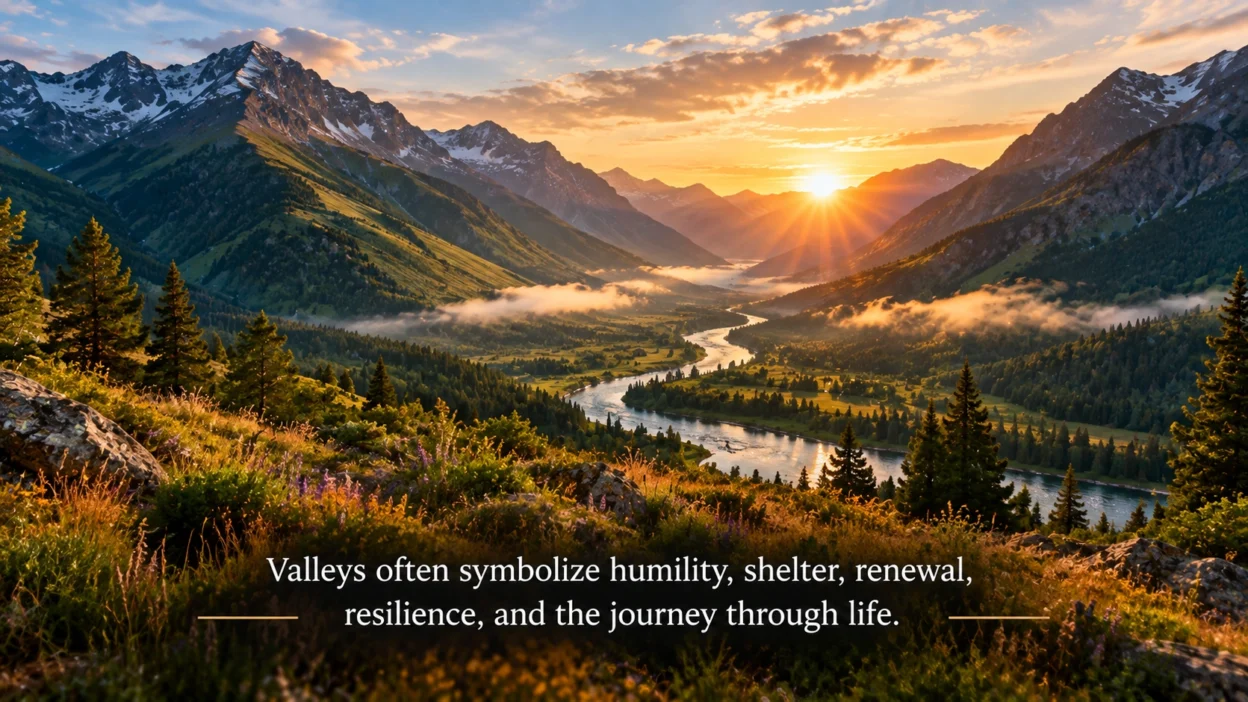
Valley Symbolism connects a familiar landscape with ideas about life, humility, shelter, growth, and transformation. A valley sits between higher places, yet it can hold rivers, forests, farms, towns, and thriving communities.
In the 21st century, valleys appear throughout everyday culture. Think of Appalachian hollows, California farming valleys, desert valleys, and dramatic Rocky Mountain landscapes. Because of this variety, a valley can suggest both hardship and abundance.
However, valleys aren’t always symbols of sadness or struggle. They can represent a necessary low point before change, a protected place where life grows, or a peaceful space between challenges. Across history, valleys have also appeared in myths, religious stories, poetry, paintings, and journeys. Their meaning often depends on what surrounds them and how people experience the landscape.
Quick Answer
Valley Symbolism in the USA commonly represents humility, protection, renewal, resilience, and life’s journey. More broadly, valleys can symbolize a low point, spiritual passage, fertile growth, or a safe place between greater challenges.
TL;DR
- Valleys often symbolize humility, shelter, growth, and transformation.
- American landscapes give valleys strong associations with nature and community.
- Ancient traditions often connected valleys with fertility and sacred journeys.
- A valley can represent hardship without meaning failure or defeat.
- Today, valleys appear in tattoos, art, photography, decor, and writing.
What Does a Valley Symbolize?
A valley is a low area between hills or mountains. It may contain rivers, forests, farmland, roads, homes, or entire communities.
Because valleys occupy a lower position, they often symbolize humility. At the same time, their sheltered shape can suggest safety, belonging, and protection.
Core Symbolic Meanings
The meaning changes with context, but several associations appear repeatedly:
- Humility — being grounded rather than seeking the highest position.
- Shelter — finding protection within a difficult or powerful landscape.
- Renewal — moving through a low period toward new growth.
- Resilience — surviving pressure while continuing forward.
- Fertility — supporting plants, animals, farms, and human communities.
- Life’s journey — moving between peaks, valleys, and changing circumstances.
A valley therefore carries an interesting contrast. It can represent being low without being lesser.
How Valleys Appear as Symbols
The physical appearance of a valley strongly influences its symbolic meaning. A green valley feels different from a barren desert valley.
For example, water running through a valley can suggest life and continuity. Meanwhile, steep cliffs may emphasize isolation, challenge, or protection.
Common Visual Forms
Artists and storytellers often use certain features deliberately:
- A green valley can suggest abundance and renewal.
- A winding river can represent movement through life.
- High mountains can symbolize obstacles or achievement.
- A narrow valley can suggest protection or confinement.
- An open valley can communicate freedom and possibility.
- Misty valleys can create mystery, reflection, or spiritual depth.
The surrounding landscape matters just as much as the valley itself.
A bright sunrise may suggest a new beginning. In contrast, darkness or fog can emphasize uncertainty.
Ancient Roots of Valley Symbolism
Valleys have carried symbolic meaning for thousands of years because early societies depended heavily on landscapes and water.
Fertile valleys often supported agriculture and settlement. As a result, people naturally connected them with life, nourishment, stability, and prosperity.
Fertility and Water
Many early civilizations developed around river valleys. Rivers supplied water for crops, animals, transportation, and settlements.
This practical importance could become symbolic. A valley with flowing water represented a place where life could continue and communities could prosper.
Ancient Egyptian civilization, for example, depended on the Nile Valley. The contrast between fertile land and surrounding desert made the valley especially important to Egyptian life and worldview.
Myth and Sacred Landscapes
Ancient myths frequently placed important events in mountains, valleys, forests, and springs.
Mountains could represent height and connection with the heavens. Valleys, meanwhile, could represent the human world, fertile earth, or a passage between important places.
These patterns later influenced poetry, religious imagery, painting, and storytelling.
Valley Symbolism in American Culture
The American landscape gives valley symbolism many different forms. The country contains agricultural valleys, mountain valleys, desert basins, and densely populated valleys.
Because of this variety, Americans may associate valleys with both nature and human settlement.
Landscapes and Identity
Valleys are closely connected with several American regional identities.
The Appalachian landscape includes narrow valleys surrounded by wooded mountains. California’s Central Valley is strongly associated with agriculture and food production.
Meanwhile, valleys in the Rocky Mountains often appear in outdoor photography and national-park imagery. In the Southwest, desert valleys can suggest endurance, openness, and dramatic natural beauty.
Common American Associations
| Context | Meaning in the USA | Common Associations | Notes |
| Mountain valley | Shelter and natural beauty | Hiking, wilderness, parks | Often appears in landscape photography |
| Agricultural valley | Abundance and productivity | Farms, food, community | Connects land with livelihood |
| Desert valley | Endurance and adaptation | Heat, distance, survival | Highlights resilience |
| Valley town | Belonging and community | Home, family, local identity | The valley becomes a shared place |
| Misty valley | Mystery and reflection | Stories, photography, spirituality | Often creates an emotional mood |
American films and photographs have also helped shape these associations. Wide valley landscapes can represent freedom, exploration, or a return to nature.
Spiritual Meaning of a Valley
Valleys appear in several religious and spiritual traditions, although their meanings aren’t identical.
In some traditions, a valley represents a difficult passage. A person may move through darkness or uncertainty before reaching safety, wisdom, or renewal.
Valleys in Religious Imagery
One well-known example comes from the Valley of the Shadow of Death in Psalm 23 of the Hebrew Bible and Christian Old Testament. The image describes passing through danger while emphasizing divine protection.
The valley itself isn’t necessarily portrayed as permanent defeat. Instead, it forms part of a journey through fear and uncertainty.
Broader Spiritual Interpretations
Outside specific religious traditions, people may use valleys as personal spiritual metaphors.
A valley can represent a period of reflection, surrender, patience, or inner change. The symbolism often focuses on what someone learns while moving through a difficult stage.
Valley Symbolism Across Cultures
Valleys have different meanings across cultures because geography shapes human experience.
River valleys have historically supported large populations in many parts of the world. Mountain valleys have also provided routes, farmland, and protected settlements.
Shared Themes
Despite cultural differences, several ideas appear repeatedly:
- Fertile valleys can represent nourishment and abundance.
- River valleys can symbolize continuity and life.
- Mountain valleys can represent refuge from harsh conditions.
- Hidden valleys can suggest mystery and discovery.
- Valleys between peaks can symbolize balance and contrast.
These similarities don’t mean every culture interprets valleys in the same way. Instead, they show how physical landscapes can inspire recurring human metaphors.
Emotional Meaning of a Valley
Valleys often create a strong emotional contrast. They can feel peaceful, lonely, hopeful, or overwhelming.
The emotion usually depends on the valley’s condition and the story surrounding it.
When a Valley Represents Struggle
In everyday speech, people sometimes describe difficult periods as being “in a valley.” This metaphor contrasts with being on a “mountaintop.”
The valley represents a lower stage, while the mountain peak represents achievement or celebration. However, this doesn’t mean the valley has no value.
When a Valley Represents Peace
A valley can also feel deeply comforting.
Surrounding mountains may create a sense of shelter. Trees, water, and fertile soil can make the valley appear like a protected home within a larger world.
For many people, this creates associations with rest, belonging, safety, and quiet reflection.
Valley Symbolism and the Human Life Journey
One reason valley imagery remains powerful is its connection to life’s ups and downs.
People rarely experience life as a straight line. Instead, they move through periods of success, uncertainty, loss, learning, and renewal.
Peaks and Valleys
A mountain peak may represent accomplishment. The valley between peaks can represent everything that happens between major achievements.
This creates a simple but powerful metaphor:
The valley isn’t necessarily the end of the journey. It’s part of the journey.
That idea makes valley imagery especially useful in poetry, memoirs, motivational writing, and personal art.
Valley Symbolism in Nature and Ecology
Modern environmental awareness adds another layer to valley symbolism. Valleys aren’t empty spaces between mountains.
They can contain complex ecosystems and important water systems.
Life Within the Valley
Depending on geography, valleys may support forests, grasslands, rivers, farms, wildlife, and cities.
This makes the valley a useful symbol of interdependence. Different forms of life can gather around shared resources.
In American environmental imagery, a valley may therefore suggest the relationship between people and the natural world.
It can also remind viewers that landscapes have practical value beyond their visual beauty.
Valley Symbolism in Art and Literature
Artists have long used valleys to create emotional settings. A peaceful valley can establish comfort, while a dark valley can introduce danger or uncertainty.
A Flexible Storytelling Symbol
Writers can use a valley in several ways:
- A traveler entering a valley may begin a new chapter.
- A hidden valley may represent discovery.
- A barren valley may emphasize hardship.
- A fertile valley may symbolize reward.
- A valley after a mountain climb may suggest rest.
- A valley surrounded by peaks may highlight human smallness.
Landscape paintings often use valleys to guide the viewer’s eye. Roads and rivers can lead toward distant mountains, creating a visual sense of movement.
Valley Symbolism in Tattoos and Personal Identity
Valley tattoos can carry highly personal meanings. Unlike a simple decorative landscape, a tattoo may represent a specific chapter of someone’s life.
Someone might choose a valley after overcoming a difficult period. Another person may associate it with home, nature, family, travel, or personal growth.
Popular Tattoo Elements
Common designs can include:
- Mountain ranges surrounding a valley.
- A river winding through the landscape.
- Trees placed along the valley floor.
- A rising or setting sun.
- Birds suggesting freedom and movement.
- A road representing an ongoing journey.
Adding text can make the meaning more specific. However, the landscape alone can communicate a quiet personal story.
Valley Symbolism in Home Decor and Social Media
Valley landscapes work naturally in American home decor because they connect interiors with the outdoors.
Large mountain-valley photographs can create a peaceful atmosphere. Paintings can also suggest travel, wilderness, or a connection with a particular region.
Digital and Decorative Uses
On social media, valley photographs often communicate ideas about:
- Adventure and outdoor exploration.
- Peaceful escapes from busy routines.
- Personal reflection.
- Travel memories.
- Appreciation for natural beauty.
- Freedom and open space.
The same photograph can carry different meanings depending on its caption and context.
Misunderstandings and Changing Meanings
One common misunderstanding is that valleys always symbolize sadness. This interpretation comes mainly from the metaphor of moving through a low point.
However, the physical valley has many positive associations. Fertility, shelter, water, community, and renewal are equally important.
Why Context Matters
A dark, empty valley in a dramatic painting may suggest isolation. A sunny valley filled with crops may communicate abundance.
Therefore, readers shouldn’t treat one symbolic meaning as universal.
Valley imagery can also be used in religious contexts, personal storytelling, environmental campaigns, and commercial artwork. Its meaning depends on the surrounding message.
How Valley Symbolism Has Changed Over Time
Valley symbolism has shifted as human relationships with landscapes have changed.
Early agricultural societies often experienced valleys as essential sources of food and water. Later religious and literary traditions expanded the valley into a metaphor for spiritual testing, danger, and transformation.
Modern Americans often encounter valleys through photography, tourism, films, outdoor recreation, and environmental imagery.
Read More: Mountain Peak Symbolism: Meaning, History & Modern Uses
From Survival to Reflection
For earlier societies, a valley could have very practical importance. Today, someone looking at the same landscape may focus more on beauty, peace, adventure, or personal meaning.
Yet one idea remains remarkably consistent: valleys connect low places with life and movement.
That combination gives the symbol its lasting emotional power.
FAQs
What does a valley symbolize spiritually?
A valley can symbolize a period of difficulty, reflection, or spiritual passage. In some traditions, moving through a valley also represents protection and eventual renewal.
What does a valley symbolize in the Bible?
Biblical valley imagery can represent danger, hardship, judgment, fertility, or important places of human experience. The meaning depends on the specific passage and its context.
What does a valley symbolize in dreams?
A valley in a dream may be interpreted as a symbol of transition, reflection, safety, or emotional difficulty. Dream meanings aren’t universal, so personal circumstances matter.
Why do valleys symbolize humility?
Valleys sit below surrounding peaks, creating a natural contrast with height and status. This makes them useful metaphors for groundedness, modesty, and accepting life’s changing stages.
What does a valley symbolize in a tattoo?
A valley tattoo can represent resilience, nature, home, personal growth, or a difficult chapter that someone survived. Mountains, rivers, and sunlight can add more personal meaning.
Are valleys symbols of sadness?
Not necessarily. Although valleys can represent difficult periods, they also symbolize fertility, shelter, peace, renewal, and community.
Conclusion
Valleys carry a rich mixture of meanings because they occupy a unique place between high and low. They can represent humility, shelter, resilience, fertility, renewal, and the changing journey of life. Ultimately, Valley Symbolism reminds us that low places can still hold beauty and life. Whether you encounter a valley in nature, art, literature, or personal symbolism, its meaning often comes from what happens there and where the journey leads next.