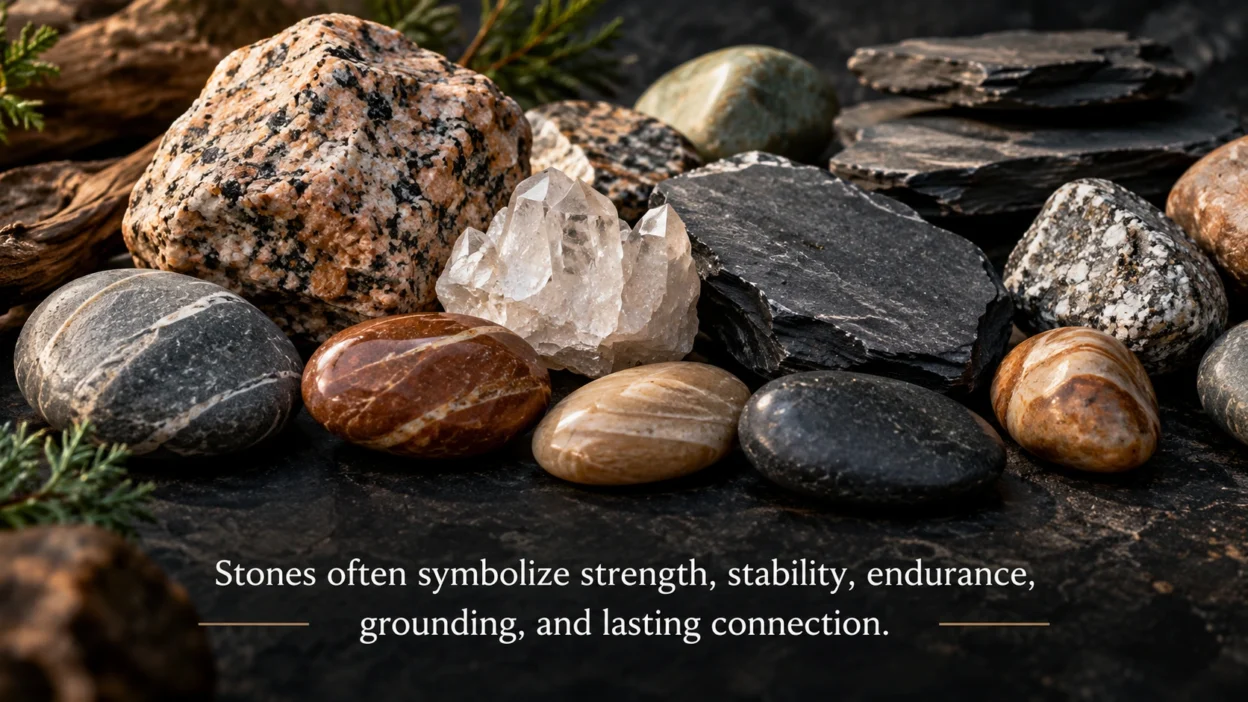
Stone Symbolism reflects the deep human connection between natural stone and ideas of strength, stability, endurance, protection, and permanence. For centuries, people have used stones to build homes, mark important places, create monuments, and preserve memories. Their weight and durability make them a natural symbol of things that remain steady through change.
Yet stone can express more than toughness. A polished pebble may represent peace, patience, and balance, while a weathered rock can suggest resilience and survival. Different colors, shapes, textures, and settings can also change what a stone represents, giving it meanings connected to nature, emotions, spirituality, and personal experiences.
In modern life, stones appear in landscaping, architecture, memorials, jewelry, gardens, meditation spaces, and decorative objects. Whether it is a simple rock collected from a meaningful place or a carefully carved monument, stone often reminds people of memory, grounding, connection to the earth, and the passage of time.
Quick Answer
Stone symbolism in the USA commonly represents strength, stability, endurance, grounding, and permanence. More broadly, stones can symbolize protection, wisdom, memory, spiritual connection, and the lasting nature of life.
TL;DR
- Stones commonly represent strength, stability, endurance, and permanence.
- Ancient societies used stones for monuments, boundaries, tools, and sacred places.
- American culture connects stone with nature, memory, heritage, and durability.
- Different stone types can carry different symbolic associations.
- Smooth stones often suggest calm, while rough stones suggest resilience.
- Today, stones appear in jewelry, tattoos, landscaping, memorials, and home decor.
What Does Stone Symbolism Represent?
Stones have a simple physical quality that shapes much of their symbolic meaning. They are heavy, durable, and often remain in place for generations.
For that reason, people frequently use stones as metaphors for qualities that withstand pressure. In American culture, this idea appears in expressions about having a solid foundation or standing strong.
Core Meanings of Stones
Several symbolic ideas appear repeatedly across different settings:
• Strength through resistance to pressure and change
• Stability through weight, balance, and permanence
• Endurance through survival across long periods
• Grounding through connection with the earth
• Protection through walls, barriers, and durable structures
• Memory through monuments, graves, and memorial stones
The meaning also depends on context. A stone placed beside a garden path may feel peaceful, while a memorial stone carries a deeper connection to remembrance.
Why Stones Feel Powerful
Unlike flowers or leaves, stones don’t quickly disappear. They can survive weather, human activity, and dramatic changes in their surroundings.
Because of this, people naturally connect them with permanence. A stone can become a quiet reminder of something that existed long before the present moment.
What Is the Historical Meaning of Stones?
Stone has been important to human life since prehistoric times. Early humans shaped stone into tools, weapons, cutting edges, and other objects needed for survival.
Over time, stone also became part of human architecture and ceremony. Large stones could mark places, boundaries, burials, gathering areas, or important events.
Ancient Roots
Ancient communities around the world built structures from stone because it offered durability. Stone monuments could communicate that a place, person, or event deserved to be remembered.
In many societies, particular stones also gained sacred or ceremonial importance. Their meanings differed widely, so there isn’t one universal ancient interpretation.
From Survival to Symbol
As societies developed, stone moved beyond practical use. Builders used it to create temples, walls, tombs, roads, castles, bridges, and monuments.
This gave stone another symbolic layer. A stone structure could represent power, order, permanence, protection, or collective memory.
How Did Stone Symbolism Develop in America?
Stone symbolism in America grew from both Indigenous traditions and later European, African, Asian, and other cultural influences. However, Indigenous cultures themselves have diverse traditions, so their relationships with stones shouldn’t be treated as one single belief system.
American landscapes also strongly shaped the meaning of stone. Mountains, deserts, riverbeds, forests, and rocky coastlines all provide distinctive stone environments.
Stones and American Landscapes
The country’s national parks and wilderness areas often encourage people to associate stone with natural endurance. Mountains and cliffs can appear timeless even when their surfaces slowly change.
Meanwhile, smooth stones from rivers and beaches often suggest movement and transformation. Their rounded shapes result from long exposure to water, sand, and friction.
Stone in American Buildings
Stone also communicates durability in American architecture. Government buildings, universities, churches, courthouses, homes, and monuments have often used stone to create a sense of permanence.
The material can therefore suggest trust, history, seriousness, and continuity. These associations are especially noticeable when stone appears in memorial architecture.
What Do Different Stones Symbolize?
Not every stone carries the same meaning. People often interpret a stone according to its color, texture, origin, shape, rarity, and cultural context.
For example, granite can suggest toughness because of its use in buildings and monuments. River stones may feel softer symbolically because water has gradually shaped them.
| Stone or Form | Common Symbolic Meaning | Typical Associations | Context |
| Granite | Strength and endurance | Monuments, foundations | Architecture and memorials |
| River stone | Peace and adaptability | Water, patience, change | Gardens and nature |
| Slate | Stability and protection | Roofing, layers, structure | Architecture and decor |
| Mountain rock | Resilience and permanence | Mountains, wilderness | Nature symbolism |
| Smooth stone | Calm and balance | Touch, water, simplicity | Meditation and decor |
These associations aren’t fixed rules. A person’s experience, culture, and the setting can change how a particular stone feels or what it represents.
What Is the Spiritual Meaning of Stones?
Stones have appeared in many spiritual and religious traditions. However, their meanings differ significantly between cultures, religions, and historical periods.
Some traditions use stones as markers of sacred places, memorials, boundaries, or ritual objects. Others give particular stones special importance because of their color, origin, shape, or traditional story.
Stones and Grounding
In modern American spiritual and wellness spaces, stones are sometimes associated with grounding. The basic idea is that contact with something solid and natural can serve as a reminder to slow down and reconnect with the present.
This is a symbolic or personal practice rather than a universal religious belief. Different people may understand the same stone in completely different ways.
Stones in Religious Traditions
Stone appears in the imagery and practices of many religions. It can represent foundations, sacred places, remembrance, protection, or transformation.
However, it’s important not to combine all these traditions into one meaning. A stone’s significance should be understood within its particular cultural or religious setting.
What Do Stones Mean Emotionally and Psychologically?
People often respond emotionally to stones because their physical qualities are easy to understand. A heavy stone feels stable, while a smooth stone can feel pleasant to hold.
As a result, stones can become personal symbols. Someone might keep a stone from a meaningful trip, for example, turning an ordinary object into a reminder of a specific person or moment.
Emotional Associations
Stone imagery commonly suggests:
• Feeling grounded during periods of uncertainty
• Finding strength after difficult experiences
• Seeking calm through natural surroundings
• Remembering people or places with lasting emotional importance
• Building confidence through an image of endurance
These associations don’t mean stones produce particular emotional effects. Instead, they show how people can use physical objects to express or reinforce personal meanings.
How Are Stones Used in American Culture?
Stone has a strong presence in everyday American life. You can see it in landscaping, architecture, jewelry, monuments, hiking culture, crafts, and nature photography.
Today, people also use stones to communicate ideas about simplicity and connection with nature. Their natural imperfections can feel more personal than highly manufactured objects.
Home Decor and Landscaping
Stone appears frequently in American gardens, fireplaces, patios, pathways, walls, and decorative arrangements. These uses can create feelings of permanence and connection with the outdoors.
River rocks and stacked stones often produce a quieter visual effect. Larger natural rocks can create a stronger sense of permanence and landscape.
Memorials and Monuments
Stone has a particularly important role in remembrance. Headstones, memorial walls, engraved plaques, and monuments use durable materials to preserve names and stories.
Here, stone symbolism becomes closely connected with memory. The physical object remains after a person or event has passed, creating a lasting marker.
What Does Stone Symbolism Mean in Tattoos?
Stone imagery can make a meaningful tattoo because it offers several possible interpretations. A mountain rock, stone wall, cairn, or polished stone can represent different ideas.
The surrounding imagery usually helps explain the intended meaning. A stone combined with flowers may suggest growth alongside endurance, while a mountain scene may emphasize resilience.
Popular Stone Tattoo Ideas
• Mountain stones can represent strength through hardship
• River stones can suggest adaptability and peaceful change
• Stone walls can symbolize boundaries and protection
• Engraved stones can represent memory and remembrance
• Stone hearts can express enduring love or emotional strength
The design doesn’t have to follow a traditional symbolic dictionary. Personal experience can be the most important part of its meaning.
What Does a Stone Mean in Dreams and Stories?
Stone imagery often carries metaphorical meaning in dreams, literature, and storytelling. However, there isn’t one scientifically established interpretation for dreaming about a stone.
In stories, a stone can represent an obstacle, burden, foundation, secret, or lasting truth. Writers may also use stone to contrast with water, plants, or human life.
Stone as an Obstacle
A large rock blocking someone’s path can symbolize difficulty. In this context, its weight and immovability become part of the metaphor.
However, the same rock can become a foundation. This contrast shows why stone symbolism isn’t always negative or positive.
Stone as Transformation
A rough stone can also represent potential. When people carve, polish, or shape stone, the process becomes a metaphor for patience and personal development.
What Are the Cross-Cultural Meanings of Stones?
Stone symbolism appears across many cultures, but the specific meanings vary. Some traditions emphasize sacred landscapes, while others focus on ancestors, protection, ceremony, or artistic expression.
In East Asian garden traditions, for example, carefully placed rocks can contribute to representations of mountains and natural landscapes. In many Indigenous cultures, particular stones and landscapes can hold meanings connected with place, history, ceremony, or community.
A Shared Natural Symbol
Despite these differences, one idea appears repeatedly: stone connects people with the physical world. Its age and durability make it a natural symbol for continuity.
Still, shared themes don’t mean every culture interprets stones identically. Context remains essential.
Are There Negative Meanings Associated With Stones?
Stone can have negative meanings when its physical qualities become metaphors for emotional or social behavior. Someone described as “stone-hearted,” for example, may be portrayed as emotionally distant.
Stone can also symbolize burdens or obstacles. A heavy stone may represent something difficult to carry or a problem that seems difficult to move.
Positive and Negative Contrasts
The same qualities can create opposite interpretations:
• Hardness can suggest strength or emotional coldness
• Weight can suggest stability or burden
• Permanence can suggest commitment or stubbornness
• Stillness can suggest peace or inaction
• Walls can represent protection or separation
This contrast is one reason stone remains useful in storytelling and visual symbolism.
How Has Stone Symbolism Changed Over Time?
Stone has shifted from a basic survival material to a powerful cultural symbol. Early humans depended on stone for practical tools, while later societies used it to express architecture, religion, authority, memory, and identity.
Today, the meaning has become more personal. Someone might carry a stone from a favorite hiking trail or display one as part of a minimalist home.
Read More: Valley Symbolism: Meaning, History, and Modern Uses
From Monumental to Personal
Large stone monuments once communicated collective memory on a grand scale. Modern people can also use small stones to preserve private memories.
For example, a pebble collected during a family trip can become emotionally valuable despite having little monetary worth. Its meaning comes from the story attached to it.
A Symbol That Keeps Evolving
Digital culture has also changed how people share natural imagery. Stones, mountains, crystals, and landscapes frequently appear in photographs, inspirational posts, tattoos, and lifestyle content.
As a result, stone can now represent both ancient ideas and modern personal identity.
FAQs
What does a stone symbolize?
A stone commonly symbolizes strength, stability, endurance, grounding, and permanence. Its meaning can change based on its type, setting, and cultural context.
What does a stone symbolize spiritually?
Spiritually, stones can represent grounding, sacred places, protection, memory, or connection with nature. Specific meanings depend on the tradition involved.
What does a stone symbolize in America?
In the United States, stones often connect with natural landscapes, durability, remembrance, architecture, and personal resilience. Memorials and national landscapes are especially strong examples.
What does a smooth stone symbolize?
A smooth stone can suggest peace, patience, balance, and adaptation. Its rounded surface often reminds people of gradual change caused by water and time.
What does a stone symbolize in a tattoo?
A stone tattoo can represent resilience, stability, memory, protection, or enduring values. The surrounding design often adds a more personal meaning.
Why are stones used for memorials?
Stone is durable and can preserve names, dates, and messages for generations. This physical permanence makes it a natural material for remembrance.
Conclusion
Stone symbolism centers on qualities that are easy to recognize: strength, stability, endurance, grounding, and permanence. Yet stone can also represent memory, protection, resilience, patience, or even emotional barriers. The next time you notice a stone, consider its context. Its shape, texture, location, and personal history may reveal a meaning far beyond its physical appearance.