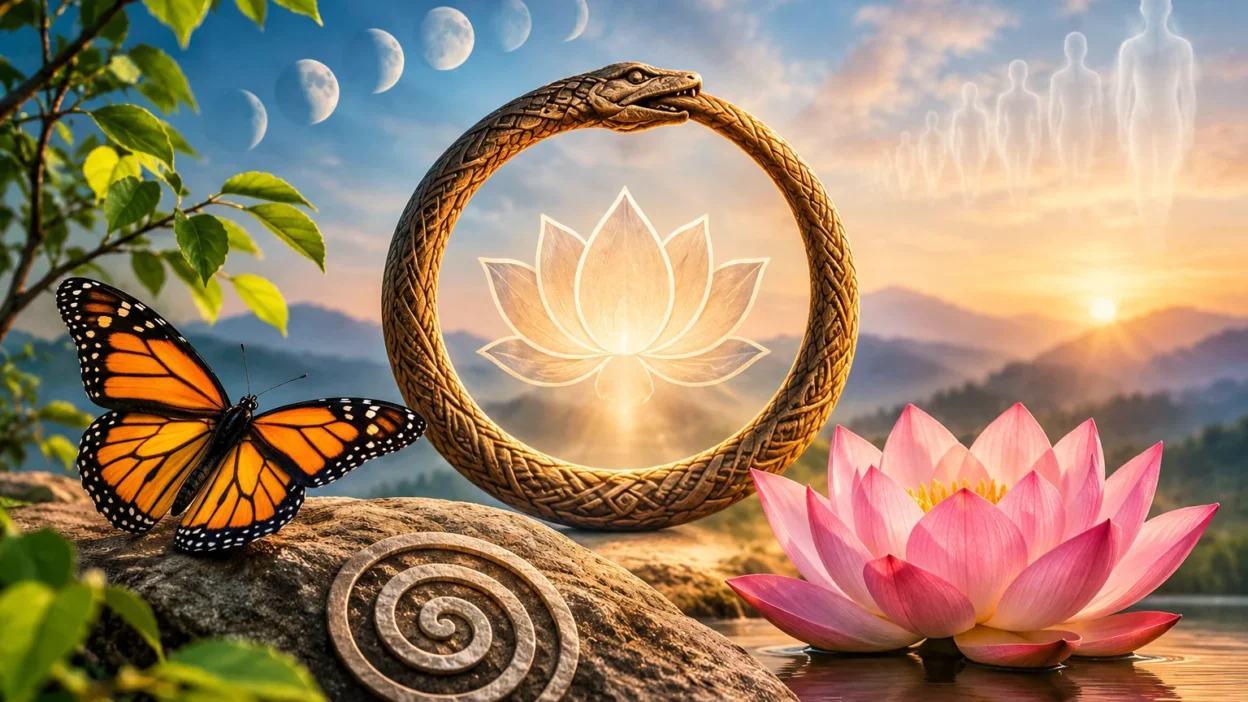
Reincarnation symbolism explores the belief that life continues beyond death through rebirth into another existence. In the United States, Reincarnation Symbolism often represents renewal, spiritual growth, transformation, and the possibility of another beginning. People may express these ideas through butterflies, spirals, circular patterns, lotus flowers, and images of life returning after death.
For some people, reincarnation is a religious belief. For others, it offers a spiritual explanation for life’s mysteries or a metaphor for personal change. Someone who leaves an old identity behind might describe the experience as being reborn, even without believing in a literal afterlife.
However, reincarnation doesn’t have one universal meaning. Its interpretation depends on cultural traditions, religious teachings, personal experiences, and the symbols used to represent it. Understanding these differences reveals why the idea continues to interest Americans seeking purpose, healing, and a deeper connection with existence.
Quick Answer
In the United States, Reincarnation Symbolism commonly represents renewal, personal transformation, spiritual growth, and life continuing beyond death. Across different traditions, it can also symbolize karma, the soul’s journey, and the repeating cycles of existence.
TL;DR
- Reincarnation represents rebirth, continuity, transformation, and spiritual development.
- Ancient Indian religious traditions developed important teachings about rebirth and karma.
- Butterflies, spirals, and circles often represent renewal and life’s repeating cycles.
- American interpretations range from religious beliefs to personal spirituality and metaphorical rebirth.
- Modern tattoos and artwork express hope, resilience, and the possibility of starting again.
- Religious traditions differ significantly in their explanations of life, death, and rebirth.
What Does Reincarnation Symbolism Mean?
Reincarnation symbolism represents the idea that existence doesn’t necessarily end with physical death. Depending on the belief system, a person may be understood to return in another body, continue through different forms of life, or participate in a larger cycle of existence.
In everyday American culture, the concept also describes personal renewal. For example, someone who overcomes a difficult period may feel they’ve become an entirely different person.
The Core Symbolic Meanings
Three central meanings appear frequently in discussions of reincarnation.
- Renewal: Life offers the possibility of beginning again after an ending.
- Continuity: Something essential may continue even when the physical body changes.
- Transformation: Each stage of existence may bring new experiences, lessons, or understanding.
These meanings overlap, but they aren’t identical. Renewal emphasizes a fresh start, while continuity focuses on what survives change.
Reincarnation as a Symbol of Life’s Cycles
Many reincarnation symbols use circular shapes to represent repeated beginnings. A circle has no obvious starting or ending point, making it a natural image for recurring existence.
However, the circle doesn’t always mean literal rebirth. In American art and personal spirituality, it may represent the seasons, family generations, emotional recovery, or the continuing influence of loved ones.
Historical Origins of Reincarnation Beliefs
Reincarnation has a long and varied history. Its development includes ancient religious teachings, philosophical debates, and modern spiritual movements.
Although people in many societies have imagined life continuing after death, their explanations differ. Therefore, similar symbols shouldn’t automatically be treated as evidence of identical beliefs.
Ancient Indian Traditions
Some of the clearest early teachings about rebirth developed in ancient India. Hindu traditions describe samsara, the cycle of birth, death, and rebirth, alongside teachings about karma and liberation.
Buddhist traditions also teach rebirth, but they generally don’t describe it as the permanent soul moving unchanged between bodies. Instead, they explain continuity through causes and conditions, without accepting an eternal, unchanging self.
These distinctions matter because reincarnation is often discussed as though every tradition teaches the same thing. In reality, Hindu and Buddhist explanations contain important philosophical differences.
Ancient Greek Philosophy
Ideas resembling reincarnation also appeared in ancient Greek thought. Some philosophical and religious movements associated with Pythagoras and Orphism taught that the soul could undergo multiple lives.
Plato explored related ideas in philosophical works about the soul, justice, and existence after death. These teachings helped establish rebirth as a subject of Western philosophical discussion.
However, ancient Greek beliefs varied widely. Reincarnation wasn’t a universal Greek religious doctrine, and many other Greek thinkers offered different explanations of the soul.
How the Concept Reached Modern America
During the nineteenth century, American interest in reincarnation grew through spiritualism, religious experimentation, and interest in Asian philosophies. Transcendentalist thinkers and later Theosophical movements helped introduce alternative views of spiritual development.
In the twentieth century, yoga, meditation, translated religious texts, and popular spiritual writing brought these ideas to wider audiences. Reincarnation became familiar even among Americans who didn’t follow a religion that formally teaches it.
Today, people may encounter the concept through books, films, spiritual communities, online discussions, or conversations about death and personal identity.
Reincarnation Symbolism in American Culture
In the United States, reincarnation exists within a diverse religious and cultural landscape. Some Americans understand it as a sacred teaching, while others treat it as a personal possibility or an imaginative way to describe transformation.
Its meaning often reflects broader American interests in individual choice, self-discovery, and the freedom to explore different beliefs.
Spirituality and Personal Freedom
American spiritual culture frequently emphasizes personal experience. As a result, some people explore reincarnation without formally joining a religious community.
For these individuals, rebirth may offer a framework for thinking about purpose, relationships, and experiences that seem difficult to explain. Others accept reincarnation as a firm religious conviction rather than an open question.
Popular Culture and Media
Movies, television shows, novels, and fantasy stories often use reincarnation to explore identity. A character might return in another body, recognize someone from a supposed past life, or discover that an earlier existence influences the present.
These stories can make the concept emotionally accessible. However, fictional portrayals often simplify religious teachings to create suspense, romance, or dramatic revelations.
Common American Interpretations
| Context | Symbolic Meaning | Common Association |
| Personal spirituality | Continuation beyond death | Hope and purpose |
| Self-development | Becoming a new version of yourself | Growth and resilience |
| Fiction and entertainment | Returning in another life | Destiny and mystery |
| Memorial art | Life’s continuing cycles | Remembrance and comfort |
| Tattoos and jewelry | A personal spiritual journey | Identity and transformation |
These interpretations can coexist, but they don’t necessarily express the same beliefs. A person may choose a rebirth symbol for its emotional meaning without accepting reincarnation literally.
Religious and Spiritual Meanings of Reincarnation
Reincarnation takes different forms across religious and spiritual traditions. Understanding these distinctions helps readers interpret its symbols respectfully, especially when those symbols appear in American fashion, art, or popular spirituality.
Hinduism and the Cycle of Samsara
In Hindu traditions, samsara refers to the cycle of birth, death, and rebirth. Karma, often understood in terms of actions and their consequences, plays an important role in many explanations of this cycle.
The ultimate spiritual goal is often moksha, or liberation from samsara. Therefore, rebirth isn’t always viewed as a desirable outcome; freedom from the cycle can represent the highest spiritual achievement.
Buddhism and Rebirth
Buddhist teachings generally describe rebirth without a permanent, independent soul. Instead, continuity arises through causes and conditions, including karma.
The goal is liberation from suffering and the cycle of samsara. Consequently, Buddhist symbolism associated with rebirth may emphasize impermanence, awareness, and freedom rather than endless personal renewal.
Jainism and Other Spiritual Perspectives
Jain traditions teach that individual souls pass through repeated births and deaths, with karma affecting their condition. Liberation involves freeing the soul from karmic bondage.
Some contemporary spiritual movements also interpret reincarnation as an opportunity for learning or spiritual evolution. These modern interpretations vary, so they shouldn’t be assumed to represent Hinduism, Buddhism, or Jainism as a whole.
Common Symbols Associated With Reincarnation
Reincarnation doesn’t have one universally recognized symbol. Instead, people use images associated with cycles, transformation, continuity, and renewed life.
The meaning depends on the image’s cultural background and the context in which it appears.
The Circle and Ouroboros
A circle often represents wholeness, continuity, and cycles without a clear beginning or end. The ouroboros, an image of a serpent eating its own tail, adds the idea of renewal through an ongoing cycle.
Historically, the ouroboros appeared in several ancient symbolic and philosophical settings. Today, it may represent eternal return, self-renewal, or the relationship between endings and beginnings.
However, neither symbol exclusively means reincarnation. Their broader associations include eternity, unity, and the recurring patterns of nature.
The Butterfly
The butterfly is a popular modern symbol of transformation. Its movement from caterpillar to chrysalis to adult butterfly offers a powerful image of dramatic change.
In American culture, butterflies often represent hope, personal growth, freedom, and remembrance. Some people connect them with reincarnation, although a butterfly doesn’t traditionally carry that meaning in every culture.
Its strongest general association is transformation rather than proof of life after death.
The Lotus Flower
The lotus holds important spiritual meaning in several Asian traditions, particularly Hinduism and Buddhism. Its growth from muddy water into an open flower can represent spiritual development, purity, and awakening.
Some people connect the lotus with reincarnation because of its relationship to life, renewal, and spiritual cycles. However, its established religious meanings are broader than rebirth alone.
When using lotus imagery, understanding its cultural and religious background helps preserve its significance.
Emotional and Psychological Meaning of Reincarnation
Reincarnation can carry strong emotional meaning because it addresses questions about death, identity, regret, and purpose. Even without a literal belief in rebirth, the concept can help people imagine change as part of a larger journey.
Its emotional effects vary according to individual experience. For some, it brings comfort; for others, it raises difficult questions.
Hope and Comfort After Loss
The possibility of another life may comfort people who wonder whether death represents a complete ending. For some believers, reincarnation also offers hope of meeting loved ones again in another existence.
However, traditions differ in how they understand relationships across lives. Reincarnation shouldn’t automatically be interpreted as a promise that the same people will reunite.
Identity and Personal Transformation
Reincarnation also provides a metaphor for major life changes. Leaving a harmful relationship, changing careers, or recovering confidence may feel like beginning a new life.
In this sense, the symbol encourages people to see identity as something that can develop over time. It doesn’t require belief in a previous lifetime.
The Need for Meaning
People naturally ask questions about why they exist and what happens after death. Reincarnation offers one possible framework for considering those questions.
Still, emotional comfort doesn’t establish whether a spiritual belief is factually true. People can explore its meaning while remaining thoughtful about uncertainty and different perspectives.
Reincarnation Symbolism in Dreams
Dreams involving death, returning to life, unfamiliar identities, or historical settings may inspire questions about reincarnation. Their meaning, however, depends on the dreamer’s personal experiences and beliefs.
A dream alone doesn’t establish that someone has experienced a past life.
Common Dream Images
- Being born again: May represent a fresh start or changing identity.
- Meeting an unfamiliar person: Can reflect curiosity, emotional connection, or uncertainty.
- Visiting another historical period: May express imagination, memories, or interest in the past.
- Dying and returning: Can symbolize transition, recovery, or fear of change.
These are possible interpretations, not universal rules. Dreams can also arise from ordinary memories, emotions, and experiences.
Spiritual Interpretations Versus Personal Reflection
Some spiritual traditions interpret certain dreams as meaningful experiences connected to previous lives. Others understand dreams through different religious, philosophical, or psychological frameworks.
Rather than assuming one explanation is correct, consider how the dream relates to your current feelings. The most useful interpretation may be the one that helps you understand your concerns without treating speculation as established fact.
Reincarnation Tattoos, Jewelry, and Modern Art
Reincarnation imagery has a natural place in personal art because it combines powerful ideas about death, change, and continuity. In the United States, people often choose such designs to express their beliefs or mark an important turning point.
However, a symbol’s meaning isn’t always obvious to other people. Personal context can be just as important as the design itself.
Popular Tattoo Designs
- Circular snakes can represent recurring cycles and renewal.
- Butterflies can express transformation, freedom, and new beginnings.
- Lotus flowers can reflect spiritual growth and awakening.
- Spirals can suggest movement, continuity, and repeated experience.
- Trees with renewing leaves can represent life across generations.
These designs are interpretations rather than fixed definitions. For example, a butterfly tattoo may celebrate recovery without referring to reincarnation at all.
Jewelry and Home Decor
Some people wear circular pendants, lotus jewelry, or symbolic charms as reminders of spiritual beliefs. Others display spiral artwork or natural imagery to express a broader interest in life’s cycles.
In American homes, these objects may become personal conversation pieces. Their significance often comes from the owner’s experiences rather than a universal symbolic code.
Choosing a Meaningful Design
Before choosing a design, consider what you want it to communicate. A circle might express eternity, while a butterfly might emphasize change.
If a design draws from a specific religious tradition, learn about its original context. This approach helps you make a thoughtful choice without reducing a complex tradition to a decorative trend.
Misunderstandings and Controversies About Reincarnation
Reincarnation can be meaningful and comforting, but it also raises questions about evidence, cultural respect, and differences between religious beliefs.
Clear distinctions help prevent confusion. They also allow people to discuss spiritual ideas without dismissing believers or presenting uncertain claims as established facts.
Reincarnation Is Not Universal to All Religions
One common misunderstanding is that every religion teaches the soul returns after death. In reality, religious traditions offer different views of the afterlife, personal identity, and spiritual liberation.
For example, many Christian and Islamic traditions emphasize resurrection or other forms of afterlife rather than reincarnation. Individual beliefs can vary, but these concepts shouldn’t be treated as interchangeable.
Symbolism Is Not Scientific Proof
A butterfly, recurring dream, or strong feeling of familiarity may seem connected to reincarnation. However, symbolic associations alone cannot demonstrate that a person lived before.
Reports of apparent past-life memories have attracted research and public interest, but interpretations and evidence remain debated. It is reasonable to distinguish personal conviction from conclusions established through scientific methods.
Cultural Appropriation and Oversimplification
Religious symbols sometimes become popular in Western fashion without much attention to their origins. A lotus design, for instance, may carry specific meanings within Buddhist or Hindu traditions beyond general ideas of peace.
Using such imagery isn’t automatically disrespectful. Nevertheless, learning its context and avoiding misleading claims can help people engage with these traditions thoughtfully.
How Reincarnation Symbolism Has Changed Over Time
The symbolism of reincarnation has changed as religious teachings, philosophical ideas, and popular culture have interacted. In modern America, it can represent both a specific spiritual belief and a flexible metaphor for personal renewal.
Understanding these shifts explains why the same image can mean different things to different people.
From Religious Teaching to Personal Spirituality
In older religious settings, rebirth was often part of a larger system involving karma, moral responsibility, suffering, and liberation. Its meaning depended on teachings about the nature of existence and the goals of spiritual life.
Later, Western spiritual movements sometimes reframed reincarnation as a journey of personal growth. Contemporary interpretations may focus more on individual development than on liberation from repeated existence.
From Sacred Imagery to Popular Culture
Today, circles, butterflies, spirals, and lotus flowers appear in tattoos, jewelry, illustrations, and entertainment. These images can communicate renewal without requiring knowledge of their religious histories.
However, popular culture often combines ideas from unrelated traditions. As a result, a modern reincarnation design may express a personal mixture of spirituality, self-improvement, and artistic preference.
Read More: Fate Symbolism: Meaning, History, and Spiritual Signs
What Has Stayed Consistent?
Despite changing interpretations, several themes remain recognizable.
- Life may be understood as a continuing journey.
- Endings can create possibilities for transformation.
- Identity can involve more than present circumstances.
- Symbols can help people express beliefs about life’s mysteries.
These shared themes explain the concept’s enduring appeal, even among people who disagree about what happens after death.
FAQs
What Is the Main Symbol of Reincarnation?
There isn’t one universally accepted symbol of reincarnation. Circles, spirals, ouroboros imagery, butterflies, and lotus flowers are commonly associated with cycles or transformation, although each has additional meanings.
What Does Reincarnation Mean Spiritually?
Spiritually, reincarnation often refers to existence continuing through repeated births and deaths. Its meaning varies, especially regarding karma, the soul, and whether liberation from the cycle is the ultimate goal.
What Does a Butterfly Symbolize in Reincarnation?
A butterfly can represent transformation and the possibility of a new beginning. Some people connect this change with rebirth after death, but butterflies don’t have a universal or exclusive reincarnation meaning.
Is Reincarnation Part of Christianity?
Most mainstream Christian traditions emphasize resurrection and eternal life rather than reincarnation. Some individuals and minority groups have explored reincarnation, but it isn’t a standard teaching of mainstream Christianity.
What Does Reincarnation Symbolism Mean in a Dream?
A dream about returning to life may symbolize change, recovery, or a new chapter. Some people interpret such dreams spiritually, but a dream doesn’t prove that a previous life occurred.
What Tattoo Represents Reincarnation?
Circles, spirals, butterflies, lotus flowers, and ouroboros designs can represent rebirth or continuing cycles. The best choice depends on whether you want to emphasize spiritual belief, transformation, or a personal life experience.
Conclusion
Reincarnation symbolism brings together ideas of renewal, continuity, transformation, and the mysteries surrounding death. Its roots extend across ancient religious and philosophical traditions, while modern American culture has added personal interpretations centered on growth and fresh beginnings. However, reincarnation doesn’t mean the same thing to everyone. For some, it describes a deeply held spiritual belief; for others, it offers a meaningful metaphor for becoming someone new. Symbols such as circles, butterflies, and lotus flowers can communicate these ideas, even when their original cultural meanings differ. Ultimately, exploring Reincarnation Symbolism invites you to reflect on change, identity, and the possibility of renewal. Consider which images speak to your own understanding of life’s journey, and learn about their origins before deciding what they mean to you.