Destiny has fascinated people for centuries because it raises an important question: Is your future already written, or do your choices create it? Destiny symbolism explores this question through familiar images such as winding roads, stars, compasses, clocks, and golden threads. These symbols help people express their hopes, beliefs, and ideas about life’s direction.
In 2026, destiny often connects with personal ambition, freedom, opportunity, and the search for purpose. Someone pursuing a dream career may describe it as their calling, while another person might view an unexpected meeting as a meaningful coincidence. Both experiences can give ordinary moments a deeper meaning.
However, destiny means different things to different people. Some connect it with divine guidance or spiritual beliefs, while others understand it as a story shaped by choices, circumstances, and chance. Exploring its symbolism reveals how ancient traditions and modern American culture continue to influence the way people understand their lives.
Quick Answer
Destiny symbolism in the United States represents purpose, fate, personal direction, hope, and the possibility of a meaningful future. Across cultures, it can also symbolize divine plans, cosmic order, spiritual connections, or the relationship between human choices and events beyond personal control.
TL;DR
- Destiny symbolizes purpose, fate, direction, and life’s important turning points.
- Ancient myths often portrayed destiny as a power governing human lives.
- American culture connects destiny with ambition, freedom, and opportunity.
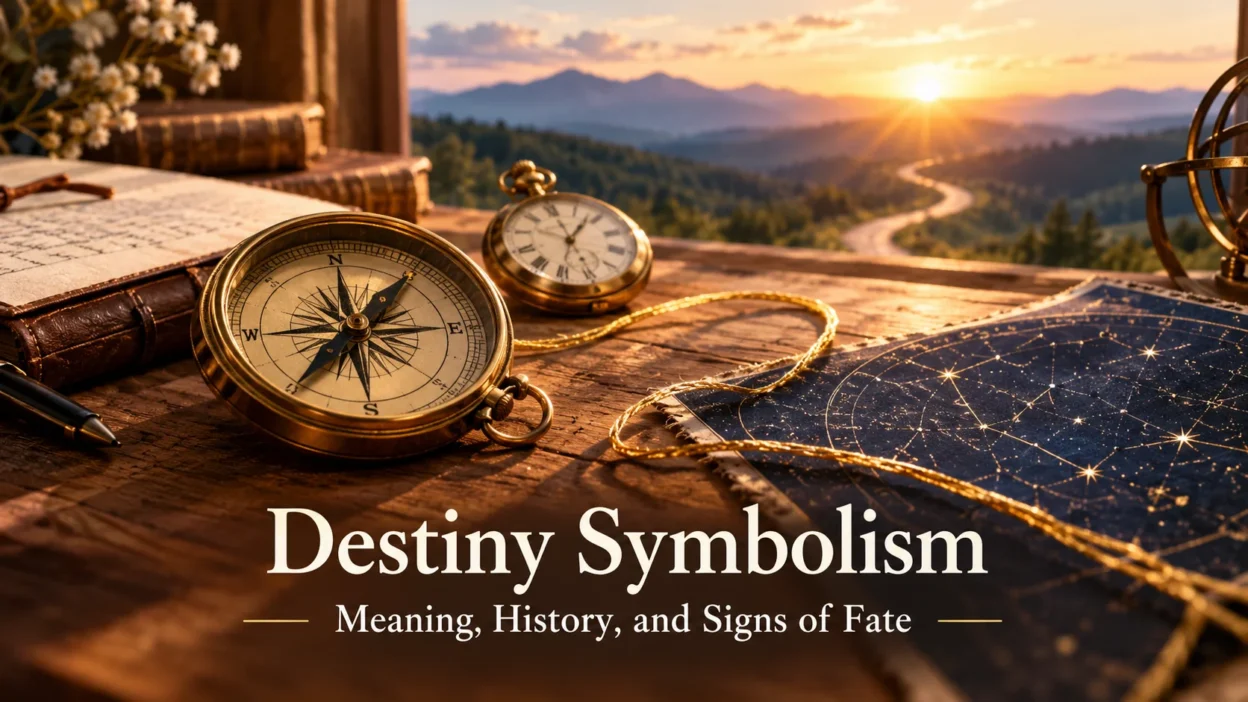
- Compasses, roads, stars, clocks, and threads commonly represent destiny.
- Spiritual traditions interpret destiny through divine purpose, karma, or cosmic order.
- Modern tattoos and jewelry express personal beliefs about fate and life’s journey.
What Does Destiny Symbolism Mean?
Destiny symbolism gives visual form to the belief that life has a direction, purpose, or meaningful outcome. It helps people express ideas about the future, important decisions, and events that seem connected.
The Core Meanings of Destiny
Destiny can carry several meanings depending on the context and the person interpreting it.
- Purpose: The belief that your life has meaning beyond everyday routines.
- Fate: The idea that certain events may be beyond personal control.
- Direction: The search for a path through uncertainty and change.
- Transformation: The possibility that difficult experiences can lead to new beginnings.
- Connection: The feeling that certain people or experiences enter your life for meaningful reasons.
These interpretations often overlap, but they aren’t identical. For example, someone may believe in destiny while still believing that personal decisions shape the future.
Destiny, Fate, and Fortune
People frequently use destiny and fate as interchangeable terms. However, destiny often suggests a meaningful future, while fate can emphasize events that appear predetermined.
Fortune usually relates to luck, chance, or favorable circumstances. A lucky coin might symbolize fortune, while a winding road can represent destiny and the choices made along the way.
Common Symbols of Destiny and Their Meanings
Destiny doesn’t have one universally recognized emblem. Instead, people use objects and images that suggest guidance, time, connection, and the unknown.
Popular Symbols Associated With Destiny
- Compass: Represents guidance, direction, and finding your way through uncertainty.
- Winding road: Symbolizes life’s journey, personal decisions, and unexpected changes.
- Golden thread: Suggests connections between life events, relationships, and the passage of time.
- Clock or pocket watch: Represents time, mortality, and life’s changing seasons.
- Stars and constellations: Symbolize hope, guidance, and humanity’s search for meaning.
- Open door: Suggests opportunity, transformation, and the beginning of a new chapter.
- Hourglass: Represents the passage of time and the importance of the present.
- Bridge: Symbolizes transitions between different stages of life.
How Context Changes a Symbol’s Meaning
The same object can communicate different ideas depending on its surroundings. A broken clock, for example, might represent regret, freedom from deadlines, or a life-changing moment.
Likewise, a compass may represent spiritual guidance in one design and independence in another. Personal experiences, cultural traditions, and accompanying imagery all influence its meaning.
Historical Origins of Destiny Symbolism
Destiny has appeared in ancient myths, religious traditions, and philosophical debates for thousands of years. Early societies used stories about divine powers and cosmic order to explore why events happened and whether human lives followed a larger plan.
Ancient Mesopotamian Beliefs
In ancient Mesopotamia, divine powers were associated with decrees that shaped the world and its order. Some myths connected the determination of destinies with the authority of the gods.
These beliefs linked destiny with divine power, cosmic structure, and the future. They also show that destiny was not always understood as an individual’s personal journey.
Greek and Roman Mythology
In ancient Greek mythology, the Moirai were three figures associated with the course of human life. Roman tradition had related figures known as the Parcae.
Their roles are commonly represented through the image of a thread:
- Clotho spins the thread of life.
- Lachesis measures or assigns its length.
- Atropos cuts the thread when its end arrives.
The thread became a powerful symbol because it connected birth, the passage of life, and death. Although mythological accounts varied, these figures helped establish a lasting visual connection between destiny and the thread of human existence.
Norse Mythology and the Norns
Norse mythology also features the Norns, figures associated with destiny and the conditions of life. They are connected with Yggdrasil, the great world tree that links different parts of the cosmos.
Their stories explore the relationship between individual lives and a larger cosmic order. Although these ideas resemble themes found in other traditions, they developed within their own distinct cultural and religious setting.
Destiny Symbolism in American Culture
In the United States, destiny is closely connected with personal ambition, independence, and the hope of building a better future. It appears in everyday expressions, entertainment, national stories, and ideas about individual purpose.
The American Dream and Personal Purpose
The American Dream is often associated with the belief that effort and opportunity can help people improve their lives. For some Americans, this ideal feels like a personal destiny: a future worth working toward despite uncertainty.
A student pursuing a degree, an entrepreneur building a business, or an artist developing a creative vision may describe their goals as a calling. In these situations, destiny represents direction and motivation rather than a future that cannot change.
This interpretation reflects an important American cultural theme: people want to believe that their decisions matter. Destiny can provide a sense of purpose while leaving room for hard work, setbacks, and unexpected opportunities.
Destiny in American Stories and Entertainment
American films, television shows, and novels frequently feature characters who discover a calling or face an expected future. Heroes may resist a prophecy, accept a responsibility, or choose a different path from the one others expect.
These stories make destiny relatable because they combine uncertainty with personal decisions. They also raise a familiar question: Are people following a path already laid out for them, or creating one through their actions?
Manifest Destiny and Its Controversial History
The phrase Manifest Destiny has a specific historical meaning in the United States. It referred to a nineteenth-century belief that American expansion across North America was justified or inevitable.
What Manifest Destiny Meant
The phrase became prominent during the 1840s, when American expansionists used it to support territorial growth. The idea connected national ambition with a sense of providence, mission, and historical inevitability.
However, Manifest Destiny was not simply a neutral expression of hope. It helped justify territorial expansion that displaced Indigenous peoples and contributed to war, dispossession, and the loss of Native lands.
Why the Phrase Remains Sensitive
Today, Manifest Destiny is often examined critically in American history education and public discussions. It demonstrates how the language of destiny can make political goals appear unavoidable or morally justified.
Understanding this history helps distinguish personal destiny symbolism from a national ideology with serious consequences. It also highlights an important concern: describing an outcome as “meant to be” can obscure the human decisions and harms involved in achieving it.
Spiritual and Cross-Cultural Meanings of Destiny
Different cultures and spiritual traditions offer distinct ways to understand destiny. Some emphasize divine guidance, while others focus on moral responsibility, cause and effect, or harmony with the wider universe.
Destiny in Christianity and Islam
Within Christianity, beliefs about divine providence and predestination vary among denominations and theological traditions. Some Christians understand life’s direction through God’s guidance, while also emphasizing human choices and moral responsibility.
In Islam, qadar refers to divine decree or determination. Muslim scholars have explored how God’s knowledge and will relate to human responsibility, and interpretations differ across theological traditions.
Both religions include ideas that people may interpret through images of light, paths, guidance, and meaningful journeys. These are illustrative associations, not official symbols with one fixed meaning.
Destiny in Hinduism and Buddhism
In Hindu traditions, karma concerns actions and their consequences, often within broader beliefs about rebirth and spiritual development. Karma should not be reduced to the idea that every event is predetermined or deserved.
Buddhist traditions also explore karma and dependent arising, which describes how conditions contribute to the emergence of experiences and events. These teachings don’t simply claim that every person’s future has already been written.
Fate in East Asian Traditions
In Chinese thought, ming can refer to fate, life circumstances, or an allotted course, depending on the context. The concept of tianming, commonly translated as the Mandate of Heaven, has also played an important role in Chinese political philosophy.
Meanwhile, red-thread traditions in parts of East Asia associate an unseen thread with destined relationships. Popular versions often focus on romantic partners, although stories and interpretations vary.
These examples show that destiny can represent divine direction, moral consequence, cosmic order, or meaningful connection. No single interpretation represents every member of a culture or religion.
Psychological and Emotional Meanings of Destiny
Destiny symbolism helps people express feelings that can be difficult to explain directly. It offers a way to reflect on uncertainty, major changes, and the search for meaning.
Hope, Comfort, and a Sense of Purpose
When life feels unpredictable, the idea of destiny may offer reassurance. Someone experiencing a setback might view it as a turning point rather than the end of their plans.
A personal symbol can reinforce this outlook. A compass necklace may remind someone to follow their values, while a star tattoo might represent hope during a difficult period.
However, finding meaning in an experience doesn’t prove that the event was predetermined. People can develop meaningful interpretations of their lives without settling the larger philosophical question.
Identity, Choice, and Uncertainty
Destiny can express a belief that life has direction, but it can also create anxiety about losing control. If someone believes every outcome is fixed, they may question whether their decisions matter.
A more flexible interpretation allows room for both circumstances and personal action. You may not control every opportunity or obstacle, but you can still decide how to respond.
Destiny symbolism can therefore express two ideas at once: a desire to trust life’s direction and a determination to participate in shaping it.
Destiny Symbols in Tattoos, Jewelry, and Home Decor
In modern American culture, destiny symbols frequently appear in personal accessories, tattoos, and decorative objects. People choose them to represent their beliefs, relationships, goals, or memories.
Destiny Tattoos and Personal Expression
Destiny tattoos turn an abstract idea into a lasting personal reminder. Their meanings usually depend on the wearer’s experiences rather than a universal definition.
Common designs include:
- A compass with an arrow, representing direction and confidence.
- A winding road, representing growth and life’s unpredictable journey.
- Stars connected by fine lines, representing guidance and meaningful connections.
- An hourglass, representing time, change, and the present moment.
- A golden thread, representing relationships or events that seem connected.
- An open door, representing new opportunities and personal transformation.
Some people combine these designs with dates, initials, or short personal messages. The details can make a familiar symbol deeply personal.
Jewelry and Everyday Objects
Jewelry offers a subtle way to carry a reminder of destiny. Compass pendants, star necklaces, infinity designs, and pocket-watch charms can suggest direction, connection, or time.
Similarly, a framed constellation map or a compass displayed on a desk can express someone’s interest in exploration and life’s possibilities. These objects don’t have one official meaning; their significance often develops through personal use.
Colors and Shapes Associated With Destiny
Color and shape influence how people interpret destiny imagery. Although no universal color system defines destiny, certain visual choices commonly suggest particular ideas.
Common Destiny Colors
- Gold: Achievement, value, illumination, and a hopeful future.
- Blue: Guidance, calmness, trust, and reflection.
- Purple: Mystery, imagination, spirituality, and the unknown.
- White: New beginnings, clarity, and possibility.
- Black: Uncertainty, mystery, and the seriousness of life’s turning points.
- Green: Growth, renewal, and the potential for change.
These associations are flexible rather than universal. Black may communicate grief in one design and strength or elegance in another.
Shapes That Suggest a Life Path
Lines, circles, spirals, and branching paths can also represent destiny. A straight line may suggest a clear direction, while a winding line conveys uncertainty and discovery.
A circle can symbolize continuity or recurring cycles. Meanwhile, a spiral may suggest growth, transformation, or movement through different stages of life.
Destiny Symbolism in Dreams and Coincidences
People sometimes interpret dreams, coincidences, and unexpected meetings as signs of destiny. These experiences can feel especially powerful during periods of change.
Dreams About Roads, Stars, and Doors
Dream imagery doesn’t have one proven universal meaning. Still, people often use familiar destiny symbols to reflect on their emotions and current concerns.
- A road may prompt reflection on an important decision.
- Stars may evoke hope, curiosity, or a desire for guidance.
- An open door may suggest transition or a new possibility.
- A missed train may reflect worries about timing or lost opportunities.
- A compass may represent a wish for greater clarity.
These are possible personal interpretations, not reliable predictions of future events. A dream’s meaning depends on the dreamer’s circumstances and feelings.
Coincidences and Meaningful Meetings
A chance meeting or unexpected opportunity can feel like destiny, especially when it changes someone’s life. People may interpret these experiences through faith, intuition, or a belief in meaningful coincidences.
Psychology offers another perspective. Humans naturally search for patterns and connections, so events that match an existing hope or expectation can stand out in memory.
Finding personal meaning in a coincidence doesn’t require treating it as proof that a particular future is guaranteed.
Misunderstandings, Misuse, and Controversies About Destiny
Destiny can inspire hope, but misunderstandings arise when people treat personal interpretations as absolute truths. Understanding its limits helps distinguish symbolic meaning from established fact.
Does Destiny Mean Everything Is Predetermined?
Not necessarily. Some philosophical and religious traditions teach that events follow a predetermined plan, while others emphasize free will, responsibility, or the interaction between different causes.
Even people who believe in destiny may consider choices essential. They might view opportunities as part of a larger plan while believing that their responses still matter.
Can Destiny Symbols Predict the Future?
A compass, star, thread, or clock can represent beliefs about destiny, but the object itself cannot establish what will happen. Similarly, a coincidence may feel meaningful without proving that the universe arranged it.
Symbols are most useful when they help people express values, explore questions, or remember important experiences. Treating them as guaranteed predictions can create unrealistic expectations.
When Destiny Becomes an Excuse
The idea of destiny can become harmful when it encourages people to ignore their responsibilities or accept mistreatment as unavoidable. For example, someone might remain in an unhealthy situation because they believe suffering must be part of their fate.
A belief in destiny doesn’t remove the importance of personal safety, informed decisions, or accountability. Meaningful experiences can influence a person’s life without making every event necessary or beneficial.
How Destiny Symbolism Has Changed Over Time
The meaning of destiny has evolved alongside changes in religion, philosophy, science, and popular culture. Older ideas about divine authority now exist alongside modern interpretations centered on identity and personal growth.
From Divine Fate to Individual Purpose
In many ancient myths, destiny was connected with gods, cosmic order, and the limits of human power. Later religious and philosophical traditions developed different accounts of divine will, moral responsibility, and freedom.
In modern American culture, destiny frequently takes a more personal form. People may describe a career, relationship, or creative pursuit as their destiny without believing that a supernatural power determined it.
Read More: Reincarnation Symbolism: Meaning, History, and Spiritual Beliefs
Modern Interpretations of Destiny
Today, destiny can express several viewpoints at once. One person may see it as a spiritual plan, while another treats it as a metaphor for recognizing meaningful opportunities.
The table below summarizes common interpretations and how they appear in contemporary American life.
| Context | Meaning of Destiny | Common Association |
| Personal growth | Discovering purpose through experience | Goals and self-development |
| Relationships | Feeling that a meeting was meaningful | Love and connection |
| Spirituality | Trusting a larger plan or order | Faith and guidance |
| Popular culture | Facing a calling or expected future | Heroes and personal transformation |
| National history | Believing a country’s future is inevitable | Manifest Destiny and expansion |
| Tattoos and jewelry | Carrying a personal reminder | Direction and hope |
The shift isn’t complete or universal. Ancient beliefs remain meaningful to many people, while modern interpretations continue to borrow imagery from mythology and religion.
FAQs
What Is the Main Symbol of Destiny?
There isn’t one universally accepted symbol of destiny. The compass, winding road, stars, and golden thread are common choices because they represent direction, life’s journey, guidance, and connections between events.
What Does Destiny Mean Spiritually?
Spiritually, destiny may represent divine guidance, a meaningful life purpose, or a connection with a larger order. Its exact meaning depends on the person’s beliefs and religious or cultural tradition.
What Does a Compass Symbolize in Destiny?
A compass commonly represents guidance, direction, and the search for a meaningful path. It can remind someone to follow personal values when the future feels uncertain.
What Does a Golden Thread Symbolize?
A golden thread can represent connections between people, events, or stages of life. Its association with destiny also recalls ancient myths in which a thread represented the course of human existence.
What Is the Difference Between Destiny and Fate?
Destiny often suggests a meaningful direction or future, while fate tends to emphasize events that seem predetermined. However, the terms overlap, and their meanings vary among individuals and traditions.
Is Destiny the Same as Manifest Destiny?
No. Destiny is a broad concept concerning fate, purpose, and the future. Manifest Destiny was a specific nineteenth-century American ideology used to justify territorial expansion, including actions that displaced Indigenous peoples.
Conclusion
Destiny symbolism expresses the human desire to understand life’s direction, purpose, and unexpected turning points. Through images such as compasses, roads, stars, and threads, it gives visible form to ideas about fate, hope, connection, and personal choice. Ultimately, destiny doesn’t have to mean that every event is predetermined. You can use destiny symbolism as a reminder to reflect on your experiences, recognize opportunities, and choose the direction you want your life to take.