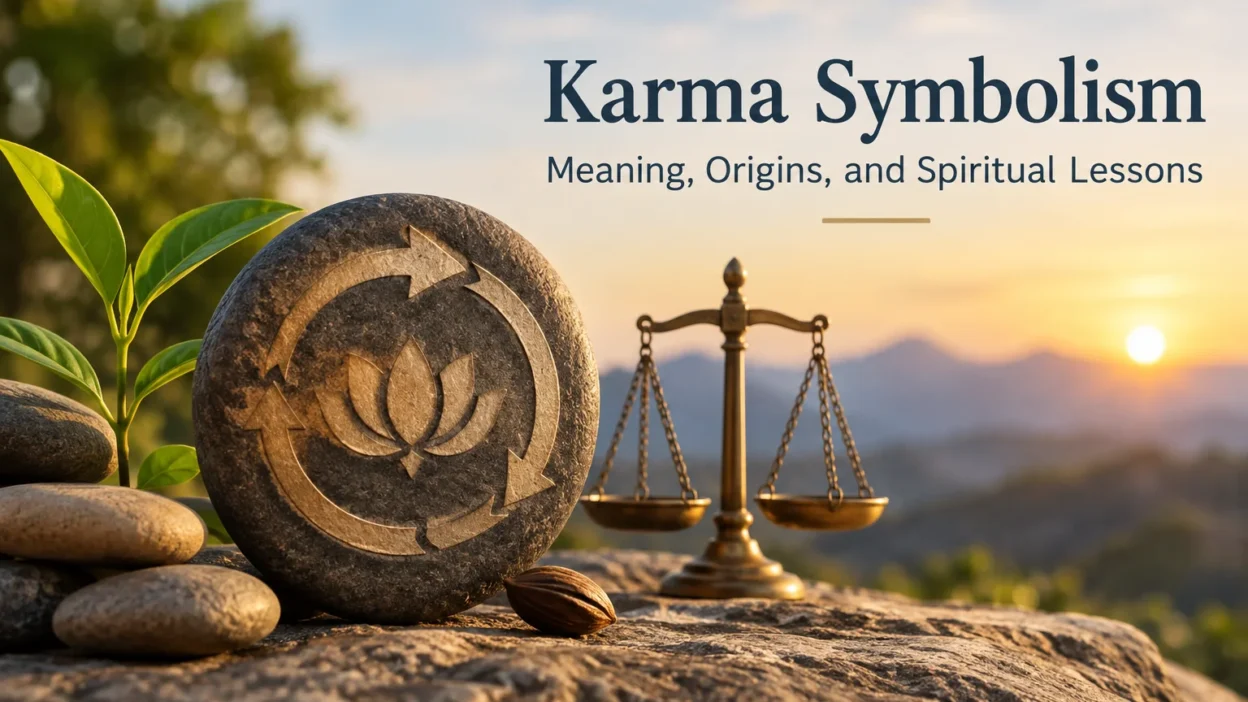
Karma symbolism represents the connection between actions and consequences. In the United States, people often associate karma with fairness, personal responsibility, and the idea that what you do eventually comes back to you. The concept appears in everyday conversations, spiritual practices, tattoos, social media posts, and popular sayings about justice.
However, karma has a deeper meaning than simply getting rewarded for good behavior or punished for bad choices. It originated in ancient Indian religious and philosophical traditions, where it became closely connected to action, intention, moral responsibility, and the cycle of rebirth. Different traditions explain these ideas in distinct ways.
Today, karma offers a way to think about how our choices affect ourselves and others. It can encourage kindness, patience, and self-reflection. At the same time, misunderstandings can turn karma into an oversimplified explanation for suffering or success. Understanding its symbolism helps reveal why this ancient concept remains meaningful in modern American culture.
Quick Answer
Karma symbolism in the United States commonly represents cause and effect, personal responsibility, fairness, and the belief that actions have consequences. In Hinduism, Buddhism, and Jainism, karma has distinct meanings involving action, intention, moral consequences, and spiritual development.
TL;DR
- Karma symbolizes cause and effect, accountability, and the consequences of actions.
- Its roots lie in ancient Indian religious and philosophical traditions.
- American popular culture often connects karma with fairness and poetic justice.
- Spiritual traditions understand karma more deeply than simple rewards and punishments.
- Karma tattoos and online expressions often represent personal growth and moral responsibility.
- Karma doesn’t mean every hardship is deserved or every good deed earns a reward.
What Does Karma Symbolize?
Karma is a concept about action and consequence, but its symbolism extends beyond everyday cause and effect. For American readers, it often provides a simple way to discuss fairness, character, and the lasting effects of personal choices.
The Core Meaning of Karma
The word karma comes from Sanskrit and broadly means action or deed. In religious and philosophical contexts, it can describe how actions, intentions, and choices produce consequences.
Karma is often represented symbolically through cycles, paths, scales, seeds, and returning objects. These images help people understand an idea that has no single universal symbol.
Three meanings appear especially often in modern interpretations:
- Cause and effect: Actions influence what happens afterward.
- Accountability: People must consider the consequences of their choices.
- Moral balance: Ethical behavior matters, even when results aren’t immediate.
Why Karma Matters Today
Karma gives people a framework for thinking about their behavior. For example, someone who repeatedly treats friends with respect may build stronger, more trusting relationships.
However, everyday consequences aren’t the same as spiritual karma in every tradition. The distinction matters because karma can describe both a practical lesson and a much deeper religious belief.
The Historical Origins of Karma
Karma symbolism developed over centuries in South Asia. Its history is important because modern Western interpretations often simplify a concept with deep religious and philosophical roots.
Ancient Indian Roots
The earliest Vedic texts contain discussions of ritual action and its consequences. Over time, ideas about karma developed further in the Upanishads, ancient philosophical texts that explored the self, moral action, death, and rebirth.
Karma gradually became connected with the belief that actions could influence a person’s future beyond a single lifetime. Different Indian traditions developed their own explanations of how this process works.
Rather than beginning as a modern slogan about getting what you deserve, karma emerged within broader questions about life, ethical conduct, spiritual knowledge, and liberation.
Karma in Hinduism, Buddhism, and Jainism
Karma plays an important role in Hinduism, Buddhism, and Jainism, although each tradition understands it differently.
In many Hindu traditions, karma connects actions with consequences across lifetimes and the cycle of rebirth. Some schools emphasize duty, intention, devotion, or knowledge as part of spiritual development.
Buddhist teachings place particular importance on intention. Actions shaped by greed, hatred, or ignorance can contribute to suffering, while skillful intentions support a path toward liberation.
Jainism presents a distinctive understanding in which karma is associated with subtle matter that binds to the soul. Ethical conduct, nonviolence, and spiritual discipline help a person work toward freedom from karmic bondage.
These differences show why karma shouldn’t be treated as one identical doctrine shared by every religion.
The Symbolism of Karma in American Culture
In the United States, karma is widely understood through the language of fairness, accountability, and consequences. Its popular meaning reflects a blend of spiritual ideas, personal ethics, entertainment, and everyday social experiences.
Karma and the American Idea of Fairness
American culture often celebrates personal responsibility. People are encouraged to consider their decisions, accept consequences, and learn from mistakes.
Karma fits naturally into these conversations because it suggests that behavior matters. Someone who lies to coworkers might eventually lose their trust, while someone who consistently helps others may develop lasting friendships.
However, these outcomes don’t always follow a predictable pattern. Karma’s popular appeal often comes from the hope that fairness will eventually emerge, even when immediate circumstances seem unjust.
Karma in Everyday American Language
People frequently use karma to explain surprising reversals of fortune. A driver who cuts in line and then misses an important turn might become the subject of a joke about karma.
Social media has strengthened this casual meaning through short videos, reaction posts, and stories about people facing the consequences of their behavior. In these settings, karma often means poetic justice rather than a detailed religious teaching.
The idea can encourage accountability, but it can also become a way to celebrate another person’s embarrassment. Context determines whether the expression communicates a thoughtful lesson or simply mocks someone’s misfortune.
The Spiritual Meaning of Karma
Karma’s spiritual symbolism concerns the relationship between actions, intentions, and personal development. For many believers, it offers a way to understand moral responsibility within a larger view of existence.
Karma and the Cycle of Rebirth
In several Indian religious traditions, karma is connected with samsara, the cycle of birth, death, and rebirth. Actions can influence the conditions of future existence, although the precise explanation varies by tradition.
Within this framework, karma extends beyond immediate rewards and punishments. It becomes part of a person’s spiritual journey and the search for liberation from the cycle of rebirth.
Karma as a Path Toward Growth
Karma can also symbolize the importance of examining one’s intentions. A person may ask whether a choice comes from compassion, fear, jealousy, generosity, or selfishness.
This perspective shifts attention away from judging other people. Instead, it encourages individuals to develop awareness and act with greater care.
However, spiritual growth doesn’t always mean avoiding every difficulty. Many traditions emphasize wisdom, discipline, and freedom from harmful attachments rather than a life without challenges.
Karma Symbolism Across Different Cultures and Religions
Although karma originated in South Asian traditions, related ideas about moral consequences appear in many societies. These similarities can be useful comparisons, but they don’t make different beliefs identical.
Hinduism, Buddhism, and Jainism
Each tradition offers a distinctive understanding of karma.
- Hindu traditions often connect karma with duty, rebirth, and spiritual liberation.
- Buddhist teachings emphasize intention and how actions contribute to suffering or its reduction.
- Jain teachings connect karma with bondage of the soul and the pursuit of liberation.
These traditions contain diverse schools and interpretations. Their teachings shouldn’t be reduced to a single rule that good actions always produce immediate rewards.
Similar Ideas in Other Traditions
American readers may compare karma with familiar sayings about reaping what one sows. Christianity, for example, contains teachings about moral responsibility, actions, and their consequences, although Christian theology doesn’t simply equate these teachings with karma.
Other cultures also have stories about pride, generosity, dishonesty, and justice eventually producing consequences. Such stories reflect a widespread human interest in moral order.
Nevertheless, similar themes don’t prove that all traditions share the same beliefs about the afterlife, destiny, or how consequences unfold.
Common Symbols Associated With Karma
Karma doesn’t have one universally recognized visual emblem. Instead, artists and spiritual practitioners use different images to communicate its meanings.
The Circle and the Wheel
Circles and wheels often represent cycles, continuity, and the repeated effects of actions. In spiritual artwork, a wheel may also evoke broader ideas about existence and liberation.
However, the Buddhist Wheel of Dharma is a specific religious symbol associated with the Buddha’s teachings. It shouldn’t be treated as a generic karma logo.
Seeds, Scales, and Returning Objects
Seeds suggest that small actions can produce results over time. A seed may remain hidden before eventually growing into a plant, much like the consequences of a decision may not appear immediately.
Scales suggest fairness, while a returning object represents the popular idea that actions come back to their source. These images are useful artistic metaphors, not universal religious symbols of karma.
| Symbol | Common Meaning | Modern Use | Important Distinction |
| Circle | Cycles and continuity | Jewelry and illustrations | Not exclusive to karma |
| Seed | Growth and future consequences | Art and personal reminders | A metaphor rather than a formal emblem |
| Scales | Fairness and accountability | Posters and decorative art | Also associated with justice and law |
| Returning arrow | Actions coming back | Tattoos and digital graphics | A modern visual interpretation |
| Wheel | Cycles and spiritual teachings | Religious and contemplative art | Meaning depends on the specific tradition |
Choosing a Karma-Inspired Image
People who want a visual reminder of karma often choose imagery that reflects their personal values. A seed might represent patience, while a circle could suggest continuity and self-reflection.
For a religious design, understanding the symbol’s original context is important. This helps distinguish a meaningful traditional image from a decorative design created for general audiences.
The Psychological Meaning of Karma
Karma can influence how people think about their behavior, relationships, and sense of fairness. Psychologically, its symbolism often reflects a desire to believe that choices matter and that life has some moral order.
Accountability and Personal Control
Thinking about karma can encourage people to take responsibility for their decisions. Instead of blaming every problem on outside forces, they may consider how their own actions affect their circumstances.
For example, someone who repeatedly breaks promises might recognize why others have stopped relying on them. This understanding can support more honest behavior in the future.
However, personal responsibility has limits. People don’t control every event, and many outcomes depend on circumstances beyond their influence.
The Desire for Justice
Karma can offer emotional comfort when someone experiences unfair treatment. Believing that harmful actions have consequences may help a person feel that injustice won’t remain unanswered forever.
Yet this belief can become harmful when it leads people to assume that every victim must have done something wrong. Suffering can result from accidents, illness, discrimination, violence, and many other circumstances unrelated to personal wrongdoing.
A balanced understanding of karma encourages ethical action without turning other people’s pain into evidence of moral failure.
Karma in Tattoos, Jewelry, and Personal Identity
Karma-inspired designs have become part of modern self-expression. In the United States, people may choose them to represent personal growth, spiritual interest, resilience, or a commitment to treating others well.
Karma Tattoo Meanings
A karma tattoo can express a personal belief that actions matter. Some designs use lettering, while others rely on circles, seeds, wheels, or imagery that suggests movement and return.
Common motivations include:
- Remembering to act with kindness and integrity.
- Marking a period of personal change or recovery.
- Expressing interest in Eastern philosophy or spirituality.
- Emphasizing accountability and the consequences of choices.
- Representing patience during uncertain periods of life.
A tattoo’s meaning ultimately depends on its wearer. The same design may express a religious commitment for one person and a general life philosophy for another.
Jewelry, Clothing, and Home Decor
Karma appears on necklaces, bracelets, clothing, journals, wall art, and other personal items. These objects can serve as reminders to pause before reacting or making a difficult choice.
However, a product labeled with the word karma doesn’t automatically carry traditional religious meaning. Some designs are primarily decorative, while others are connected to a person’s spiritual practice.
Karma on Social Media and in Popular Culture
Online culture has made karma a familiar word in American conversations about behavior and justice. Short videos and viral stories often present it as an unexpected consequence that arrives at exactly the right moment.
Instant Karma and Viral Stories
The phrase instant karma usually describes a quick reversal of fortune. For example, a person who behaves rudely might immediately experience an embarrassing mishap.
These stories can be entertaining because they create a satisfying connection between wrongdoing and consequence. However, a coincidental event doesn’t prove that a spiritual law caused it.
Karma as a Digital Expression
People use karma-related captions and comments to express approval, frustration, or amusement. Sometimes, the word encourages reflection about fairness and responsibility.
At other times, it becomes a label used to celebrate someone’s suffering. A more thoughtful approach distinguishes accountability from cruelty and avoids assuming that a person’s misfortune reveals their moral character.
Misunderstandings and Controversies About Karma
Karma’s popularity has helped spread its message, but it has also produced oversimplified interpretations. These misunderstandings matter because they can affect how people judge themselves and others.
Does Karma Always Punish Bad People?
No. Karma shouldn’t be understood as a guaranteed system in which every wrongdoer immediately suffers and every kind person receives a reward.
Religious explanations of karma are more complex, particularly when they involve intention, rebirth, and spiritual liberation. Even within those traditions, karma isn’t always described through the simple reward-and-punishment model popular in Western entertainment.
Blaming People for Their Suffering
One serious misuse occurs when people claim that someone deserves hardship because of bad karma. This can be especially damaging when directed toward people experiencing poverty, illness, abuse, or other forms of suffering.
Such judgments assume knowledge that an observer doesn’t possess. They can also ignore social conditions, chance, and the harmful actions of others.
A respectful understanding of karma shouldn’t become an excuse to withhold compassion. Helping someone who suffers can be a meaningful expression of kindness, regardless of one’s beliefs about why the hardship occurred.
Commercialization and Cultural Context
Karma is frequently used to sell jewelry, clothing, and lifestyle products. Commercial use isn’t automatically disrespectful, but it can strip a complex religious concept of its original meaning.
The same concern applies when specific religious symbols are used without understanding their context. Learning about a tradition helps people engage with its ideas more thoughtfully.
How Karma’s Meaning Has Changed Over Time
Karma’s meaning has evolved as it moved across languages, religions, and cultural settings. Its modern American interpretation is only one part of a much longer history.
From Religious Philosophy to Popular Expression
In ancient Indian traditions, karma developed within discussions of action, ethics, rebirth, and liberation. These teachings became central to several religious and philosophical systems.
As South Asian religious ideas spread internationally, karma entered new cultural conversations. In modern Western settings, it increasingly became associated with personal responsibility, moral balance, and the expectation that actions eventually return to their source.
This shift made the concept accessible to people unfamiliar with its religious background. However, it also encouraged simplified explanations that overlook important differences among traditions.
Read More: Destiny Symbolism: Meaning, History, and Signs of Fate
Traditional and Modern Meanings Compared
The following comparison shows how karma can carry different meanings depending on its context.
| Context | Understanding of Karma | Main Emphasis |
| Ancient Indian philosophy | Action and its consequences | Ethics and spiritual questions |
| Hindu traditions | Karma within varied teachings about duty and rebirth | Spiritual development |
| Buddhist traditions | Intentional action and its consequences | Suffering and liberation |
| Jain traditions | Karma connected with bondage of the soul | Ethical discipline and liberation |
| Modern American culture | Actions eventually coming back to a person | Fairness and accountability |
These categories are broad summaries, not complete descriptions of each tradition. Modern spiritual communities also vary in how they interpret and practice karma.
How to Apply Karma’s Lessons in Everyday Life
Karma can be a useful reminder to think carefully about choices. For people who approach it as a spiritual belief or a general life principle, its practical value often lies in encouraging ethical behavior.
Practice Intention and Accountability
Before making a difficult decision, consider why you’re making it and whom it might affect. A choice that benefits you immediately may still damage trust or cause unnecessary harm.
When you make a mistake, acknowledge it and take reasonable steps to repair the damage. Personal growth comes from recognizing behavior and changing it, not simply waiting for life to deliver a consequence.
Focus on What You Can Control
You can’t control every result, but you can often influence your actions, responses, and treatment of other people.
- Practice honesty even when telling the truth feels uncomfortable.
- Offer help without expecting a guaranteed reward.
- Accept responsibility when your choices hurt someone.
- Avoid assuming that another person’s hardship is deserved.
- Learn from mistakes instead of repeating harmful patterns.
These practices don’t guarantee an easy life. Instead, they encourage integrity and compassion regardless of what happens next.
FAQs
What Is the Main Symbol of Karma?
Karma has no single universal symbol. Circles, wheels, seeds, and returning objects are commonly used to represent cycles, growth, and the consequences of actions.
What Does Karma Mean Spiritually?
Spiritually, karma often concerns how actions and intentions influence future experiences. In Hinduism, Buddhism, and Jainism, its meaning differs according to each tradition’s teachings about rebirth, ethics, and liberation.
Is Karma a Religious Belief?
Karma is an important concept in Hinduism, Buddhism, and Jainism, among other Indian philosophical traditions. Many people also use the word in a nonreligious way to describe personal responsibility and cause and effect.
Does Karma Mean What Goes Around Comes Around?
That phrase expresses a popular interpretation of karma, especially in American culture. However, traditional teachings can involve much more than immediate consequences or the expectation that wrongdoing will always be punished.
What Does a Karma Tattoo Symbolize?
A karma tattoo may represent accountability, kindness, personal growth, or spiritual interest. Its meaning depends on the design, the wearer’s beliefs, and the personal experience behind the choice.
Can Karma Be Both Positive and Negative?
Karma is often discussed in terms of beneficial and harmful actions and their consequences. However, the precise meaning varies across religious traditions, so it isn’t always accurate to describe karma simply as a positive or negative force.
Conclusion
Karma symbolism represents the relationship between actions, intentions, and consequences. In the United States, it often expresses fairness, personal accountability, and the hope that behavior matters in the long run. Its deeper roots, however, reveal a complex concept shaped by centuries of Indian religious and philosophical thought. Understanding karma means looking beyond the popular idea that every person automatically gets what they deserve. It invites reflection on how we treat others, how we respond to mistakes, and how our choices influence the world around us. Whether you encounter karma in spiritual teachings, a tattoo, or an everyday conversation, consider what it encourages you to do. A thoughtful approach begins with acting responsibly, practicing compassion, and remembering that other people’s struggles deserve understanding rather than judgment.