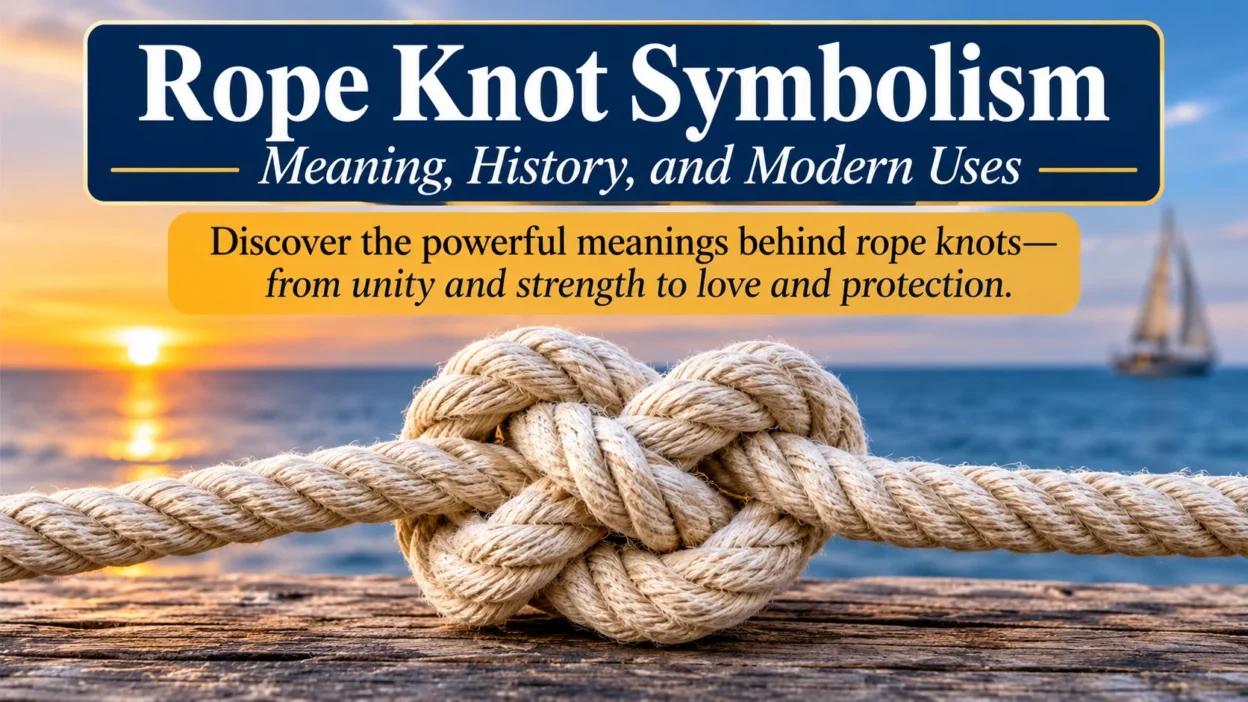
Rope knot symbolism explores how a simple knot can represent unity, strength, commitment, and the bonds that connect people. A knot forms when a rope loops, crosses, or tightens around itself. Although its practical purpose is to hold things together, its symbolic meaning often reaches far beyond its physical function.
In 2026, knots appear in friendship bracelets, nautical traditions, wedding ceremonies, outdoor activities, tattoos, and decorative crafts. They can represent relationships that endure hardship, promises that hold firm, or challenges that require patience to untangle. However, a knot can also suggest restriction, confusion, and the feeling of being trapped.
The meaning depends on the type of knot, its setting, and the person interpreting it. For example, a decorative love knot may suggest lasting affection, while a sailor’s knot can symbolize skill, reliability, and trust. Understanding these different interpretations reveals why knots remain powerful symbols in everyday American life.
Quick Answer
Rope knot symbolism in the United States most commonly represents unity, strength, loyalty, commitment, and resilience. More broadly, knots can symbolize spiritual connection, protection, interconnectedness, or complicated situations that require patience to resolve.
TL;DR
- Knots often represent relationships, loyalty, and lasting connections.
- Strong knots symbolize resilience, reliability, and the ability to endure pressure.
- Ancient knot designs appeared in art, practical crafts, and religious traditions.
- American sailors and outdoor communities associate knots with skill and trust.
- Love knots and decorative knots can express commitment and enduring affection.
- Tangled ropes may represent confusion, restriction, or unresolved problems.
What Does a Rope Knot Symbolize?
A rope knot transforms a flexible strand into something secure and purposeful. Symbolically, this transformation can represent how separate people, ideas, or experiences become connected.
In American culture, knots often carry positive meanings when they hold things together. However, their symbolism changes when they become tangled, difficult to loosen, or impossible to escape.
Core Symbolic Meanings
Several central ideas appear repeatedly in interpretations of rope knots:
- Unity: Separate strands become connected through a shared structure.
- Strength: A properly tied knot represents stability under pressure.
- Commitment: A secured knot can symbolize a promise that someone intends to keep.
- Protection: Knots can hold, secure, and safeguard something valuable.
- Complexity: Interwoven strands may represent difficult emotions or complicated relationships.
- Restriction: A tight knot can suggest limitations, obligations, or a loss of freedom.
These meanings aren’t universal rules. Instead, they offer a starting point for understanding how people use knots to express personal values and experiences.
Why the Type of Knot Matters
Not every knot communicates the same message. A loop that joins two ends may suggest connection, while a complicated tangle can represent uncertainty.
Likewise, a decorative knot designed without visible beginnings or endings may evoke continuity. A practical knot securing a boat, however, usually communicates dependability before anything else.
Historical Origins of Knot Symbolism
Knots existed long before modern rope-making industries, recreational boating, or decorative crafts. Early communities used twisted fibers, plant materials, animal sinew, and other flexible materials to bind objects and construct useful tools.
Because knots helped people survive, work, travel, and preserve possessions, they naturally became associated with control, security, and human cooperation. Their symbolic meanings developed alongside their practical importance.
Ancient Uses of Knots
In ancient societies, cords and knots served many purposes, including fastening clothing, securing loads, making nets, and organizing information. Some communities also incorporated knotted cords into ceremonial practices and systems of recordkeeping.
The ancient Inca, for example, used a system called khipu, which relied on knotted cords to record information. This demonstrates that knots could communicate organized knowledge rather than merely hold physical objects together.
However, not every historical knot had a spiritual meaning. Many existed primarily because people needed reliable ways to connect materials.
Knots in Ancient Art and Myth
Knot-like patterns appeared in decorative designs across different regions. Their interwoven forms offered artists a way to create repeating shapes, visual movement, and intricate borders.
Greek mythology also includes the famous Gordian knot, associated with a difficult problem that Alexander the Great was said to have resolved by cutting through it. Over time, the story became a metaphor for a challenge that requires an unconventional solution.
This tradition helped establish the connection between knots and complicated problems. Today, people still describe difficult situations as knots that need to be untangled.
Rope Knot Symbolism in American Culture
In the United States, knots have strong associations with practical skill, personal relationships, and the outdoors. Their meanings often come from familiar activities rather than formal religious teachings.
Sailing, camping, fishing, scouting, and crafts all involve knots that must perform reliably. As a result, American interpretations frequently connect them with preparation, responsibility, and trust.
Nautical Traditions and American Identity
Knots have an important place in American maritime culture. Sailors use different knots to secure lines, fasten equipment, and manage ropes safely aboard vessels.
This practical background gives nautical knots symbolic associations with experience, discipline, and dependability. A person who knows how to tie a reliable knot demonstrates patience and competence.
Knots can also evoke adventure, independence, and life near the sea. In coastal communities, nautical decorations featuring ropes and knots often reflect an appreciation for maritime history.
Knots in Everyday American Life
Outside maritime settings, knots appear in familiar moments that give them emotional significance.
- Wedding ceremonies may use knot imagery to represent two lives joining together.
- Friendship bracelets use tied cords to express affection and shared memories.
- Camping equipment relies on knots that represent preparation and practical knowledge.
- Handmade gifts can include decorative knots as signs of care and attention.
- Family crafts may use interwoven cords to represent belonging and shared identity.
These examples show how an ordinary object can acquire meaning through repeated use. In many cases, the relationship or memory attached to a knot matters more than its precise design.
Spiritual Meaning of Rope Knots
Spiritually, a knot can represent the connection between people, the relationship between the visible and invisible worlds, or the bonds that shape a person’s life. Its interwoven structure makes it a natural image for ideas that involve unity and continuity.
However, there isn’t one spiritual interpretation shared by every tradition. The meaning depends on the design, historical setting, and beliefs of the people using it.
Connection and Interdependence
A knot requires its strands to interact. This makes it a useful symbol for relationships in which different individuals contribute to a larger whole.
Some people interpret this structure as a reminder that actions affect others. A decision made by one person can influence a family, community, or friendship, much like changing one part of a knotted rope can affect its structure.
Protection and Intention
In some folk traditions, cords and knots have been used in protective or ceremonial practices. A tied object may hold personal significance because someone connects it with a prayer, intention, blessing, or promise.
Modern spiritual practitioners may also use knot imagery when reflecting on boundaries, personal goals, or emotional commitments. Still, a knot doesn’t have an objectively established supernatural power simply because someone assigns it spiritual meaning.
For many people, its value lies in the intention and remembrance associated with the object.
Cross-Cultural Meanings of Knots
Knots appear in numerous cultural traditions, but similar shapes don’t always carry identical meanings. Understanding their context helps avoid treating all knot designs as interchangeable.
The Celtic Knot
Celtic knotwork is widely recognized for its interwoven lines and repeating patterns. These designs appear in historical manuscripts, metalwork, stone carvings, and other forms of art associated with Celtic cultural history.
Today, many people interpret Celtic knots as symbols of eternity, continuity, loyalty, or interconnected life. However, specific meanings aren’t always documented for individual ancient designs, so modern interpretations should be distinguished from established historical evidence.
In the United States, Celtic-inspired knots are popular in jewelry, tattoos, and decorative art. Some people choose them to express family heritage, while others appreciate their visual complexity.
Knots in Buddhist and Other Asian Traditions
The endless knot, commonly associated with Tibetan Buddhism, is one of the best-known examples of a spiritually meaningful knot design. It is often interpreted in relation to interconnectedness, the relationship between wisdom and compassion, and the continuing nature of causes and effects.
Knot-like motifs also appear in Chinese decorative traditions, where particular forms can be associated with good fortune, longevity, prosperity, or lasting relationships. Their meanings depend on the design and cultural setting.
These traditions shouldn’t be reduced to a single general meaning. A knot used in a Buddhist religious setting, for example, may carry a specific significance that differs from a decorative knot used at a celebration.
Emotional and Psychological Meaning of Rope Knots
Knots can communicate emotional ideas because people understand what it feels like to tighten, secure, loosen, or untangle something. These physical experiences provide familiar comparisons for relationships and personal challenges.
As a result, knot symbolism can express both reassurance and frustration. The surrounding context determines which feeling becomes strongest.
Security, Trust, and Belonging
A securely tied knot can evoke the comfort of knowing something won’t easily come apart. In relationships, this image may represent loyalty, emotional stability, and mutual support.
For example, a couple might choose a knot design because they see their relationship as something built through shared effort. The symbol doesn’t promise that a relationship will never change, but it can express a desire to remain connected through change.
Confusion, Pressure, and Emotional Tension
A tangled knot creates a different emotional response. It can suggest a problem that feels difficult to understand or a situation in which every solution seems to create another complication.
Common psychological associations include:
- Security: Feeling supported by dependable people or routines.
- Commitment: Accepting responsibility for a promise or relationship.
- Frustration: Facing a problem that resists simple solutions.
- Resilience: Maintaining stability during challenging circumstances.
- Restriction: Feeling limited by expectations, obligations, or circumstances.
These are symbolic associations, not psychological diagnoses. A person’s personal history can make a knot feel comforting, frustrating, or meaningful in ways that differ from common interpretations.
Different Types of Knots and Their Symbolism
The form of a knot can influence what it communicates. Some designs emphasize connection, while others highlight stability, repetition, or complexity.
In the United States, many people encounter knot types through maritime activities, crafts, jewelry, and decorative art. The following examples illustrate common associations without suggesting that every design has one fixed meaning.
Symbolism by Knot Type
| Knot or Design | Common Symbolic Meaning | Typical Context |
|---|---|---|
| Love knot | Affection, loyalty, lasting commitment | Jewelry and romantic gifts |
| Celtic knot | Continuity, connection, heritage | Tattoos and decorative art |
| Endless knot | Interdependence and continuity | Buddhist art and spiritual imagery |
| Bowline knot | Reliability and security | Sailing and outdoor activities |
| Square knot | Joining, cooperation, practical connection | Crafts and ropework |
| Tangled knot | Confusion, obstacles, emotional complexity | Art and figurative language |
These interpretations reflect common associations rather than universal definitions. For instance, a square knot is a practical fastening method, and its symbolic meaning depends largely on how someone uses it.
Why Shape and Material Matter
The appearance of a knot can strengthen its message. A neat, symmetrical knot may suggest order, while loose or tangled strands can communicate uncertainty.
Material also influences interpretation. Rough natural rope may evoke labor, tradition, and outdoor life, while a fine gold chain arranged in a knot may suggest elegance and enduring affection.
Color adds another layer. Red cords may suggest love or vitality in some settings, while white cords can evoke simplicity or purity in certain traditions. These meanings vary, so color alone rarely explains the entire symbol.
Rope Knot Symbolism in Love and Relationships
Knots are especially meaningful in romantic relationships because they can represent two lives becoming connected. Their structure suggests that a relationship requires both individual strands and the connections between them.
In American culture, knot imagery appears in engagement jewelry, wedding gifts, anniversary decorations, and handmade keepsakes. The design can communicate commitment without requiring a written message.
The Meaning of a Love Knot
A love knot typically features interwoven loops that appear connected or difficult to separate. Its visual structure makes it a natural expression of affection that continues over time.
Some people choose love-knot jewelry to celebrate a relationship, while others use it to honor a friendship or family bond. Its meaning comes from the relationship it represents rather than from a guaranteed traditional interpretation.
Knots and Marriage
The phrase “tying the knot” is a familiar American expression for getting married. It connects marriage with the idea of joining two people through a lasting commitment.
The phrase has historical connections to the broader use of binding and joining as images of union. However, it doesn’t establish that every wedding knot ritual has the same origin.
Today, couples may include actual cords or knot-tying ceremonies in their weddings. Others simply choose knot-shaped rings or decorations as a quiet reminder of their commitment.
Rope Knots in Tattoos, Jewelry, and Home Decor
Knot designs remain popular because they are visually adaptable. A small, simple knot can carry personal meaning, while a complex interwoven pattern can become a detailed work of art.
In the United States, these designs appear across fashion, home decoration, personal accessories, and body art. Their flexibility allows people to connect a familiar shape with a particular memory or value.
Knot Tattoos
A knot tattoo can express loyalty, perseverance, family connection, or a relationship that changed someone’s life. Celtic-inspired designs may also communicate an interest in heritage or traditional artwork.
Some people choose an untied or partially loosened knot to represent freedom from a difficult period. Others prefer a tight, closed design because it suggests continuity.
Before choosing a culturally specific knot, it’s helpful to understand its history. This is especially important when a design has religious or cultural importance beyond its decorative appearance.
Jewelry and Decorative Objects
Knot-shaped rings, necklaces, bracelets, and pendants often symbolize connection or lasting affection. Their compact form makes them suitable for everyday wear and meaningful gifts.
At home, decorative rope knots may create a nautical atmosphere or suggest craftsmanship and simplicity. Macramé wall hangings, woven plant holders, and knotted textiles also highlight the beauty of interconnected strands.
On social media, knot imagery can accompany messages about friendship, relationships, perseverance, or personal growth. However, a knot emoji or photograph doesn’t have one universally accepted meaning.
Negative Meanings and Misunderstandings
Although knots often represent unity and stability, they can also symbolize entrapment, conflict, and the difficulty of breaking free. Recognizing these negative meanings creates a more complete understanding of the symbol.
The same knot can communicate security to one person and restriction to another. Its meaning depends on whether the connection feels supportive or forced.
When a Knot Represents Restriction
A tightly bound rope may suggest a lack of freedom. In literature and visual art, knots can represent obligations that have become overwhelming or relationships that are difficult to leave.
The expression “tied up in knots” commonly describes anxiety, confusion, or intense worry. Likewise, “getting tangled up” in a problem suggests becoming involved in complications that are hard to resolve.
These expressions demonstrate how knot symbolism works in everyday American English. The physical difficulty of loosening a knot becomes a metaphor for emotional or practical challenges.
Cultural Appropriation and Historical Confusion
Some knot designs have specific cultural, spiritual, or religious associations. Using them as decoration isn’t automatically disrespectful, but presenting them inaccurately can erase their history or misrepresent their meaning.
Celtic knotwork, Buddhist endless knots, and Chinese decorative knots come from different traditions. They shouldn’t be treated as identical simply because their lines appear interwoven.
It’s also important not to assume that every old knot carries hidden spiritual power. Many patterns developed through practical craft, artistic experimentation, or decoration, and their original meanings may be uncertain.
How Rope Knot Symbolism Has Changed Over Time
The symbolism of knots has developed alongside changes in technology, culture, and daily life. Their earliest importance came largely from practical needs, but repeated use in relationships, art, and storytelling gave them wider meanings.
Today, people can appreciate knots as useful tools and as personal symbols at the same time. This combination helps explain their lasting appeal.
From Practical Tool to Symbol
Historically, knots helped people bind materials, secure objects, construct equipment, and organize information. Their reliability made them natural symbols of strength and control.
Over time, knot designs also appeared in ceremonial objects, decorative arts, and stories about relationships or difficult challenges. The Gordian knot, for example, helped establish the idea of a knot as a problem requiring an unusual solution.
Read More: Bridge Crossing Symbolism: Meaning, History, and Spiritual Significance
Modern Interpretations
Contemporary meanings often focus on personal choice and identity. A knot may represent a marriage, a family connection, a spiritual belief, or the determination to overcome hardship.
At the same time, older meanings haven’t disappeared. Sailors still value practical knot knowledge, and traditional knotwork remains important in many artistic and cultural settings.
The biggest change is that modern individuals can select knot designs for highly personal reasons. A symbol once used mainly for practical work can now serve as a reminder of a promise, a memory, or a life lesson.
FAQs
What does a rope knot symbolize spiritually?
A rope knot can symbolize connection, continuity, protection, or the relationship between different parts of life. Its spiritual meaning depends on the tradition and the intention associated with it.
Does a knot symbolize love?
Yes, knots often represent love, loyalty, and lasting commitment. Love knots are especially popular in jewelry and gifts because their interwoven forms suggest a relationship that holds together over time.
What does tying the knot mean?
In American English, “tying the knot” means getting married. The expression uses the image of joining things together to describe two people entering a committed relationship.
What does a tangled knot symbolize?
A tangled knot commonly represents confusion, emotional tension, or a complicated problem. However, it can also suggest that patience and careful effort may help someone find a solution.
What does a Celtic knot mean?
Celtic knotwork is often interpreted today as a symbol of continuity, interconnectedness, loyalty, or heritage. However, the original meaning of a particular historical design may be uncertain, and modern interpretations don’t always reflect documented ancient beliefs.
Are knots considered symbols of protection?
Knots can symbolize protection because they secure objects and keep things together. Some traditions also use knotted cords in protective practices, although beliefs about their spiritual effects vary.
Conclusion
Rope knot symbolism connects practical strength with emotional and spiritual meaning. In the United States, knots commonly represent unity, loyalty, commitment, reliability, and the ability to endure difficult circumstances. Their tangled forms can also express confusion, pressure, or the challenge of finding a way forward. From nautical traditions and wedding expressions to tattoos, jewelry, and decorative crafts, knots continue to give visible form to ideas about human connection. Their meanings aren’t fixed, and the same design can express different feelings in different situations. When you encounter a knot, consider its shape, setting, and purpose. You may discover that it represents a promise worth keeping, a connection worth protecting, or a problem that needs time and patience to untangle.