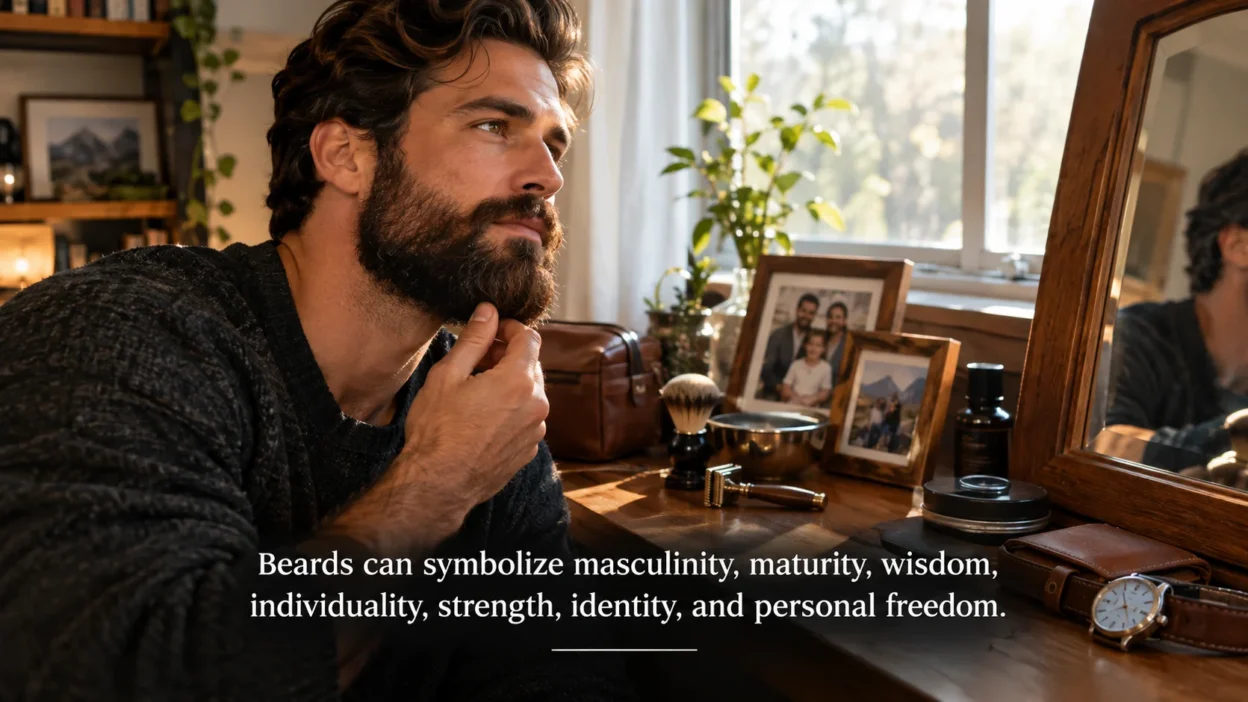
Beard symbolism explores the meanings people attach to facial hair. A beard can suggest maturity, masculinity, wisdom, strength, individuality, or independence, depending on its style and setting.
In 2026, beards have moved through many cultural phases. They have appeared on presidents, soldiers, artists, workers, religious figures, actors, and everyday men. As a result, a beard can communicate very different things to different people.
Today, facial hair is also deeply connected to personal style. A carefully shaped beard may signal grooming and confidence, while a long natural beard may suggest independence or a rejection of strict fashion rules.
Quick Answer
Beard Symbolism in the USA commonly represents masculinity, maturity, individuality, strength, and personal expression. Across history, beards have also been connected with wisdom, authority, spirituality, adulthood, and social status.
TL;DR
- Beards have long represented adulthood, masculinity, and maturity.
- American culture has linked beards with independence and individuality.
- Ancient societies sometimes connected facial hair with wisdom and authority.
- Religious traditions have given beards different spiritual meanings.
- Modern beards can express fashion, identity, confidence, or personal freedom.
- Meaning depends strongly on grooming, context, culture, and individual choice.
What Does a Beard Symbolize?
A beard is more than facial hair when people interpret it symbolically. Its meaning often comes from appearance, age, culture, and the setting where it appears.
For an American reader, the same beard can communicate several ideas at once. A short, carefully trimmed beard may feel professional, while a large natural beard may suggest a more rugged identity.
Common Symbolic Meanings
Beards are often associated with:
- Maturity and the transition into adulthood
- Masculinity and traditional male identity
- Wisdom through age and experience
- Strength and ruggedness
- Independence from changing fashion standards
- Individuality through personal grooming choices
However, these associations aren’t universal. A person’s beard doesn’t automatically reveal their personality, beliefs, or values.
Ancient Roots of Beard Symbolism
Facial hair has carried symbolic meaning for thousands of years. Ancient societies often connected a full beard with adult male status, authority, strength, or wisdom.
Beards in Ancient Civilizations
In ancient Mesopotamia, Egypt, Greece, and Rome, facial hair appeared in different forms. Art and sculpture sometimes used beards to distinguish gods, rulers, philosophers, warriors, and older men.
Greek philosophers were frequently portrayed with beards. Their appearance helped create a lasting connection between facial hair and intellectual authority.
However, ancient grooming practices varied greatly. Some societies valued shaving, while others celebrated elaborate facial hair.
Mythology and Archetypes
The bearded elder became a recurring visual pattern in mythology and storytelling. Older male gods and wise figures were often shown with substantial facial hair.
This helped establish a familiar archetype: the beard as a visible sign of experience. Modern fictional wizards, sages, kings, and mentors often continue this tradition.
Beard Symbolism in American Culture
American meanings developed from several traditions rather than one single source. European customs, religious practices, frontier culture, military history, and modern entertainment all influenced how Americans view facial hair.
The American Frontier Image
During the nineteenth century, beards became strongly connected with the rugged frontier image. Photographs and illustrations often showed explorers, settlers, soldiers, and outdoorsmen with substantial facial hair.
As a result, the beard became associated with self-reliance and physical toughness. This image still appears in modern advertising, outdoor culture, and entertainment.
Presidents and Public Figures
Beards have also appeared in American political history. Several nineteenth-century U.S. presidents wore facial hair, including Abraham Lincoln, whose beard became part of his instantly recognizable public image.
Yet clean-shaven styles later became more common among American leaders. This change shows how facial hair can move in and out of mainstream respectability.
What Does a Beard Mean in America?
In modern America, beard meanings often depend on lifestyle and presentation. The beard itself isn’t a fixed symbol.
Everyday American Associations
| Context | Meaning in the USA | Common Associations | Notes |
| Short trimmed beard | Grooming and confidence | Style, adulthood | Common in professional settings |
| Full beard | Rugged individuality | Strength, independence | Often linked with outdoor imagery |
| Long beard | Personal expression | Freedom, tradition | Meaning varies widely |
| Gray beard | Age and experience | Wisdom, maturity | Can also reflect natural aging |
| Styled beard | Fashion and identity | Grooming, creativity | Often shaped by current trends |
These associations are cultural patterns, not rules. People may grow beards for comfort, convenience, appearance, tradition, or simple preference.
Beards, Masculinity, and Maturity
Beards have a strong connection with traditional ideas of masculinity. Because most facial hair develops during puberty, it naturally became a visible marker of physical maturity.
Symbol of Adulthood
Across many societies, facial hair helped distinguish adult men from boys. That association remains familiar in modern American culture.
A first beard can therefore symbolize a personal transition. It may represent growing independence and a new stage of life.
Traditional Masculinity
Popular culture often connects beards with toughness, confidence, and physical strength. However, modern ideas of masculinity are much broader.
Today, a beard can also represent creativity, fashion, softness, individuality, or careful self-expression. Its meaning depends on the person wearing it.
Beard Symbolism and Wisdom
The connection between beards and wisdom is one of the oldest symbolic patterns associated with facial hair.
The Wise Elder
Stories frequently portray wise elders with gray or white beards. Their facial hair visually suggests years of experience and accumulated knowledge.
This pattern appears in folklore, fantasy, religious art, and modern movies. A long gray beard can immediately make a character appear older and more experienced.
Age Versus Wisdom
However, age and wisdom aren’t identical. A beard can create an impression of experience without proving anything about someone’s knowledge.
This distinction matters in everyday life. Appearance can influence first impressions, but it doesn’t provide a complete picture of a person’s character.
Spiritual and Religious Meanings of Beards
Beards also appear in religious traditions, although their meanings differ considerably. Some traditions emphasize natural appearance, while others place greater importance on grooming or shaving.
Abrahamic Traditions
Bearded figures are common in Christian, Jewish, and Islamic art and cultural history. Religious leaders and historical figures are often portrayed with facial hair.
In some Jewish traditions, interpretations of religious texts have influenced practices involving shaving. Islamic traditions also include diverse teachings and cultural practices concerning facial hair.
Christian traditions have varied widely. Some religious communities historically favored beards, while others accepted or preferred shaving.
Beyond Religious Rules
It’s important to separate religious teachings from popular stereotypes. Not every person with a beard follows a particular religion, and not every religious tradition treats facial hair the same way.
In modern America, religious and personal meanings frequently overlap with ordinary fashion.
Emotional and Psychological Associations
A beard can influence how someone feels about their own appearance. It can also affect how others initially perceive them.
Common Emotional Associations
People may connect beards with:
- Confidence when facial hair feels like part of personal identity
- Maturity because facial hair develops during adulthood
- Security through familiar masculine visual cues
- Individuality when someone chooses a distinctive style
- Freedom when growing facial hair challenges strict grooming norms
- Pride when a beard becomes part of someone’s appearance
These are associations rather than psychological guarantees. The same beard can produce different impressions in different communities.
Beard Symbolism in Tattoos and Art
Beards appear in visual art because they can quickly communicate character. Artists often use facial hair to suggest age, personality, heritage, or toughness.
Symbolic Portraits
A bearded face can represent a father, grandfather, warrior, craftsman, philosopher, traveler, or mentor. The surrounding imagery usually determines the deeper message.
For example, a beard beside mountains may reinforce ruggedness. A beard combined with books may emphasize wisdom or learning.
Tattoo Meanings
A beard tattoo can symbolize masculine identity, family heritage, personal transformation, or admiration for a bearded figure.
However, tattoo symbolism is highly personal. The wearer’s story matters more than any universal dictionary definition.
Beards in Fashion and Social Media
Modern grooming culture has transformed the beard into a major form of personal style. Barbershops, grooming products, photographs, and social platforms have helped popularize countless beard shapes.
Grooming as Identity
Today, men can choose from short stubble, boxed beards, full beards, mustaches, goatees, and many other combinations.
Because of this variety, beard symbolism has become more flexible. Facial hair can communicate a carefully constructed aesthetic rather than simply appearing natural.
Social Media Culture
On social media, beards often appear in lifestyle, fitness, fashion, travel, and men’s grooming content. Hashtags and visual trends can turn particular beard styles into recognizable cultural signals.
Still, online imagery often presents an idealized version of grooming. Real facial hair varies naturally in thickness, color, texture, and growth pattern.
Beards, Work, and Professional Identity
American attitudes toward workplace facial hair have changed considerably. Many industries now accept beards that meet ordinary grooming standards.
From Restriction to Acceptance
Certain workplaces historically expected men to remain clean-shaven. Safety requirements, uniforms, customer expectations, and professional traditions sometimes influenced these rules.
Today, many offices and industries allow facial hair. However, some occupations still maintain specific grooming requirements, particularly when facial hair can interfere with protective equipment.
What a Beard Can Signal
A well-maintained beard may communicate attention to appearance. At the same time, an unconventional style may emphasize individuality.
Neither interpretation is universal. Workplace culture remains an important part of the message.
Beards in Pop Culture and Media
Movies, television, advertising, and music have helped shape modern beard symbolism. Characters often receive particular beard styles to communicate personality before they even speak.
The Rugged Hero
Adventure stories commonly use beards to create a rugged or outdoors-oriented appearance. This builds on older American frontier imagery.
The Wise Mentor
Long gray or white beards often signal experience and knowledge. Fantasy stories have especially reinforced this visual shorthand.
The Rebel
Unusual or deliberately unkempt facial hair can symbolize rejection of conventional expectations. However, the same appearance can simply reflect fashion or personal preference.
Misunderstandings and Controversies
Beards can become controversial when people attach assumptions to someone’s appearance. Facial hair alone cannot reliably establish a person’s religion, politics, personality, or intentions.
Stereotypes and Assumptions
A beard may trigger assumptions about masculinity, religion, age, or lifestyle. These assumptions can be especially strong when media repeatedly connects certain appearances with particular groups.
However, appearance and identity aren’t interchangeable. A person may wear a beard for entirely personal reasons.
Historical Associations
Some beard styles have appeared in political, religious, military, or countercultural movements. Their meanings can therefore shift depending on time and place.
A style that once carried a strong social message may later become ordinary fashion. Context remains essential when interpreting facial hair.
Read More: Makeup Symbolism: Meaning, History, and Modern Culture
How Beard Symbolism Has Changed Over Time
Beard symbolism has never remained fixed. Its meaning has moved between authority, wisdom, masculinity, rebellion, fashion, and ordinary personal grooming.
A Simple Historical Pattern
In ancient societies, beards could signify adulthood, authority, or wisdom. During different European periods, shaving and beard styles repeatedly moved in and out of fashion.
In nineteenth-century America, facial hair became closely connected with prominent public figures and frontier imagery. During much of the twentieth century, clean-shaven faces became more dominant in mainstream professional culture.
Today, beards are widely accepted as one option among many. That flexibility has made facial hair a particularly personal form of identity.
FAQs
What does a beard symbolize spiritually?
A beard may symbolize maturity, wisdom, tradition, devotion, or natural growth in spiritual contexts. However, specific meanings depend on the religious or cultural tradition.
What does a beard symbolize in American culture?
In the United States, beards commonly connect with masculinity, maturity, individuality, strength, and independence. Popular culture has also linked them with rugged outdoor identities.
Does a beard symbolize wisdom?
Beards have a long association with wisdom, especially when shown on older men. This is a cultural visual pattern rather than evidence that facial hair indicates actual wisdom.
Why are beards associated with masculinity?
Facial hair commonly develops during male puberty, making it a visible marker of adulthood. Over time, societies connected that physical feature with masculine identity.
What does a long beard symbolize?
A long beard can suggest tradition, age, independence, spirituality, or ruggedness. In modern settings, it can simply represent a preferred grooming style.
Can a beard symbolize freedom?
Yes, some people use facial hair to express independence from conventional grooming expectations. However, freedom isn’t an automatic meaning attached to every beard.
Conclusion
Beard symbolism has developed through thousands of years of changing customs. Across different periods, facial hair has represented maturity, masculinity, wisdom, authority, strength, tradition, and individuality. A beard can be natural, carefully groomed, symbolic, fashionable, traditional, or simply practical. Its most meaningful interpretation often comes from the individual wearing it.