Aura symbolism explores the invisible energy or atmosphere that people associate with a person, place, or living thing. In spiritual traditions, an aura often appears as a field of light surrounding the body. Today, Americans also use the word to describe someone’s personality, mood, or unmistakable presence.
You might hear someone say a person has a calming aura or a mysterious aura. These descriptions don’t always involve spiritual beliefs. Instead, they can express how someone’s behavior, appearance, and emotional presence affect others.
However, aura symbolism means different things to different people. Some view auras as spiritual energy, while others treat them as metaphors for personality. Understanding these differences helps explain why auras appear in wellness practices, art, fashion, social media, and everyday conversations.
Quick Answer
Aura symbolism in the United States commonly represents personal energy, emotional atmosphere, spirituality, and identity. Depending on the context, an aura may suggest someone’s mood, spiritual development, personality, or the impression they leave on others.
TL;DR
- Auras symbolize energy, personality, emotional presence, and spiritual awareness.
- Different aura colors carry different meanings in modern spiritual interpretations.
- Religious art historically used halos and radiant light to suggest holiness.
- Americans use aura language in wellness, fashion, relationships, and social media.
- Aura readings reflect spiritual or personal beliefs, not established personality measurements.
- Modern interpretations combine ancient imagery, contemporary spirituality, and everyday language.
What Is Aura Symbolism?
Aura symbolism gives meaning to the idea of an invisible field surrounding a person or living being. Its appearance and interpretation depend on the spiritual, artistic, or cultural setting.
What Does an Aura Look Like?
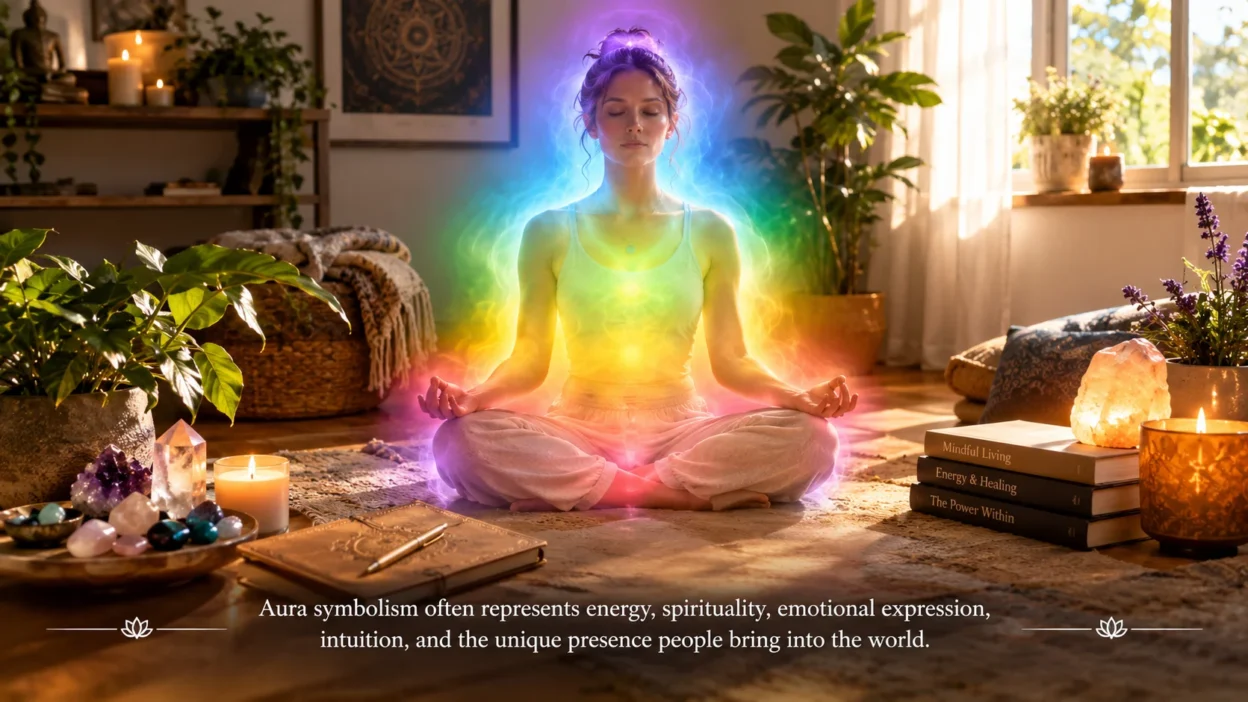
In spiritual artwork, an aura often appears as colored light around the head or entire body. Artists may use transparent layers, glowing edges, or soft gradients to suggest an unseen presence.
Common visual elements include:
- Violet or purple light associated with spiritual awareness.
- Blue and green shades suggesting calmness, healing, or emotional balance.
- Golden or yellow light representing optimism, clarity, or vitality.
- Pink and red tones expressing love, passion, or strong emotions.
These associations aren’t universal rules. Different aura readers and spiritual communities may interpret the same color differently.
Aura as a Symbol of Personal Presence
An aura doesn’t always need a visible shape. In everyday American English, it can describe the atmosphere someone creates through their actions, expressions, or personality.
For example, a welcoming person might have a warm aura. Someone quiet and thoughtful might be described as having a peaceful or mysterious aura.
Historical Origins of Aura Symbolism
Aura symbolism draws on several historical traditions, including ancient ideas about life, breath, sacred radiance, and invisible forces. However, the modern concept of a colored energy field developed through a mixture of spiritual movements and later interpretations.
Ancient Ideas About Invisible Life Forces
Many ancient societies developed ideas about breath, vitality, or forces that connected living beings with the wider world. Examples include prana in Indian philosophical and religious traditions and qi in Chinese traditions.
These concepts have their own meanings and histories. They shouldn’t be treated as exact equivalents of the modern Western idea of an aura.
Nevertheless, they help explain why invisible energy remains a powerful image for life, health, and spiritual connection.
Halos and Sacred Light in Art
Religious art provides another important historical connection. Artists in ancient and medieval traditions used circles, rays, and glowing backgrounds to distinguish sacred figures.
Early Christian art adopted and developed halo imagery, while other religious artistic traditions also used radiant light to express divine significance. A halo, however, is not necessarily an aura. A halo usually marks holiness or spiritual status, whereas modern aura imagery often represents a person’s overall energy.
The Rise of Modern Aura Beliefs
During the nineteenth and early twentieth centuries, Western spiritual movements explored hidden forces, human consciousness, and unseen dimensions of existence. Some writers and spiritual teachers connected these ideas with colored fields around the body.
Later, New Age spirituality popularized colorful aura charts, energy interpretations, and aura-reading practices. Consequently, today’s aura symbolism reflects both older spiritual ideas and relatively recent developments.
Aura Symbolism in American Culture
In the United States, aura symbolism appears in spiritual communities, wellness spaces, creative industries, and everyday speech. Its meaning often depends on whether someone is discussing a spiritual belief or simply describing a person’s presence.
Spirituality and Personal Growth
American wellness culture often uses aura imagery to represent self-awareness and emotional balance. Meditation studios, spiritual workshops, and personal development communities may use colored light as a visual reminder of inner growth.
For some people, an aura represents a connection between the body, mind, and spirit. Others use it as a personal symbol without following a particular religion.
Everyday American Language
The word aura has also become a casual way to describe someone’s social presence. A person may seem confident, approachable, intimidating, or effortlessly cool.
In these situations, the term usually describes an impression rather than a literal field of energy. This flexible meaning helps aura symbolism cross from spiritual discussions into ordinary American conversation.
Popular Culture and Online Identity
Social media has made aura language especially easy to share. People use it to describe celebrities, fictional characters, outfits, photographs, and memorable social interactions.
In this setting, aura often means charisma, confidence, or a distinctive personal style. A glowing purple aura in digital artwork may communicate mystery, while a golden aura might suggest warmth or success.
Aura Color Symbolism and Their Meanings
Aura colors are among the most recognizable features of contemporary aura symbolism. Although spiritual practitioners often assign meanings to individual colors, there is no single color system accepted across all traditions.
Common Aura Color Interpretations
The following interpretations are common in modern spiritual and popular contexts. They should be understood as symbolic associations rather than reliable measurements of someone’s character.
- Red: Passion, vitality, courage, determination, or intense emotion.
- Orange: Creativity, enthusiasm, confidence, and emotional expression.
- Yellow: Optimism, curiosity, intellectual energy, and joy.
- Green: Growth, renewal, compassion, and emotional balance.
- Blue: Peace, communication, honesty, and calmness.
- Indigo: Intuition, reflection, and inward awareness.
- Violet: Spirituality, imagination, and personal transformation.
- Pink: Affection, tenderness, kindness, and emotional warmth.
- White: Purity, spiritual clarity, or a sense of wholeness.
- Gold: Wisdom, confidence, illumination, or sacred significance.
Why Aura Colors Differ Between Interpretations
Color meanings depend on context. For example, red can represent love and celebration in one setting, but danger or anger in another.
Likewise, a blue aura may symbolize calm communication for one practitioner and spiritual sensitivity for another. Therefore, it’s helpful to ask which interpretation system someone uses before assigning a fixed meaning.
Spiritual Meaning of Aura Symbolism
For people who approach auras spiritually, they can represent the relationship between visible life and an unseen dimension of existence. This interpretation often emphasizes awareness, intention, and personal development.
Auras and Spiritual Awareness
Some spiritual practitioners believe an aura reflects a person’s spiritual condition or emotional state. They may describe changes in color or brightness as signs of growth, stress, or shifting intentions.
These beliefs can give people a symbolic language for examining their experiences. However, interpretations vary, and claims about reading a person’s spiritual condition aren’t scientifically established.
Aura Symbolism and Inner Connection
An aura can also represent the idea that people influence their surroundings in ways that aren’t always easy to explain. A compassionate person may create a feeling of safety, while a tense interaction may leave others uncomfortable.
This understanding works even without literal energy beliefs. In either case, the aura becomes a symbol of the connection between personal experience and the atmosphere around us.
Cross-Cultural Meanings of Aura Symbolism
The idea of invisible presence appears in many cultures, but similar imagery doesn’t mean every tradition teaches the same concept. Understanding those distinctions prevents modern aura interpretations from oversimplifying older beliefs.
South Asian Spiritual Traditions
Some South Asian religious and philosophical traditions discuss subtle bodies, life forces, and spiritual centers. Concepts such as prana and the chakras are important within particular Hindu, yogic, and related traditions.
Contemporary aura systems sometimes connect these ideas with colored energy fields. However, the chakra system and modern aura-color charts are not interchangeable, and interpretations differ among traditions and teachers.
Chinese Traditions and Life Energy
The Chinese concept of qi refers to a vital force or process discussed in several philosophical, medical, and spiritual traditions. It has a distinctive history and cannot simply be translated as an aura.
Nevertheless, contemporary wellness imagery sometimes places ideas about qi alongside aura concepts. These comparisons can be useful when carefully explained, but they shouldn’t erase important differences.
Sacred Radiance in Religious Art
Radiant light also appears in Christian, Buddhist, and other religious artistic traditions. Depending on the tradition, it may represent holiness, enlightenment, divine presence, or spiritual achievement.
These images share visual similarities with modern aura artwork. Still, a sacred halo, a depiction of enlightenment, and a contemporary aura reading each carry distinct meanings.
Emotional and Psychological Meanings of Auras
Aura symbolism can express how people understand emotions, personality, and social impressions. Its psychological appeal comes partly from giving abstract experiences a visible form.
Auras as Emotional Atmospheres
People often notice how others make them feel before they can explain why. A relaxed voice, open posture, and friendly expression may create a welcoming impression.
An aura can serve as a metaphor for this combined effect. For example, describing someone as having a gentle aura may communicate warmth more easily than listing every behavior that creates that impression.
Color as a Tool for Self-Reflection
Some people choose an aura color to represent their current mood or personal goals. A green design might remind them of growth, while blue might represent the calmness they want to cultivate.
This practice can encourage reflection without requiring supernatural claims. However, an aura color cannot reliably diagnose a mental state, reveal hidden intentions, or determine someone’s personality.
The Power of First Impressions
Aura language can also highlight the way appearance and behavior shape social judgments. Clothing, facial expressions, speech, and surroundings influence how others perceive a person.
However, first impressions can be wrong. Someone who appears distant may simply be tired, shy, or distracted, so aura descriptions shouldn’t replace genuine communication.
Aura Symbolism in Tattoos, Fashion, and Home Decor
Modern aura imagery offers a flexible way to express identity, creativity, and personal beliefs. In the United States, it can appear in body art, clothing, decorative objects, and wellness-inspired interiors.
Aura Tattoos and Personal Identity
Aura tattoos often use colored outlines, radiant silhouettes, or abstract clouds of light. Their meanings may reflect spiritual curiosity, self-discovery, emotional growth, or individuality.
Common design ideas include:
- A multicolored silhouette representing personal complexity.
- A violet glow symbolizing spiritual curiosity or imagination.
- A golden halo suggesting confidence, hope, or inner strength.
- A soft blue field expressing peace and emotional steadiness.
The wearer’s personal story matters more than any universal color chart. A meaningful tattoo can reflect an experience rather than a fixed spiritual belief.
Fashion and Beauty
Aura-inspired fashion often uses iridescent fabrics, color gradients, glowing makeup, and layered accessories. These visual choices suggest movement, individuality, and a sense of personal energy.
Similarly, photography and beauty trends may use colored lighting to create an otherworldly atmosphere. The resulting image can communicate a mood without making any claim about invisible energy.
Home Decor and Creative Spaces
In American homes, aura imagery may appear in wall art, lamps, meditation corners, and abstract paintings. Soft gradients and luminous colors can create a peaceful or dreamlike atmosphere.
For example, blue and green artwork might complement a quiet reading corner. Brighter pink, orange, and gold tones can give a creative space a more energetic appearance.
Aura Symbolism on Social Media
Online, aura has become a versatile word for describing personality, charisma, and social presence. Its popularity shows how an older spiritual term can acquire a playful, everyday meaning.
What Does Having an Aura Mean Online?
When someone says a person has an aura, they may mean that person looks confident, acts naturally, or attracts attention without trying. The phrase can describe a memorable performance, an impressive outfit, or a strong first impression.
The meaning often has little to do with spiritual energy. Instead, it reflects how people communicate admiration, style, and social confidence.
Aura Points, Memes, and Internet Humor
Some online communities use imaginary aura points to jokingly measure someone’s coolness or awkwardness. A confident action might supposedly earn points, while an embarrassing moment might lose them.
This playful use turns aura into a form of social scoring. It can be harmless humor, although it may also encourage people to judge themselves or others through constant comparison.
Why the Meaning Keeps Changing
Internet language changes quickly because users adapt words to new situations. Aura can describe spiritual imagery in one post and a funny social interaction in the next.
As a result, context matters more than ever. A serious discussion about spiritual beliefs requires a different interpretation from a meme about someone’s confidence.
Aura Symbolism in Art, Film, and Photography
Artists have long used light and color to represent qualities that ordinary physical details cannot easily show. Modern aura imagery continues this tradition by making invisible feelings appear visible.
Light as a Visual Symbol
A glowing outline can suggest mystery, power, warmth, or spiritual significance. Soft light often creates a peaceful feeling, while sharp or saturated colors may communicate intensity.
These effects work because viewers already associate light with visibility, attention, and revelation. However, the exact meaning depends on the surrounding image and the story being told.
Aura Effects in Digital Art
Digital artists can create aura effects with gradients, translucent layers, particles, and luminous outlines. Video games, fantasy films, and illustrated characters may use these effects to distinguish heroes, supernatural beings, or moments of transformation.
For American audiences, these images connect aura symbolism with familiar ideas about character development and extraordinary abilities. Yet a fictional aura is a storytelling device, not evidence that such effects occur around people.
Misunderstandings and Controversies About Aura Symbolism
Aura symbolism can support personal reflection and creative expression. However, confusion arises when symbolic beliefs are presented as proven facts or when traditions are blended without enough care.
Are Auras Scientifically Proven?
There is no widely accepted scientific evidence that people possess visible, multicolored spiritual fields that reveal personality or spiritual condition. Humans do emit measurable physical signals, such as body heat, but these aren’t the same as the colored auras described in spiritual readings.
Some people report seeing or sensing auras, and those experiences may feel meaningful to them. Still, personal experiences don’t establish that aura colors objectively reveal someone’s inner nature.
Aura Readings and Personal Judgments
Aura readings may be used as spiritual practices or reflective exercises. Problems can arise when someone treats a reading as a certain explanation of another person’s character, intentions, or future.
For example, labeling someone as having a supposedly negative aura could encourage unfair assumptions. It’s more respectful to assess people through their actual behavior and communication.
Cultural Respect and Appropriation
Modern aura systems sometimes borrow language from Hindu, Buddhist, Chinese, or other traditions. These connections deserve care because related concepts may have specific religious, historical, and cultural meanings.
Using colorful aura art doesn’t automatically disrespect a tradition. However, presenting distinct beliefs as identical, claiming authority without understanding their context, or reducing sacred practices to decorative trends can create misunderstandings.
How Aura Symbolism Has Changed Over Time
Aura symbolism has evolved from broad ideas about unseen vitality and sacred radiance into a diverse collection of spiritual, artistic, and everyday meanings. Its modern flexibility reflects changes in religion, popular culture, and digital communication.
From Sacred Imagery to Personal Energy
Historically, radiant light in art often highlighted divine figures or spiritual importance. Later Western spiritual movements developed new interpretations of subtle energies and the human body.
By the late twentieth century, aura colors became more familiar through New Age books, workshops, and wellness culture. These developments helped make aura imagery a recognizable symbol of personal spirituality.
From Spiritual Belief to Everyday Slang
In contemporary American speech, aura often describes confidence, charisma, or a person’s overall impression. Social media has further expanded the term through jokes, memes, and informal ratings of social presence.
However, the older spiritual meaning hasn’t disappeared. Today, spiritual practitioners, artists, wellness communities, and internet users may use the same word in very different ways.
What Has Stayed Consistent?
Despite these changes, aura symbolism continues to express something difficult to capture directly. It gives people a way to talk about presence, identity, emotional atmosphere, and the possibility of deeper meaning.
Its central appeal lies in connecting what people feel with what they can imagine or depict visually.
Read More: Meditation Symbolism: Meaning, History, and Modern Use
Aura Symbolism at a Glance
The following table summarizes common interpretations across different settings. These meanings are flexible associations, not universal definitions.
| Context | Common Symbolic Meaning | Typical Appearance | Important Note |
| Spirituality | Energy and spiritual awareness | Colored light around the body | Beliefs vary among practitioners |
| Emotional expression | Mood and personal atmosphere | Soft gradients or shifting colors | Often used metaphorically |
| American social media | Charisma and confidence | Glowing edits, memes, or aura points | Frequently playful or humorous |
| Tattoos and fashion | Identity and self-expression | Radiant outlines and color fields | Personal meaning takes priority |
| Religious art | Holiness or sacred presence | Halos, rays, or luminous backgrounds | Not identical to modern aura beliefs |
FAQs
What Does an Aura Symbolize Spiritually?
An aura often symbolizes a person’s spiritual presence, energy, or connection with a deeper reality. Some practitioners believe its colors reflect emotional or spiritual conditions, although these interpretations aren’t scientifically established.
What Do Different Aura Colors Mean?
Modern aura interpretations often associate red with vitality, blue with calmness, green with growth, and violet with spirituality. However, color meanings vary among practitioners, and no single system is universally accepted.
Can Everyone See Auras?
There is no reliable scientific evidence that people can visually detect spiritual auras around others. Some individuals report such experiences, but these reports don’t establish that colored energy fields can be objectively observed.
What Does It Mean When Someone Says You Have an Aura?
In everyday American conversation, it usually means you have a noticeable presence or distinctive personality. Depending on the situation, the speaker might be describing your confidence, warmth, mystery, or general impression.
Is Aura Symbolism Connected to Chakras?
Some modern spiritual systems connect aura interpretations with chakras, which are spiritual centers described in certain South Asian traditions. However, auras and chakras are distinct concepts, and their relationship varies across different teachings.
What Does a White Aura Symbolize?
In some contemporary aura systems, white represents purity, clarity, spiritual awareness, or wholeness. These associations are interpretive rather than universal, so the meaning depends on the system and the person’s beliefs.
Conclusion
Aura symbolism offers a way to explore personal energy, emotional presence, spirituality, and identity. Its history connects ancient ideas about life and sacred radiance with modern spiritual practices, creative imagery, and popular culture. Today, an aura might represent spiritual awareness, a calming personality, a colorful tattoo, or someone’s confident online presence. Its meaning depends on the context, and no single interpretation applies to everyone. When you encounter an aura image or description, consider what its colors and setting communicate. You may discover that its greatest value lies in helping people express the qualities, feelings, and connections that matter to them.