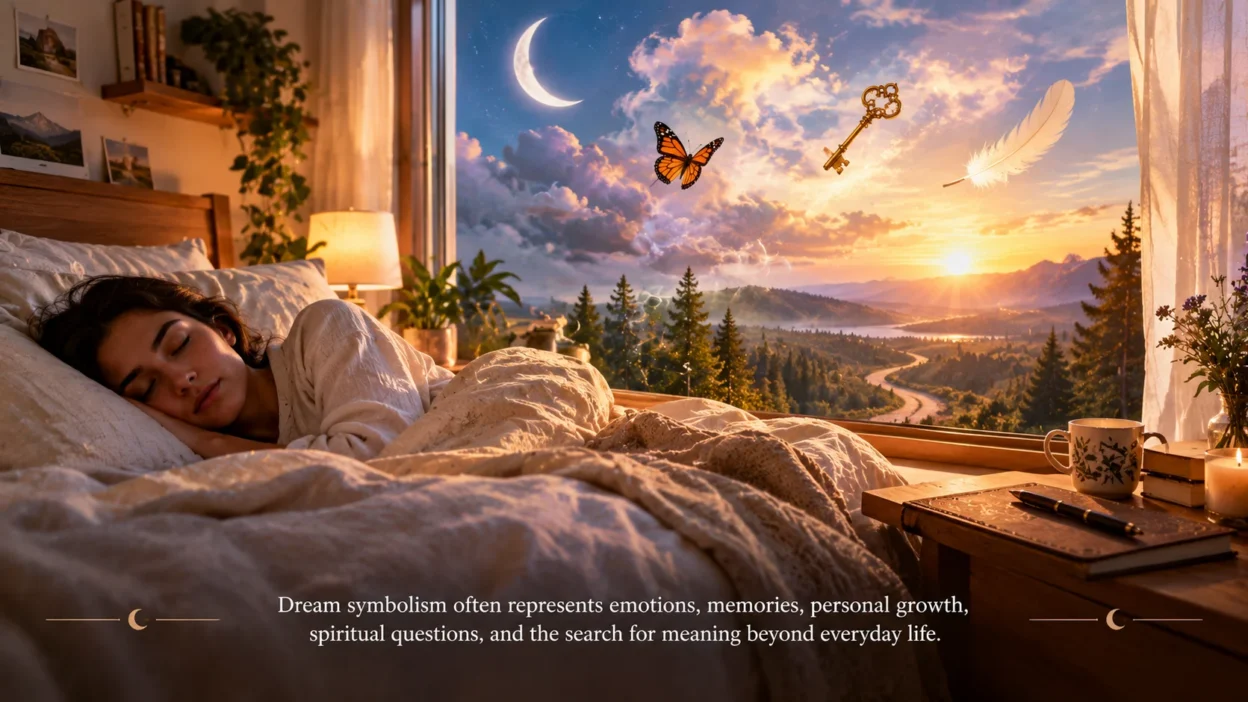
Dream symbolism explores the meanings people associate with images, feelings, and experiences that appear during sleep. Dreams can feature familiar people, strange places, animals, falling, flying, or events that seem impossible in waking life. For many Americans, these experiences inspire curiosity about emotions, personal challenges, and the deeper parts of the mind.
Throughout history, people have viewed dreams as messages, warnings, spiritual encounters, or reflections of daily life. However, their meanings have never been completely universal. A snake might represent danger to one person and transformation to another. Similarly, dreaming about a loved one may bring comfort, sadness, or memories of an important relationship.
Today, dream symbolism appears in psychology, spiritual practices, literature, movies, social media, and personal journals. Some people search for spiritual guidance, while others explore dreams to understand their feelings. Learning about these interpretations can help you reflect on your experiences without assuming every dream predicts the future or carries a hidden message.
Quick Answer
Dream symbolism in the United States commonly represents emotions, personal growth, unresolved concerns, hopes, and the search for self-understanding. Across cultures, dreams may also symbolize spiritual guidance, warnings, connection with ancestors, or contact with the divine.
TL;DR
- Dreams often reflect emotions, memories, concerns, and personal experiences.
- Ancient civilizations sometimes treated dreams as divine messages or warnings.
- American culture connects dreams with ambition, identity, creativity, and self-discovery.
- Spiritual traditions interpret certain dreams as meaningful experiences or guidance.
- Common dream images can carry different meanings for different people.
- Modern dream interpretation appears in therapy, journaling, entertainment, and online discussions.
What Is Dream Symbolism?
Dream symbolism refers to the meanings people attach to images, events, and emotions experienced during sleep. These symbols may connect with personal memories, cultural beliefs, spiritual traditions, or everyday concerns. Their meaning often depends on the dreamer’s circumstances.
For American readers, dreams can offer a way to think about feelings that remain difficult to express. However, a symbolic interpretation is a possibility, not a proven explanation for every dream.
Common Symbols Found in Dreams
Certain dream images appear frequently in popular interpretations. Their meanings depend on context rather than following a universal rulebook.
- Water: Often associated with emotions, change, uncertainty, or renewal.
- Flying: May suggest freedom, ambition, confidence, or escape.
- Falling: Can reflect insecurity, vulnerability, or a sense of losing control.
- Snakes: May symbolize danger, transformation, healing, or hidden fears.
- Doors: Often represent choices, opportunities, boundaries, or new beginnings.
- Houses: May connect with identity, family life, memories, or personal security.
For example, calm water might feel peaceful, while a violent flood could create fear. The same symbol can communicate different things depending on the surrounding events.
The Historical Origins of Dream Symbolism
Dream symbolism has ancient roots. Long before modern psychology, people tried to understand why sleeping minds produced vivid scenes, unfamiliar voices, and powerful emotions.
Across different societies, dreams became part of religious life, storytelling, healing traditions, and political decisions. Their interpretations changed as people developed new explanations for the mind and the natural world.
Ancient Civilizations and Sacred Dreams
In ancient Mesopotamia and Egypt, dreams sometimes received religious and political importance. Surviving texts describe dream interpretation, while some records connect dreams with divine messages or future events.
Ancient Greek traditions also explored dreams. Some people visited healing sanctuaries associated with Asclepius, the god of medicine, hoping for meaningful dreams connected with their illnesses.
The Roman world inherited and adapted many Greek ideas. Writers discussed dreams as possible predictions, reflections of physical conditions, or products of ordinary experience.
However, ancient interpretations varied considerably. Not everyone understood every dream as a supernatural message.
Dreams in Ancient Religious Traditions
Dreams also appear throughout ancient religious literature and mythology. Some stories describe gods communicating through dreams, while others present dreams as warnings or turning points.
These accounts helped establish lasting associations between dreams and hidden knowledge. Even today, people may connect vivid dreams with important life decisions or spiritual questions.
Dream Symbolism in the United States
In the United States, dream symbolism combines psychological ideas, religious beliefs, popular entertainment, and personal reflection. Americans approach dreams from many different backgrounds, so there is no single national interpretation.
The American emphasis on individual identity also encourages people to ask what a dream means for their own lives. A dream about escaping a crowded room, for instance, might prompt someone to consider whether they need more privacy or independence.
The American Dream and Aspirations
The phrase American Dream has a separate meaning from dreams experienced during sleep. It describes an ideal of opportunity, progress, and the possibility of building a better life.
Nevertheless, the two ideas sometimes overlap in everyday language. Dreams can symbolize hopes for education, career success, homeownership, family stability, or personal freedom.
In this context, dreams may represent:
- The courage to pursue a long-term goal.
- Hope during a difficult period of life.
- A desire for independence or a fresh start.
- Creative ambition and the wish to accomplish something meaningful.
For many Americans, saying someone has a dream suggests more than sleep imagery. It can describe a personal vision that guides everyday choices.
Religion, Family, and Personal Beliefs
Some Americans interpret dreams through Christianity or other religious traditions. Others view them through psychology, family stories, or personal experience.
A dream involving a deceased relative, for example, may feel like a comforting reunion. One person might understand it spiritually, while another sees it as a natural expression of grief and memory.
Neither response should automatically be imposed on someone else. Personal beliefs and experiences strongly influence the meaning a dream holds.
4. Spiritual Meaning of Dreams
Spiritually, dreams may symbolize guidance, transformation, connection, or a search for deeper understanding. Many traditions recognize that dreams can feel significant, although they differ in how they explain their source.
For some people, a powerful dream becomes an invitation to reflect on their values. For others, it may strengthen an existing religious belief or encourage prayer and meditation.
Dreams as Messages or Guidance
Certain religious traditions describe dreams as a possible means of divine communication. In biblical narratives, for example, dreams sometimes deliver warnings, reveal important information, or influence major decisions.
Some Indigenous traditions also recognize meaningful dreams within particular cultural and spiritual practices. However, these traditions are diverse, and their teachings should not be reduced to one universal interpretation.
A respectful approach recognizes that spiritual meaning belongs within its cultural and personal context.
Dreams of Transformation and Renewal
Dreams involving light, open doors, rising water, or new landscapes may feel like signs of change. Some spiritual interpretations associate these images with awakening, release, or a new stage of life.
However, these associations are interpretive rather than universal. A dream’s emotional tone and personal context matter more than a fixed symbolic dictionary.
Psychological Meaning of Dreams
Psychologically, dreams can be explored as experiences connected with memory, emotion, imagination, and waking life. Modern research studies how dreaming relates to sleep and mental processes, but it does not establish one definitive meaning for every dream image.
Dreams may incorporate recent events, older memories, concerns, and unexpected combinations of familiar experiences. Their strange qualities can make ordinary feelings appear in surprising forms.
Dreams and Emotional Processing
A dream about missing an important appointment might reflect a real concern about responsibility. Alternatively, it could simply combine memories of schedules, travel, and everyday stress.
Researchers continue to investigate how dreaming relates to emotional memory and sleep. However, interpreting a particular image remains uncertain without considering the individual.
Questions worth reflecting on include:
- What emotion felt strongest during the dream?
- Does the dream resemble anything happening in your life?
- Did a particular person, place, or event feel familiar?
- Has the same theme appeared in several dreams?
These questions encourage reflection without treating every dream as a diagnosis or prediction.
The Influence of Freud and Jung
In the late nineteenth and early twentieth centuries, Sigmund Freud argued that dreams could express unconscious wishes and conflicts. His work helped make dream interpretation influential in modern discussions of the mind.
Carl Jung later developed a different approach. He explored archetypes, recurring patterns, and symbols that he believed could help people understand psychological development.
Both thinkers influenced popular dream interpretation. However, many of their specific claims remain debated, and their theories should not be treated as proven explanations for every dream.
Common Dream Symbols and Their Meanings
Dream symbols often gain meaning from their setting, emotional tone, and connection to waking experiences. Popular interpretations can provide starting points, but they should never replace personal reflection.
The following table summarizes common associations found in contemporary dream discussions.
| Dream symbol | Common interpretation | Possible personal connection |
| Water | Emotions, change, uncertainty | Relationships or difficult feelings |
| Flying | Freedom, ambition, escape | Independence or new opportunities |
| Falling | Insecurity, vulnerability | Pressure or fear of failure |
| Teeth falling out | Anxiety, change, loss of control | Concerns about appearance or communication |
| Being chased | Fear, avoidance, pressure | A problem you feel unprepared to face |
| Death | Endings, transition, loss | Change, grief, or a new life stage |
These are common associations, not reliable formulas. For instance, dreaming about death does not mean that someone will die. It might reflect a recent loss, a major transition, or nothing especially symbolic.
Why Context Changes Meaning
Consider a dream about a locked door. If you feel frightened, the door might bring to mind an obstacle or exclusion. If you feel curious, it might suggest an unexplored opportunity.
Similarly, dreaming about a familiar house may bring back childhood memories. For another person, the same setting might represent comfort, family responsibilities, or a desire to return home.
The dreamer’s feelings provide useful context. That context is usually more informative than assigning one fixed meaning to every image.
Dream Symbolism Across Cultures and Religions
Dream interpretation has developed differently across cultures. Some traditions emphasize spiritual communication, others focus on community knowledge, and still others approach dreams through philosophical or psychological ideas.
These differences show why dream symbolism cannot be reduced to a single worldwide system.
Christian and Islamic Perspectives
In some Christian traditions, dreams may be understood as possible forms of divine guidance. Biblical accounts include dreams that influence important events, although Christian communities differ in how they interpret dreams today.
Islamic traditions also include discussions of meaningful dreams. Classical Islamic teachings distinguish among different kinds of dreams, including those regarded as good visions, distressing experiences, or reflections of a person’s own thoughts.
In both traditions, interpretations depend on religious teachings and individual circumstances. A dream should not automatically be treated as a command, prediction, or unquestionable spiritual truth.
Other Cultural Traditions
Across history, some societies have treated dreams as important links between personal experience, ancestors, community life, or the spiritual world. The practices and beliefs involved vary widely.
Some Buddhist contexts examine dreams in relation to the nature of experience and awareness. Certain Indigenous communities maintain their own teachings about dreams, which should be understood through their specific histories and living traditions.
There is no single interpretation shared by every member of any large religious or cultural group. Respectful discussion acknowledges these differences rather than presenting one person’s belief as universal.
Emotional and Personal Meaning of Dreams
Dreams can feel joyful, frightening, confusing, or deeply comforting. Their emotional power often explains why people remember them long after waking.
For many Americans, reflecting on dreams offers an accessible way to explore personal concerns. However, an intense dream does not necessarily reveal a hidden truth or predict an event.
Positive Emotional Associations
Pleasant dreams may inspire hope, confidence, or a renewed sense of connection. Dreaming about a loved one, a peaceful landscape, or a personal achievement can leave a person feeling encouraged.
Common positive associations include:
- Flying freely: A feeling of independence or possibility.
- Finding a lost object: Relief, discovery, or renewed confidence.
- Walking through sunlight: Peace, optimism, or emotional warmth.
- Meeting a loved one: Affection, remembrance, or a sense of connection.
These interpretations depend on how the dream feels to the person experiencing it. A symbol that comforts one person may remind another of a painful memory.
Fear, Anxiety, and Uncertainty
Nightmares may involve pursuit, falling, conflict, or an inability to speak. Sometimes, these themes resemble concerns people experience during waking life.
However, nightmares can occur for many reasons, including stress, disrupted sleep, and other sleep-related factors. Their presence alone does not prove that a person has an unresolved emotional problem.
If recurring nightmares seriously affect sleep or daily life, speaking with a qualified health professional may help.
Dream Symbolism in Tattoos, Art, and Home Decor
Dream imagery has a natural place in modern American self-expression. People use moons, clouds, stars, doors, butterflies, and other dreamlike images to communicate ideas about mystery, freedom, and personal change.
These designs can express individual stories without requiring everyone to interpret them in the same way.
Tattoos and Personal Identity
Dream-inspired tattoos often combine several symbols into one personal design. A person might choose a butterfly to represent change or a moon to suggest mystery and reflection.
Popular design ideas include:
- A crescent moon surrounded by stars.
- A butterfly emerging from a dreamlike cloud.
- An open eye representing awareness or imagination.
- A doorway opening onto a bright landscape.
- A feather floating above a winding path.
Before choosing a design, consider what its imagery means to you. A personal connection often makes a tattoo more meaningful than following a popular interpretation.
Art, Journals, and Interior Design
Artists frequently use dreamlike scenes to express imagination, uncertainty, and the passage between familiar and unfamiliar worlds. Surreal landscapes, floating objects, and distorted rooms can communicate feelings that ordinary scenes may not capture.
At home, people may choose celestial wall art, soft lighting, or dream-inspired photography to create a calm atmosphere. Meanwhile, dream journals help some people record images and emotions they want to explore later.
Social media has also made dream discussions more visible. However, short videos and online symbol lists often present uncertain interpretations as universal facts.
Misunderstandings and Controversies About Dream Symbolism
Dream symbolism can encourage useful reflection, but it can also create confusion when interpretations are treated as certain. Some websites claim that specific images always predict particular events or reveal secret truths about other people.
Such claims go beyond what scientific evidence can establish.
Do Dreams Predict the Future?
Some people believe that certain dreams provide warnings or glimpses of future events. Stories about seemingly prophetic dreams appear in many cultural and religious traditions.
However, there is no reliable scientific basis for treating ordinary dream images as dependable predictions. Coincidences, selective memory, and interpreting a dream after an event can influence how meaningful it appears.
It is reasonable to respect a person’s spiritual beliefs while distinguishing personal faith from established evidence.
Avoiding Fear-Based Interpretations
Online dream dictionaries sometimes attach alarming meanings to ordinary images. For example, a dream about teeth falling out might be described as a warning of death or disaster.
There is no sound basis for treating that interpretation as a universal rule. A dream about teeth could relate to anxiety, recent experiences, or no clear symbolic theme at all.
Dream interpretation becomes less helpful when it creates unnecessary fear, encourages suspicion, or pressures someone into major decisions.
11. How Dream Symbolism Has Changed Over Time
Dream symbolism has shifted as societies developed new religious ideas, scientific explanations, and forms of popular entertainment. Earlier interpretations often gave dreams a sacred or prophetic role, while modern approaches include personal reflection and psychological research.
These views continue to coexist, especially in a culturally diverse country such as the United States.
From Divine Messages to Personal Reflection
In some ancient societies, dreams were connected with gods, healing, or political choices. Later religious traditions preserved certain ideas about meaningful dreams while developing their own explanations.
During the nineteenth and twentieth centuries, psychological theories brought increased attention to unconscious thought, memory, and emotion. Meanwhile, novels, films, and television made dream imagery a familiar tool for representing fear, desire, and imagination.
Today, people may combine several approaches. Someone might keep a dream journal, discuss a dream with a religious leader, or explore its emotional themes without choosing one final explanation.
The Influence of Modern Media
Movies often use dreams to create suspense, reveal a character’s fears, or blur the line between reality and imagination. Video games and digital art also use dreamlike settings to create unusual experiences.
Social media has expanded access to symbolic interpretations. However, its quick explanations can remove important cultural and personal context.
A thoughtful modern approach combines curiosity with caution. It allows dreams to feel meaningful without assuming every image carries a fixed message.
How to Reflect on Your Own Dreams
You don’t need a special dictionary to begin exploring your dreams. A few simple questions can help you connect their images with your experiences, emotions, and personal beliefs.
The goal is not to discover one guaranteed answer. Instead, reflection can help you notice patterns and understand why a particular dream stayed with you.
Read More: Aura Symbolism: Spiritual Meaning, Energy, and Identity
Keep a Dream Journal
Write down what you remember soon after waking. Dreams can fade quickly, so capturing a few details may be more useful than trying to reconstruct everything.
Record the setting, people, main events, and strongest emotions. Also, note whether anything similar happened recently in your waking life.
Ask Open-Ended Questions
Rather than assuming that a symbol has one meaning, consider several possibilities.
- What does this image mean to me personally?
- Which emotions did I experience during the dream?
- Does the dream connect with a recent change or concern?
- Could it reflect a memory rather than a hidden message?
- How might my cultural or spiritual beliefs shape my interpretation?
Keep interpretations flexible as you consider different explanations. If a dream feels important, you can reflect on it over several days rather than making an immediate decision.
FAQs
What Does Dream Symbolism Mean?
Dream symbolism refers to the meanings people associate with images, events, and emotions experienced during sleep. These meanings may reflect personal experiences, cultural traditions, spiritual beliefs, or psychological ideas.
Are Dreams Messages From God?
Some religious traditions understand certain dreams as possible forms of divine communication. However, beliefs differ, and a dream alone cannot establish that a message came from God.
What Does It Mean When You Dream About Someone?
Dreaming about someone may relate to memories, affection, conflict, or recent experiences involving that person. It doesn’t necessarily mean they are thinking about you or that something will happen between you.
Why Do Certain Dreams Keep Repeating?
Recurring dreams may revisit familiar emotions, concerns, or experiences, although their causes vary. Stress and disrupted sleep can also influence dreaming, and repetition doesn’t prove that a hidden message remains unresolved.
Can Dreams Predict the Future?
People sometimes interpret dreams as predictions, particularly within spiritual traditions. However, scientific evidence doesn’t support using ordinary dreams as a reliable method of forecasting future events.
Why Do I Remember Some Dreams but Forget Others?
Dream recall can depend on when you wake, sleep patterns, and how much attention you give a dream afterward. Many dreams fade quickly, so forgetting them is a normal experience.
Conclusion
Dream symbolism connects the sleeping mind with personal emotions, cultural traditions, spiritual beliefs, and human imagination. Throughout history, people have treated dreams as sacred messages, psychological experiences, or meaningful reflections of everyday life. Ultimately, dream symbolism can be an invitation to reflect on what matters to you. When a dream stays in your memory, consider its feelings, images, and personal connections. You may discover a useful perspective, even if the dream never offers a single definitive answer.