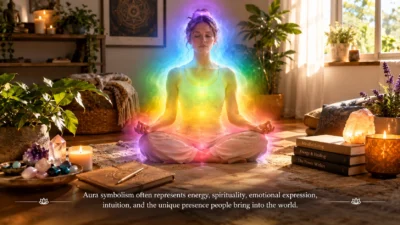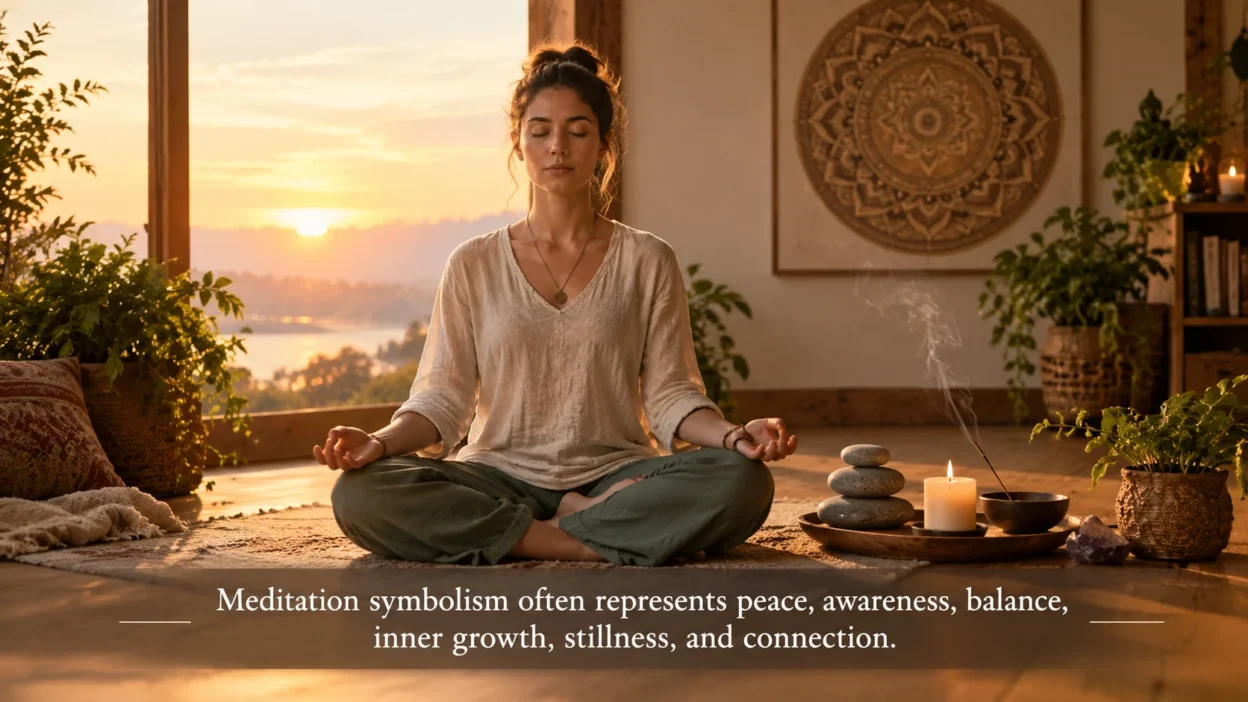
Meditation symbolism appears in many forms, from a quiet seated figure to a lotus flower, circle, candle, or peaceful landscape. Together, these images suggest stillness, awareness, balance, and a deeper connection with oneself.
In 2026, meditation has become part of many everyday wellness practices. People use meditation imagery in homes, tattoos, journals, clothing, apps, studios, and social media. However, these symbols often have histories much older than modern wellness culture.
Understanding their meanings adds depth to familiar images. A lotus can suggest growth, while closed eyes may represent inward attention. Meanwhile, a circle can suggest wholeness, continuity, or a complete inner state.
Quick Answer
Meditation symbolism in the USA commonly represents peace, mindfulness, self-awareness, balance, healing, and personal growth. More broadly, meditation symbols can express spiritual discipline, inner transformation, compassion, and the search for deeper understanding.
TL;DR
- Meditation symbols commonly represent peace, awareness, balance, and inner growth.
- Lotus imagery connects beauty with growth through difficult conditions.
- Seated postures often suggest discipline, stillness, and focused attention.
- American culture blends ancient imagery with modern wellness practices.
- Meditation symbols can express both spiritual beliefs and personal identity.
- Meanings change depending on culture, context, and individual experience.
What Does Meditation Symbolism Represent?
Meditation symbolism turns an inner practice into something people can see. Because meditation focuses on attention and stillness, its visual language often uses calm shapes, natural objects, and balanced forms.
For American readers, these symbols can have both spiritual and secular meanings. A person may use a lotus because of its traditional associations, or simply because it represents personal growth.
Common Meanings
Several ideas appear repeatedly in modern meditation imagery:
• Inner peace and emotional calm
• Mindfulness and present-moment awareness
• Personal growth and transformation
• Balance between body, mind, and surroundings
• Self-reflection and deeper awareness
• Spiritual exploration without a fixed belief system
The meaning depends heavily on context. A Buddhist meditation image carries different associations from a minimalist wellness logo, even when both show a seated person.
How Meditation Symbols Appear
Meditation symbolism doesn’t have one fixed shape or object. Instead, it uses a collection of visual elements that communicate quietness, focus, balance, and inward attention.
In American settings, simple imagery often works best. Clean lines, natural materials, soft lighting, and uncluttered spaces reinforce the feeling of calm.
Common Visual Elements
• A seated figure suggests stillness, discipline, and focused attention.
• Closed eyes often suggest inward awareness rather than sleep.
• A lotus can represent growth, renewal, and spiritual development.
• Circles may suggest wholeness, unity, and continuity.
• Candles can symbolize concentration, presence, and quiet reflection.
• Stones often suggest grounding, stability, and connection with nature.
Colors also influence interpretation. Soft blue can suggest calm, while green can connect meditation with nature and renewal. White often communicates simplicity, while warm earth tones create a grounded feeling.
Ancient Roots of Meditation Symbolism
Meditation itself has a long history across several religious and philosophical traditions. Its visual symbols developed gradually rather than appearing from one single source.
Ancient South Asian traditions played an especially important role in shaping imagery associated with contemplative practice. Over centuries, meditation became connected with disciplined attention, spiritual insight, liberation, and self-understanding.
Early Traditions
Meditative practices appear in ancient Indian religious and philosophical traditions, including Hindu traditions and later Buddhist and Jain traditions. These traditions developed different teachings and practices, so their symbols shouldn’t be treated as interchangeable.
The lotus became especially important in South Asian religious art. Its ability to rise from muddy water while producing a beautiful flower made it a powerful image of transformation and spiritual development.
Buddhist Influence
Buddhist art helped spread recognizable images of meditation across Asia. Seated figures, lotus positions, balanced postures, calm facial expressions, and symbolic hand gestures became common visual elements.
Over time, these images traveled across cultures. Today, Americans may encounter them in museums, meditation centers, homes, yoga studios, books, and popular wellness culture.
Meditation Symbolism in American Culture
Meditation symbolism has taken on a distinctive place in the United States. It often connects traditional spiritual imagery with modern ideas about wellness, stress management, personal development, and intentional living.
However, American interpretations aren’t uniform. Some people approach meditation through religion, while others treat it as a secular practice of attention and reflection.
American Associations
In the USA, meditation imagery commonly appears alongside ideas such as:
• Personal wellness and intentional living
• Stress reduction and emotional balance
• Yoga and contemplative fitness practices
• Nature-based retreats and quiet spaces
• Personal development and self-reflection
• Digital mindfulness and wellness communities
American culture has also made meditation imagery highly adaptable. A traditional lotus may appear beside modern typography, neutral interiors, or contemporary clothing.
Everyday American Use
You might see meditation symbolism in home offices, bedrooms, gardens, spas, studios, journals, and personal artwork. The same imagery can therefore move between spiritual and lifestyle settings.
This flexibility is one reason meditation symbols remain popular. They can communicate a desire for calm without requiring the viewer to follow one particular belief system.
Spiritual Meanings of Meditation Symbols
Meditation symbolism has important spiritual meanings, although those meanings vary among traditions. It can represent prayerful attention, spiritual discipline, awakening, compassion, detachment, or the search for truth.
It is important not to combine every tradition into one generalized system. Similar symbols can carry different teachings depending on their religious and cultural setting.
Different Spiritual Associations
In Buddhist traditions, meditation imagery can relate to mindfulness, concentration, compassion, and awakening. Hindu traditions contain many different contemplative practices and symbolic systems connected with consciousness, devotion, knowledge, and spiritual realization.
Jain traditions also have long contemplative practices emphasizing discipline and liberation. Meanwhile, Christian contemplative traditions use quiet prayer and inward reflection, although their symbols and theological meanings differ.
A Broader Spiritual Reading
Outside specific traditions, meditation symbols may express a general desire to slow down and seek meaning. They can also represent a person’s private spiritual journey.
For many modern Americans, that personal meaning matters more than a fixed symbolic dictionary. The image becomes a reminder of an intention rather than a universal statement.
What Does the Lotus Mean in Meditation?
The lotus is one of the most recognizable symbols connected with meditation. Its roots in ancient South Asian religious art give it meanings that extend far beyond modern wellness decoration.
The flower grows from muddy environments yet emerges above the water with a clean and striking appearance. Because of this contrast, it became a natural image for transformation.
Lotus Symbolism
The lotus may suggest:
• Growth that develops through difficulty
• Inner beauty emerging from challenging circumstances
• Spiritual development and awakening
• Renewal after periods of struggle
• Purity within an imperfect world
Today, Americans often use lotus imagery in tattoos, artwork, jewelry, clothing, and meditation spaces. However, its meaning can become simplified when separated from its cultural and religious history.
Meditation Posture and the Meaning of Stillness
The seated meditation posture is another major visual symbol. A stable body communicates an idea of stability within the mind.
Traditional seated positions vary across practices. Therefore, the familiar cross-legged pose shouldn’t be treated as the only authentic form of meditation.
Why Posture Matters
A balanced posture can visually communicate:
• Physical stability and grounded attention
• Discipline practiced over time
• Quietness and restraint
• Awareness of the body
• Focus without unnecessary movement
Modern American imagery sometimes exaggerates the idea that meditation requires perfect stillness. In reality, meditation traditions include many approaches, including walking, standing, lying down, and moving practices.
Colors and Shapes in Meditation Symbolism
Colors and geometric forms strongly affect how meditation imagery feels. Designers often choose soft or natural tones because they create a visual sense of quiet.
However, color meanings aren’t universal. Cultural background, personal memories, and the surrounding image can change interpretation.
Common Color Associations
| Color or Form | Meaning in the USA | Common Associations | Notes |
| Blue | Calm and clarity | Sky, water, peace | Often used in wellness spaces |
| Green | Renewal and balance | Nature, growth, restoration | Connects meditation with the outdoors |
| White | Simplicity and purity | Light, openness, cleanliness | Can carry religious meanings too |
| Gold | Awareness and value | Light, wisdom, sacredness | Often appears in traditional religious art |
| Circle | Wholeness and continuity | Unity, balance, completeness | Meaning changes across traditions |
Circles are especially useful because they have no obvious beginning or end. In modern design, they can therefore suggest completeness or ongoing awareness.
Emotional and Psychological Associations
Meditation symbols often work because they trigger emotional expectations before people consciously analyze them. A quiet face, soft light, or balanced circle can create an immediate impression of calm.
These associations don’t mean that an image has a guaranteed psychological effect. Instead, they show how visual language can influence mood and attention.
Feelings Commonly Linked With Meditation
Meditation imagery may evoke:
• Calm after a demanding day
• Hope during personal change
• Patience during uncertain periods
• Confidence through greater self-awareness
• Comfort through familiar peaceful imagery
• Curiosity about inner experience
For example, someone might place a meditation image near a desk as a reminder to pause. The symbol then becomes part of a personal routine rather than merely decoration.
Meditation Symbols in Tattoos and Personal Identity
Meditation symbolism has become common in American tattoo culture. People may choose lotus flowers, mandalas, seated figures, meaningful words, or minimalist circles to represent a personal chapter.
A tattoo can preserve a private experience in visible form. For some people, it marks recovery, growth, spiritual exploration, or a commitment to living more intentionally.
Popular Tattoo Meanings
• Lotus tattoos can represent transformation and resilience.
• Mandalas can suggest balance, order, and personal reflection.
• Seated figures may represent calm and disciplined attention.
• Small circles can symbolize wholeness or an ongoing journey.
• Nature elements can connect meditation with grounding and renewal.
However, symbols shouldn’t automatically reveal someone’s beliefs. A tattoo may have deeply personal meaning that differs from traditional interpretations.
Meditation Symbols in Homes and Social Media
Meditation imagery is now part of American interior design and digital culture. People use candles, stones, plants, neutral colors, cushions, and simple artwork to create spaces that feel peaceful.
Social media has expanded this visual language. Images of sunrise meditation, quiet rooms, journals, nature, and candles often communicate a lifestyle built around slowing down.
Modern Digital Meanings
On social platforms, meditation imagery can signal:
• A commitment to mindful living
• A preference for peaceful environments
• Personal reflection and intentional routines
• Interest in wellness and self-development
• A desire to disconnect from constant digital activity
However, social media can also make meditation look more effortless than it really is. Beautiful imagery may show the atmosphere without showing the patience and practice behind it.
Cross-Cultural Meanings and Religious Context
Meditation is not limited to one culture or religion. Many societies have traditions involving contemplation, prayer, silence, breath awareness, or disciplined attention.
Still, these practices shouldn’t be treated as identical. Their goals, teachings, and symbols can differ greatly.
A Respectful Comparison
South Asian traditions contributed many symbols now associated with meditation. Buddhist traditions developed rich visual languages around awakening and compassionate awareness.
Meanwhile, contemplative Christianity has traditions of silence and prayer. Islamic traditions also include forms of reflection and remembrance, although these should not simply be labeled as identical to modern secular meditation.
The safest approach is to respect each tradition on its own terms. Similar visual themes don’t always mean identical beliefs.
Misunderstandings and Misuse of Meditation Symbols
Meditation symbols can become misunderstood when they are removed from their original settings. This often happens when complex religious imagery becomes a simple lifestyle decoration.
That doesn’t automatically make modern use disrespectful. Context and intent matter, but cultural awareness also matters.
Common Misunderstandings
One misconception is that every lotus, mandala, or seated figure has one universal meaning. In reality, meanings vary by tradition, artwork, historical period, and personal use.
Another issue involves treating all Asian spiritual traditions as one system. This can erase important differences between Buddhist, Hindu, Jain, and other traditions.
A thoughtful approach recognizes the symbol’s history while allowing modern users to develop personal meanings.
How Meditation Symbolism Has Changed Over Time
Meditation imagery has shifted dramatically as it moved between religious traditions, Asian art, Western scholarship, modern wellness culture, and digital media.
Older religious images often carried detailed teachings. Modern American versions may instead emphasize calmness, self-care, balance, or personal growth.
From Sacred Practice to Lifestyle Image
During the 19th and 20th centuries, growing Western interest in Asian philosophies helped introduce meditation-related ideas to American audiences. Later, yoga, wellness movements, psychology, and popular media broadened its reach.
By the 21st century, meditation had become visible in workplaces, schools, fitness communities, apps, homes, and online spaces. Its imagery followed that expansion.
Today, a lotus can still carry deep religious meaning. Yet it may also simply represent resilience or personal transformation. Both readings can exist, depending on context.
Why Meditation Symbols Still Matter Today
Meditation symbols remain powerful because modern life often feels crowded with noise, speed, and constant information. Images of stillness offer a visual contrast.
For American audiences, the appeal isn’t always religious. Sometimes the symbol simply expresses a wish to slow down, breathe, reflect, or reconnect with personal priorities.
Read More: Yoga Symbolism: Meaning, History, and Modern Use
A Symbol of Intentional Living
A meditation symbol can serve as a small visual reminder. A person may see it on a wall, phone background, journal, or piece of jewelry and remember an intention.
That makes symbolism especially personal. The image doesn’t have to explain an entire philosophy. Sometimes it only needs to remind someone to pause.
FAQs
What does meditation symbolism mean?
Meditation symbolism commonly represents peace, awareness, balance, inner growth, and focused attention. Its exact meaning depends on the symbol and cultural context.
What flower symbolizes meditation?
The lotus is one of the best-known flowers associated with meditation. It can represent transformation, spiritual development, renewal, and growth through difficult conditions.
What symbol represents inner peace?
Several symbols can represent inner peace, including lotus flowers, circles, candles, calm water, and seated meditation figures. There isn’t one universal symbol for inner peace.
What does a meditation tattoo symbolize?
A meditation tattoo may represent personal growth, resilience, calmness, spiritual exploration, or a commitment to greater self-awareness. The owner’s personal story usually matters most.
What does the lotus symbolize spiritually?
The lotus has important spiritual meanings in several South Asian traditions. It can symbolize purity, awakening, transformation, and development beyond difficult circumstances.
Is meditation symbolism religious?
It can be religious, spiritual, secular, or deeply personal. Some symbols have specific religious histories, while modern users may adopt them as reminders of calm and self-reflection.
Conclusion
Meditation symbolism brings ideas such as peace, awareness, balance, transformation, and inner growth into visible form. In the United States, these meanings now appear across spiritual practice, wellness culture, art, tattoos, home design, and digital life. At the same time, many familiar meditation symbols have long and complex histories. Understanding those roots helps you appreciate why a lotus, circle, candle, or peaceful posture can carry such lasting meaning. Ultimately, Meditation Symbolism is less about one fixed definition and more about what stillness represents to you. A simple image can become a quiet reminder to pause, reflect, and move through life with greater awareness.