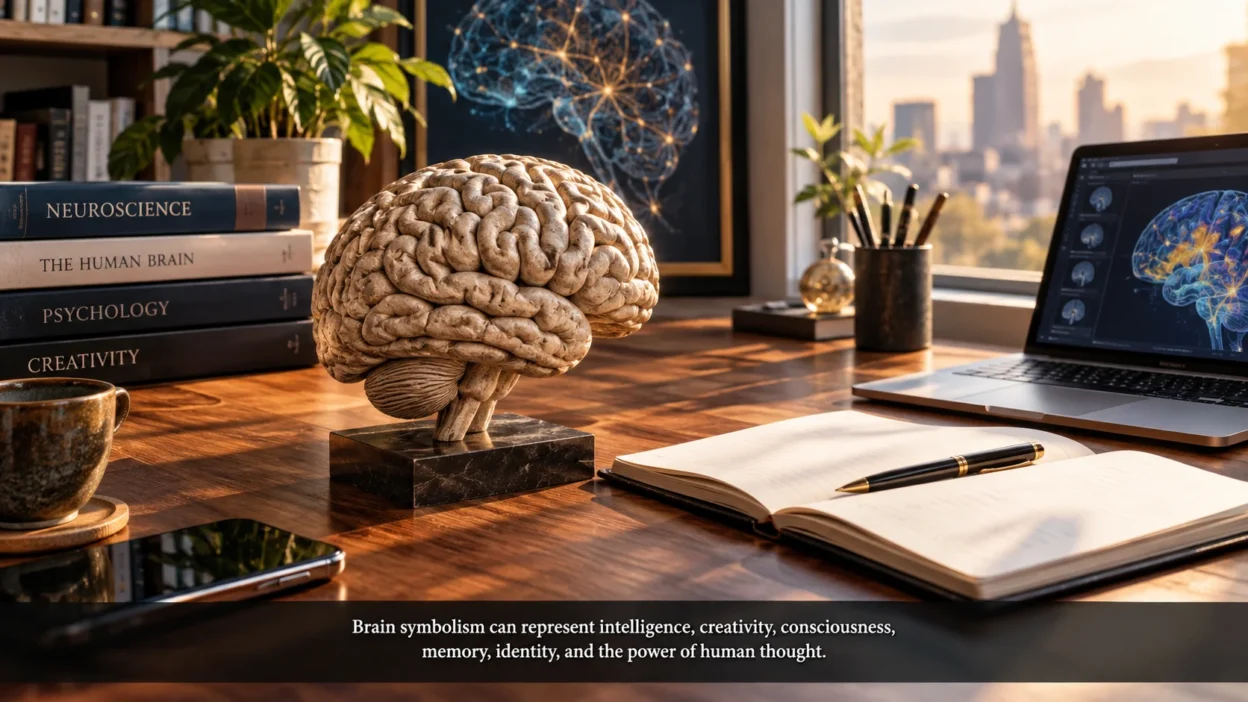
The human brain is one of the most powerful symbols of thought and identity. Brain Symbolism often represents intelligence, creativity, memory, consciousness, and the ability to understand the world.
In 2026, the brain also connects with education, science, technology, innovation, and personal achievement. You may see brain imagery in classrooms, medical settings, tattoos, artwork, technology, and social media.
However, the meaning goes beyond intelligence. The brain can represent curiosity, self-awareness, imagination, emotional complexity, and the endless search for knowledge.
Quick Answer
Brain Symbolism in the USA commonly represents intelligence, knowledge, creativity, memory, consciousness, and personal identity. More broadly, the brain can symbolize thought, wisdom, awareness, transformation, and the mystery of being human.
TL;DR
- The brain commonly symbolizes intelligence, knowledge, creativity, and awareness.
- Ancient traditions connected the head with thought, spirit, and personal identity.
- American culture strongly links the brain with education and scientific progress.
- Brain imagery can express curiosity, individuality, memory, or personal growth.
- Modern art uses the brain to explore technology, identity, emotions, and consciousness.
What Does the Brain Symbolize?
The brain is a physical organ, but people often use its image to express abstract ideas. Its complex shape makes it instantly recognizable and strongly connected with the human experience.
For American readers, the brain often suggests the power to learn and solve problems. However, it can also represent imagination, memory, emotions, and the private world inside a person.
Intelligence and Knowledge
The most familiar meaning is intelligence. A brain image can suggest learning, reasoning, education, or mental skill.
This association appears everywhere in American life. Schools, science programs, educational campaigns, and technology brands often use brain imagery to suggest knowledge.
Creativity and Imagination
The brain can also symbolize creative thinking. Artists, writers, designers, and inventors may use it to represent ideas forming inside the mind.
Because creativity isn’t visible, the brain provides a simple visual metaphor. It turns an invisible thought into something people can picture.
Consciousness and Identity
The brain is closely associated with consciousness and self-awareness. Therefore, it can represent the inner self and the question of what makes someone unique.
This meaning appears frequently in modern philosophy, science fiction, psychology, and contemporary art.
Ancient Roots of Brain Symbolism
People have wondered about the meaning and purpose of the brain for thousands of years. However, ancient cultures didn’t always understand its biological function as modern science does.
In several early traditions, the head held special importance because it contained the eyes, ears, mouth, and other senses. As a result, the head could represent awareness and human experience.
Ancient Egypt
Ancient Egyptian beliefs gave the brain an unusual place compared with the heart. The heart was often treated as especially important to identity, thought, and moral character.
During mummification, the brain was sometimes removed, while the heart received greater symbolic importance. This difference shows that ideas about thought and identity have changed considerably.
Ancient Greece
Greek thinkers debated where thought and sensation came from. Some philosophers emphasized the brain, while others gave greater importance to the heart.
Over time, medical investigation strengthened the connection between the brain and sensation, movement, and thought. These discussions helped shape later Western ideas about the mind.
The Head as a Symbol
Long before modern neuroscience, the head could symbolize authority and awareness. A person’s face and eyes revealed identity, while the head represented the seat of thought in many later interpretations.
Therefore, modern brain symbolism has older roots in the broader symbolism of the head and mind.
Brain Symbolism in the USA
American culture often connects the brain with education, invention, science, and achievement. This makes brain imagery especially common in schools, laboratories, technology, and professional environments.
At the same time, American culture increasingly treats mental life as part of personal identity. People discuss learning styles, creativity, memory, emotions, attention, and personal development in everyday language.
Education and Achievement
A brain icon can immediately suggest learning and academic effort. You may see it in educational illustrations, children’s materials, and discussions about studying.
However, the symbol doesn’t necessarily mean high intelligence. It can simply represent curiosity and the desire to learn.
Science and Innovation
The brain also represents scientific discovery. Neuroscience, artificial intelligence, psychology, medicine, and computer technology frequently use brain imagery.
In American culture, this creates an association between the brain and innovation. The symbol can suggest a future shaped by ideas and discovery.
Individual Thought
The United States places strong cultural emphasis on individuality and independent thinking. Therefore, the brain can represent independent thought and personal perspective.
A brain symbol may communicate a simple message: think for yourself.
| Context | Meaning in the USA | Common Associations | Notes |
| Education | Learning and intelligence | Schools, books, studying | Often represents curiosity |
| Science | Discovery and research | Neuroscience, medicine | Highlights human understanding |
| Technology | Innovation and computing | AI, digital tools | Can blur biological and digital ideas |
| Tattoos | Identity and individuality | Thought, memory, creativity | Meaning depends on the wearer |
| Art | Consciousness and complexity | Dreams, emotions, imagination | Often intentionally open-ended |
Spiritual and Cross-Cultural Meanings
Brain symbolism varies across cultures because ideas about the mind and spirit differ. In many traditions, the brain itself wasn’t always treated as the main location of consciousness.
For example, some religious and philosophical systems have historically emphasized the heart, breath, soul, or entire body instead.
Mind and Awareness
In some Buddhist traditions, awareness and mental activity receive major attention. However, reducing these ideas to the modern biological brain can oversimplify them.
The broader concept of the mind can involve perception, attention, thought, and awareness.
Head Symbolism
Across different traditions, the head can carry ideas of authority, sacredness, wisdom, or spiritual importance. However, these meanings don’t always equal modern brain symbolism.
For this reason, it’s useful to distinguish between the symbolic head and the biological brain.
Wisdom and Inner Knowledge
Brain imagery can also represent inner knowledge. Someone may choose it to express a personal journey toward greater awareness.
However, wisdom traditionally involves more than intelligence. It can include experience, judgment, compassion, and understanding.
Emotional and Psychological Meaning of the Brain
Although people usually connect the brain with logic, brain symbolism can represent emotions too. Modern culture increasingly recognizes that human thought and emotional experience are closely connected.
As a result, brain imagery can communicate complexity rather than simple rationality.
Common Emotional Associations
Brain symbols may suggest:
- Curiosity about the world and how things work
- Self-awareness and reflection
- Mental strength during difficult experiences
- Creativity and freedom of imagination
- Memory of people, places, or important moments
- Personal growth through learning and experience
Mental Strength
A brain can represent resilience and the ability to keep thinking through difficult situations. In this context, it becomes a symbol of mental endurance.
However, this interpretation should not suggest that emotional struggles are simply problems of willpower. Human experiences are more complicated than a single symbol can show.
Self-Discovery
People sometimes use brain imagery when exploring their identity. The symbol can represent questions such as “Who am I?” or “How do I see the world?”
Therefore, a brain tattoo or artwork may communicate an ongoing process rather than a fixed personality trait.
Brain Symbolism in Tattoos
Brain tattoos can carry deeply personal meanings. Some people choose them because they value education, science, creativity, memory, or independent thought.
Others use brain imagery to represent an important period of personal development.
Popular Brain Tattoo Ideas
Common approaches include:
- A realistic brain representing intelligence and scientific curiosity
- A colorful brain expressing creativity and imagination
- A brain with flowers suggesting growth and emotional development
- A brain with geometric patterns suggesting order and thought
- A brain connected to stars representing imagination and possibility
The surrounding imagery can change the message considerably. A brain with a heart, for example, can explore the relationship between reason and emotion.
Brain Symbolism in Art and Media
Artists often use the brain because it can represent something people cannot directly see: the inner world.
In American films, television, advertising, and digital media, brain imagery can suggest intelligence, mystery, science, technology, or psychological tension.
Brain and Technology
Modern technology has created a new layer of meaning. Digital networks and artificial intelligence often use brain-like graphics to suggest advanced thinking.
However, a computer system and a human brain aren’t the same thing. Brain imagery is often metaphorical rather than a literal description of how technology works.
Brain and Creativity
Artists may show brains filled with colors, plants, galaxies, buildings, or landscapes. These combinations turn the brain into a visual map of imagination.
This style works especially well because thoughts can contain many worlds at once.
Brain Symbolism in Social Media and Digital Culture
Online, brain imagery can communicate intelligence very quickly. It can also appear in jokes, educational posts, motivational content, and discussions about psychology.
However, digital culture sometimes reduces complicated ideas into simple labels.
Common Online Meanings
A brain graphic may suggest:
- Learning something new
- Having a clever idea
- Overthinking a situation
- Exploring psychology or emotions
- Improving personal habits
- Understanding a difficult concept
The surrounding text usually determines the intended meaning. A realistic brain in a science post differs greatly from a cartoon brain used in a joke.
Brain, Heart, and the Conflict Between Reason and Emotion
One of the most recognizable symbolic pairings is the brain and heart. The brain often represents reason, while the heart represents emotion and affection.
This contrast is powerful, but it can be misleading when treated as a strict division.
Reason Versus Emotion
Popular culture often presents decisions as either rational or emotional. However, real human decision-making involves many interacting processes.
Therefore, brain-and-heart imagery is best understood as a metaphor. It represents an inner tension that many people recognize.
Balance and Integration
A combined brain-and-heart design can instead symbolize balance. It may express the idea that good decisions can involve both thought and feeling.
This interpretation has become especially common in modern self-development and relationship imagery.
Brain Symbolism in Dreams and Personal Reflection
Dreams have long been associated with the hidden parts of the mind. Because of this, brain imagery can represent thoughts that remain outside everyday awareness.
However, there isn’t one universal meaning for seeing a brain in a dream. Personal experiences and the surrounding dream imagery matter.
Thinking and Overthinking
A brain appearing in a personal dream or artwork might reflect mental activity. It could represent planning, studying, worry, curiosity, or unresolved questions.
Rather than treating it as a fixed prediction, many people use such imagery as a prompt for reflection.
Memory
Because the brain is strongly associated with memory, it can symbolize the desire to preserve important experiences.
This is especially meaningful when paired with photographs, names, dates, or objects connected to someone’s past.
Misunderstandings and Controversies
Brain symbolism is generally positive, but some uses can become misleading. The biggest issue is the tendency to treat the brain as a simple explanation for complicated human behavior.
Intelligence Isn’t Everything
A brain symbol can accidentally suggest that intelligence has a single visible form. In reality, people have many different abilities and ways of learning.
Therefore, brain imagery works best as a broad symbol of mental life rather than a measurement of someone’s intelligence.
Brain Versus Mind
The words “brain” and “mind” are often used interchangeably in everyday conversation. However, they aren’t identical concepts.
The brain is a biological organ. The mind is a broader concept involving thoughts, experiences, awareness, and other mental processes.
Pop Culture Simplification
Movies and advertising sometimes portray the brain as a control center with simple switches for emotions or behavior. Such imagery is useful storytelling, but it doesn’t capture the full complexity of human biology.
Recognizing that difference helps keep the symbolism interesting without confusing metaphor with science.
How Brain Symbolism Has Changed Over Time
The meaning of the brain has shifted alongside human understanding. Ancient people had different ideas about thought, identity, and the body.
Later medical and philosophical traditions increasingly connected the brain with sensation and thought. Modern neuroscience then added a detailed biological framework.
From Mystery to Science
Earlier societies often treated thought as mysterious or spiritual. Today, the brain is also studied through biology, medicine, psychology, and technology.
Yet the mystery hasn’t disappeared. Questions about consciousness and personal identity remain deeply important.
From Intelligence to Identity
Older modern interpretations often focused on intelligence. Today, brain imagery can also represent identity, mental health awareness, creativity, memory, and personal growth.
This broader meaning reflects a culture increasingly interested in the inner life.
Why Brain Symbolism Still Matters Today
The brain remains powerful because it represents something every person experiences but cannot directly see: their inner world.
For American audiences, it connects naturally with education, innovation, independence, creativity, and scientific discovery. At the same time, it can express private experiences such as memory, imagination, reflection, and identity.
A Symbol of Human Potential
The brain can represent what a person might learn, imagine, create, or discover. This makes it especially fitting for educational and creative settings.
Read More: Mind Symbolism: Meaning, History, and Modern Uses
A Symbol of Complexity
A brain doesn’t have to mean “smart.” It can represent the complicated mixture of thoughts, memories, feelings, and experiences that make up a human life.
That broader interpretation gives the symbol lasting relevance.
FAQs
What does a brain symbolize?
A brain commonly symbolizes intelligence, knowledge, creativity, memory, awareness, and consciousness. In modern American culture, it can also represent education, innovation, and independent thinking.
What does a brain tattoo symbolize?
A brain tattoo may represent intelligence, creativity, personal identity, memory, or a love of science. Its meaning often becomes more specific through accompanying images such as flowers, stars, hearts, or geometric designs.
What does a brain and heart symbolize together?
A brain and heart commonly represent the relationship between reason and emotion. Together, they can also symbolize balance, thoughtful decisions, and the connection between thinking and feeling.
Does the brain symbolize wisdom?
Yes, a brain can symbolize wisdom, but intelligence and wisdom aren’t identical. Brain imagery usually emphasizes thought and knowledge, while wisdom often suggests experience and sound judgment.
What does a brain symbolize spiritually?
Spiritually, brain imagery can represent awareness, inner knowledge, consciousness, or the search for deeper understanding. Meanings vary widely because different spiritual traditions have different ideas about the mind and self.
Why is the brain a symbol of intelligence?
The association developed because thinking, learning, memory, and reasoning are strongly connected with the brain. Modern science reinforced an association that had already developed through centuries of philosophical and medical discussion.
Conclusion
Brain Symbolism represents much more than intelligence. It can express knowledge, creativity, memory, consciousness, individuality, curiosity, and the search for understanding. Whether it appears in a tattoo, artwork, classroom, or digital design, the brain invites a simple question: What makes us who we are? That question gives this symbol its lasting power.