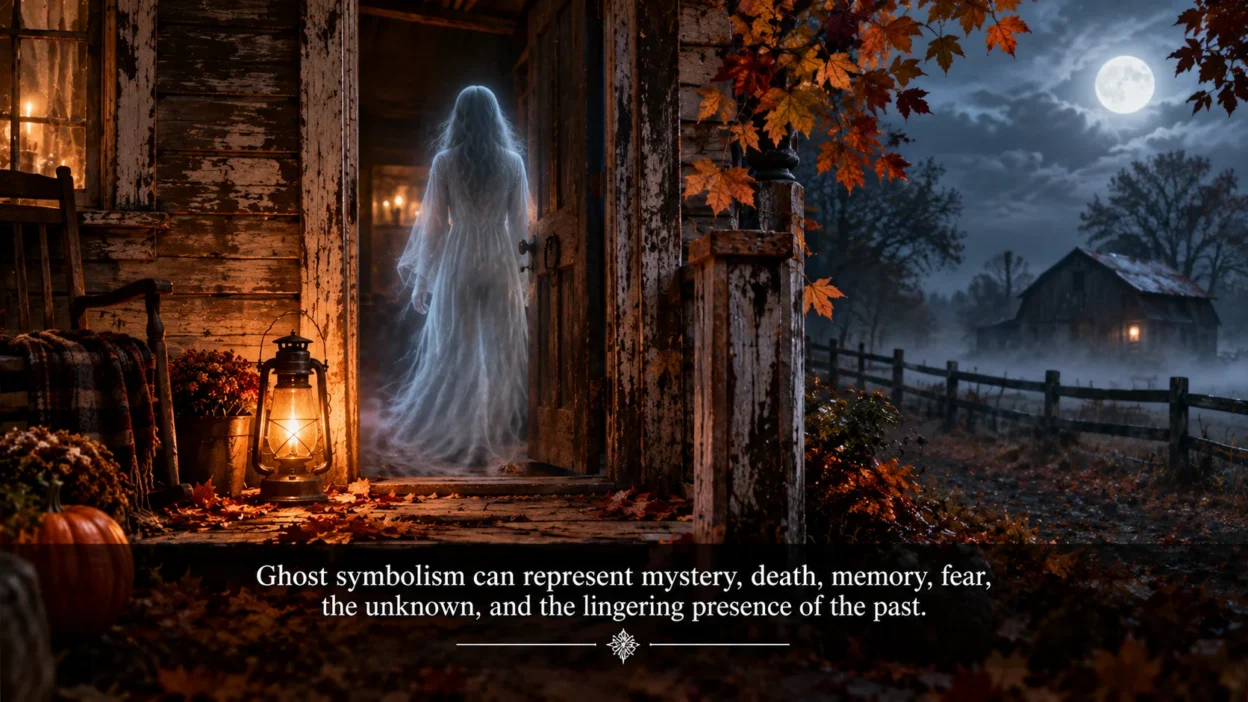
Ghost symbolism appears in folklore, literature, religion, art, movies, Halloween decorations, tattoos, and everyday expressions. A ghost usually appears as a pale human figure, shadowy presence, misty shape, or translucent spirit. Its meaning often depends on the story and setting.
In 2026, ghosts are strongly connected with Halloween, haunted houses, horror movies, and American folklore. However, the symbol can also represent grief, memory, unfinished business, mystery, or something that refuses to disappear.
Across history, people have used ghost stories to explore questions about death and what might exist beyond ordinary experience. Today, the ghost remains both frightening and playful, making it one of the most flexible symbols in popular culture.
Quick Answer
Ghost symbolism in the USA commonly represents death, mystery, memory, fear, and the unknown. More broadly, ghosts can symbolize the past, unresolved emotions, spiritual presence, transformation, or the boundary between life and death.
TL;DR
- Ghosts often symbolize death, mystery, memory, and the unknown.
- American culture strongly connects ghosts with Halloween and horror.
- Ancient cultures had varied ideas about spirits and the dead.
- A ghost can represent grief or an unresolved past.
- Modern media often makes ghosts frightening, funny, or sympathetic.
What Does a Ghost Symbolize?
A ghost is usually shown as an unusual human presence connected with death or the supernatural. Traditional images include pale faces, flowing white shapes, shadows, mist, or transparent bodies.
However, there isn’t one universal meaning. A ghost can frighten someone in a horror story while representing remembrance in a memorial context.
Common Ghost Meanings
Several ideas repeatedly appear around ghost imagery:
• Death and the boundary between life and death
• Mystery surrounding what cannot be easily explained
• Memories that remain after someone is gone
• Fear of the unknown or unseen
• Unfinished experiences from the past
• Spiritual presence or connection
The setting changes the emotional effect. A ghost beside an abandoned house feels mysterious, while a small cartoon ghost can feel playful.
Ghost Symbolism in Ancient Cultures
Ideas about ghosts are much older than modern horror stories. Ancient societies developed many different explanations for what happens to a person after death.
Some traditions imagined the dead as continuing in another realm. Others believed spirits could remain connected to families, places, or unfinished duties.
Ancient Beliefs About Spirits
Ancient Mesopotamian cultures had beliefs about the dead and the importance of funerary practices. In ancient Egypt, ideas about the afterlife were closely connected with religious rituals and the continued existence of the deceased.
Ancient Greek traditions also included stories of the dead appearing among the living. Roman culture inherited and developed many ideas about spirits, omens, and restless dead.
These traditions weren’t identical. Still, they show a recurring human concern: death may end physical life, but the relationship with the dead can continue through memory, ritual, and storytelling.
The Restless Dead
Stories about restless spirits often involve something left incomplete. A person might return because of an injustice, broken promise, improper burial, or unresolved attachment.
This idea later became important in European ghost folklore. It also influenced modern stories about haunted houses and spirits seeking closure.
Ghost Symbolism in American Culture
Ghosts became deeply embedded in American storytelling through Indigenous traditions, European folklore, African American spiritual traditions, colonial stories, and later popular entertainment.
The result is not one single American ghost tradition. Instead, American ghost culture developed from many overlapping sources.
American Folklore
European settlers brought supernatural stories involving spirits, witches, haunted places, and apparitions. Over time, these ideas mixed with local landscapes and American history.
Legends connected to old houses, battlefields, cemeteries, rivers, hotels, and historic towns became part of American folklore.
Some stories are presented as supernatural encounters. Others are treated as legends that help communities remember unusual people or events.
Halloween and Popular Culture
Halloween transformed the ghost into one of America’s most recognizable seasonal symbols.
Today, ghost decorations appear on front porches, greeting cards, costumes, store displays, and social media posts. The familiar white-sheet ghost has also become a simple visual shorthand for Halloween.
In children’s culture, ghosts are often cute rather than frightening. This shift shows how the same symbol can move between fear and humor.
What Does a Ghost Mean Spiritually?
Spiritual interpretations of ghosts vary widely between religions, cultures, and individuals. Some traditions distinguish carefully between ancestors, spirits, angels, demons, and other supernatural beings.
Because these categories differ, it’s better to avoid treating every ghost belief as the same.
Spirits and the Afterlife
In some religious and cultural traditions, the dead are understood to have an existence beyond physical life. Stories about spirits may therefore reflect ideas about remembrance, judgment, ancestors, or the afterlife.
However, not every spiritual tradition views ghosts as ordinary returning humans. Some traditions reject or reinterpret the idea of ghosts entirely.
Ancestors and Memory
In cultures with strong ancestor traditions, communication with or remembrance of the dead can carry important family meaning. The concept doesn’t always resemble the frightening ghost of American horror.
Instead, the deceased may represent family continuity, heritage, wisdom, or remembrance.
Ghost Symbolism and Death
Death is one of the strongest meanings associated with ghost imagery. A ghost visually connects the living world with something that appears to have passed beyond it.
However, ghost symbolism isn’t always about death itself. It can also explore how people remember those who have died.
Between Life and Death
A ghost is often imagined as occupying an uncertain middle position. It looks human but isn’t physically alive in the ordinary sense.
That ambiguity gives the image much of its symbolic power. It represents a boundary that people cannot directly experience or fully explain.
Memory After Loss
Ghost imagery can also symbolize someone who remains emotionally present after death. In this sense, the ghost becomes a metaphor for memory rather than a literal supernatural claim.
For example, a person might describe a loved one’s presence as lingering in a familiar home, song, photograph, or object.
Ghost Symbolism and Fear
Ghosts are powerful symbols of fear because they represent something unseen. They challenge the idea that people can understand and control everything around them.
American horror has made this association especially strong.
Why Ghosts Feel Scary
Ghost stories often create fear through uncertainty rather than physical violence. The audience doesn’t know where the ghost is, what it wants, or whether it can be stopped.
This uncertainty activates the imagination. A dark hallway can feel more frightening when viewers believe something invisible may be there.
The Fear of the Unknown
Ghosts also represent a broader fear of uncertainty. They can symbolize questions about death, consciousness, the past, and experiences beyond ordinary explanation.
Because these questions have no universally accepted answers, ghost stories remain emotionally effective.
Ghost Symbolism and Psychology
Ghost imagery can work as a metaphor for thoughts, memories, emotions, or experiences that remain difficult to leave behind.
A person may describe a painful memory as “haunting” them without meaning anything supernatural.
The Past That Remains
In literature and everyday language, ghosts often represent the past returning to the present. This can include regret, grief, guilt, nostalgia, or unresolved relationships.
The symbol works because people understand what it means to carry something invisible from the past.
Emotional Associations
Ghost imagery can evoke different feelings depending on its presentation:
| Context | Meaning in the USA | Common Associations | Notes |
| Halloween | Seasonal mystery | Costumes, decorations, parties | Often playful |
| Horror | Fear and uncertainty | Haunted houses, darkness | Usually threatening |
| Memorial | Remembrance | Grief, memory, photographs | More emotional than frightening |
| Literature | The returning past | Secrets, guilt, history | Often metaphorical |
| Cartoon art | Humor and playfulness | Cute characters, stickers | Less connected to death |
Ghost Symbolism in Literature and Art
Writers have used ghosts for centuries because they can represent both literal supernatural beings and deeper ideas.
A ghost can reveal secrets, challenge a character, represent guilt, or connect the present with history.
Ghosts as Metaphors
In literature, a ghost may represent an old social problem that refuses to disappear. It can also symbolize guilt that a character cannot escape.
American writers have often used haunted places to explore memory, history, identity, and inherited trauma. The supernatural setting can make difficult subjects easier to examine indirectly.
Visual Art
Artists can use ghostly forms to create feelings of absence and uncertainty. Transparent figures, faded photographs, empty clothing, and blurred silhouettes can all suggest someone who is no longer present.
As a result, ghost imagery doesn’t require a literal supernatural interpretation.
Ghost Symbolism in Tattoos
Ghost tattoos can combine spooky imagery with deeply personal meanings. The design might represent humor, remembrance, mystery, independence, or an interest in horror.
Popular Ghost Tattoo Ideas
Common approaches include:
• Minimal ghost outlines for a simple playful design
• Traditional ghost figures inspired by Halloween imagery
• Ghosts combined with flowers for life and death contrasts
• Haunted houses paired with ghosts for mystery and memory
• Small cartoon ghosts representing humor and individuality
A ghost tattoo doesn’t automatically indicate a belief in spirits. For many people, it simply represents an aesthetic, personal memory, or love of spooky culture.
Ghosts in Social Media and Digital Culture
The ghost has become a highly recognizable digital symbol. Its meaning can range from Halloween humor to disappearing relationships.
The Snapchat ghost is one familiar example of how ghost imagery entered digital communication and branding. More generally, people use ghost language to describe disappearing from conversations or social spaces.
“Ghosting” and Disappearing
The modern term “ghosting” describes abruptly ending communication without explanation. It extends the older idea of a ghost being present one moment and absent the next.
This newer meaning isn’t primarily supernatural. Instead, it uses ghost imagery as a metaphor for sudden social disappearance.
Emojis and Online Expression
Ghost imagery online can communicate several moods:
• Halloween excitement and seasonal humor
• Playful references to spooky subjects
• Absence or sudden disappearance
• Interest in horror and supernatural stories
• Nostalgia for childhood Halloween traditions
Ghost Symbolism in Home Decor and Holidays
Ghost decorations are especially common in American homes during October. They appear in yards, windows, porches, party spaces, and seasonal displays.
However, modern ghost decor often looks cheerful rather than frightening.
Halloween Decor
Classic white ghosts remain popular because they’re instantly recognizable. Designers may also use fabric, paper, lights, wood, ceramic figures, or inflatable decorations.
Today, ghost decor can range from traditional horror to cute farmhouse-inspired designs. This flexibility has helped the symbol remain popular across generations.
Beyond Halloween
Outside Halloween, ghost imagery can appear in gothic interiors, horror-themed collections, artwork, books, and novelty items.
In these settings, the symbol often communicates personality or aesthetic taste rather than literal supernatural belief.
Ghost Symbolism Across Cultures
Ghost traditions exist in many parts of the world, but their meanings aren’t interchangeable.
Different cultures have distinct ideas about death, ancestors, spirits, rituals, and the relationship between the living and dead.
Different Cultural Interpretations
Japanese folklore includes various types of spirits and supernatural beings, with meanings shaped by specific stories and traditions. Chinese traditions include important concepts involving ancestors and remembrance.
European folklore contains many traditions about restless spirits and haunted locations. Meanwhile, many Indigenous cultures in North America have distinct spiritual traditions that shouldn’t be reduced to the generic Western idea of a “ghost.”
The safest interpretation is therefore contextual. A spirit figure should be understood within the culture that produced it.
Ghost Misunderstandings and Controversies
Ghost symbolism can become misleading when very different cultural traditions are treated as one universal belief.
A cartoon Halloween ghost, an ancestral figure, and a religious concept of the dead may look similar but carry very different meanings.
Avoiding Cultural Generalizations
Not every culture believes ghosts behave the same way. Some traditions focus on ancestors, while others distinguish spirits from deceased humans.
Likewise, describing all spiritual traditions through horror imagery can erase important differences.
From Sacred to Commercial
Ghost imagery can also move from spiritual contexts into entertainment and commercial culture. Halloween helped make supernatural symbols widely accessible as decorations and costumes.
This doesn’t necessarily mean the original traditions disappeared. Instead, different meanings can exist beside one another.
How Ghost Meaning Has Changed Over Time
Ghost symbolism has shifted from religious and folklore contexts toward entertainment, psychology, fashion, and digital language.
The older connection with death remains strong. However, modern culture has added humor, nostalgia, personal identity, and social meanings.
From Spirits to Symbols
Earlier ghost stories often focused on whether the dead could return. Modern stories frequently use ghosts to explore emotional or social issues.
A haunted house might now symbolize family history. A ghost character might represent loneliness, memory, or an inability to move forward.
Read More: Angel Symbolism: Meaning, History, and Modern Uses
From Fear to Humor
American Halloween culture has also softened the ghost’s image. Cute ghosts, cartoon characters, plush toys, and playful decorations are common.
Therefore, a ghost doesn’t always signal danger. Context determines whether the symbol feels frightening, sad, mysterious, or funny.
FAQs
What does a ghost symbolize in America?
In the United States, ghosts commonly symbolize death, mystery, fear, Halloween, and the unknown. They can also represent memories or people from the past who remain emotionally important.
What does a ghost symbolize spiritually?
Spiritual meanings vary between traditions. A ghost may represent a deceased person, spiritual presence, ancestral connection, or unresolved existence, depending on the belief system.
What does a ghost symbolize in dreams?
Ghost imagery in dreams can be interpreted in many ways, so there is no single universal meaning. Symbolically, it may represent memory, fear, loss, the past, or something that feels unresolved.
Why are ghosts associated with Halloween?
Halloween developed traditions involving death, spirits, costumes, and supernatural imagery. Ghosts became one of the clearest visual symbols for these themes in American Halloween culture.
What does a ghost tattoo mean?
A ghost tattoo can represent mystery, remembrance, humor, individuality, death, or an interest in spooky culture. Its personal meaning depends mainly on the wearer and accompanying design.
What does ghosting mean?
Ghosting describes suddenly ending communication without explanation. The term uses the idea of a person becoming like a ghost by disappearing from another person’s social life.
Conclusion
Ghost symbolism brings together ideas about death, mystery, memory, fear, and the unknown. In every culture, it has also become closely connected with Halloween, horror, humor, and popular entertainment. At the same time, ghosts can represent something much more personal. They may stand for a remembered person, an unresolved past, or a question that has no simple answer. Ultimately, Ghost Symbolism shows how one familiar image can move between folklore, emotion, spirituality, and everyday culture.