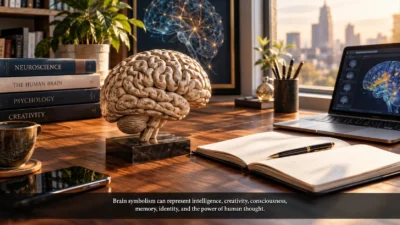
Mind symbolism refers to the many images and ideas people use to represent thought, awareness, intelligence, memory, imagination, and inner life. In American culture, these meanings often appear through the brain, head, eyes, books, light bulbs, clouds, mirrors, and abstract patterns.
The mind is invisible, yet people have always searched for ways to picture it. As a result, mind symbols connect physical images with private experiences such as thinking, remembering, dreaming, and making choices.
Today, these symbols appear in education, art, tattoos, social media, psychology-inspired designs, home decor, and popular culture. They can also express curiosity, personal growth, creativity, or a desire to understand yourself.
Quick Answer
Mind symbolism usually represents thought, intelligence, awareness, memory, imagination, and inner identity in the USA. More broadly, it can symbolize wisdom, consciousness, self-knowledge, spiritual reflection, and the unseen world of human thought.
TL;DR
- The mind commonly symbolizes thought, awareness, intelligence, and identity.
- Ancient cultures connected the head with wisdom and spiritual power.
- American culture often links the mind with learning and personal growth.
- Brains, books, eyes, light, and mirrors can represent mental activity.
- Modern designs use mind imagery to express creativity and self-discovery.
- Meanings depend strongly on context, culture, and personal experience.
What Does Mind Symbolism Represent?
The mind is usually represented through images rather than one fixed symbol. A brain may suggest intelligence, while an open book can suggest knowledge or learning.
However, symbolic meaning depends on context. A glowing head might represent inspiration, while a maze inside a head could suggest confusion, self-discovery, or complex thinking.
Common Mind Symbols
Several images repeatedly appear when people want to represent the mind:
• Brain imagery often represents intelligence, thought, or mental ability.
• Books can symbolize knowledge, learning, memory, and intellectual curiosity.
• Light often represents insight, understanding, inspiration, or discovery.
• Mirrors can suggest self-awareness, reflection, identity, or inner examination.
• Eyes may symbolize perception, awareness, observation, and deeper understanding.
• Clouds can represent imagination, dreams, thoughts, or mental distraction.
Because these images overlap, no single interpretation always applies.
Historical Origins of Mind Symbolism
Ideas about the mind existed long before modern neuroscience. Ancient societies often connected thought with physical parts of the body, especially the head, heart, or breath.
Over time, these ideas changed as philosophy, religion, medicine, and science developed. The modern brain became increasingly important as people learned more about the nervous system.
Ancient Roots
Ancient Egyptians placed strong importance on the heart as a center of thought, character, and moral identity. The brain also had a physical role, although ancient Egyptian ideas about consciousness differed greatly from modern ones.
In ancient Greek thought, philosophers debated where thought and perception originated. Some traditions emphasized the brain, while others gave the heart a central role.
The head itself also carried symbolic importance. It could represent identity, authority, wisdom, and the individual person.
From Philosophy to Science
Later European traditions continued debating the relationship between body and mind. Religious art often used light, halos, eyes, books, and elevated positions to suggest wisdom or spiritual understanding.
During the scientific revolution and later developments in medicine, the brain became increasingly connected with thought and behavior. Today, brain imagery often stands for the mind even though the concepts aren’t identical.
Mind Symbolism in American Culture
In the United States, mind symbolism is strongly connected with education, independence, innovation, and personal development. American culture often celebrates the ability to think independently and solve problems.
Schools reinforce this meaning through books, graduation imagery, academic symbols, and language about expanding the mind. Meanwhile, technology and science often use brain imagery to represent intelligence and innovation.
Education and Knowledge
Books, glasses, pencils, light bulbs, and brains frequently appear in educational settings. Together, they suggest learning and intellectual growth.
The idea of an “open mind” is also common in American culture. It generally suggests willingness to consider new ideas rather than accepting only familiar beliefs.
Individual Identity
Mind symbolism can also represent individuality. A person’s thoughts, memories, beliefs, imagination, and experiences contribute to how they understand themselves.
This makes mind imagery especially useful in personal artwork. Someone may choose a brain, eye, mirror, or abstract head design to express an inner journey.
What Does the Mind Symbolize in America?
American interpretations often connect the mind with freedom of thought and personal development. These ideas appear in education, self-help culture, creative work, science, and everyday speech.
However, American meanings aren’t completely separate from older traditions. Many modern symbols still borrow familiar images of light, wisdom, reflection, and knowledge.
| Context | Meaning in the USA | Common Associations | Notes |
| Education | Learning and intelligence | Books, graduation, studying | Often celebrates intellectual growth |
| Science | Discovery and knowledge | Brain, laboratory, technology | Focuses on understanding how things work |
| Art | Inner identity and imagination | Abstract heads, colors, shapes | Meaning can be highly personal |
| Self-development | Awareness and growth | Mirrors, journals, light | Often linked with reflection |
| Technology | Innovation and problem-solving | Digital brains, networks | Common in modern visual design |
Freedom of Thought
The mind can represent the ability to form independent opinions. In this sense, it becomes a symbol of intellectual freedom.
American cultural ideas about individual liberty can therefore overlap with mind symbolism. Yet the exact meaning depends on the setting and the creator’s intention.
Spiritual and Cross-Cultural Meanings of the Mind
Many cultures have treated thought, consciousness, dreams, and inner awareness as important parts of human existence. However, traditions explain these ideas in very different ways.
Some spiritual traditions distinguish between ordinary thoughts and deeper awareness. Others connect the mind with the soul, heart, breath, or a larger spiritual reality.
Inner Awareness
In several contemplative traditions, attention and awareness are important practices. The mind may be viewed as something that can become calmer, clearer, or more focused.
However, these traditions shouldn’t be reduced to one universal meaning. Their ideas developed within distinct religious and philosophical systems.
Wisdom and Reflection
Across many cultures, wisdom is associated with reflection rather than simply possessing information. This is why symbols such as elderly faces, books, eyes, lamps, and quiet landscapes can suggest mental wisdom.
The broader theme is understanding gained through experience.
Psychological Meaning of Mind Symbols
Mind symbols often communicate something about a person’s inner world. They can suggest curiosity, self-awareness, creativity, uncertainty, or personal transformation.
However, symbolic interpretation isn’t a diagnosis. The same image can carry completely different emotional meanings for different people.
What Mind Imagery Can Suggest
A person might use mind symbolism to express:
• Curiosity about how people think and understand the world.
• A strong interest in learning, science, philosophy, or creativity.
• Personal reflection after a major experience or life change.
• The importance of memory, imagination, dreams, or identity.
• A desire to understand hidden thoughts and emotions.
• Growth from confusion toward greater awareness and understanding.
These associations explain why mind imagery works well in personal art.
Mind Symbolism and Intelligence
The brain is probably the most direct modern image of intelligence. It appears in classrooms, scientific illustrations, technology designs, and educational materials.
Yet intelligence isn’t always represented literally. Light bulbs, books, owls, glasses, and complex geometric patterns can also communicate intelligence.
Brain Versus Mind
The words “brain” and “mind” are related but aren’t interchangeable in every context. The brain refers to a physical organ, while the mind can describe thoughts, experiences, awareness, and mental activity.
Therefore, a brain symbol may emphasize biology or intelligence. A more abstract mind symbol may focus on consciousness, imagination, or identity.
Mind Symbolism in Art and Literature
Artists have long used the head, face, eyes, and interior spaces to explore private thought. Literature also turns the mind into a symbolic landscape filled with memories, dreams, fears, and desires.
A character staring into a mirror, for example, may be confronting identity. A maze may represent difficult thinking, uncertainty, or a complicated inner journey.
Visual Metaphors
Modern artwork may place entire landscapes inside a human head. This creates a visual connection between the outer world and inner experience.
Similarly, floating objects around a person’s head can suggest memories or ideas. These designs are common because they communicate complex concepts without many words.
Mind Symbolism in Tattoos
Mind-themed tattoos often carry personal meanings. A person may choose a brain to represent intelligence, an eye for awareness, or a maze for an ongoing personal journey.
However, tattoo symbolism is highly individual. The same design can represent different memories or values for different people.
Popular Design Ideas
Common approaches include:
• A brain combined with flowers for growth and intellectual creativity.
• An eye paired with geometric shapes for awareness and perception.
• A head containing stars for imagination and possibility.
• A maze representing uncertainty, choices, or personal discovery.
• A book combined with light to symbolize learning and insight.
Personal context usually matters more than a fixed symbolic dictionary.
Mind Symbolism in Social Media and Modern Design
Digital culture has made mind imagery even more recognizable. Brain icons, thought bubbles, eyes, light bulbs, and abstract heads can communicate ideas quickly.
Today, creators may use these images to discuss creativity, learning, productivity, psychology, or personal reflection.
Thought Bubbles and Digital Symbols
Thought bubbles are especially familiar in cartoons and digital communication. They visually show that something is happening inside someone’s mind.
Meanwhile, emojis and simple icons often reduce complex ideas to instantly recognizable shapes. Their meanings can change depending on the surrounding message.
Mind Symbolism in Home Decor and Lifestyle
Mind-themed decor often appears in offices, libraries, classrooms, studios, and creative spaces. Books, sculptures, abstract faces, and inspirational artwork can create an atmosphere of learning or reflection.
In American homes, these objects may also express personality. A study filled with books can suggest curiosity, while abstract artwork may emphasize imagination rather than literal knowledge.
Creating a Reflective Atmosphere
Decor can use soft lighting, mirrors, journals, artwork, and natural materials to suggest calm thought. These choices don’t have one universal meaning.
Instead, they create an environment associated with reflection, creativity, or quiet attention.
Misunderstandings and Controversies
Mind symbolism rarely has one universally accepted meaning. Problems usually arise when people assume that a particular image must represent one fixed belief or identity.
Brain imagery, for example, can represent intelligence, neuroscience, mental struggle, education, or simply an interest in anatomy.
Context Matters
A symbol’s meaning can change based on its surrounding imagery. A brain surrounded by flowers feels different from a brain surrounded by broken glass.
Likewise, a mirror can represent self-knowledge in one artwork and vanity or insecurity in another.
Avoiding Overinterpretation
Symbolism is useful because it allows multiple layers of meaning. However, readers shouldn’t assume they know someone’s beliefs simply because of a tattoo, decoration, or artwork.
Personal intention remains an important part of interpretation.
How Mind Symbolism Has Changed Over Time
Mind symbolism has moved from broad philosophical and spiritual ideas toward increasingly scientific and psychological interpretations. Yet older themes such as wisdom, awareness, and inner knowledge remain visible.
Today, a brain can symbolize neuroscience while also representing creativity. A mirror can suggest psychology while still carrying older associations with self-reflection.
Read More: Soul Symbolism: Meaning, History, and Modern Uses
From the Invisible to the Visual
People once relied heavily on metaphors to describe invisible mental experiences. Modern science provides more knowledge about the brain, but symbolism remains useful because consciousness is still experienced personally.
As a result, modern mind imagery often combines scientific and artistic elements.
Old Symbols, New Meanings
Some traditional symbols continue to evolve:
• Light remains associated with insight and understanding.
• The eye continues to suggest awareness and perception.
• The mirror still represents self-reflection and identity.
• Books remain powerful symbols of knowledge and learning.
• The brain now strongly represents modern ideas about cognition.
The symbols survive because their basic themes remain relevant.
FAQs
What does mind symbolism mean?
Mind symbolism usually represents thought, awareness, intelligence, memory, imagination, and identity. Its meaning depends on the specific image and context.
What symbolizes the human mind?
The brain is the most direct modern symbol of the mind. Eyes, books, mirrors, light bulbs, clouds, and abstract heads can also represent different aspects of mental life.
What does a brain symbolize spiritually?
A brain can symbolize consciousness, wisdom, awareness, or the search for deeper understanding. Spiritual interpretations vary widely between traditions.
What does a mind tattoo symbolize?
A mind-themed tattoo can represent intelligence, creativity, self-awareness, memory, personal growth, or curiosity. The meaning usually comes from the person’s chosen design and life experience.
Why is the brain a symbol of intelligence?
Modern science strongly connects the brain with thinking, memory, learning, and behavior. As a result, brain imagery became a familiar visual shorthand for intelligence.
What does an open mind symbolize?
An open mind commonly represents curiosity, tolerance of different ideas, flexibility, and willingness to learn. In American culture, it can also suggest independent thinking and personal growth.
Conclusion
Mind symbolism connects visible images with invisible experiences such as thought, memory, awareness, imagination, and identity. In the United States, it often reflects learning, creativity, independence, science, and personal growth. Across history, Mind Symbolism has changed as ideas about consciousness and the brain have developed. Yet its central purpose remains familiar: giving visual form to the inner world. Whether it appears in art, tattoos, books, digital designs, or home decor, mind imagery invites people to think about what happens beneath the surface.