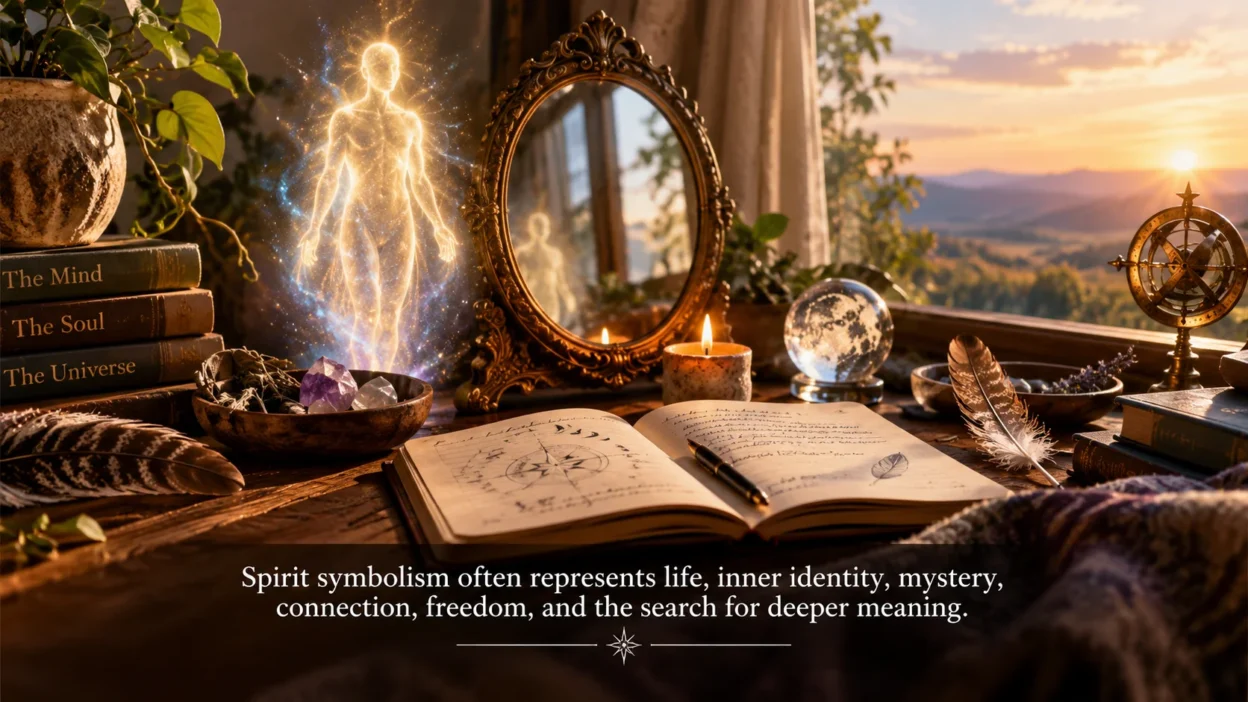
The idea of spirit has appeared in human stories for thousands of years. People have used light, breath, wind, birds, flames, and human figures to express something unseen but deeply meaningful.
In World, spirit symbolism often connects with personal identity, faith, nature, freedom, memory, and inner strength. It can appear in religious art, tattoos, jewelry, literature, films, home decor, and personal rituals.
However, the meaning of a spirit symbol depends heavily on context. A white feather may suggest peace to one person, while another may see it as a sign of remembrance or spiritual connection.
Quick Answer
Spirit symbolism in the USA commonly represents life, inner identity, freedom, mystery, connection, and something beyond the physical self. Across wider traditions, spirits may also symbolize ancestors, nature, breath, divine presence, or the unseen parts of human existence.
TL;DR
- Spirit symbols often express life, identity, mystery, freedom, and inner connection.
- Ancient traditions connected spirit with breath, wind, fire, and invisible forces.
- American culture often links spirit with faith, individuality, nature, and remembrance.
- Feathers, flames, wings, stars, and light commonly suggest spiritual ideas.
- Modern tattoos and art use spirit imagery to express personal beliefs or memories.
- Meanings can change greatly between religions, cultures, families, and individuals.
What Is Spirit Symbolism?
Spirit symbolism gives visible form to an invisible idea. Because people cannot directly see a spirit, cultures have often represented it through familiar images.
Common Forms of Spirit Symbols
Spirit imagery can appear in many shapes, colors, materials, and settings. Light is especially common because it suggests something powerful without having a physical body.
Common examples include:
- Light for awareness, purity, hope, or divine presence
- Fire for life, transformation, passion, or sacred energy
- Wind for movement, freedom, breath, or invisible presence
- Feathers for freedom, remembrance, or spiritual connection
- Wings for transcendence, protection, or movement beyond earthly limits
- Stars for guidance, eternity, or connection to the heavens
However, none of these meanings is universal. Context matters more than the object alone.
Spirit and the Invisible World
Spirit symbolism often creates a bridge between the physical and invisible worlds. A candle, for example, is physically small but can represent something much larger.
Likewise, an open sky may suggest freedom or spiritual possibility. A quiet forest can symbolize mystery, reflection, and connection with nature.
Ancient Roots of Spirit Symbolism
Ideas about spirit are much older than modern religions or spiritual movements. Early humans often connected life with breath, movement, dreams, weather, and natural forces.
Breath, Wind, and Life
Across many ancient cultures, breath became closely connected with life. A living person breathed, while a dead person no longer did.
This connection helped make air and wind powerful symbols. Something invisible could still move leaves, carry sound, and affect the human body.
Ancient languages also developed words connecting breath, wind, spirit, or life force. These relationships influenced later religious and philosophical ideas.
Fire and Sacred Presence
Fire became another major spiritual image. It gave warmth and light while also transforming whatever it touched.
For this reason, fire could represent life, purification, sacrifice, energy, or transformation. Its flickering movement also made it seem alive.
Ancient and later religious traditions used flames in ceremonies and sacred spaces. Over time, the image continued into candles, lamps, memorials, and personal rituals.
Birds and the Sky
Birds naturally became symbols of the spirit because they move between earth and sky. Their flight can suggest freedom and movement beyond ordinary human limits.
Different cultures gave different meanings to specific birds. However, the broader connection between flight and transcendence remains widespread.
Spirit Symbolism in the USA
American interpretations of spirit symbolism reflect several traditions at once. Christianity, Indigenous traditions, immigration, literature, popular culture, and individual spirituality have all shaped the country’s symbolic landscape.
Faith and Religious Life
For many Americans, spirit symbolism appears through Christian imagery. Doves, flames, light, angels, crosses, and heavenly imagery can communicate spiritual ideas.
However, Americans practice many different religions and spiritual traditions. Therefore, there isn’t one single American interpretation of spirit imagery.
Freedom and Individual Identity
The word “spirit” also has a strong connection with American ideas about individuality. Expressions such as “free spirit” suggest independence, creativity, and resistance to strict expectations.
This meaning appears outside formal religion. Someone may describe an adventurous person as having a strong spirit, for example.
Nature and the American Landscape
American landscapes also provide powerful spiritual imagery. Mountains, deserts, forests, oceans, and open skies often appear in spiritual photography and artwork.
These places can suggest solitude, wonder, renewal, or a connection with something larger than everyday life.
| Context | Meaning in the USA | Common Associations | Notes |
| Religious art | Sacred presence or divine connection | Light, dove, flame | Meaning depends on faith tradition |
| Memorials | Remembrance and continued connection | Candle, feather, star | Often connected with loved ones |
| Nature imagery | Freedom and inner reflection | Mountains, sky, forests | Common in personal spirituality |
| Tattoos | Identity and personal belief | Wings, feathers, symbols | Usually highly individual |
| Literature | Inner character and moral strength | Soul, fire, shadow | Meaning changes with the story |
Spiritual Meanings Across Cultures
Spirit symbolism exists across many cultures, although its meanings are not identical. Some traditions describe spirits as ancestors, natural beings, divine forces, or parts of the human person.
Ancestors and Remembrance
In many cultures, ancestors remain important after death. Symbols connected with family, candles, photographs, flowers, or particular animals may express remembrance.
However, beliefs about ancestors differ significantly. A respectful interpretation should avoid treating every tradition as having the same concept of spirit.
Nature and Spiritual Presence
Some Indigenous and traditional cultures have rich relationships with animals, landscapes, ancestors, and spiritual beings. These systems cannot be reduced to a single universal idea of “nature spirituality.”
For American readers, this distinction matters. Indigenous nations have distinct histories, languages, beliefs, and ceremonial practices.
Religious Interpretations
Christianity, Judaism, Islam, Hindu traditions, Buddhism, and many other traditions discuss spiritual realities in different ways.
Some emphasize the soul, divine presence, moral life, rebirth, liberation, or a relationship with God. Therefore, a symbol should always be understood within its particular tradition.
Emotional and Psychological Meaning of Spirit
Spirit imagery often speaks to feelings that are difficult to describe directly. It can give shape to questions about identity, purpose, loss, hope, and personal growth.
Inner Strength
People frequently use “spirit” to describe courage during difficult periods. A strong spirit can suggest persistence, hope, or the ability to continue after hardship.
This meaning is especially common in everyday American speech. Someone may praise another person’s “fighting spirit” without making a religious statement.
Mystery and Self-Reflection
Spirit symbols can also create a sense of mystery. Shadows, stars, moonlight, open doors, and distant horizons can suggest questions without providing simple answers.
As a result, spiritual imagery often appears in journals, meditation spaces, personal artwork, and reflective photography.
Grief and Connection
Spirit symbolism can become particularly meaningful after someone dies. A photograph, feather, candle, or favorite object may serve as a personal reminder.
For some people, these objects represent spiritual connection. For others, they simply preserve memory. Both interpretations can be meaningful without requiring the same belief.
Spirit Symbols in Tattoos and Body Art
Spirit imagery is common in American tattoo culture because it can combine personal identity with visual symbolism.
Popular Designs
Wings, feathers, flames, birds, stars, trees, eyes, halos, and celestial imagery can all suggest spiritual ideas.
However, the intended message usually comes from the person wearing the tattoo. A wing may represent freedom, a loved one, faith, personal growth, or simply an appreciation for its appearance.
Memorial Tattoos
Spirit-related tattoos can also serve as memorials. People may combine names, dates, portraits, birds, flowers, or meaningful objects.
These designs often transform private memories into permanent visual symbols.
Spirit Symbolism in Home Decor and Art
Spiritual imagery has also entered American home design. Candles, celestial artwork, natural materials, crystals, feathers, and abstract human forms can create reflective spaces.
Creating a Reflective Atmosphere
Soft lighting often supports spiritual themes because it feels calm and intimate. Natural wood, stone, plants, and neutral colors can reinforce connections with nature.
However, these design choices don’t necessarily indicate a specific religion. Many people use them simply to create a peaceful environment.
Art and Photography
Artists often represent spirit without showing a literal supernatural being. Instead, they use light, empty space, movement, silhouettes, or landscapes.
This approach allows viewers to bring their own experiences to the image.
Spirit Symbolism in Social Media and Popular Culture
Modern digital culture has made spiritual imagery easier to share and reinterpret. Images of stars, moons, wings, candles, and glowing figures often appear in profiles, posts, artwork, and inspirational content.
Personal Identity Online
People may use spiritual symbols to communicate values without writing a long explanation. A feather might suggest remembrance, while a mountain may represent resilience or personal growth.
Because online symbols move quickly between communities, their meanings can also shift.
Movies, Music, and Literature
American entertainment frequently uses spirits, ghosts, angels, dreams, and supernatural worlds. These stories can explore grief, morality, identity, family, or the unknown.
Importantly, fictional spirits don’t necessarily represent the beliefs of the people watching them. Popular culture often combines religious, mythological, and invented ideas.
Colors and Objects Connected With Spirit
Colors can influence how spirit imagery feels, although their meanings aren’t fixed.
White, Gold, Blue, and Black
White often suggests purity, peace, light, or transcendence. Gold can suggest sacred value, illumination, or something precious.
Blue may create feelings of calm, depth, and openness. Black can suggest mystery, mourning, the unknown, or protection.
The surrounding image changes the meaning. A black feather may communicate grief in one setting and strength or mystery in another.
Light and Shadow
Light is one of the strongest visual tools for expressing spirit. It can make an ordinary object seem meaningful or otherworldly.
Shadow works differently. It can represent mystery, hidden identity, uncertainty, or the parts of life people don’t fully understand.
Misunderstandings and Controversies
Spirit symbols can be misunderstood when an image is removed from its original cultural setting. A symbol that seems decorative may have serious religious or cultural meaning for another community.
Cultural Context Matters
Feathers, sacred animals, ceremonial objects, and religious symbols may have specific meanings within particular communities.
Using such imagery as a generic fashion trend can sometimes overlook that history. Learning the original context helps avoid treating living traditions as decoration.
Spirit Does Not Mean One Thing
Another common misunderstanding is assuming that every spiritual symbol represents the same belief.
A Christian symbol, an Indigenous cultural symbol, a New Age image, and a fictional fantasy symbol may all use spiritual language differently.
How Spirit Symbolism Has Changed Over Time
The meaning of spirit symbolism has expanded as cultures have interacted and communication has changed. Older religious symbols now appear alongside modern ideas about identity, creativity, wellness, nature, and personal expression.
From Sacred Symbol to Personal Symbol
In earlier settings, symbols often belonged to specific religious or cultural systems. Today, people may select a symbol because it connects with their own story.
For example, someone might choose wings because they represent freedom rather than a particular religious belief.
Revival of Older Imagery
Modern audiences have also renewed interest in ancient mythology, astrology, folklore, and traditional spiritual imagery. Social media has helped spread these visual traditions to new audiences.
However, modern interpretations don’t always match historical meanings. A contemporary symbol may combine several different sources.
Choosing a Spirit Symbol for Personal Meaning
There is no single correct spirit symbol for every person. The most meaningful choice usually depends on the experience or value you want the image to express.
Read More: Ghost Symbolism: Meaning, History, and Modern Uses
Match the Symbol With the Message
Consider the feeling behind your choice before focusing on appearance. Different symbols can communicate very different ideas.
You might consider:
- A feather for remembrance, freedom, or lightness
- A flame for life, transformation, or inner energy
- A bird for freedom, movement, or a personal journey
- A star for guidance, hope, or lasting memory
- A tree for growth, connection, and continuity
- A mountain for endurance, solitude, and personal strength
Consider Your Context
A symbol used in a tattoo may carry a different message from the same symbol in a memorial.
Likewise, religious artwork deserves more cultural context than a purely decorative image. Knowing that context can make the symbol more meaningful.
FAQs
What Does Spirit Symbolism Represent?
Spirit symbolism commonly represents life, inner identity, freedom, mystery, connection, and something beyond physical existence. Its exact meaning depends on cultural, religious, and personal context.
What Symbol Represents the Spirit?
There isn’t one universal symbol for the spirit. Light, breath, wind, feathers, birds, flames, wings, stars, and trees have all been used to express spiritual ideas.
What Color Represents the Spirit?
White, gold, blue, and other colors can represent spiritual ideas in different settings. However, no color has one universal spiritual meaning.
What Animal Symbolizes the Spirit?
Birds are commonly associated with spirit because they move through the sky. However, particular animals have different spiritual meanings across cultures and traditions.
What Does a Feather Symbolize Spiritually?
A feather can represent freedom, remembrance, protection, or a connection with something unseen. Its meaning depends strongly on the tradition and personal context.
What Does Spirit Mean in American Culture?
In the USA, “spirit” can refer to faith, inner strength, individuality, courage, memory, or connection with nature. It can therefore have both religious and everyday meanings.
Conclusion
Spirit symbolism gives people a way to express ideas that are difficult to see or explain. Light, feathers, wings, fire, birds, stars, and natural landscapes can all suggest life, mystery, freedom, remembrance, or inner strength. When you encounter a spirit symbol, consider both its original context and your own response to it. Sometimes the most meaningful symbols are the ones that leave room for reflection.