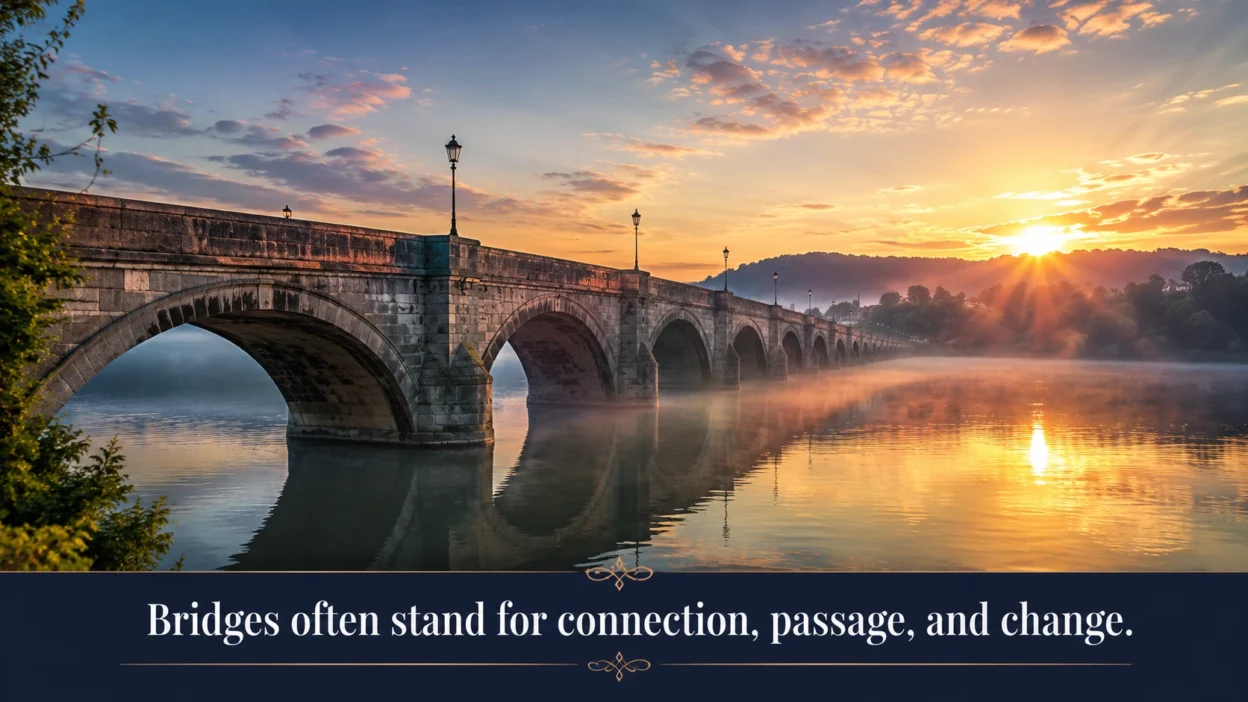
Bridge Symbolism shows how every bridge becomes a meaningful symbol that connects hope with change, guiding every journey through transition and connection.
A physical bridge is more than a structure because bridge symbolism reflects deep symbolic meanings found in spiritual traditions, cultures, religions, belief systems, dreams, and art. From my own study of symbols, I have noticed that this powerful image is associated with connecting separate places and distances through meaningful links. The idea is shaped by its purpose and can represent or symbolize connection, passage, transition, movement, progress, and overcoming obstacles and challenges.
Whether bridges appear in daily life, stories, or personal reflection, they often remind us that growth happens between where we are and where we are going. Every journey from one phase of life to another can feel like crossing a bridge. Wherever this symbol appears, it encourages steady steps forward, showing that difficult moments can lead to positive change.
Quick Answer
Bridge symbolism in the USA most often stands for connection, transition, and progress. It can also suggest healing, teamwork, and the idea of crossing safely into a new stage of life.
TL;DR
- Bridges often mean crossing, change, and connection.
- In the USA, they also suggest progress and unity.
- Their image can feel hopeful, steady, or risky.
- Historically, bridges linked communities and trade routes.
- Spiritually, they can symbolize passage and guidance.
- Today, bridges appear in art, tattoos, stories, and memorials.
What a Bridge Looks Like and Why That Matters
A bridge usually spans a gap. That gap may be a river, road, valley, or train line. It may look simple, like a wooden footbridge, or dramatic, like a suspension bridge with tall towers and hanging cables.
Shape, Material, and Setting
The material often changes the feeling. Stone bridges can suggest strength and history. Steel bridges can feel modern and practical. Rope or temporary bridges can suggest risk, effort, or a narrow path forward.
• A low bridge can feel quiet and grounded.
• A high bridge can feel bold and exposed.
• An arched bridge often suggests elegance and balance.
• A long bridge can suggest distance, effort, and endurance.
The setting matters too. A bridge over still water feels reflective. A bridge over traffic feels active and urban. A bridge in fog can suggest mystery, while one in sunlight often feels hopeful.
Historical Roots of Bridge Symbolism
Bridges have been meaningful for a very long time. Long before modern roads, people built crossings to move between settlements, farmland, and trading areas. Because bridges solved a real problem, they quickly became associated with human skill and cooperation.
Ancient and Early Symbolic Meanings
In older traditions, bridges often stood for passage between worlds. Some cultures imagined a bridge as a route the soul might take after death. Others used bridge-like images to describe a person moving from ignorance to wisdom.
That pattern makes sense. A bridge does not remove the gap. Instead, it creates a way through it. That is why bridges became such strong symbols of transition, especially in stories about tests, journeys, and change.
From Utility to Metaphor
As civilizations grew, bridges became more than tools. They represented engineering, trade, and political power. A strong bridge could link markets, families, and entire regions.
Because of that, bridge imagery slowly moved into language. People began to speak about bridging differences, bridging generations, or bridging two ideas. The physical object became a mental picture for solving problems and joining what was once separate.
Bridge Symbolism in American Life
In the United States, bridges carry both practical and emotional meaning. They connect major cities, help communities grow, and shape how people understand distance and access. At the same time, they often appear as symbols of ambition and resilience.
Unity Across Distance
America is a large country with rivers, bays, canyons, and long travel routes. Bridges help people cross those spaces. So, they naturally became symbols of connection across separation.
That makes bridges feel especially American in a few ways:
• They represent movement and expansion.
• They support trade, travel, and daily life.
• They link communities that would otherwise stay apart.
• They suggest public cooperation and shared effort.
In this sense, bridges can symbolize the hope that different places, people, or views can still meet in the middle.
Progress, Industry, and National Identity
Many Americans also see bridges as symbols of progress. Large bridge projects became signs of growth, technical skill, and national confidence. Iconic bridges often appear in photos, films, and local pride, which adds to their symbolic weight.
However, bridges can also remind people of strain and responsibility. They must be maintained, trusted, and repaired. That gives them a second meaning: connection is valuable, but it takes care.
A Table of Common U.S. Bridge Meanings
| Context | Meaning in the USA | Common Associations | Notes |
| Daily travel | Connection | Commutes, access, convenience | Bridges reduce distance |
| Civic life | Cooperation | Public works, shared investment | Built through collective effort |
| Personal growth | Transition | Change, moving on, new stages | Often used in life advice |
| Art and film | Hope or tension | Crossing, escape, reunion | Tone depends on scene |
| Memorial settings | Remembrance | Loss, healing, tribute | Can honor people and places |
Cross-Cultural and Spiritual Meanings
Bridge symbolism appears in many traditions, though the exact meaning changes from place to place. In one culture, a bridge may suggest sacred passage. In another, it may represent the meeting of opposites.
A Symbol of Passage
Spiritually, bridges often stand for moving from one condition to another. That could mean moving from fear to trust, from grief to healing, or from confusion to insight. Because a bridge connects two sides, it can feel like a sign of guidance.
In religious and spiritual writing, bridge-like images often point to connection between the human and the divine. They may also suggest reconciliation, forgiveness, or peace between divided people.
Respectful Cross-Cultural Notes
In some Asian traditions, bridge forms in gardens and temples can represent harmony and balance. In European folklore, bridges sometimes appear as places of choice, risk, or transformation. In modern spiritual language, the bridge may stand for inner work and emotional healing.
Even so, the core image stays familiar. A bridge helps someone cross safely. That simple action gives it lasting symbolic power.
Emotional and Psychological Meaning
People often react to bridges with strong feelings. A bridge can feel comforting because it offers a path forward. It can also feel uneasy because it hangs over unknown space.
What a Bridge Often Signals Emotionally
Bridge symbolism often suggests one or more of these feelings:
• Hope during a difficult transition
• Trust in a process you cannot fully control
• Relief after crossing a hard moment
• Connection after distance or conflict
• Courage to move forward anyway
This is why bridge imagery shows up in grief, recovery, and personal change. It gives shape to the idea that hard things can be crossed, even if they are not erased.
A Psychological Image of Problem-Solving
Psychologically, a bridge is also a very practical symbol. It does not deny the gap. Instead, it acknowledges it and offers structure. That makes it a useful image for resilience.
People often use bridge language when they want to sound calm, wise, and forward-looking. It suggests progress without pretending life is easy. It also suggests that one person, idea, or moment can connect two separate worlds.
Modern Usage in Tattoos, Decor, and Media
Bridge imagery remains popular because it works in both personal and public settings. It can be elegant, dramatic, or deeply personal.
Tattoos and Personal Meaning
Bridge tattoos often represent:
• A major life transition
• A connection to home or family
• Recovery after loss or conflict
• A reminder to keep moving forward
Some people choose a specific bridge from their city or hometown. Others choose a simple silhouette. Either way, the bridge becomes a private marker of crossing something important.
Decor, Branding, and Visual Storytelling
In home decor, bridge images can create a feeling of openness and calm. They may appear in wall art, travel prints, or landscape photography. In branding, bridge imagery often suggests service, connection, or trust.
In film and social media, bridges are used as visual shorthand. A scene on a bridge can mean departure, reunion, danger, or turning point. Because the image is so clear, viewers understand it quickly.
Holiday and Community Contexts
Bridges are not tied to one holiday, but they often appear in civic celebrations and remembrance events. They may be lit in national colors, used as backdrops for parades, or featured in city identity campaigns.
That public role matters. It shows that bridge symbolism is not only personal. It also belongs to shared spaces and shared memory.
Misunderstandings, Misuse, and Negative Associations
Not every bridge image feels positive. Some bridges are linked to tragedy, conflict, or unsafe conditions. Others are used in ways that do not match their traditional meaning.
When the Symbol Turns Dark
A bridge can symbolize danger if it is broken, unstable, or blocked. In stories, a damaged bridge often means broken trust or a failed connection. In real life, collapsed or closed bridges can symbolize infrastructure problems and public concern.
There is also a deeper emotional side. Some people connect bridges with despair because they are isolated places in difficult times. That is a serious and sensitive use of the image, and it should be treated with care.
Shifting and Conflicting Meanings
Bridge symbolism can shift depending on context. A bridge might mean reunion in one setting and separation in another. It might mean peace in a photo, but urgency in a protest image.
That is why context matters so much. The bridge itself is neutral. The meaning comes from how people frame it, where it appears, and what story surrounds it.
Bridges in Language and Everyday Speech
A big part of bridge symbolism lives in ordinary speech. People use bridge language all the time without thinking about it.
Common Phrases and Their Meaning
When someone says they want to “bridge the gap,” they mean they want to reduce distance between two sides. When they “build bridges,” they are trying to create trust. When they “burn bridges,” they destroy a possible connection.
These phrases show how deeply the image has entered American thought. Bridges are not just structures. They are a way of talking about relationships, timing, and decisions.
Why These Phrases Last
The reason is simple. Almost everyone understands what a bridge does. It lets you cross something that would otherwise stop you. That makes it one of the clearest metaphors in the language.
Read More: Star Symbolism: Meaning, History, and Today
How Bridge Symbolism Has Changed Over Time
Bridge symbolism has stayed familiar, but its emphasis has shifted. Older meanings often focused on passage, trade, and sacred crossing. Modern meanings often stress progress, unity, and personal growth.
From Sacred Passage to Daily Life
In earlier periods, bridges could feel rare and almost magical. Today, many people cross them without thinking. However, the symbolic meaning has not disappeared. It has just become more ordinary and more widely shared.
That shift is important in the United States. Bridges are now part of infrastructure, but they still carry emotional weight. They can mark entrance into a city, a memory of home, or a moment of change.
What Has Stayed the Same
Even with all these changes, one idea remains steady. A bridge always means there is a way across. It may be difficult, temporary, elegant, or strong, but it gives shape to hope.
FAQs
1. What does Bridge Symbolism mean?
Bridge Symbolism represents connection, transition, and the journey from one stage of life to another. It often reminds people that growth comes through change and by overcoming obstacles.
2. What does a bridge symbolize spiritually?
In many spiritual traditions, a bridge symbolizes the passage between different states of life, personal transformation, hope, and a deeper connection with faith, purpose, or inner wisdom.
3. What does seeing a bridge in a dream mean?
A bridge in a dream often reflects an important life transition. It may suggest that you are moving toward a new opportunity, resolving a challenge, or connecting different parts of your life.
4. Why are bridges important symbols in different cultures?
Across many cultures and belief systems, bridges represent unity, progress, communication, and the ability to connect people, places, and ideas that once seemed far apart.
5. How is Bridge Symbolism used today?
Today, Bridge Symbolism appears in art, literature, architecture, personal tattoos, motivational writing, and everyday conversations. It continues to represent hope, resilience, growth, and positive change.
Conclusion
Bridge Symbolism remains one of the most meaningful symbols because it reflects connection, progress, and transformation. Whether viewed through history, spirituality, dreams, or modern life, a bridge reminds us that every challenge can become a path to new possibilities. By connecting separate places and experiences, it encourages us to move forward with confidence, embrace change, and appreciate the journey that shapes who we become.