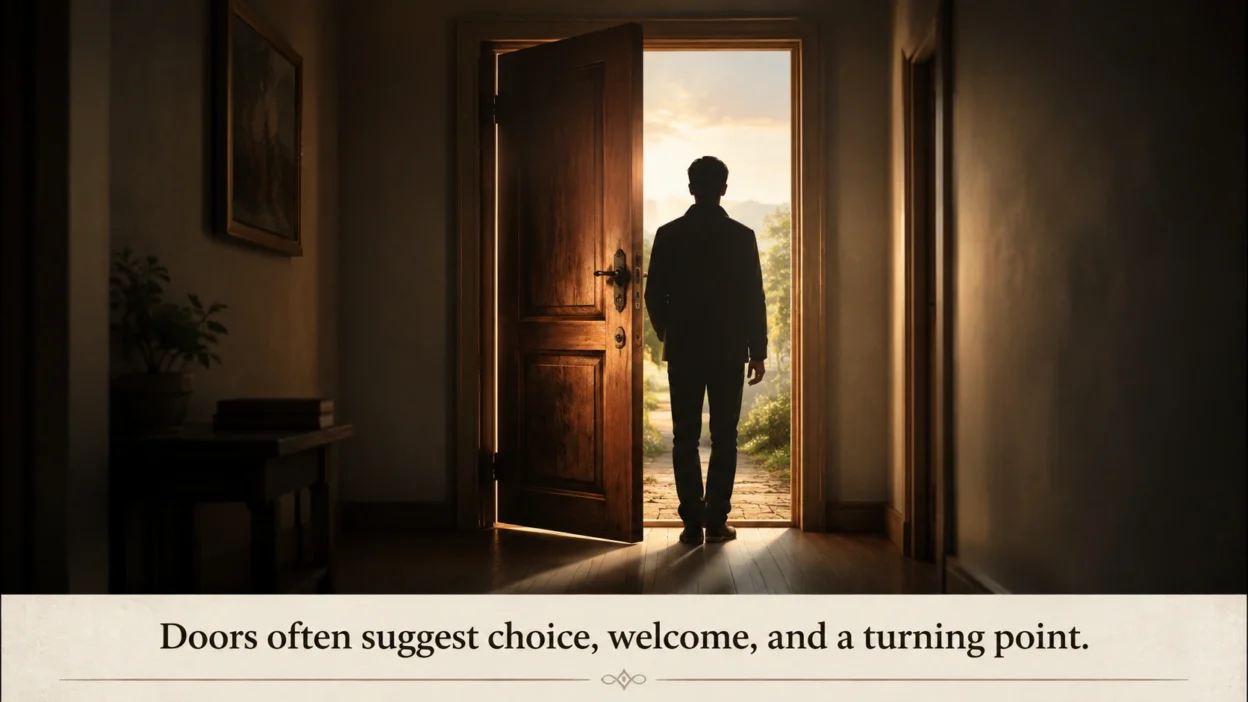
Door Symbolism explores the symbolic meanings of doors throughout history. Their role as thresholds between spaces has made them important in many belief systems because they symbolize choice, access, transition, protection, and destiny. From my experience studying symbols, I have learned that a simple doorway often carries a deeper message than people expect, as it quietly marks the place where one path ends and another can begin.
Every door reminds us that real change begins with the decision to enter or leave. Whether someone is stepping toward a new opportunity or walking away from the past, Door Symbolism encourages thoughtful decisions instead of rushed ones. This is why thresholds remain meaningful across different belief systems, representing the meeting point between the familiar and the unknown.
Across cultures, the symbolic meanings of doors continue to shape personal growth. Their role reaches beyond physical spaces and influences everyday life, where they continue to symbolize choice, access, transition, protection, and destiny. Reflecting on these ideas has shown me that an ordinary doorway becomes a lasting reminder that every meaningful journey starts with the courage to enter a new path or leave an old one.
Quick Answer
Door symbolism in the USA usually stands for choice, transition, privacy, and opportunity. More broadly, it can also represent protection, welcome, mystery, and new beginnings.
TL;DR
- Doors often mean choice and change.
- Open doors suggest opportunity and welcome.
- Closed doors can mean privacy or limits.
- In the USA, doors connect to home and identity.
- Doors also appear in dreams, faith, and stories.
- Modern use includes decor, tattoos, and social media.
What a Door Usually Symbolizes
This section gives the basic meaning first. That matters because door symbolism works through everyday experience, not just old stories. Most people meet the idea of a door before they ever study it.
A Simple Object With Layered Meaning
A door is a moving boundary. It can open, shut, lock, or invite. Because of that, it often stands for access, decision-making, and the line between what is known and unknown.
In plain language, a door can mean:
- A chance to begin something new
- A limit that protects private space
- A signal that someone is welcome
- A warning that entry is restricted
Why People Read Meaning Into It
People connect emotions to doors because doors shape daily life. You open one to leave home, enter work, meet someone, or start fresh. You close one to rest, protect yourself, or create space.
That makes doors feel personal. They are both practical and symbolic, which is part of their lasting appeal.
Core Meanings at a Glance
This section gathers the most common meanings in one place. For USA readers, these meanings often overlap instead of staying separate. A door can mean opportunity in one moment and privacy in the next.
Common Symbolic Themes
| Context | Meaning in the USA | Common Associations | Notes |
| Open door | Opportunity | Welcome, access, new chances | Often used in work and school talk |
| Closed door | Privacy | Rest, limits, refusal | Can feel safe or disappointing |
| Locked door | Protection | Security, control, secrecy | Sometimes suggests barriers too |
| Front door | Home identity | Family, hospitality, belonging | A strong symbol in American life |
| Threshold | Change | Transition, choice, movement | Often linked to rites and milestones |
What People Usually Notice First
In daily life, people usually read a door as either open or closed. That first impression shapes the meaning fast. However, the full meaning often depends on the place, color, material, and setting.
Historical Roots of Door Symbolism
This section looks at where the symbolism comes from. Doors have been meaningful for a very long time because every culture needs ways to mark safety, entry, and change. That older history still affects how people think about doors today.
Ancient Thresholds and Sacred Space
Long before modern houses, entrances mattered in temples, palaces, and homes. A doorway marked the line between outside danger and inside safety. In many ancient societies, crossing a threshold was treated with care.
Because of that, doors often became connected to blessing, protection, and status. They were not just physical openings. They were signs of who belonged inside and who did not.
From Ancient Homes to Modern Houses
As building styles changed, the door stayed important. It remained the main point of arrival and departure. Over time, it became tied to hospitality, household identity, and personal boundaries.
Today, that older meaning is still easy to see. A front door says something about the home before anyone even walks in.
The Role of Doors in the USA
This section matters most for American readers. In the USA, doors are tied to home life, individual choice, and social boundaries. They appear in everyday speech and in the way people think about privacy and opportunity.
Home, Privacy, and Personal Space
American culture places strong value on personal space. A door helps create that space. It can keep out noise, mark private rooms, and let someone control access.
For many people, a closed door means rest, safety, or “do not disturb.” However, it can also suggest distance or emotional walls. That mix makes doors powerful in American settings.
Opportunity Language in Everyday Speech
The phrase “open door” is common in American English. It suggests a fair chance, a helpful connection, or a path forward. “Door of opportunity” also appears often in business, school, and self-improvement talk.
These phrases show how deeply doors are tied to hope in the USA. A door is not just an object. It becomes a way to talk about possibility.
Doors in American Culture
Doors appear everywhere in American life:
- Historic homes and neighborhood front porches
- Public buildings that signal access or restriction
- Holiday decorations like wreaths and signs
- Films and ads that use doors to show change
In all these settings, the door often represents a decision point. It says something about welcome, identity, or what comes next.
Religious and Cross-Cultural Meanings
This section adds a wider view without losing focus. Door symbolism appears in many traditions, but the details vary. That broad use helps explain why the symbol feels familiar across cultures.
Spiritual Thresholds
In many faith traditions, a doorway can stand for crossing into sacred space. It may suggest reverence, preparation, or transformation. Because of that, doors are often treated with special care.
In some traditions, entering through a doorway may feel like entering a different state of mind. The physical act mirrors a spiritual one.
Global Themes That Repeat
Even when traditions differ, a few ideas return again and again:
- Boundaries between ordinary and sacred
- Safe passage from one stage to another
- Welcome for guests and strangers
- Protection from harm or disorder
These themes are not unique to one culture. They show how basic the idea of a door really is.
Emotional and Psychological Meaning
This section focuses on feeling. Doors affect people emotionally because they suggest what is inside, what is hidden, and what might happen next. That makes the symbol useful in art, therapy language, and personal reflection.
What a Door Can Make People Feel
A door can create curiosity. It can also create caution. An open door may feel hopeful, while a shut door can feel final or lonely.
Psychologically, doors often connect to:
- Readiness for change
- Fear of rejection
- Desire for safety
- Hope for a fresh start
Why the Image Sticks
People remember doors because they are easy to imagine. Everyone has stood before one. Everyone has passed through one. That shared experience makes the symbol feel immediate and believable.
Open Doors vs. Closed Doors
This section is about contrast. Open and closed doors are the two strongest versions of the symbol. For USA readers, they often show different attitudes toward life, trust, and control.
Open Doors
Open doors usually mean:
- Welcome
- Opportunity
- Honesty
- Access
- Movement forward
An open door can feel generous. It can also feel fragile, because it leaves space unprotected. That is why context matters so much.
Closed Doors
Closed doors usually mean:
- Privacy
- Safety
- Delay
- Refusal
- Separation
A closed door is not always negative. Sometimes it shows care, rest, or healthy limits. However, it can also suggest exclusion or missed chances.
Door Symbolism in Homes and Architecture
This section shows how meaning appears in real spaces. Doors are part of design, but they also send messages about values and status. In the USA, that message is often read quickly and intuitively.
The Front Door as a Social Signal
The front door is often the most symbolic part of a home. It suggests who lives there, how they present themselves, and how they welcome others. Color, shape, and decoration can all affect that impression.
A bright door may feel cheerful. A plain one may feel practical. A heavy one may feel formal or protective.
Why Materials Matter
Wood, glass, iron, and metal all change the mood. Glass doors can suggest openness and light. Heavy wooden doors can suggest warmth, history, or security.
Each material adds a different emotional layer. That is one reason doors are so common in design language and home style.
Door Symbolism in Modern Life
This section covers current use. Door symbolism still shows up in tattoos, social media, decor, branding, and personal identity. That keeps the symbol alive in a very modern way.
Tattoos and Personal Meaning
People choose door tattoos for many reasons. Some want a reminder of change. Others want a symbol of privacy, inner growth, or a fresh start.
A door tattoo can mean:
- New beginnings
- Guarded trust
- Spiritual passage
- Personal resilience
Social Media and Pop Culture
Doors appear in quotes, mood posts, and image captions. They often support messages about growth, endings, and moving on. Because the image is simple, it fits well in short-form content.
Movies and ads also use doors to create tension. A door can hide a secret, reveal a truth, or frame a life-changing moment.
Decor and Identity
In home decor, doors are often painted, decorated, or highlighted to create a certain feeling. A decorated door can signal welcome, celebration, or pride in home life.
People also use door imagery to express who they are. It can feel calm, private, bold, or hopeful depending on the style.
Misunderstandings and Controversies
This section clears up common confusion. Door symbolism is usually harmless, but it can be misread when context is ignored. A symbol that means welcome in one place can mean exclusion in another.
Not Every Closed Door Is Negative
People sometimes assume a closed door means failure. That is too simple. A closed door can mean rest, protection, or a healthy boundary.
In the same way, an open door is not always safe. It can also mean exposure, pressure, or lack of privacy.
When the Symbol Becomes Political or Social
In public life, doors can also symbolize access and exclusion. Who gets in, who stays out, and who controls the lock can become bigger social questions. That is why the symbol can appear in debates about fairness and belonging.
Still, the core meaning stays the same. A door marks the line between one condition and another.
How the Meaning Has Shifted Over Time
This section shows change across history. Door symbolism has stayed important, but the emphasis has shifted. Older ideas about sacred thresholds still exist, yet modern readers often focus more on privacy, opportunity, and self-direction.
From Sacred Boundary to Everyday Metaphor
In older settings, a door could feel strongly tied to ritual and protection. Today, many Americans read it more through daily life. They think of homes, career paths, relationships, and personal growth.
That shift does not erase the old meaning. Instead, it layers new meaning on top of it.
Why the Symbol Still Works
Door symbolism lasts because it is simple and flexible. It can fit religion, psychology, culture, and design all at once. That makes it easy to understand and hard to outgrow.
Read More: Bridge Symbolism: Crossing, Connection, and Change
FAQs
1. What does door symbolism mean?
Door symbolism represents choice, transition, opportunity, protection, and the beginning or end of an important stage in life. It reflects the moment of moving from one experience to another.
2. Why are doors important in spiritual beliefs?
Many spiritual traditions see a door as a symbol of access to new understanding, personal growth, and deeper wisdom. It also represents crossing from the familiar into the unknown.
3. What does an open door symbolize?
An open door often symbolizes welcome, opportunity, freedom, hope, and the chance to embrace positive change or a fresh beginning.
4. What does a closed door symbolize?
A closed door can represent protection, privacy, limits, delayed opportunities, or the need to wait before taking the next step.
5. Why do doors appear in dreams?
In dreams, doors frequently symbolize important decisions, hidden possibilities, personal transition, and the choices that shape future experiences.
Conclusion
Door Symbolism continues to hold meaning because it reflects the choices people make throughout life. Whether a door is open or closed, it reminds us that every step forward involves choice, transition, and the courage to move beyond familiar boundaries. Across cultures and belief systems, doors remain lasting symbols of protection, access, personal growth, and new beginnings.