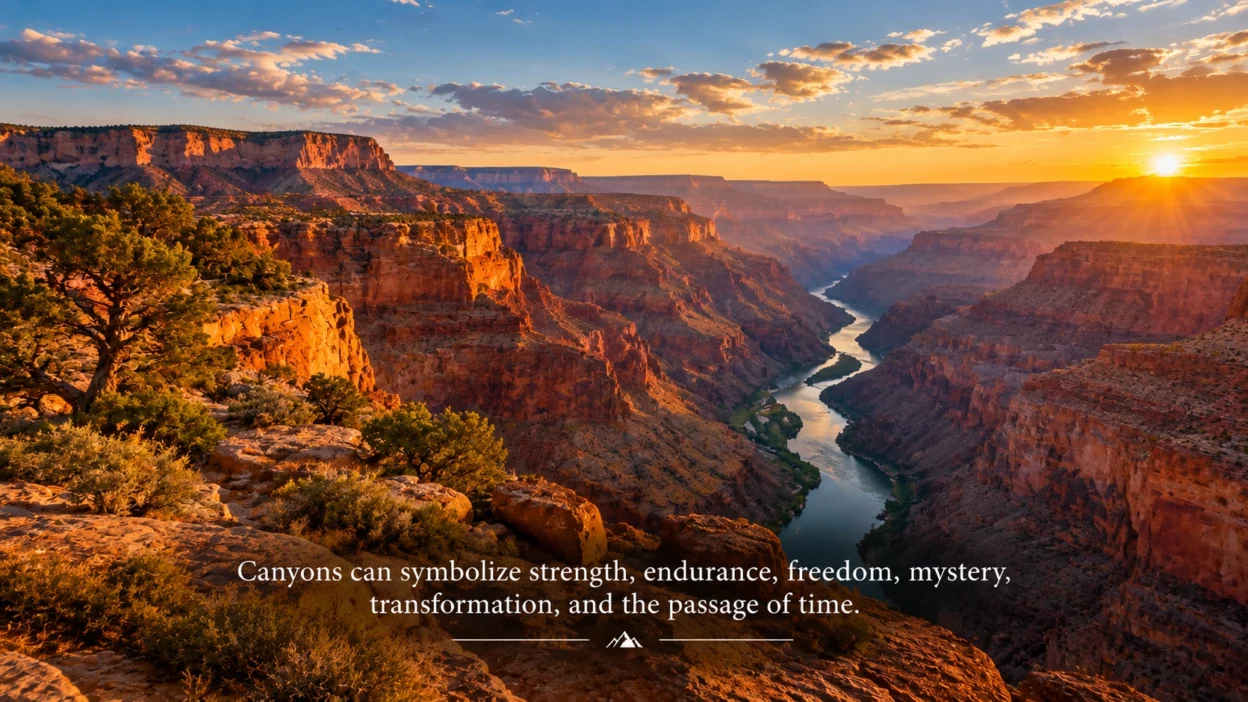
Canyons are among the most powerful landscapes in the American imagination. Canyon symbolism often connects these enormous landforms with strength, endurance, freedom, mystery, and transformation. Their towering walls and deep valleys can make people feel both small and deeply connected to nature.
In the modern world, canyons are closely linked with the American West. Places such as the Grand Canyon have become cultural symbols of wilderness, exploration, vastness, and natural beauty. However, a canyon can also represent something personal, such as overcoming hardship or gaining a new perspective.
The meaning changes with context. A narrow canyon may suggest mystery or isolation, while a wide canyon beneath an open sky can suggest freedom and possibility. Because canyons develop slowly through natural forces, they also provide a strong image of patience and lasting endurance.
Quick Answer
Canyon symbolism in the USA commonly represents strength, endurance, freedom, mystery, transformation, and perspective. More broadly, canyons can symbolize the passage of time, the power of nature, spiritual reflection, and the journey through difficult experiences.
TL;DR
- Canyons often symbolize endurance because they form through long periods of natural change.
- In America, canyons strongly connect with wilderness and the American West.
- Deep canyon walls can represent mystery, isolation, and hidden knowledge.
- Open canyon landscapes often suggest freedom, adventure, and personal exploration.
- Their changing layers can symbolize history, memory, transformation, and time.
- Modern designs use canyon imagery for tattoos, art, decor, and identity.
What Does a Canyon Symbolize?
A canyon is more than a geological formation in symbolic language. Its depth, height, colors, and surrounding landscape can all affect its meaning.
For American readers, the canyon often represents nature on a massive scale. It can also become a metaphor for personal challenges, emotional distance, or a journey toward greater understanding.
Strength and Endurance
Canyons are shaped by powerful forces, including water, wind, ice, and erosion. Their existence can therefore suggest resilience.
Common symbolic associations include:
- Endurance through difficult circumstances
- Strength developed through pressure and change
- Patience across long periods of time
- Stability despite constant environmental forces
- Resilience after hardship or loss
The image is especially powerful because the canyon doesn’t form quickly. Its shape reflects countless stages of change.
Freedom and Exploration
A canyon can also suggest adventure. Roads, hiking trails, rivers, and overlooks invite people to explore a landscape that feels larger than ordinary life.
In this sense, canyon imagery may symbolize curiosity, independence, discovery, and a desire to move beyond familiar surroundings.
Canyon Symbolism in American Culture
Canyons have a particularly strong place in American cultural identity. They are closely associated with the landscapes of the Southwest and the broader idea of the American wilderness.
For generations, American art, photography, travel writing, and film have presented canyon landscapes as places of discovery. However, modern interpretations increasingly recognize that these landscapes also have long Indigenous histories.
The American West
The American West became strongly associated with dramatic deserts, mesas, mountains, rivers, and canyons. As a result, canyon imagery often carries ideas of ruggedness and independence.
The landscape can evoke:
- Wilderness and open space
- Adventure and exploration
- Rugged natural beauty
- Independence and self-reliance
- Distance from crowded cities
- Connection with the outdoors
These associations are cultural interpretations rather than fixed meanings.
National Parks and Public Memory
American national parks have helped make canyon landscapes familiar to millions of people. The Grand Canyon, for example, became an especially recognizable symbol of America’s natural heritage.
Today, canyon imagery can appear in travel photography, road-trip culture, outdoor advertising, souvenirs, paintings, and home decoration. It often communicates a desire for adventure and connection with nature.
The Historical Roots of Canyon Symbolism
Canyons themselves are ancient geological features, but their symbolic meanings developed through human relationships with landscapes.
People have long used mountains, valleys, rivers, caves, and other natural formations as ways to express ideas about life, danger, shelter, mystery, and the sacred.
Ancient Landscape Meanings
Before modern geology, people explained dramatic landscapes through stories, traditions, and spiritual frameworks. Deep valleys and cliffs could seem mysterious because their full formation was not visible.
Across different societies, dramatic natural places could become settings for stories, ceremonies, travel, or reflection. However, these traditions varied greatly and shouldn’t be treated as one universal belief system.
Indigenous Relationships With Canyon Landscapes
Many canyon regions in the United States have deep Indigenous histories. Specific nations and communities have their own traditions, relationships, histories, and understandings of particular landscapes.
This matters when discussing canyon symbolism because a canyon isn’t simply an empty wilderness. It can also be a homeland, cultural landscape, place of memory, or spiritually significant location.
Modern visitors may see a canyon as an adventure destination, while Indigenous communities may understand the same landscape through much older cultural relationships.
Canyon Symbolism and the Passage of Time
Few landscapes communicate geological time as clearly as a canyon. Layered rock can expose evidence of processes that took place over immense periods.
For this reason, canyon imagery frequently symbolizes history and time.
Layers as Memory
The visible layers of rock can resemble pages in a giant natural record. Each layer appears to tell part of a longer story.
Symbolically, this can represent:
- Memories accumulated across a lifetime
- Lessons preserved through experience
- Generations connected through history
- Change recorded through visible layers
- The relationship between past and present
This makes canyon imagery especially useful when people want to express a connection with their roots.
Erosion as Transformation
Erosion can seem destructive, but it also creates remarkable forms. Symbolically, this creates an interesting contrast.
Something can change dramatically without losing its identity completely. That idea often connects canyon imagery with personal growth, adaptation, and transformation.
Spiritual Meaning of Canyons
Canyons don’t have one universal spiritual meaning. Their significance depends heavily on the individual, culture, landscape, and tradition involved.
Still, people may experience canyons as places that encourage quiet reflection and awareness.
Reflection and Perspective
Standing beneath enormous canyon walls can change how a person experiences scale. Everyday worries may suddenly seem smaller.
For some people, this creates feelings of humility, gratitude, wonder, or peace. Others may experience the landscape as spiritually meaningful because of its silence and natural beauty.
Sacred Landscapes
Some canyon landscapes hold specific spiritual or cultural importance for Indigenous communities and other traditions. These meanings belong to particular communities and histories.
Therefore, general symbolic interpretations shouldn’t replace or speak for those traditions. A respectful approach recognizes that sacred meaning can be specific to a place and its people.
Canyon Symbolism in Different Contexts
The same canyon can communicate very different ideas depending on how it appears.
For an American audience, context is especially important because canyon imagery appears in everything from national park photography to personal tattoos.
| Context | Meaning in the USA | Common Associations | Notes |
| Grand canyon landscape | Wonder and natural heritage | Wilderness, scale, beauty | Strongly connected with American tourism |
| Narrow canyon | Mystery and challenge | Exploration, uncertainty | Often used in adventure imagery |
| Canyon with river | Renewal and movement | Life, persistence, change | Water adds a contrasting symbol |
| Sunset over canyon | Reflection and beauty | Peace, memory, transition | Common in photography and decor |
| Desert canyon | Freedom and solitude | Independence, endurance, adventure | Often associated with the Southwest |
The visual details matter because symbolism depends on the complete scene rather than the canyon alone.
Emotional and Psychological Meaning of Canyons
Canyons can create unusually strong emotional reactions. Their immense size may inspire awe, while their depth can create feelings of mystery or even vulnerability.
Awe and Smallness
A person standing near a massive canyon may suddenly become aware of their own scale. This can produce awe rather than fear.
Awe often encourages people to think beyond themselves. Canyon imagery can therefore represent humility, perspective, and appreciation for the natural world.
Challenge and Personal Growth
A canyon can also work as a metaphor for a difficult period in life. Someone may describe themselves as having crossed a deep emotional canyon or reached the other side of a difficult experience.
In this context, the canyon represents the challenge rather than the destination.
Distance and Isolation
However, not every canyon symbol feels positive. Deep cliffs and empty spaces can suggest loneliness, separation, emotional distance, or uncertainty.
This darker interpretation can be especially strong when the canyon appears shadowy, empty, or difficult to cross.
Canyon Symbolism in Tattoos
Canyon tattoos can carry personal meanings while also celebrating American landscapes. Their interpretation often depends on the surrounding elements.
A canyon with mountains may emphasize adventure and freedom. Adding a river can introduce themes of movement, persistence, and renewal.
Popular Tattoo Ideas
Common approaches include:
- A canyon beneath a wide American sky
- Layered cliffs representing personal history
- A river flowing through the canyon
- A sunrise suggesting renewal and hope
- Desert plants symbolizing survival and adaptation
- A hiker representing exploration and personal independence
Some people choose canyon tattoos because a particular landscape holds personal memories. In that case, the symbol becomes more personal than universal.
Canyon Symbolism in Art, Decor, and Social Media
Canyon imagery has become common in American visual culture. Its warm rock colors and dramatic scale work particularly well in photography and interior design.
Red, orange, brown, gold, and muted green can create a natural Southwestern feeling. Meanwhile, blue skies and flowing water can introduce openness and calm.
Home Decor
Canyon artwork may suggest:
- Adventure and travel
- Natural beauty
- Warmth and earthiness
- Freedom and open spaces
- Connection with the outdoors
- Southwestern-inspired style
However, the meaning doesn’t have to be deeply symbolic. Sometimes people simply choose canyon artwork because they find the landscape beautiful.
Social Media
On social media, canyon photographs often accompany themes of travel, self-discovery, outdoor adventure, and mindfulness.
Captions may frame the landscape as a reminder to slow down or see life from a wider perspective. The same photograph can therefore work as both travel content and personal reflection.
What Canyon Colors Can Symbolize
Color can change the emotional character of canyon imagery. Natural canyon colors are especially important because different minerals and lighting conditions produce different visual effects.
Red and Orange Canyons
Red and orange rock often feels warm, energetic, and dramatic. These colors can suggest vitality, courage, warmth, passion, and connection with the earth.
Gray and Dark Canyons
Darker canyon walls may create a more mysterious atmosphere. They can suggest solitude, uncertainty, depth, or hidden knowledge.
Green and Blue Landscapes
Vegetation and water can soften the harshness of canyon walls. Green may suggest renewal and life, while blue can suggest calm, openness, and freedom.
Golden sunlight can add another layer by creating feelings of hope, warmth, and revelation.
Canyons as Symbols of Transformation
One of the most meaningful interpretations of a canyon comes from its formation process.
A canyon isn’t usually created by one dramatic event. Instead, its landscape develops through repeated forces over immense periods.
Slow Change Creates Dramatic Results
This offers a useful metaphor for human life. Small changes can eventually produce major results.
Someone rebuilding their life after hardship may connect with the canyon because its appearance represents change that happened gradually. The landscape becomes a reminder that transformation doesn’t always happen quickly.
The Journey Through the Canyon
A canyon can also represent a journey. A trail may disappear around a bend, while the final destination remains hidden.
That visual uncertainty can symbolize the unknown parts of life. Yet the path continues, creating an image of persistence and forward movement.
Misunderstandings and Changing Meanings
Canyon symbolism is generally flexible, but some interpretations can become misleading when presented as universal truths.
A canyon doesn’t automatically mean one particular emotion or spiritual idea. Its meaning depends on context, culture, personal experience, and visual presentation.
Avoiding Universal Claims
It’s better to say that a canyon can symbolize endurance than to claim it always symbolizes endurance.
Likewise, spiritual meanings should be connected to specific traditions when possible. Indigenous relationships with particular canyon landscapes deserve special care rather than being reduced to generic ideas about mysticism.
Wilderness and Human History
Another common misunderstanding is treating dramatic American landscapes as untouched or empty spaces.
Many canyon regions have long histories of human habitation, cultural use, and stewardship. Modern symbolism can recognize both the power of nature and the human histories connected to these places.
How Canyon Symbolism Has Changed Over Time
Canyon meanings have shifted as American relationships with landscapes have changed.
Earlier interpretations often emphasized exploration, mapping, settlement, and dramatic wilderness. Later cultural movements placed greater emphasis on conservation, recreation, photography, and environmental awareness.
Today, canyon imagery can combine all of these ideas.
From Frontier to Conservation
The American West was once frequently represented through frontier stories. Over time, public ideas about these landscapes increasingly included preservation and environmental responsibility.
National parks helped strengthen the idea that dramatic landscapes could be protected for future generations.
From Landscape to Personal Symbol
Today, people often use canyon imagery for personal reasons. A canyon may represent a trip, a major life transition, family history, or a personal connection to nature.
This makes the symbol more flexible than older cultural interpretations suggest.
Why Canyons Still Matter Today
Canyons remain powerful because they combine several visual ideas at once. They show depth, height, distance, movement, color, age, and natural force.
For American audiences, they also carry strong connections to the West, national parks, outdoor recreation, road trips, and wilderness.
Read More: Island Symbolism: Meaning, History, and Modern Uses
A Symbol With Many Layers
The deepest appeal of canyon imagery may come from its ability to hold opposing ideas together.
A canyon can feel permanent while constantly changing. It can feel open while also enclosing a person between towering walls.
It can represent both solitude and connection. That flexibility helps explain why canyon imagery works so well in art, photography, tattoos, travel culture, and personal storytelling.
FAQs
What does a canyon symbolize spiritually?
A canyon can symbolize reflection, humility, transformation, endurance, and connection with nature. However, specific spiritual meanings depend on the culture and particular landscape involved.
What does a canyon symbolize in America?
In the United States, canyon imagery often represents wilderness, adventure, freedom, natural beauty, endurance, and the vastness of the American landscape. The Grand Canyon is especially influential in shaping these associations.
What does a canyon tattoo mean?
A canyon tattoo may represent adventure, resilience, personal growth, freedom, or a meaningful connection to a particular place. The surrounding imagery can make the meaning more specific.
Why do canyons symbolize strength?
Canyons are shaped by powerful natural forces over very long periods. Their ability to remain standing while constantly changing makes them a useful symbol of endurance and resilience.
What do canyon walls symbolize?
Canyon walls can symbolize protection, boundaries, history, strength, or obstacles. Their meaning changes depending on whether the image feels peaceful, dangerous, isolated, or adventurous.
What does a river through a canyon symbolize?
A river moving through a canyon often represents persistence, movement, renewal, and the ability to adapt. Together, the river and canyon create a contrast between constant movement and lasting structure.
Conclusion
Canyons can symbolize strength, endurance, freedom, mystery, transformation, and perspective. In American culture, they also connect strongly with wilderness, adventure, national parks, the American West, and the desire to experience nature on a grand scale. At a personal level, canyon symbolism can represent the difficult paths people travel and the changes that shape them. Like the landscape itself, personal growth may happen slowly, layer by layer. Whether you see a canyon as a place of adventure, reflection, beauty, or resilience, its meaning can become deeply personal. Sometimes, simply standing before something so old and immense offers a new way to see your own journey.