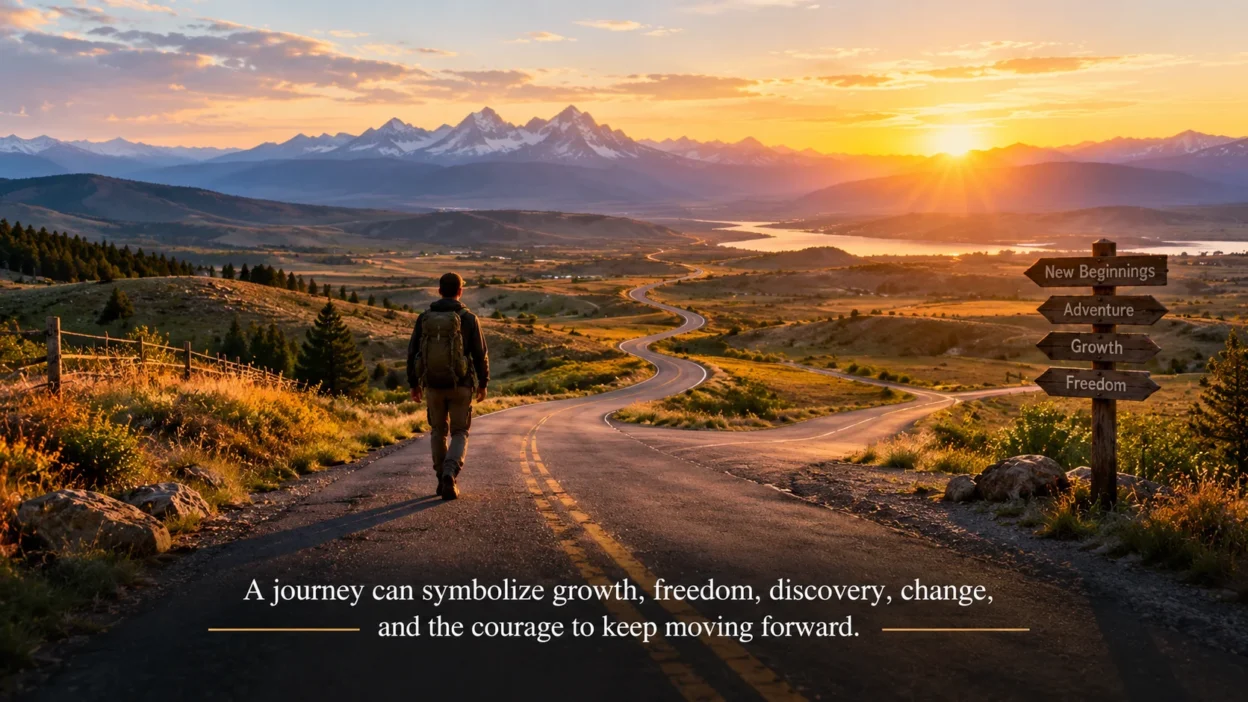
Journey symbolism appears whenever movement becomes more than simply getting from one place to another. A road, trail, path, voyage, or even a difficult life experience can represent growth, discovery, change, and personal transformation.
In 21st century, these ideas often connect with freedom, independence, exploration, and the search for a meaningful direction. People naturally connect journeys with the stages of life. You may begin somewhere familiar, face obstacles along the way, make unexpected choices, and eventually reach a new place.
However, the destination isn’t always the most important part. Sometimes, the journey itself represents what you learn and who you become.
Quick Answer
Journey symbolism often represents personal growth, freedom, discovery, change, and the movement from one stage of life to another. In the USA, it also connects strongly with independence, exploration, travel, the open road, and the idea of creating your own path.
TL;DR
- Journeys commonly symbolize growth, change, discovery, and transformation.
- American culture often connects journeys with freedom and independence.
- Ancient traditions used journeys to represent spiritual and personal transformation.
- Roads and paths can symbolize choices, uncertainty, and life’s direction.
- Modern tattoos often use journey imagery to mark important life changes.
- The meaning changes depending on the traveler, destination, and context.
What Does Journey Symbolism Represent?
Journey symbolism turns physical movement into a picture of personal experience. A path can represent the choices you make, while obstacles can represent challenges that shape your character.
For American readers, the journey often feels familiar because travel and movement are deeply connected with everyday life. Road trips, relocation, migration, education, career changes, and outdoor adventures can all become symbolic journeys.
Common Journey Meanings
Journey imagery can suggest several ideas at once:
- Personal growth through experience and difficult choices
- Freedom to choose a new direction
- Discovery of unfamiliar places, ideas, or parts of yourself
- Transformation after major challenges or life changes
- Hope for a better destination or future
A journey doesn’t have to be physical. Starting college, changing careers, recovering from a difficult period, or building a new relationship can all feel like journeys.
How Does a Journey Appear as a Symbol?
Journey symbolism doesn’t have one fixed shape. Instead, it appears through objects and scenes associated with movement, direction, distance, and transition.
A winding road is one of the clearest examples. It suggests that the future isn’t completely visible, while a straight road can suggest purpose and confidence.
Common Journey Images
Different visual elements can change the message:
- A road can represent direction, choice, and progress.
- A bridge can symbolize transition between two stages.
- A mountain trail can suggest challenge and achievement.
- A compass can represent guidance during uncertainty.
- A suitcase can symbolize departure, travel, or a fresh beginning.
- A sunrise journey can suggest hope and renewal.
Why Paths Matter
A path is especially powerful because it creates a choice. You can follow it, leave it, turn around, or choose another route.
Because of this, paths often symbolize personal freedom. They can also represent uncertainty because you can’t always see what lies beyond the next turn.
Ancient Roots of Journey Symbolism
The idea of life as a journey is extremely old. Ancient people often understood travel as both a physical experience and a symbolic movement between different states of existence.
Myths and religious stories frequently feature travelers who leave home, face trials, meet guides, and return changed. These patterns appeared long before modern ideas about travel and self-discovery.
Ancient and Mythological Journeys
In ancient stories, a journey could test courage, wisdom, loyalty, or identity. The traveler often encountered dangers that forced them to change.
Greek mythology includes many famous journeys, including the long voyage of Odysseus. Similar journey patterns appear across many cultures, although each tradition gives them its own meaning.
The Journey as Transformation
Ancient journey stories often followed a simple pattern:
- Leaving a familiar world behind
- Entering an uncertain or dangerous environment
- Facing challenges and important choices
- Gaining knowledge through experience
- Returning with a changed identity
This pattern remains recognizable today. Modern stories often replace mythical monsters with personal fears, social pressure, failure, or difficult decisions.
Journey Symbolism in American Culture
In the United States, journey symbolism has a particularly strong connection with movement and independence. The country’s history includes exploration, migration, westward expansion, immigration, long-distance travel, and the development of transportation networks.
However, these historical journeys also had complex consequences. Expansion brought opportunity for some while causing displacement and profound harm to Indigenous peoples. Understanding both sides prevents the symbol from becoming an overly simple story about progress.
The American Open Road
The open road became a powerful American image through literature, music, movies, advertising, and everyday travel. It often suggests freedom from routine and the possibility of choosing your own direction.
Road trips also make the idea personal. A long drive can represent friendship, independence, adventure, escape, or simply a break from ordinary life.
Journey Meanings in the USA
| Context | Meaning in the USA | Common Associations | Notes |
| Road trip | Freedom and adventure | Cars, highways, exploration | Often celebrates movement and independence |
| Career journey | Progress and learning | Work, ambition, experience | Focuses on development over time |
| Personal journey | Growth and self-discovery | Identity, change, resilience | Often used after major life events |
| Outdoor journey | Challenge and exploration | Hiking, camping, wilderness | Highlights endurance and discovery |
| Immigration journey | Hope and transition | Family, belonging, new beginnings | Meanings vary greatly by personal history |
The American meaning isn’t universal. For one person, a journey may represent freedom. For another, it may represent leaving family, uncertainty, sacrifice, or the search for belonging.
Spiritual and Cross-Cultural Journey Meanings
Many spiritual traditions use journeys as metaphors for transformation. A person may travel toward wisdom, understanding, renewal, or a deeper sense of purpose.
These meanings should be understood within their own traditions rather than treated as one universal belief. Still, the repeated appearance of journey imagery shows how naturally humans connect movement with change.
Pilgrimage and Spiritual Travel
Pilgrimage is one important form of symbolic journey. People travel to places considered spiritually meaningful, often as an expression of devotion, reflection, community, or personal renewal.
In Christian traditions, pilgrimage has a long history. Other religions and cultures also have important pilgrimage traditions, each with distinct practices and meanings.
A Universal Human Pattern
Across cultures, journey stories often explore similar questions:
- Where did I come from?
- What challenges must I face?
- Who can guide me?
- What have I learned?
- How have I changed?
The answers differ widely. The basic pattern, however, remains easy for people to understand.
Psychological Meaning of a Journey
Journey imagery can also describe how people understand their own lives. When someone calls life “a journey,” they often recognize that identity develops gradually.
Instead of seeing one event as defining everything, the journey metaphor creates room for mistakes, changes, and new beginnings.
Journey and Personal Growth
A difficult road can symbolize resilience. A confusing path can represent uncertainty, while a steep climb can suggest effort toward an important goal.
The metaphor can also reduce pressure around having everything figured out. You don’t need to know every step to understand your general direction.
Emotional Associations
Journey symbols can evoke feelings such as:
- Hope when the road leads toward a brighter future
- Curiosity when the destination remains unknown
- Courage when the path becomes difficult
- Nostalgia when a journey recalls an earlier period
- Freedom when movement represents independence
- Acceptance when life takes an unexpected direction
The emotional meaning depends heavily on personal experience. A highway may feel exciting to one person and stressful to another.
Journey Symbolism in Life Changes
Major transitions often feel like journeys because they involve leaving one situation and entering another. Graduation, marriage, relocation, career changes, and retirement can all create this feeling.
Because the journey metaphor allows uncertainty, it can make major transitions easier to describe. Instead of saying everything changed at once, someone can describe the process as a road with several stages.
Beginning a New Chapter
A new journey can symbolize:
- Moving away from an old identity
- Starting a different career or education
- Building independence
- Entering a new relationship
- Recovering from a difficult period
- Creating a different vision for the future
However, not every change is positive or simple. A journey can contain grief, confusion, setbacks, and progress at the same time.
Journey Symbolism in Tattoos
Journey tattoos are popular because they can preserve a personal story without explaining every detail. A person may choose a road, compass, mountain, airplane, map, coordinates, trail, or other travel-related image.
The symbol can represent an actual trip or a much deeper life experience.
Popular Journey Tattoo Ideas
Common designs include:
- A winding road representing an unfolding life path
- A compass representing guidance and direction
- Mountains representing challenges overcome
- A map representing exploration and personal history
- A small airplane representing travel and new beginnings
- A trail disappearing into the distance representing an unknown future
A journey tattoo can also mark a specific turning point. Its meaning usually comes from the story behind the design rather than the image alone.
Journey Symbols in Social Media and Modern Life
Today, journey language appears frequently in social media captions, photographs, personal profiles, and motivational content. People describe careers, relationships, travel, fitness, creativity, and personal development as journeys.
Travel photography makes the symbolism especially visible. A picture of a road disappearing toward mountains can communicate adventure without requiring much explanation.
Digital Journey Imagery
Modern visual culture often uses:
- Roads disappearing toward distant horizons
- Suitcases beside doors or train stations
- Maps showing destinations
- Footprints across sand or snow
- Sunrise scenes suggesting a new beginning
- Mountains representing ambitious goals
However, social media can simplify the journey into a constant message of success. Real journeys are usually less predictable and include ordinary or difficult moments that don’t appear in polished photographs.
Journey Symbolism in Home Decor and Art
Journey imagery can bring ideas of adventure and possibility into American homes. Maps, vintage travel signs, landscape paintings, road photography, and compass designs are common decorative themes.
For some people, these objects celebrate places they’ve visited. For others, they represent curiosity about places they hope to see.
Creating a Journey Theme
A journey-inspired space may include:
- Framed maps connected to meaningful destinations
- Landscape photography featuring roads or trails
- Vintage travel objects with personal history
- Compass or navigation-inspired decorative details
- Artwork showing mountains, oceans, or open highways
The strongest meaning usually comes from personal connection. A map of a meaningful hometown can say more than an expensive generic travel print.
Journey Symbolism in Literature and Popular Culture
Stories have long used journeys to show character development. A protagonist often starts with one understanding of life and ends with another.
American literature and popular entertainment frequently use roads, wilderness, trains, and long-distance travel to explore independence and identity.
The Hero’s Journey
The “hero’s journey” describes a storytelling pattern in which a character leaves an ordinary world, faces challenges, gains knowledge, and returns changed.
Not every story follows this pattern. Still, it remains a useful way to understand why journey stories feel familiar.
The Road as a Story
A road can also become a space where characters encounter new people and ideas. The physical movement creates opportunities for emotional movement.
That connection explains why journey stories often focus less on the final destination. The real story is what happens along the way.
Misunderstandings and Controversies
Journey symbolism is generally positive, but some journey-related images can carry complicated historical meanings. Context matters, especially when symbols connect with migration, conquest, borders, or cultural displacement.
American history provides a clear example. The idea of a journey toward opportunity can sound inspiring, yet historical expansion also involved forced removal and loss for Indigenous communities.
Why Context Matters
A symbol can mean different things depending on who uses it and why. A road representing freedom for one person might represent forced movement or separation for another.
Journey language can also become overly idealistic when it suggests that every hardship automatically produces personal growth. Real experiences are more complicated.
How Journey Symbolism Has Changed Over Time
Journey symbolism has moved from ancient myths and sacred pilgrimages into modern ideas about travel, identity, and personal development. The basic pattern stayed recognizable, but its emphasis changed.
Earlier traditions often focused on spiritual transformation, sacred destinations, or heroic trials. Modern American culture often emphasizes independence, discovery, self-direction, and personal growth.
From Destination to Process
One important modern shift is the growing focus on the process itself. People increasingly describe careers, relationships, education, and identity as ongoing journeys.
This language suggests that a person’s story isn’t finished after reaching one goal. Instead, every destination can become the beginning of another chapter.
Read More: Travel Symbolism: Meaning, History, and Modern Uses
Old Ideas in a Modern Form
The meaning has changed, but several themes remain:
- Leaving home still represents separation and change.
- Difficult roads still represent challenges.
- Guides still represent wisdom and support.
- Destinations still represent goals and hopes.
- Returning home still represents reflection and transformation.
FAQs
What does a journey symbolize spiritually?
A spiritual journey can symbolize growth, reflection, discovery, and movement toward deeper understanding. Different religious traditions interpret journeys according to their own teachings and practices.
What does a journey symbolize in America?
In the United States, journeys often symbolize freedom, independence, exploration, opportunity, and personal growth. The open road is one of the clearest examples of this cultural association.
What does a journey tattoo mean?
A journey tattoo can represent personal growth, travel, survival, change, or an important life transition. Its exact meaning depends on the design and the person’s story.
What does a road symbolize in a journey?
A road commonly represents direction, choices, progress, and the uncertainty of the future. A winding road can emphasize that the destination isn’t always visible.
What does a mountain journey symbolize?
A mountain journey often represents challenge, endurance, ambition, and achievement. Reaching the summit can symbolize accomplishing something that once seemed difficult.
Why is life described as a journey?
Life is often described as a journey because people change through experiences, relationships, challenges, and choices. The metaphor allows room for both setbacks and new beginnings.
Conclusion
Journey symbolism represents movement through change, uncertainty, discovery, and personal growth. In the United States, it also carries strong associations with freedom, independence, exploration, and the open road. Yet a journey isn’t always about reaching a perfect destination. Sometimes, the most meaningful part is the person you become while moving through unfamiliar places and experiences. Journey Symbolism reminds us that life can contain many roads, turns, pauses, and new beginnings. The path doesn’t have to be completely clear for the next step to matter.