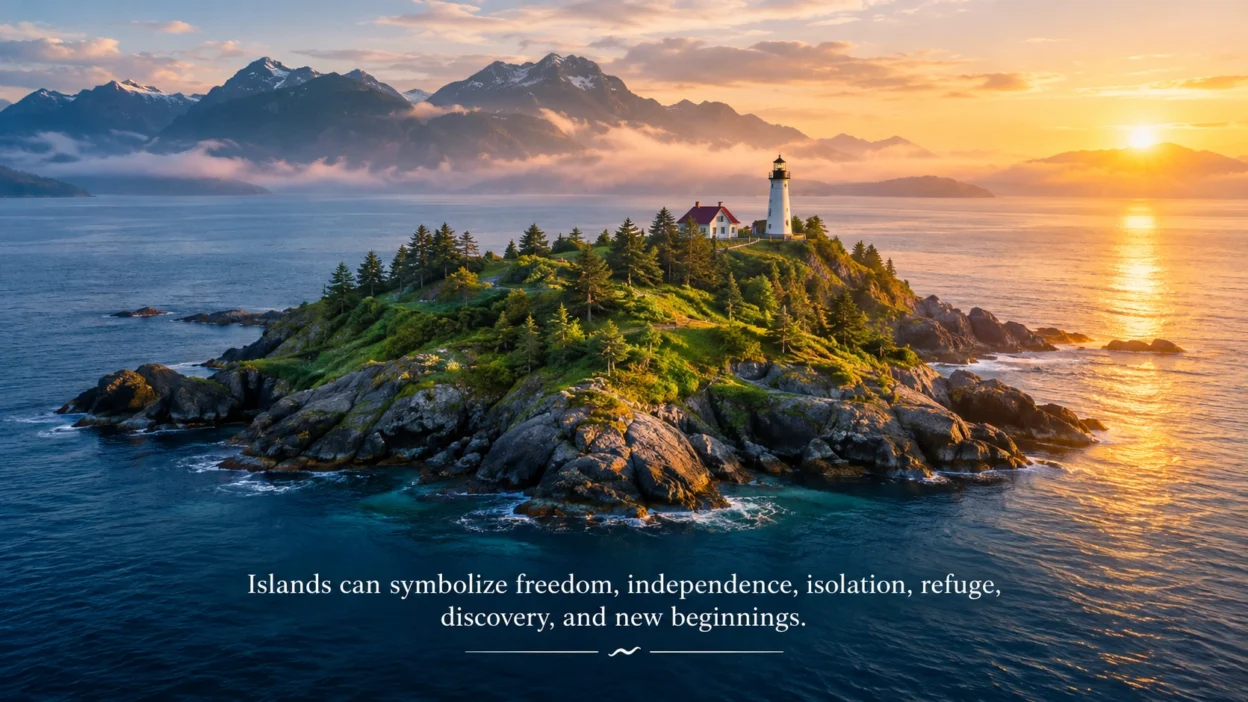
Islands have a special place in the human imagination. Surrounded by water, separated from the mainland, and often difficult to reach, they naturally suggest distance, independence, mystery, and freedom. In the United States, islands appear in travel dreams, literature, movies, family vacations, military history, and ideas about starting over.
Island Symbolism also depends heavily on context. A tropical island may suggest paradise and escape, while a lonely rocky island can represent solitude or emotional distance. A small island seen from a crowded city may symbolize peace, while an island in a survival story can represent danger and uncertainty.
Across history, people have imagined islands as places outside ordinary life. They can become sacred spaces, hidden worlds, places of exile, or settings for transformation. Today, that symbolism still appears in tattoos, artwork, home decor, fiction, social media, and personal expressions of independence.
Quick Answer
Island Symbolism in the USA commonly represents freedom, independence, escape, solitude, refuge, and personal transformation. More broadly, islands can symbolize separation from ordinary life, spiritual retreat, mystery, discovery, and the journey toward a new beginning.
TL;DR
- Islands often represent freedom because water separates them from the mainland.
- They can symbolize independence, solitude, escape, refuge, or transformation.
- American literature and popular culture often portray islands as places of discovery.
- Sacred islands appear in many religious and cultural traditions.
- Island tattoos can express travel, resilience, independence, or personal change.
- The meaning changes greatly according to the island’s setting and story.
What Does an Island Symbolize?
An island creates a natural boundary between itself and the surrounding world. Because of that separation, it easily becomes a symbol for independence, privacy, and emotional distance.
However, separation doesn’t always mean loneliness. An island can also represent safety, rest, freedom from pressure, or a chance to begin again.
Common Symbolic Meanings
Different settings create different emotional readings:
• Freedom — distance from rules, crowds, or everyday demands.
• Independence — standing alone and relying on personal strength.
• Solitude — peaceful separation or unwanted loneliness.
• Escape — leaving familiar surroundings behind for renewal.
• Refuge — finding safety away from danger or stress.
• Discovery — entering an unfamiliar place and learning through experience.
The same image can therefore communicate opposite ideas. A deserted island might mean isolation to one person and freedom to another.
Ancient Roots of Island Symbolism
Islands have carried symbolic meaning since ancient people began telling stories about oceans and distant lands. Their physical separation made them natural settings for myths, sacred stories, and imagined worlds.
Islands in Ancient Myth
Greek mythology contains several famous island settings. Crete, Delos, and other islands became associated with gods, heroes, sacred events, and legendary journeys.
For ancient Mediterranean societies, islands could feel both familiar and mysterious. They were real places, yet their separation made them ideal settings for stories about gods, monsters, heroes, and transformation.
Sacred and Otherworldly Islands
Other cultures also developed traditions involving special islands. Some stories described islands as homes of ancestors, sacred beings, fortunate people, or extraordinary realms.
These traditions shouldn’t be treated as one universal belief. Instead, they show a recurring human pattern: an isolated place can become a symbolic boundary between ordinary life and something extraordinary.
Island Symbolism in the United States
American culture has given island imagery several distinctive meanings. Geography, exploration, immigration, military history, tourism, and popular entertainment all influence how Americans understand islands.
Freedom and Independence
The United States often connects physical distance with personal freedom. An island can therefore represent a place where someone gets away from social pressure and makes independent choices.
This idea appears strongly in American travel culture. A private beach, remote cabin, or quiet island vacation can represent the dream of temporarily escaping a busy routine.
Exploration and Adventure
American stories frequently use islands as settings for exploration. A mysterious island can offer hidden treasure, danger, unfamiliar wildlife, or an unexpected challenge.
This connects island imagery with the broader American fascination with exploration and new frontiers.
Islands and American History
American islands have also served very practical purposes. Ellis Island became associated with immigration and entry into the United States, while Alcatraz Island became closely associated with imprisonment and federal law enforcement.
These examples show why island symbolism isn’t always peaceful. The same geographical separation can represent arrival, opportunity, confinement, or exclusion, depending on historical context.
Island Meanings in American Culture
The meaning of an island changes depending on where and how Americans encounter it. Tourism, literature, military history, and everyday language all create different associations.
Common American Contexts
| Context | Meaning in the USA | Common Associations | Notes |
| Tropical island | Escape and relaxation | Vacation, beaches, freedom | Often shaped by tourism imagery |
| Deserted island | Survival and isolation | Adventure, danger, independence | Common in fiction |
| Historic island | Memory and identity | Immigration, conflict, heritage | Meaning depends on location |
| Private island | Wealth and exclusivity | Luxury, privacy, status | Often appears in popular culture |
| Sacred island | Spiritual retreat | Faith, pilgrimage, reflection | Meanings vary by tradition |
Island imagery therefore works as a flexible cultural symbol. Its meaning comes from the surrounding story as much as from the island itself.
Spiritual Meaning of an Island
Islands can have spiritual meanings because they create a sense of separation from ordinary surroundings. Water surrounding the land can feel like a natural boundary between everyday life and contemplation.
Sacred Separation
In different religious and cultural traditions, isolated places have sometimes been connected with prayer, retreat, pilgrimage, or encounters with the sacred.
An island can therefore represent a temporary step away from ordinary responsibilities. The symbolism isn’t necessarily about physically leaving society; it can also describe an inner retreat.
Inner Sanctuary
Modern spiritual interpretations often use an island as a metaphor for an inner safe place. The surrounding water may represent emotional boundaries, while the land represents stability.
This interpretation can be especially meaningful in artwork or meditation imagery.
Island Symbolism Across Cultures
Island meanings vary widely around the world. Geography strongly affects these interpretations because island communities have different relationships with oceans, travel, ancestry, and land.
Polynesian and Pacific Traditions
Across many Pacific cultures, islands are connected with navigation, ancestry, community, land, and ocean knowledge. However, these traditions are diverse and shouldn’t be reduced to a single symbolic meaning.
Modern Western imagery sometimes focuses mainly on tropical paradise. That view can overlook the deeper cultural relationships that island communities have with their environments.
Japanese Cultural Imagery
Japanese literature and art have also used islands in varied ways. Islands can represent distance, beauty, isolation, homeland, or separation.
The important point is that an island doesn’t carry one fixed spiritual meaning worldwide. Its significance develops through culture and context.
Emotional and Psychological Meaning
Island imagery often connects with strong emotions because it visually represents separation. A person standing alone on an island immediately creates a story about distance and belonging.
Positive Associations
A peaceful island can suggest rest, independence, and emotional recovery. It may represent the desire to step away from noise and regain a sense of personal space.
Difficult Associations
However, an island can also represent loneliness. Someone surrounded by water may appear completely cut off from other people.
This creates one of the most interesting aspects of island symbolism: the same separation can feel either liberating or painful.
The Island as a Personal Metaphor
People sometimes use island imagery to describe themselves. Someone might see an island as representing self-reliance, emotional privacy, or the need for boundaries.
In this sense, the island becomes less about geography and more about identity.
Island Symbolism in Literature and Stories
Islands have been powerful settings in storytelling for centuries. Their isolation makes it easier to create unusual situations and force characters to face themselves.
Survival Stories
Stories such as Robinson Crusoe helped establish the deserted island as a powerful Western literary setting. The island becomes a test of survival, resourcefulness, and independence.
Later works continued this tradition with stories about shipwrecks, hidden islands, mysterious civilizations, and isolated communities.
Transformation and Discovery
An island can also function like a stage for personal change. A character arrives with one identity and leaves with another.
Because the island separates characters from familiar society, writers can explore questions about morality, leadership, survival, friendship, and human nature.
Island Tattoos and Personal Symbolism
Island tattoos are often chosen because they can carry several meanings without needing many details. A small island silhouette can represent a place, memory, journey, or personal philosophy.
Popular Tattoo Ideas
• Island with waves — connection with travel, freedom, and emotional movement.
• Palm-tree island — relaxation, adventure, and escape from routine.
• Mountain island — strength, endurance, and personal challenges.
• Island sunset — closure, peace, and a meaningful life chapter.
• Map-style island — roots, travel memories, or belonging.
• Lighthouse island — guidance, hope, and finding direction.
The meaning becomes more personal when the design includes coordinates, dates, names, or recognizable landscape features.
Island Symbolism in Art, Decor, and Social Media
Island imagery remains popular because it creates an immediate emotional scene. Blue water, open skies, palm trees, and distant land can suggest a simpler life within seconds.
Home Decor
Island-inspired decor often communicates relaxation and escape. Coastal colors, ocean artwork, shells, maps, and island landscapes can create a feeling of calm.
Social Media
On social platforms, island photographs frequently represent travel, freedom, leisure, and memorable experiences. However, they can also communicate solitude or a desire to disconnect.
The familiar phrase of being on a “desert island” shows how deeply the image has entered everyday language.
Island Symbolism in Movies and Popular Culture
Film and television frequently use islands because they naturally create dramatic boundaries. Characters can’t simply walk away, so conflicts become more intense.
Paradise and Danger
A beautiful island may initially look like paradise. However, stories often reveal hidden dangers beneath that peaceful appearance.
This contrast makes islands especially useful for storytelling. The same location can represent beauty on the surface and uncertainty underneath.
Mystery and the Unknown
An island surrounded by open water can conceal something from the outside world. As a result, fictional islands often become settings for secrets, experiments, lost civilizations, or supernatural events.
Misunderstandings and Controversies
Island symbolism can become misleading when a complex place is reduced to a simple fantasy. Tourism imagery sometimes presents islands only as peaceful escapes.
The “Paradise Island” Problem
The idea of an island as untouched paradise can hide the realities of people who actually live there. Real islands have communities, histories, economies, environmental challenges, and political relationships.
Therefore, symbolic imagery shouldn’t automatically be treated as a complete picture of island life.
Isolation Isn’t Always Freedom
Another common misunderstanding is treating isolation as universally positive. Being alone can provide rest and independence, but it can also involve loneliness or exclusion.
Context matters more than the symbol alone.
How Island Symbolism Has Changed
Island symbolism has shifted as societies have changed their relationship with travel, technology, and nature. Older stories often emphasized mystery and physical isolation.
Today, airplanes, smartphones, tourism, and digital communication have made many islands easier to reach. Yet the symbolic idea of separation remains powerful.
Read More: Lagoon Symbolism: Meaning, History, and Modern Uses
From Mystery to Escape
Historically, distant islands could seem almost unknown. Today, many people encounter islands through travel photography, movies, maps, and social media.
As a result, island imagery increasingly represents vacation, wellness, freedom, and temporary escape, while older themes of mystery and danger remain strong in fiction.
A Symbol With Opposite Meanings
Island symbolism has never been completely fixed. It can express connection to a homeland while also representing separation from others.
It can mean freedom or imprisonment, paradise or danger, solitude or belonging. That tension is what keeps island imagery meaningful.
How to Interpret an Island Symbol
When you encounter an island in artwork, dreams, tattoos, stories, or decor, look beyond the object itself. The surrounding details often reveal which meaning the creator intended.
Consider the Setting
Ask what the island looks like and what surrounds it. Calm water creates a different feeling from stormy seas.
Also consider whether people are present. A populated island can suggest community and belonging, while an empty island may emphasize independence or isolation.
Look at the Emotional Tone
A bright sunrise may suggest hope or a fresh beginning. Dark clouds, rough water, or an abandoned structure can shift the meaning toward danger or loneliness.
The strongest interpretation usually comes from combining the visual details with the story.
FAQs
What does an island symbolize spiritually?
An island can symbolize spiritual retreat, inner peace, sacred separation, or a journey away from ordinary life. Meanings vary across cultures and traditions.
What does an island symbolize in a tattoo?
An island tattoo can represent freedom, travel, independence, home, solitude, or an important personal journey. Added elements such as waves or a lighthouse can make the meaning more specific.
Why do islands symbolize freedom?
Water creates physical separation from the mainland, so islands naturally suggest distance from ordinary rules and routines. Modern travel culture has strengthened the association with escape and independence.
What does a deserted island symbolize?
A deserted island often represents isolation, survival, independence, or self-discovery. In fiction, it can also symbolize a test that forces characters to adapt.
What does an island symbolize in dreams?
An island in a dream can be interpreted in many ways, depending on the person’s experience and the dream’s emotional setting. It may suggest independence, solitude, escape, safety, or feeling disconnected from others.
Are islands symbols of loneliness?
They can be. However, island imagery can also represent peaceful solitude, privacy, freedom, and emotional recovery, so the surrounding context matters.
Conclusion
Island Symbolism brings together several powerful ideas: freedom, independence, solitude, refuge, exploration, escape, and transformation. Its meaning changes according to the landscape, story, culture, and emotions surrounding the island. Perhaps that is why island imagery remains so compelling. An island stands alone, yet it is still connected to a much larger world.