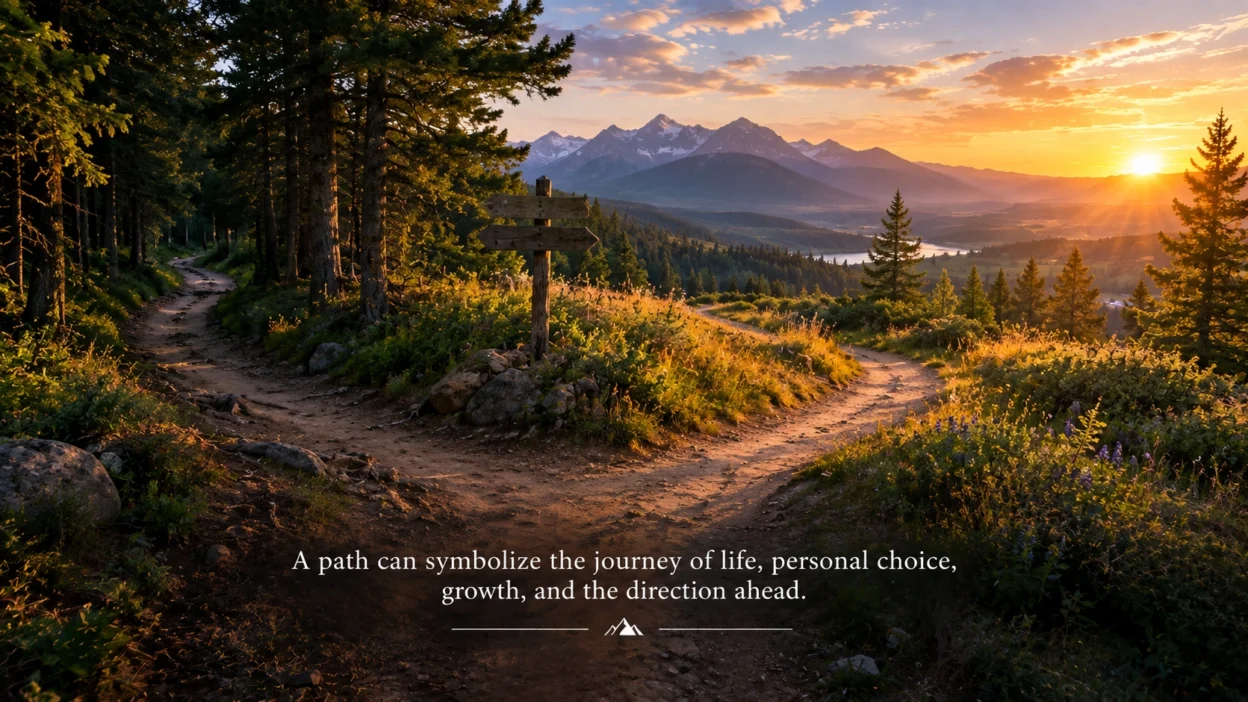
A path can look simple, but Path Symbolism carries some of the deepest meanings people attach to movement and life. A trail, road, walkway, or winding route can represent where you have been, where you are going, and the choices between those points.
In 2026, paths often connect with ideas of freedom, independence, exploration, opportunity, and personal growth. A familiar road can feel safe, while an unknown trail can suggest adventure or uncertainty.
However, paths don’t always represent physical travel. They can also describe a career, relationship, spiritual practice, personal struggle, or major life decision. In this sense, a path becomes a picture of the choices that shape a person’s life.
Quick Answer
Path Symbolism in the USA commonly represents journey, choice, progress, freedom, personal growth, and the direction of life. Across cultures, a path can also symbolize destiny, spiritual development, transformation, or the passage from one stage of life to another.
TL;DR
- Paths often symbolize journeys, choices, progress, and personal transformation.
- American culture connects roads with freedom, independence, and exploration.
- Ancient traditions used roads and paths as images of spiritual and moral journeys.
- A crossroads can represent an important decision or change in direction.
- Winding paths often suggest uncertainty, discovery, and personal growth.
- Today, paths appear in tattoos, artwork, photography, decor, and inspirational messages.
What Does a Path Symbolize?
A path creates a visual connection between one place and another. Because of that simple structure, people naturally associate it with movement, direction, and progress.
For a USA reader, the path can also reflect the idea of creating your own future. American stories often celebrate people who leave familiar surroundings and choose a new direction.
Common Meanings of a Path
A path can carry several meanings depending on its appearance and setting:
- Journey: The experiences that shape a person’s life.
- Choice: Different directions can represent different decisions.
- Growth: Moving forward can suggest learning and development.
- Freedom: An open road can suggest independence and possibility.
- Change: A new path can represent a major transition.
- Discovery: An unfamiliar trail can symbolize exploration.
The surrounding landscape changes the message, too. A bright path may feel hopeful, while a dark or blocked path may suggest uncertainty.
Historical Meaning of Paths and Roads
Paths have been part of human life since people first traveled between settlements, water sources, hunting areas, and sacred places. Long before modern highways existed, trails connected communities and helped people understand their surrounding world.
Over time, physical paths gained symbolic meanings. Traveling along a road became an easy way to describe life’s movement, while reaching a destination could represent achievement or completion.
Ancient Roots
Ancient cultures frequently connected roads and journeys with religious or moral ideas. In several traditions, the journey represented movement toward wisdom, spiritual understanding, or a sacred destination.
Greek and Roman cultures also gave roads practical and symbolic importance. Roads connected cities, armies, markets, and religious sites, making them powerful images of civilization and movement.
Religious and Mythological Journeys
Stories from different traditions often describe individuals traveling along difficult routes toward a significant destination. The journey itself can become as important as the destination.
However, these meanings differ across cultures. A path might represent spiritual discipline in one tradition and fate, pilgrimage, or personal transformation in another.
Path Symbolism in American Culture
American culture gives paths a particularly strong connection to movement and independence. Roads, trails, and highways appear throughout stories about migration, exploration, settlement, work, and personal reinvention.
The American road became an especially powerful cultural image during the 19th and 20th centuries. Expansion across the continent, automobile travel, and later popular music and movies helped turn the open road into a symbol of possibility.
The Open Road
The open road often suggests freedom because it appears to offer many possible destinations. It can represent leaving restrictions behind and deciding where to go next.
At the same time, the road can symbolize uncertainty. Freedom means choosing a direction, but it also means accepting responsibility for that choice.
Paths and the American Dream
A path can also represent the process of building a better life. Education, employment, entrepreneurship, migration, and personal ambition can all be described as paths toward a desired future.
However, the idea of a single predetermined route doesn’t fit everyone’s experience. Modern American culture increasingly recognizes that people can change careers, relationships, identities, and goals throughout life.
What Does a Path Mean Spiritually?
Spiritually, a path often represents a person’s movement toward understanding, purpose, or inner development. The destination may matter, but the experiences along the way can carry the deeper meaning.
Different religious and spiritual traditions interpret the image differently. Therefore, there isn’t one universal spiritual definition.
The Path as Spiritual Growth
A difficult path may represent discipline, patience, or lessons gained through hardship. A peaceful trail may instead suggest reflection and connection.
In some traditions, pilgrimage gives physical travel a sacred purpose. The traveler moves through a landscape while also experiencing an inner journey.
The Path and Personal Purpose
Modern spiritual language often uses “path” to describe a person’s search for meaning. Someone may speak about finding their path, changing their path, or returning to a path that feels meaningful.
These expressions don’t necessarily belong to one religion. They can also describe personal reflection and individual values.
Cross-Cultural Meanings of the Path
The path is a widely understood symbol because every society has some experience with movement and direction. Still, its specific meaning changes according to cultural context.
In many traditions, roads and trails connect the physical world with ideas about destiny, pilgrimage, wisdom, or transition.
Different Cultural Associations
Common interpretations include:
| Context | Meaning in the USA | Common Associations | Notes |
| Open road | Freedom and possibility | Travel, independence | Strong American cultural image |
| Forest trail | Discovery and growth | Nature, adventure | Often used in modern artwork |
| Crossroads | Choice and uncertainty | Decisions, change | Meaning depends on context |
| Spiritual path | Personal development | Reflection, purpose | Used across many traditions |
| Blocked path | Obstacles or delay | Frustration, uncertainty | Often appears in visual metaphors |
These meanings overlap, but they shouldn’t be treated as universal rules. Context always influences interpretation.
Emotional and Psychological Meaning of Paths
Paths can trigger strong emotions because they resemble decisions people face in real life. A person doesn’t simply see a route; they may imagine themselves walking along it.
For example, a long path disappearing into the distance can create curiosity. A narrow path can create tension, while a wide open road may create a feeling of possibility.
What a Path Can Suggest Emotionally
A path may evoke:
- Hope about what lies ahead.
- Curiosity about unfamiliar experiences.
- Anxiety about uncertain decisions.
- Confidence when the direction feels clear.
- Nostalgia for places already visited.
- Relief when an obstacle finally disappears.
However, these reactions depend on personal experience. Someone who loves hiking may see a difficult trail as exciting, while another person may see the same trail as intimidating.
What Does a Crossroads Symbolize?
A crossroads usually represents a moment when different choices become possible. It can suggest an important decision, a turning point, or uncertainty about the future.
The image has remained powerful because it turns an abstract decision into something visible. Instead of simply asking “What should I do?”, the viewer sees several directions.
Crossroads and Life Decisions
A crossroads may represent:
- Choosing between two careers.
- Entering a new stage of adulthood.
- Ending or beginning a relationship.
- Moving to a different place.
- Leaving an old habit behind.
- Deciding between familiar and unfamiliar options.
In modern American culture, the crossroads frequently appears in motivational art and personal storytelling.
What Does a Winding Path Symbolize?
A winding path often represents uncertainty, discovery, and a journey that doesn’t follow a straight line. You can see where the journey begins, but you can’t always see its final destination.
This makes the winding path especially useful as a metaphor for personal growth. Life rarely moves in a perfectly straight line.
The Meaning of the Unknown
A path disappearing around a corner can create mystery. It suggests that something remains hidden until the traveler continues forward.
However, the unknown doesn’t always have a negative meaning. It can also represent adventure, opportunity, surprise, and new experiences.
Paths in Nature and American Landscapes
Natural trails have a strong symbolic presence in American photography, painting, literature, and outdoor culture. Mountains, forests, deserts, beaches, and grasslands all give paths different emotional qualities.
A mountain trail can suggest challenge and achievement. A coastal path may suggest freedom, reflection, and openness.
Landscape Changes the Meaning
The setting can transform the message of a path:
- Forest: Mystery, reflection, discovery, and renewal.
- Mountain: Challenge, ambition, endurance, and achievement.
- Desert: Solitude, survival, endurance, and spiritual reflection.
- Beach: Freedom, transition, peace, and emotional release.
- Meadow: Hope, simplicity, openness, and calm.
- City: Opportunity, movement, ambition, and modern life.
Because of these differences, artists often choose landscapes carefully when using paths symbolically.
Path Symbolism in Tattoos, Art, and Decor
Path imagery works well in tattoos because it can represent an ongoing personal story. A person may choose a trail, road, staircase, or winding line to express growth or a major life transition.
In home decor, path images often create a calm and reflective atmosphere. Landscape photographs showing trails can suggest exploration while also adding a sense of depth to a room.
Popular Modern Uses
Today, path imagery appears in:
- Nature and landscape photography.
- Inspirational artwork and wall decor.
- Tattoos representing personal journeys.
- Travel photography and social media posts.
- Journals and personal-growth artwork.
- Memorial and remembrance designs.
The symbol can remain highly personal. Two people may choose almost identical path imagery while giving it completely different meanings.
Paths in Literature and Popular Culture
The journey is one of the oldest storytelling structures. A character leaves a familiar place, encounters challenges, changes through experience, and eventually reaches a new understanding.
Because of this pattern, roads and paths frequently appear in American literature and film. The physical journey often mirrors an internal transformation.
The Road as a Story
A character walking down a road may be searching for something. That “something” could be another person, a home, freedom, identity, or a better future.
However, the destination isn’t always the main point. Sometimes the road represents the experiences that change the character along the way.
The Familiar Path
A familiar path can symbolize tradition and routine. It may represent the life someone knows and understands.
Choosing a different route can then suggest independence or rebellion. Yet it can also represent uncertainty, depending on the story.
Misunderstandings and Misuse of Path Symbolism
Because paths have many meanings, people sometimes assume that one interpretation must apply everywhere. That can lead to oversimplification.
For example, a crossroads doesn’t automatically mean a spiritual decision. A road doesn’t always mean freedom. The surrounding story, culture, and personal context matter.
Why Context Matters
A path used in a memorial may symbolize remembrance rather than adventure. A difficult hiking trail may represent achievement rather than fear.
Likewise, religious imagery involving a path should be understood within its specific tradition. Modern inspirational interpretations shouldn’t automatically replace the original cultural or religious context.
How Path Symbolism Has Changed Over Time
The meaning of paths has expanded as human life and technology have changed. Ancient trails were essential for survival and trade, while modern highways can symbolize mobility and independence.
Today, digital life adds another layer. People talk about career paths, life paths, creative paths, learning paths, and personal journeys even when they never physically travel.
Read More: Canyon Symbolism: Meaning, History, and Modern Uses
From Roads to Personal Identity
The modern idea of “finding your path” often focuses on individuality. It suggests that a person can make choices rather than simply follow an inherited route.
At the same time, the phrase can be complicated. Not everyone has equal access to opportunities, so personal outcomes aren’t always determined by individual choices alone.
FAQs
What does a path symbolize in life?
A path commonly symbolizes the journey of life and the choices made along the way. It can also represent growth, change, uncertainty, and movement toward a goal.
What does a path symbolize spiritually?
A spiritual path can represent personal development, wisdom, reflection, or movement toward a meaningful goal. Specific meanings depend on the religious or spiritual tradition involved.
What does a crossroads symbolize?
A crossroads commonly represents an important choice or turning point. It suggests that several directions are possible and that the decision may shape what happens next.
What does a winding path symbolize?
A winding path often represents uncertainty, discovery, and the unpredictable nature of life. It can also suggest that meaningful growth doesn’t always follow a straight route.
Why are paths important in American symbolism?
Paths and roads connect strongly with American ideas of movement, exploration, independence, and opportunity. The open road became especially important through American travel culture, literature, music, and film.
What does a path tattoo mean?
A path tattoo can represent a personal journey, transformation, resilience, freedom, or a major life transition. Its exact meaning depends on the person’s story and the design surrounding it.
Conclusion
Path Symbolism connects a simple visual idea with some of life’s biggest questions. A road, trail, or winding route can represent journey, choice, freedom, growth, change, uncertainty, and discovery. Ultimately, a path doesn’t need to show the entire journey to carry meaning. Sometimes, simply seeing the next stretch ahead is enough to remind us that every direction begins with a choice.