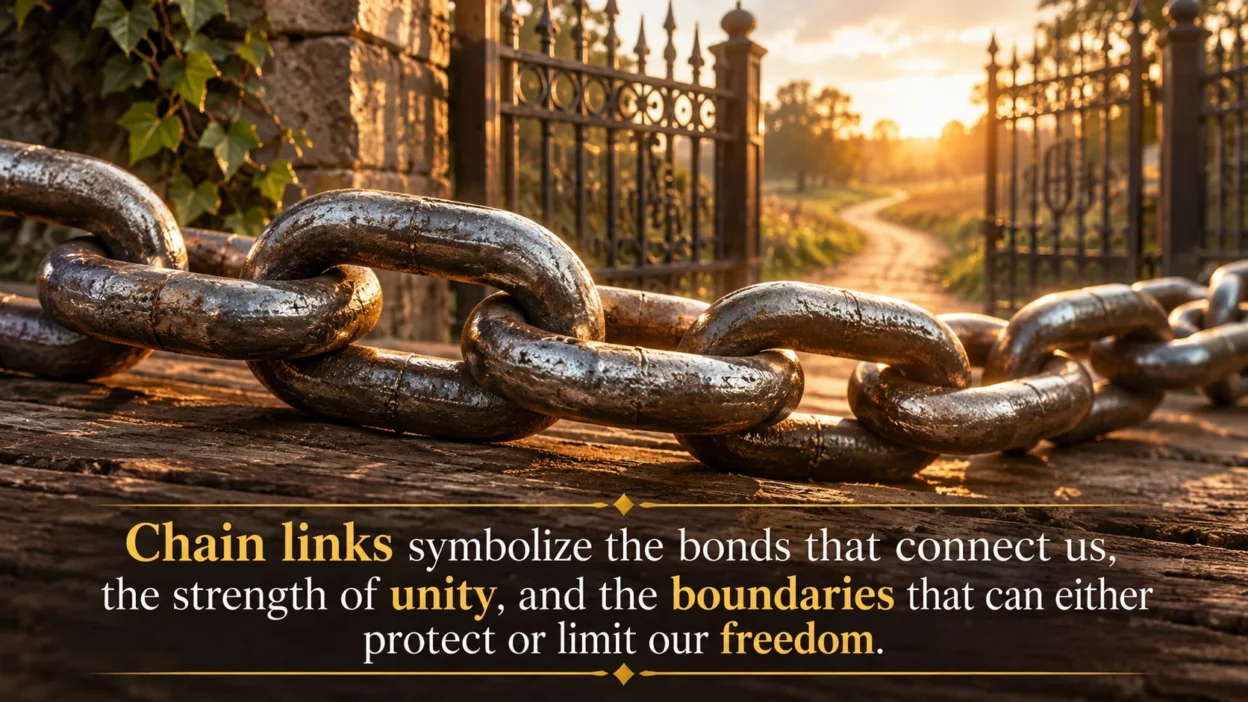
Chain link symbolism explores the meanings behind connected metal loops, linked rings, and the bonds they create. In American culture, a chain can represent strength, loyalty, unity, protection, or the restrictions that hold someone back. Its meaning often depends on whether the chain connects people, secures something valuable, or prevents someone from moving freely.
You might see chain links on jewelry, tattoos, fences, industrial equipment, memorial artwork, or clothing. Although these objects share a basic shape, they can communicate very different ideas. A gold chain around someone’s neck may express personal style or status, while a broken chain can represent independence and liberation.
The symbol also raises a familiar question: does a chain bring people together, or does it keep them apart? That contrast makes it especially meaningful in discussions about relationships, family, identity, social struggles, and personal growth. Understanding its history helps explain why such a simple object can carry both positive and negative meanings today.
Quick Answer
Chain link symbolism in the United States commonly represents connection, loyalty, strength, security, and unity. However, chains can also symbolize confinement, dependence, inequality, or lost freedom. Across cultures and personal traditions, linked rings often express lasting bonds, while broken links suggest release and transformation.
TL;DR
- Connected links represent relationships, cooperation, and shared responsibility.
- Strong chains symbolize resilience, stability, and protection.
- Broken chains often represent freedom, independence, and overcoming obstacles.
- Gold and silver chains can suggest identity, style, wealth, or status.
- Fences and barriers may symbolize security, separation, or restricted access.
- Modern tattoos use chains to express loyalty, remembrance, struggle, or personal strength.
Understanding the Basic Meaning of Chain Links
Chain links form a recognizable symbol because each loop connects with another. Together, individual pieces create something stronger and more useful than a single link alone. This simple structure makes the chain a natural symbol of relationships, teamwork, and shared responsibility.
Why Interlocking Links Matter
Each link depends on the links around it. If one link breaks, the entire chain may become weaker or lose its purpose.
This physical feature creates several common symbolic meanings:
- Connection: People, communities, and ideas remain joined through shared bonds.
- Strength: Individual contributions combine to create greater collective power.
- Continuity: Connected links suggest an ongoing relationship or an unbroken story.
- Dependence: Every part relies on the stability of the others.
- Restriction: A chain can prevent movement or limit personal choices.
However, the same chain doesn’t always communicate the same message. A decorative chain may suggest elegance, while a heavy iron chain can evoke imprisonment or hardship.
What Different Chain Designs Suggest
The chain’s appearance often shapes its interpretation. Large, thick links may communicate toughness, while delicate links can suggest intimacy, refinement, or subtle connections.
A continuous chain usually emphasizes unity and permanence. In contrast, a snapped or disconnected chain often represents change, separation, or the courage to leave something behind.
The Historical Origins of Chain Link Symbolism
Chains have served practical purposes for thousands of years. They have secured gates, lifted heavy loads, anchored vessels, and restrained people. As a result, their symbolic meanings developed alongside their everyday uses.
Ancient Uses of Chains
In ancient societies, metal chains represented both practical skill and the ability to control valuable resources. Their strength made them useful for securing objects, protecting property, and displaying authority.
However, chains also appeared in depictions of captives and enslaved people. This connection gave the object a darker meaning associated with domination and the loss of freedom.
Medieval and Religious Interpretations
During the medieval period, chains appeared in religious art, funerary monuments, and symbols of public office. Their meanings ranged from imprisonment and spiritual struggle to loyalty and lasting commitment.
In some older European interpretations, a golden chain connected the human soul with the body or represented a link between heaven and earth. These ideas belonged to particular philosophical and religious traditions rather than a universal belief.
From Restraint to Liberation
Over time, broken chains became powerful images of freedom. In European and American abolitionist imagery, broken shackles and opened restraints helped communicate the struggle against slavery.
This history remains important in the United States. A broken chain can represent emancipation, resistance to oppression, and the restoration of human dignity. Its meaning is especially powerful when used in historical memorials or artwork addressing civil rights.
Chain Link Symbolism in American Culture
In the United States, chains appear throughout daily life, from jewelry and construction equipment to fences, military settings, and public monuments. Because Americans encounter chains in so many different situations, their meanings often reflect the setting.
Freedom, Independence, and Opportunity
American cultural ideals frequently emphasize personal freedom and the ability to overcome obstacles. Therefore, a broken chain can represent independence from unfair restrictions or a difficult past.
The symbol may appear in artwork celebrating emancipation, political freedom, or personal recovery. However, its significance depends on the historical experience being represented.
Security and Boundaries
Chain-link fences are familiar sights around schools, sports courts, homes, and industrial sites. They can suggest protection, controlled access, and the separation of public and private spaces.
At the same time, a fence can create feelings of exclusion. A chain around a gate may protect one community while keeping others outside.
Work, Industry, and Collective Effort
Chains are essential in transportation, construction, manufacturing, and many other industries. Consequently, they can represent physical labor, reliability, and the effort required to keep systems working.
The phrase “a chain is only as strong as its weakest link” also reflects a familiar American idea about teamwork. It reminds people that one vulnerable part can affect an entire group.
Spiritual Meaning of Chain Link Symbolism
Spiritually, chain links can represent interconnectedness, responsibility, commitment, and the ties between different stages of life. However, no single interpretation applies to every religion or spiritual tradition.
Connection and Shared Purpose
An unbroken chain can serve as a reminder that people influence one another. Family relationships, friendships, and community bonds all involve connections that extend beyond a single individual.
For some people, this image also suggests that life experiences connect in ways that become clearer with time.
Releasing Negative Attachments
A broken chain may represent letting go of resentment, unhealthy habits, limiting beliefs, or painful experiences. Rather than rejecting every connection, this interpretation focuses on releasing what prevents personal growth.
However, the symbol doesn’t prove that a spiritual transformation has occurred. Its meaning comes from the person’s beliefs, experiences, and intentions.
Religious Contexts
In some Christian interpretations, broken chains represent liberation from spiritual bondage. Elsewhere, chains may symbolize imprisonment, suffering, or the challenges faced by a person of faith.
Other philosophical traditions may use chains as metaphors for cause and effect, dependence, or interconnected existence. These interpretations should be understood within their own contexts rather than treated as interchangeable teachings.
The Emotional and Psychological Meaning of Chain Links
Chain links can evoke strong emotional responses because they resemble familiar experiences of connection and control. A chain can make someone feel secure, supported, trapped, or burdened.
When Chains Represent Security
A sturdy chain can provide reassurance because it holds something in place. Symbolically, this may reflect the comfort people find in dependable relationships and clear commitments.
For example, someone might associate a chain bracelet with a parent who gave it to them. The object becomes meaningful because it connects a physical item with a lasting emotional memory.
When Chains Represent Restriction
Chains can also suggest a lack of control. Someone dealing with an unwanted obligation might view a heavy chain as a fitting image of their circumstances.
In this context, a broken link may represent the hope of regaining independence. It can express the desire to make choices without unnecessary pressure.
Why the Same Symbol Can Feel Different
Personal experiences shape how people interpret chains. Someone who values loyalty might see an unbroken chain as reassuring, while another person may associate it with a relationship that feels controlling.
Neither interpretation is automatically correct for everyone. The emotional meaning depends on the circumstances, the person’s history, and whether the connection feels voluntary.
Chain Link Tattoos and Their Meanings
Chain link tattoos are popular visual choices because their designs can communicate several ideas without requiring words. Their meaning often changes with the chain’s condition, placement, and accompanying symbols.
Common Chain Tattoo Designs
- Unbroken chain: Represents loyalty, endurance, unity, or a lasting promise.
- Broken chain: Suggests liberation, recovery, independence, or a new beginning.
- Chain around a heart: May express devotion, emotional attachment, or love that feels restrictive.
- Chain with a name or date: Can honor a loved one or preserve an important memory.
- Chain around the wrist or ankle: May suggest commitment, confinement, resilience, or a personal struggle.
Choosing a Personal Meaning
Some people choose chain tattoos to honor family bonds or friendships that have endured difficult times. Others use broken links to mark a turning point in their lives.
However, chain imagery can carry associations with imprisonment, forced labor, and historical oppression. A design intended to represent strength might communicate something different to viewers familiar with those histories.
If the tattoo represents a personal experience, its intended meaning can be made clearer through additional imagery or a thoughtful design.
Chain Links in Jewelry, Fashion, and Home Decor
Chains are common in American fashion and interior design. Their symbolic meaning often depends on the material, size, and way they’re displayed.
Jewelry and Personal Identity
Gold chains may communicate achievement, confidence, cultural identity, or personal style. Silver chains can suggest simplicity, versatility, or a preference for understated accessories.
Nevertheless, these meanings aren’t universal. Many people wear chains simply because they enjoy their appearance.
Home Decor and Architecture
Decorative chains appear in lighting fixtures, garden designs, railings, and industrial-style furniture. They can add a sense of durability, structure, or vintage character.
In contrast, a chain across a doorway may emphasize a boundary. Its visual message changes depending on whether it decorates a space or physically blocks access.
Chain Links in Digital Culture
On social media, chain imagery may appear in graphics about friendship, resilience, personal transformation, or solidarity. A broken chain can quickly communicate the idea of leaving something behind.
However, a chain-link image doesn’t have a universal digital meaning. Its caption, accompanying symbols, and surrounding discussion help determine how viewers interpret it.
Chain Link Symbolism in Relationships and Family
Relationships often involve a balance between connection and independence. Chain links offer a simple way to explore how people stay connected while maintaining their individuality.
Loyalty and Commitment
An unbroken chain can represent a relationship that has survived challenges. Each link may stand for a person, shared memory, or promise that helps maintain the bond.
This interpretation works especially well in family keepsakes and matching jewelry. It suggests that the relationship continues even when people live far apart.
Family History and Generations
A chain can also represent the connection between generations. Parents, children, grandparents, and extended relatives contribute different links to a family’s story.
However, inherited connections aren’t always easy. Some people use broken chains to symbolize freedom from harmful family patterns or expectations.
Healthy Bonds Versus Restrictive Attachments
A chain’s symbolism becomes more complicated when commitment feels like control. An unbroken chain may represent loyalty, but it can also suggest that someone feels unable to leave.
The important distinction is whether the bond supports both people. Symbolically, a strong relationship can connect individuals without taking away their independence.
The Difference Between Broken and Unbroken Chains
The condition of a chain often provides the clearest clue to its meaning. An intact chain usually emphasizes continuity, while a broken chain introduces change, loss, or release.
| Chain Design | Common Meaning | Possible Emotional Association |
|---|---|---|
| Unbroken chain | Unity and commitment | Belonging and stability |
| Broken chain | Freedom and release | Relief and independence |
| Rusted chain | Neglect or endurance | Nostalgia or disappointment |
| Repaired chain | Reconciliation and renewal | Hope and restored trust |
| Heavy chain | Burden or restraint | Pressure or confinement |
Why a Broken Chain Isn’t Always Positive
A broken chain can symbolize escape from an oppressive situation. However, it can also represent the end of a relationship, the loss of family unity, or a commitment that could not survive.
Similarly, an intact chain may represent devotion or unwanted restriction. The image itself doesn’t determine whether the change is good or bad.
The Meaning of Repair
A repaired chain introduces another possibility: relationships and systems can sometimes recover after damage. The repaired section may represent forgiveness, renewed effort, or the decision to rebuild trust.
This interpretation emphasizes resilience without pretending that every broken connection must be restored.
Controversies and Misunderstandings About Chain Link Symbolism
Chains are ordinary objects, but their history includes serious human suffering. Understanding that history helps prevent symbolic interpretations from overlooking the experiences associated with captivity and forced labor.
Chains and the History of Slavery
In American history, chains and shackles are closely associated with the enslavement of African people and the denial of their freedom. These associations give broken-chain imagery particular significance in discussions of emancipation and human rights.
When used in memorials or educational settings, such imagery can communicate resistance and liberation. However, it should be presented with respect for the people whose suffering it represents.
Chains Don’t Always Mean Bondage
A decorative necklace, industrial chain, or linked wedding design doesn’t automatically carry the same meaning as shackles. The object’s purpose and context matter.
Likewise, a chain-link fence isn’t inherently a symbol of oppression. It may serve a practical safety function, although its placement can also raise questions about access and exclusion.
Avoiding Universal Interpretations
It’s easy to assign a single meaning to a symbol and assume everyone will understand it the same way. Chain link symbolism doesn’t work that simply.
A chain may express love to one person and confinement to another. Careful interpretation considers history, personal intent, cultural setting, and the details of the design.
How Chain Link Symbolism Has Changed Over Time
The chain’s meaning has never been entirely fixed. Its practical functions created several symbolic possibilities, and different societies emphasized different aspects over the centuries.
From Physical Strength to Social Connection
Early chains were valued for their ability to hold, secure, and restrain. Those practical uses helped establish associations with power, protection, labor, and control.
Over time, connected links also became useful metaphors for families, communities, institutions, and relationships. The structure made cooperation visible: each part contributed to the whole.
From Captivity to Freedom
Chains have long been associated with imprisonment and forced restraint. Consequently, broken chains became recognizable images of release from domination.
In American historical memory, this meaning is especially important because of slavery and struggles for civil rights. The broken chain now appears in broader contexts involving independence, personal recovery, and resistance to unfair limitations.
Read More: Maze Symbolism: Meaning, History, and Spiritual Significance
Contemporary Meanings
Today, chain imagery appears in fashion, tattoos, entertainment, public art, and everyday design. People can use it to express solidarity, personal identity, resilience, or a desire for independence.
Despite these changes, the central contrast remains familiar. Chains can connect people and provide security, but they can also restrict movement and limit choice.
FAQs
What does a chain link symbolize in everyday life?
A chain link commonly represents connection, strength, reliability, or dependence. Its practical role and surrounding context help determine which meaning is most relevant.
What does a chain necklace symbolize?
A chain necklace may represent fashion, confidence, personal identity, wealth, or an emotional connection. If it carries a meaningful pendant or was given by someone special, it may also serve as a personal reminder.
What does a broken chain symbolize spiritually?
A broken chain may symbolize liberation, release from limiting attachments, or the beginning of personal change. Spiritual interpretations vary, so the design shouldn’t be treated as having one universal religious meaning.
Is chain link symbolism positive or negative?
It can be either. Connected chains often suggest unity and commitment, while chains used as restraints suggest confinement; broken chains can represent freedom or loss.
What does a chain tattoo mean in American culture?
A chain tattoo may represent loyalty, strength, family, personal struggle, or liberation. Its exact meaning depends on the design, the wearer’s intentions, and the cultural associations of the imagery.
What does a chain around a heart symbolize?
A chain around a heart may represent lasting love, loyalty, or a powerful emotional bond. However, it can also suggest possessiveness or feeling trapped in a relationship, depending on the design.
Conclusion
Chain link symbolism captures two sides of human experience: the connections that strengthen us and the restrictions that can hold us back. In American culture, it can represent loyalty, teamwork, family, protection, personal identity, and the struggle for freedom. Its meaning changes with its appearance, history, and setting. An unbroken chain may celebrate a bond worth preserving, while a broken chain can mark the courage to move forward. Neither image tells the whole story on its own. When you encounter a chain in jewelry, artwork, a tattoo, or a memorial, consider what it connects and whether that connection offers support or limits freedom. That simple question can reveal the deeper message behind the symbol.