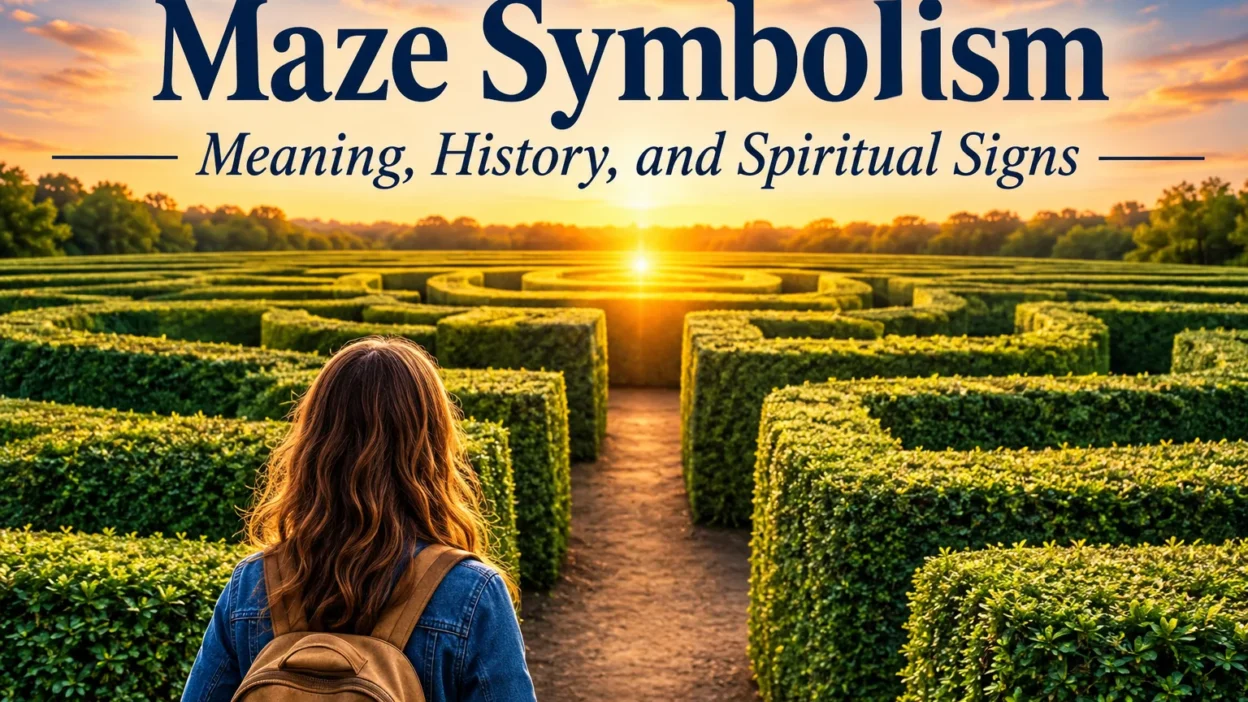
Maze symbolism explores the meanings behind winding paths, confusing turns, and journeys toward a hidden center or final destination. A maze can represent life’s challenges, difficult choices, personal growth, or the search for answers. In the United States, people often connect mazes with problem-solving, mystery, adventure, and the feeling of finding their way through uncertainty.
At first glance, a maze may look like a simple puzzle. However, its twisting paths can reflect experiences that are much more personal. You might see a maze as a symbol of confusion during a difficult period or as a reminder that patience can lead to understanding.
Throughout history, mazes have appeared in ancient stories, religious spaces, gardens, artwork, and popular entertainment. Their meanings have changed across cultures and generations. Today, maze imagery continues to attract people who want to express resilience, independence, curiosity, and the search for direction.
Quick Answer
Maze symbolism in the United States commonly represents confusion, life’s challenges, problem-solving, and the search for direction. It can also symbolize spiritual exploration, self-discovery, patience, and the hope of finding a way forward.
TL;DR
- Confusion: Winding paths reflect uncertainty and complicated situations.
- Life’s journey: Each turn represents a decision, challenge, or new experience.
- Self-discovery: Searching for an exit can mirror understanding yourself.
- Patience: Reaching a destination requires persistence and careful thought.
- Spiritual growth: A winding route can represent an inward journey toward understanding.
- Hope: Finding a way out suggests resilience and the possibility of change.
What Is the Symbolism of a Maze?
A maze is a network of paths designed to challenge someone searching for a destination. Unlike a simple straight road, it may contain dead ends, confusing turns, and several possible routes.
However, maze symbolism extends beyond the physical structure. Its meaning often depends on whether the person feels trapped, enjoys the challenge, or finally discovers the correct path.
The Difference Between a Maze and a Labyrinth
People often use the words maze and labyrinth interchangeably. However, their traditional designs and symbolic meanings can differ.
A maze usually contains multiple paths, branching routes, and dead ends. It challenges visitors to make decisions and discover the correct way forward.
A traditional labyrinth, by contrast, generally follows one continuous path toward a center and back out. It may represent meditation, reflection, or a journey toward spiritual understanding.
Today, artists sometimes combine these designs. Therefore, the intended meaning depends on the pattern, surrounding imagery, and cultural context.
Common Visual Features
Maze imagery can appear in many forms, from simple geometric drawings to elaborate gardens.
- Circular mazes can suggest cycles, wholeness, and life’s repeating challenges.
- Square mazes often emphasize order, structure, and practical problem-solving.
- Dark corridors can evoke fear, secrecy, and the unknown.
- A visible center may represent a goal, truth, or personal discovery.
- An open exit can suggest freedom, relief, and a fresh beginning.
These associations aren’t universal rules. Instead, they offer ways to understand how a maze communicates meaning through its design.
The Ancient Origins and History of Maze Symbolism
Maze symbolism reaches back thousands of years. Ancient people used maze-like designs in art and architecture, although the original purpose of every early pattern isn’t known.
Over time, these structures became connected with mythology, sacred spaces, protection, and the challenges of human existence. Their continued appearance shows how easily a winding path can express a complicated journey.
Ancient Maze Designs
One of the best-known early maze traditions comes from the ancient Mediterranean world. Greek mythology describes the Labyrinth of Crete, a complex structure built to contain the Minotaur, a creature with a human body and a bull’s head.
In the myth, the hero Theseus enters the Labyrinth to confront the Minotaur. With Ariadne’s help, he uses a thread to find his way back.
This story helped establish the maze as an image of danger, courage, intelligence, and escape. It also introduced an enduring idea: finding your way through confusion may require help from another person.
Mazes Across the Ancient World
Maze-like patterns appeared in several ancient societies, including parts of the Mediterranean and South Asia. Their forms and purposes varied, so they shouldn’t all be treated as versions of one shared tradition.
Some patterns may have served decorative or ritual purposes. Others may have reflected ideas about movement, order, protection, or sacred space.
However, evidence doesn’t support assigning one universal spiritual meaning to every ancient maze. Each design needs to be understood within its own historical setting.
From Medieval Europe to Modern Gardens
During the Middle Ages, labyrinth patterns appeared in some European churches. Certain designs became associated with religious reflection and symbolic journeys, although practices differed between locations.
Later, European gardens developed hedge mazes that challenged visitors to navigate winding paths. These gardens became places for recreation, social activity, and displays of landscape design.
By the modern era, mazes had become familiar entertainment. Corn mazes, puzzle books, and digital games helped make the symbol accessible to everyday American audiences.
Maze Symbolism in American Culture
In the United States, mazes often represent the challenges of everyday life. People encounter them in entertainment, education, seasonal traditions, and stories about finding a way through difficult circumstances.
American culture also emphasizes independence and practical problem-solving. As a result, a maze can become a visual reminder that reaching a goal requires choices, effort, and the willingness to try again.
Corn Mazes and Fall Traditions
Corn mazes are a familiar feature of autumn in many parts of the United States. Farms create temporary paths through tall cornfields, attracting families, school groups, and visitors looking for seasonal activities.
These mazes connect the symbol with harvest traditions, outdoor recreation, and community gatherings. They turn the idea of being lost into a playful challenge rather than a frightening experience.
Mazes in American Entertainment
Movies, books, video games, and escape-room experiences often use mazes to create suspense. Characters must solve puzzles, avoid danger, or uncover information before reaching their destination.
In these settings, the maze can represent more than physical confusion. It may reflect a complicated investigation, a difficult personal decision, or a world where appearances hide the truth.
Everyday American Associations
Maze imagery can also express common experiences that have little to do with physical puzzles.
- Career uncertainty: Searching for a satisfying direction through competing opportunities.
- Bureaucratic complexity: Navigating forms, procedures, rules, or unfamiliar systems.
- Personal change: Working through difficult transitions before reaching greater clarity.
- Intellectual challenge: Finding solutions through logic, experimentation, and persistence.
- Emotional uncertainty: Trying to understand complicated feelings or relationships.
These associations make the maze a flexible symbol. It can describe an ordinary frustration or a major turning point in someone’s life.
Spiritual Meaning of a Maze
Spiritually, a maze can represent the journey toward wisdom, inner peace, or a deeper understanding of life. Its winding route suggests that meaningful discoveries don’t always happen in a straight line.
However, spiritual interpretations vary. A maze may be sacred in one setting, a meditation aid in another, or simply an artistic design elsewhere.
A Journey Toward the Center
In some spiritual interpretations, the center represents a deeper truth or a place of reflection. Walking toward it can symbolize turning your attention away from distractions and examining your inner life.
The center doesn’t have to represent a supernatural destination. It might simply stand for a clearer understanding of your values, priorities, or hopes.
Walking a Labyrinth for Reflection
Some people use labyrinth walking as a quiet practice for contemplation. The single winding path encourages slow movement and focused attention rather than competition or rapid decision-making.
In certain Christian settings, labyrinths have been used as aids to prayer and reflection. Modern visitors may also approach them through secular mindfulness or personal reflection.
It’s important to distinguish these practices from ordinary mazes. A labyrinth used for contemplation doesn’t necessarily have the dead ends and multiple choices found in a conventional maze.
Transformation Through Uncertainty
A maze can symbolize the uncomfortable middle stage between an old situation and a new understanding. You may not know exactly where you’re going, yet each step can reveal something useful.
This interpretation makes the maze meaningful during periods of change. It suggests that uncertainty doesn’t always mean failure; sometimes, it accompanies learning.
Psychological Meaning of a Maze
Psychologically, a maze can reflect how people experience uncertainty, make decisions, and respond to obstacles. Its branching paths resemble situations where several choices appear possible but none guarantees an easy outcome.
The symbol can therefore express both stress and curiosity. One person may see a maze as a trap, while another sees an interesting problem waiting to be solved.
Confusion and Decision-Making
A maze can represent the mental strain of facing too many choices. When every route seems uncertain, deciding what to do next may feel harder than moving forward.
This association often appears when people describe complicated relationships, career decisions, or major life changes. The maze gives a visible shape to a problem that otherwise feels difficult to explain.
Patience and Resilience
Finding a route through a maze requires attention and a willingness to reconsider earlier decisions. A wrong turn may delay progress, but it can also provide information about which direction to avoid.
As a result, the maze can represent resilience rather than defeat. Its message isn’t necessarily that every problem has an easy solution, but that persistence and flexibility can help people respond to challenges.
The Search for Identity
A maze may also symbolize the process of understanding yourself. Each turn can suggest a new experience, while the destination represents a clearer sense of identity or purpose.
However, the symbol doesn’t mean everyone must reach one final answer about who they are. Personal growth can remain an ongoing journey with room for change.
Maze Symbolism in Dreams
Dreaming about a maze is sometimes interpreted as a reflection of uncertainty, competing choices, or the desire to solve a problem. However, dreams don’t have fixed meanings that apply equally to everyone.
Your feelings during the dream and your current circumstances matter more than any universal symbol dictionary.
Getting Lost in a Maze
Getting lost may reflect a situation where you feel uncertain about your next step. For example, you might be considering a career change or trying to resolve a difficult disagreement.
Still, the dream doesn’t predict failure. It may simply reflect concerns already occupying your attention.
Finding the Exit
Finding your way out can represent relief, renewed confidence, or a growing sense of direction. The image may feel especially meaningful when you’ve recently made a difficult decision.
However, it doesn’t guarantee a particular future outcome. Instead, consider whether the dream reflects progress or hope in your waking life.
Reaching the Center
Reaching a maze’s center may symbolize a goal, an important discovery, or a desire to understand yourself more clearly. If the center feels peaceful, it may reflect a sense of resolution.
If it feels frightening or empty, the dream may express uncertainty about what happens after achieving a goal. Your personal associations provide the most useful starting point for reflection.
Maze Symbolism Across Cultures and Traditions
Maze-like designs appear in different cultural settings, but their meanings aren’t identical. Some traditions emphasize sacred journeys, while others focus on stories, decorative patterns, or practical puzzles.
Understanding these differences helps avoid treating all winding designs as evidence of the same belief.
Greek Mythology
The Cretan Labyrinth represents danger, confinement, and the challenge of confronting something frightening. Theseus’s escape adds themes of courage, cleverness, cooperation, and successful navigation.
The story remains influential because it combines physical danger with a mental challenge. A person must enter an unfamiliar place, face an obstacle, and find a route home.
Christian Labyrinth Traditions
Some Christian churches have used labyrinths as spaces for prayer and contemplation. The winding path can represent a journey of faith, reflection, or spiritual commitment.
However, labyrinths aren’t central to every Christian tradition. Their use varies by church, community, and historical period.
Other Cultural Interpretations
Maze-like patterns also appear in traditions outside Europe. For example, certain Native American designs include complex geometric forms, but their meanings depend on the specific people, artwork, and cultural context involved.
It would be inaccurate to label every such pattern a maze or assign it a generic spiritual meaning. Respectful interpretation requires attention to the original design and its community.
In broader modern spirituality, people may use maze imagery to express personal transformation, contemplation, or the search for meaning. These contemporary interpretations shouldn’t be confused with the beliefs of specific Indigenous or religious communities.
Maze Tattoos and Their Modern Meanings
Maze tattoos offer a way to represent a personal journey without using words. Their meanings can be private, making them appealing to people who want body art connected to life experiences.
The exact design matters. A dense maze with no obvious exit can communicate a different feeling from a simple labyrinth with a clear center.
Common Maze Tattoo Designs
- Minimalist line maze: Suggests mental complexity, curiosity, or the search for direction.
- Circular labyrinth: Represents reflection, continuity, or a personal journey.
- Maze with an exit: Expresses hope, persistence, or moving beyond a difficult period.
- Maze with a central symbol: Connects the journey to a personal goal, memory, or belief.
- Geometric blackwork maze: Emphasizes order, precision, logic, and visual complexity.
These interpretations are possibilities, not fixed meanings. A person’s own story usually explains the tattoo better than its appearance alone.
Why People Choose Maze Tattoos
Someone may choose a maze to mark a period of uncertainty that eventually led to personal growth. Another person may simply enjoy puzzles, geometric art, or the challenge of navigating complicated situations.
In either case, the symbol can serve as a reminder that the path matters as much as the destination. It can also acknowledge that progress sometimes includes wrong turns.
Maze Symbolism in Art, Literature, and Popular Media
Artists and storytellers use mazes to create mystery and represent situations that resist easy answers. Their twisting paths provide a natural setting for suspense, discovery, and personal transformation.
In American popular culture, maze imagery frequently appears in fantasy stories, thrillers, puzzle games, and interactive entertainment.
The Maze as a Test
A character who enters a maze may need to demonstrate intelligence, courage, patience, or teamwork. Each obstacle tests the character’s ability to adapt.
This structure makes the maze useful in stories about growing up or overcoming fear. Escaping can mark a change in the character’s understanding of the world.
The Maze as a Trap
Sometimes, a maze represents a system designed to confuse or control people. Endless corridors, locked doors, and repeated routes can suggest that freedom is difficult to achieve.
This darker meaning appears in stories about isolation, oppressive systems, or hidden dangers. The maze becomes a picture of feeling powerless rather than simply solving a puzzle.
The Maze as a Metaphor for Life
Writers also use mazes to explore the unpredictable nature of human experience. A person may believe they’re moving toward one goal before discovering an unexpected route.
In this interpretation, there may be no single perfect path. What matters is how someone responds to setbacks, learns from experience, and chooses their next step.
Common Maze Symbols and Their Meanings
A maze’s surrounding details can change how people interpret it. Colors, shapes, entrances, and exits all influence the impression it creates.
The table below summarizes common associations in contemporary American settings. These meanings are interpretive rather than universal.
| Maze Feature | Common Meaning | Emotional Association | Context |
|---|---|---|---|
| Circular maze | Cycles and continuity | Reflection | Art, meditation, personal growth |
| Dark maze | Uncertainty and hidden challenges | Fear or suspense | Fiction, dreams, visual art |
| Open exit | Freedom and resolution | Relief and hope | Tattoos, illustrations, personal milestones |
| Central point | Goals or self-discovery | Focus and purpose | Spiritual art, personal symbolism |
| Multiple dead ends | Difficult choices | Frustration | Puzzles, stories, everyday metaphors |
| Green hedge maze | Exploration and adventure | Curiosity and enjoyment | Gardens, tourism, fall activities |
How Context Changes the Meaning
A maze drawn in bright colors may feel playful, while a shadowy maze can create a sense of danger. Likewise, a maze in a peaceful garden may encourage reflection, whereas one in a suspenseful story may suggest entrapment.
The same principle applies to personal symbols. A maze tattoo might represent a difficult past for one person and a love of puzzles for another.
Therefore, the most accurate interpretation considers the design, setting, and intended message together.
Misunderstandings and Controversies About Maze Symbolism
Maze symbolism is generally flexible and widely used, but misunderstandings can arise when people treat one interpretation as the only correct one. Historical designs also deserve care when they come from traditions with meanings that outsiders may not fully understand.
Confusing Mazes and Labyrinths
A common misunderstanding is that every maze is a spiritual labyrinth. Traditional mazes often involve choices and dead ends, while classical labyrinth designs generally follow a continuous route.
Their meanings can overlap in modern art. However, recognizing the design difference helps explain why some patterns emphasize problem-solving while others encourage contemplation.
Assuming Every Maze Has a Hidden Spiritual Meaning
Some people associate mazes with spiritual awakening, hidden knowledge, or the journey of the soul. Others see them as puzzles or decorative designs.
Neither perspective automatically applies to every example. The artist’s intention and the setting provide important clues.
Misinterpreting Cultural Designs
Not every geometric pattern from an ancient or Indigenous tradition should be called a maze. Some designs have specific cultural, ceremonial, or historical meanings that differ from modern maze symbolism.
It’s best to avoid assigning a spiritual meaning without reliable cultural context. Respectful interpretation recognizes the limits of what an image alone can tell us.
How Maze Symbolism Has Changed Over Time
Maze symbolism has shifted from ancient myth and historical architecture to modern entertainment, personal art, and spiritual reflection. Yet its central theme remains familiar: people must navigate a path when the destination isn’t immediately clear.
From Myth to Entertainment
Ancient stories connected labyrinths with danger, confinement, and heroic escape. Later, gardens and public attractions made mazes accessible as recreational challenges.
Today, corn mazes and puzzle games often emphasize enjoyment and cooperation. The experience of getting lost becomes temporary and entertaining rather than threatening.
From Sacred Space to Personal Reflection
In some historical religious settings, labyrinths supported prayer or contemplation. Modern people may still use them for these purposes, while others approach them through secular reflection.
This change shows how a symbol can retain an older association while gaining new meanings. Spirituality, personal development, and recreation can coexist without being identical.
From Physical Structure to Digital Metaphor
Today, people use maze imagery to describe complicated systems, uncertain relationships, and difficult decisions. Digital games and online art also keep its visual language familiar.
The maze has become a flexible metaphor because modern life often involves multiple choices and unexpected obstacles. Its enduring appeal lies in the possibility of finding a way forward.
FAQs About Maze Symbolism
What Does a Maze Symbolize Spiritually?
A maze can symbolize a journey toward inner wisdom, spiritual understanding, or personal transformation. Its winding paths suggest that reflection and growth may involve uncertainty rather than a direct route.
However, a maze doesn’t have one universal spiritual meaning. Interpretations depend on the tradition, design, and individual perspective.
Is a Maze a Symbol of Life?
Yes, people often interpret a maze as a metaphor for life. Its turns and dead ends resemble the decisions, setbacks, and unexpected changes people experience.
The symbol can also suggest that mistakes provide useful lessons. Finding a route forward may require patience and a willingness to change direction.
What Does Getting Lost in a Maze Symbolize?
Getting lost can represent confusion, uncertainty, or difficulty choosing between different options. It may reflect a period when someone feels unsure about a relationship, career, or personal goal.
However, getting lost doesn’t automatically mean failure. It can also represent exploration and the process of discovering new possibilities.
What Does a Maze Tattoo Mean?
A maze tattoo may represent resilience, self-discovery, complicated life experiences, or the pursuit of a personal goal. Some people choose it because it reminds them to keep moving despite setbacks.
Others simply appreciate its geometric appearance or connection to puzzles. The wearer’s personal intention determines its most meaningful interpretation.
What Is the Difference Between a Maze and a Labyrinth Symbolically?
A maze often represents choices, confusion, challenges, and problem-solving because it can contain multiple routes and dead ends. A traditional labyrinth usually represents a continuous journey toward a center and back.
As a result, labyrinths are often associated with reflection or contemplation. However, contemporary art sometimes combines both forms and their meanings.
Read More: Lock Symbolism: Meaning, History, and Spiritual Significance
Does a Maze Symbolize Confusion or Hope?
It can symbolize both. The confusing paths may represent uncertainty, while the search for an exit can express hope, persistence, and the desire for resolution.
The surrounding imagery often determines which meaning feels strongest. A maze with an open exit may emphasize possibility, while a dark, enclosed design may focus on fear.
Conclusion
Maze symbolism represents the challenges of finding direction through uncertainty. Its winding paths can suggest confusion, personal growth, courage, patience, and the search for meaningful answers. In the United States, the maze appears in everything from autumn cornfields and puzzle games to tattoos, storytelling, and personal reflection. Its history also reveals how one design can carry different meanings across time and cultures. Ancient mythology emphasized danger and escape, while some labyrinth traditions encouraged spiritual reflection. Modern interpretations continue to connect the maze with life’s unpredictable journey. Ultimately, a maze doesn’t have to represent being lost. It can remind you that progress isn’t always straightforward and that every turn offers another chance to learn. When you encounter a maze, consider whether its paths reflect a challenge you’re facing or a journey you’re ready to begin.